Bitcoin And The Quantum Panic: What Developers Are Actually Doing

bitcoinistPublished on 2025-12-15Last updated on 2025-12-15

Abstract

Quantum computing is often portrayed as an existential threat to Bitcoin, but this narrative overlooks ongoing efforts by developers to address the risk. While quantum computing poses a genuine challenge to all cryptographic systems, Bitcoin developers are actively researching solutions. A recent paper from Blockstream explores hash-based, post-quantum signature schemes optimized for Bitcoin’s specific constraints, such as signature size and verification efficiency. The goal is to balance quantum resistance with practical concerns like bandwidth and node operation costs, ensuring the network remains decentralized. Although no final solution exists, the work demonstrates serious preparation for a potential quantum future, countering claims that Bitcoin is ignoring the issue.

Quantum risk has become a recurring stress point in Bitcoin discourse, often framed as an existential threat. The claim usually follows a familiar arc: quantum computing is advancing quickly, cryptography is vulnerable, and Bitcoin isn’t adapting fast enough.

Marty Bent doesn’t buy that framing. In his Dec. 14 episode, Bent acknowledged that quantum computing represents a genuine risk — not just for Bitcoin, but for any system built on modern cryptography — while pushing back on the idea that Bitcoin developers are ignoring the issue.

“Short answer is yes, it is a risk,” Bent said. “But it’s not only a risk for Bitcoin. It’s a risk for any system that depends on cryptography for security.”

What Developers Are Doing To Make Bitcoin Quantum-Safe

What tends to get lost, he argued, is the work already underway. Bent pointed to ongoing developer discussions and, more recently, a research paper published by Blockstream’s Jonas Nick and Mikhail Kutunov examining hash-based, post-quantum signature schemes tailored specifically for Bitcoin.

“I just wanted to make this video to push back on that notion,” Bent said, referring to claims that Bitcoin isn’t moving fast enough. “Because I think it’s pretty clear if you’ve been following Bitcoin development discussions over the last year, the quantum risk is certainly being taken seriously and the conversations have started.”

Nick summarized the paper in a Dec. 9 post on X, describing it as an analysis of post-quantum schemes optimized for Bitcoin’s constraints rather than generic cryptographic benchmarks. Bent described the work as a signal that research is shifting from abstract concern to concrete design space.

Nick wrote via X: “Hash-based signatures are conceptually simple and rely solely on hash functions, which is a primitive Bitcoin already trusts. While NIST has standardized SLH-DSA (SPHINCS+), we investigate alternatives that are better suited to Bitcoin’s specific needs. We explore in detail how various optimizations and parameter choices affect size and performance. Signature size can be reduced to ~3-4KB, which is comparable to lattice-based signature schemes (ML-DSA).”

The challenge, Bent emphasized, isn’t a lack of candidate solutions. It’s that Bitcoin is a globally distributed system with nearly 17 years of operational history, and changes at the protocol level come with heavy trade-offs.
“Bitcoin is a globally distributed peer-to-peer system that depends on consensus protocol rules that are very hard to change,” Bent said. “And you really don’t want to change them too often.”

That reality complicates any transition to quantum-resistant signatures. Existing address types, HD wallets, multisig setups, and threshold schemes all need to be considered. And beyond compatibility, there’s the question of performance.

“One of the biggest hurdles when approaching this problem in Bitcoin is that many quantum-resistant schemes are very data intensive,” Bent said. “Yes, there are many different schemes that can be implemented. However, they come with trade-offs — particularly verification and bandwidth trade-offs.”

Larger signatures can slow block propagation and make it more expensive to run a full node, which directly impacts decentralization. The Blockstream paper focuses heavily on that tension, exploring optimizations that could reduce signature sizes to a few kilobytes while keeping verification costs manageable.

“They feel pretty confident that they’ve done the research to find signature schemes that would have a nice trade-off balance,” Bent said. “You get quantum resistance, but at the same time it remains conducive for people to download full nodes and verify transactions without needing a significant amount of bandwidth and data storage.”

Bent was careful not to frame the research as a finished solution. Instead, he described it as groundwork — mapping the problem space early so the network isn’t caught flat-footed if quantum capabilities advance faster than expected.

“This is by no means like, ‘hey, we solved the problem,’” he said. “But we are taking this problem seriously, doing research and beginning to figure out ways in which we could solve the quantum risk that may or may not manifest in the medium to long term.”

He also noted that BTC tends to be singled out in quantum discussions, even though most of the internet relies on cryptographic assumptions that would face similar pressure in a true post-quantum scenario.

“If quantum computers do come, Bitcoin is not the only thing,” Bent said. “Almost everything you touch on the internet is depending on some cryptographic security at some point.”

For now, Bent’s takeaway was measured. Quantum risk exists. Progress in quantum computing is real. But the narrative that developers are ignoring the issue doesn’t align with what’s happening in technical circles.

“Very smart developers, cryptographers more importantly, are researching the problem,” he said. “If you know where to look, it’s pretty clear that people are preparing for this.” Not solved. Not ignored. Just quietly being worked on.

At press time, BTC traded at $89,854.
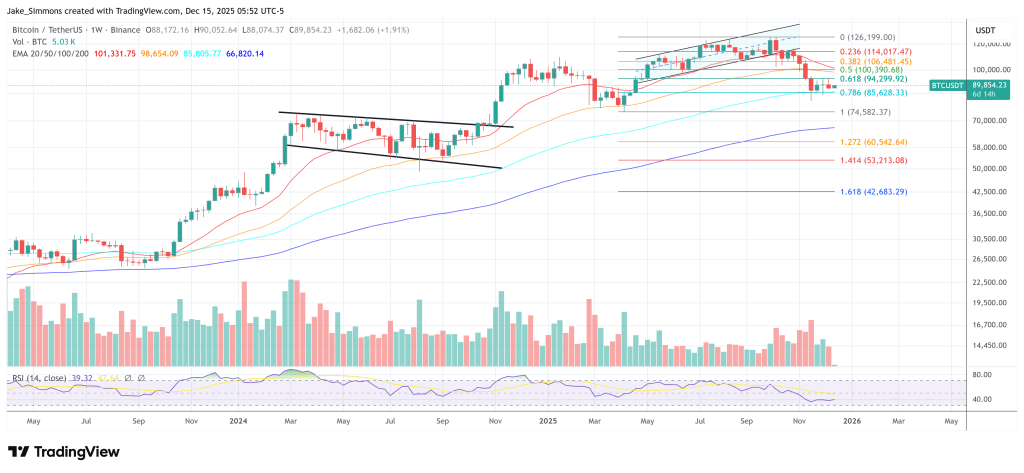
Bitcoin still hovers between the 0.618 and 0.786 Fib, 1-week chart | Source: BTCUSDT on TradingView.com

Related Reads

SpaceX, OpenAI, Anthropic: The Three AI Giants Racing for IPO, Which One Is Worth Betting On?

SpaceX, OpenAI, and Anthropic are poised for historic IPOs within weeks, potentially raising a combined $180 billion—a sum exceeding the entire internet bubble's fundraising. The hosts of the Limitless Podcast argue this isn't just individual company financing but an unprecedented capital concentration for AI infrastructure, driven by an insatiable need for compute, data centers, power, and chips. SpaceX's IPO is notable for reportedly changing market index rules to allow faster inclusion, potentially funneling trillions in passive retirement funds into its stock, despite its unproven space-based data center business model. In contrast, Anthropic demonstrates explosive growth, with ARR reportedly hitting $45 billion and approaching profitability, fueled by strong enterprise adoption of products like Claude Code. Google's separate $80 billion raise highlights the immense capital pressure, even for giants. The discussion acknowledges bubble risks but leans optimistic. The hosts contend the massive spending is building essential physical infrastructure for the next technological era. A key bottleneck isn't capital but the real-world limits of chip manufacturing and construction speed. As long as demand for AI compute outstrips supply, this investment cycle represents a foundational build-out rather than a purely financial bubble. All three companies are seen as foundational bets on the future, with Anthropic often cited as the most immediately compelling due to its proven revenue trajectory.

marsbitHá 59m

SpaceX, OpenAI, Anthropic: The Three AI Giants Racing for IPO, Which One Is Worth Betting On?

marsbitHá 59m

From 'Old Guys' to 'New Favorites': How AI Is Revaluing Old Infrastructure from Dell to Nokia?

From "Vintage Tech" to "New AI Darlings": How AI Revalues Old Infrastructure One year ago, tech giants like Dell, Nokia, Cisco, and Western Data were seen as slow-growth, low-valuation stories, far from the AI spotlight dominated by players like Nvidia. Now, these legacy tech stocks are gaining market attention, sparking debate on whether this is genuine industry revaluation or a temporary narrative. As AI moves from model parameters to real-world data centers, the market is recognizing companies with proven delivery and infrastructure capabilities. This shift marks a change in the AI investment thesis: from pure model and GPU focus to the complex systems engineering required for deployment. Companies like Dell, HPE, and Corning are being revalued not for being "sexy" AI innovators, but for their decades of accumulated expertise in supply chains, enterprise delivery, and infrastructure—assets that have become critical in the AI buildout phase. The revaluation is unfolding across three key infrastructure lines: 1. **Servers & System Integration:** Dell and HPE are emerging as crucial system integrators or "general contractors" for AI data centers, translating GPU orders into complete, deployable server racks integrated with power, cooling, and networking. 2. **Networking & Connectivity:** AI's scale demands robust high-speed connections. Corning (fiber optics), Nokia (AI-RAN, 6G), and Cisco (data center switches) are gaining importance for enabling efficient data transfer within and between AI clusters. 3. **Storage:** Beyond high-speed memory (HBM/DRAM), the AI data explosion is driving demand for high-capacity hard drives (HDDs) from companies like Western Digital and Seagate to handle training data, logs, and cold storage cost-effectively. For this revaluation to be substantive and not just a narrative, three criteria are key: 1) Concrete AI-related order and revenue growth (e.g., Dell's AI server sales), 2) Upward revisions to company financial guidance, and 3) Sustainable improvements in profit quality, not just top-line revenue spikes. In essence, AI's transition to a real construction phase is re-pricing "old assets" against "new demand." The opportunity, however, is selective. Only those legacy firms that are demonstrably integrated into the capital expenditure chains of data center and enterprise AI deployment are likely to experience a true "logic re-rating" rather than just a temporary valuation bounce.

marsbitHá 1h

From 'Old Guys' to 'New Favorites': How AI Is Revaluing Old Infrastructure from Dell to Nokia?

marsbitHá 1h

The Merger of Codex and ChatGPT Marks the Beginning of a Major Reshuffle in Programming Tools

OpenAI is shifting its strategic focus from ChatGPT to Codex, merging them along with the browser tool Atlas into a unified desktop super-app. This move signals an internal belief that Codex, originally a programming tool, represents the next evolution of AI more than conversational models like ChatGPT. Over the past year, Codex's weekly active users have surged past 5 million. The key distinction is that while ChatGPT answers questions, Codex executes tasks. Enterprises increasingly value this ability to get work done over simply receiving advice. Consequently, Codex is attracting professionals beyond developers, including analysts, bankers, marketers, and product managers. OpenAI's reorganization and increased investment in Codex stem from recognizing that the future of AI competition lies in execution capabilities, not just conversation. The company is launching role-specific plugins (e.g., for data analysis, sales, design) to transform Codex into a broad knowledge work platform that automates and redefines white-collar workflows. Beyond being a tool, Codex reflects OpenAI's ambition to redefine software. New features like "Sites"—which generates interactive websites from documents—and collaborative "Annotations" aim to create a paradigm where the AI understands the goal and handles the tools and steps, functioning more like a digital colleague than traditional software. The ultimate goal is a unified experience where the user cares only about the completed task.

marsbitHá 1h

The Merger of Codex and ChatGPT Marks the Beginning of a Major Reshuffle in Programming Tools

marsbitHá 1h

Interpreting Investment Opportunities in the Age of Great Navigation, Invesco Great Wall Fund Releases '2026 Report on Chinese Enterprises Going Global'

Invesco Great Wall Fund has released its "2026 China Corporate Globalization Report," titled "The 'Great Navigation Era' of Chinese Enterprises." The report analyzes the new trends and investment opportunities as Chinese companies expand globally, moving from simple product exports to comprehensive overseas operations involving services, branding, and local production. Driven by factors like trade friction, the pursuit of higher profit margins abroad, and policy support, globalization is becoming essential for Chinese companies. The report outlines an evolution: from early product export ("Globalization 1.0") to the current "Globalization 2.0," characterized by overseas capacity, capital goods investment, consumer brand expansion, and service exports. Chinese firms' competitive advantages are highlighted, including a vast engineer talent pool, low-cost and robust infrastructure, and complete industrial clusters. Specific sectors with significant出海 potential are identified: * **Capital Goods** (e.g., engineering machinery, power equipment): Benefiting from global demand, especially in Belt & Road markets and the AI-driven power grid upgrade cycle. * **Consumer Brands**: Transitioning from cost to brand advantage, leveraging供应链 efficiency. * **Technology & Innovation**: Including AI applications, optical modules within global tech supply chains, and new energy vehicles focusing on local production. * **Pharmaceuticals**: Chinese biotech firms are becoming preferred partners for global pharma, with potential for breakthrough drugs in areas like oncology and weight loss. The report concludes that corporate globalization represents a sustained, core theme for China's capital markets, though companies must navigate challenges like geopolitics and localization.

marsbitHá 1h

Interpreting Investment Opportunities in the Age of Great Navigation, Invesco Great Wall Fund Releases '2026 Report on Chinese Enterprises Going Global'

marsbitHá 1h

Trading

Spot
Futures

Hot Articles

What is $BITCOIN

DIGITAL GOLD ($BITCOIN): A Comprehensive Analysis Introduction to DIGITAL GOLD ($BITCOIN) DIGITAL GOLD ($BITCOIN) is a blockchain-based project operating on the Solana network, which aims to combine the characteristics of traditional precious metals with the innovation of decentralized technologies. While it shares a name with Bitcoin, often referred to as “digital gold” due to its perception as a store of value, DIGITAL GOLD is a separate token designed to create a unique ecosystem within the Web3 landscape. Its goal is to position itself as a viable alternative digital asset, although specifics regarding its applications and functionalities are still developing. What is DIGITAL GOLD ($BITCOIN)? DIGITAL GOLD ($BITCOIN) is a cryptocurrency token explicitly designed for use on the Solana blockchain. In contrast to Bitcoin, which provides a widely recognized value storage role, this token appears to focus on broader applications and characteristics. Notable aspects include: Blockchain Infrastructure: The token is built on the Solana blockchain, known for its capacity to handle high-speed and low-cost transactions. Supply Dynamics: DIGITAL GOLD has a maximum supply capped at 100 quadrillion tokens (100P $BITCOIN), although details regarding its circulating supply are currently undisclosed. Utility: While precise functionalities are not explicitly outlined, there are indications that the token could be utilized for various applications, potentially involving decentralized applications (dApps) or asset tokenization strategies. Who is the Creator of DIGITAL GOLD ($BITCOIN)? At present, the identity of the creators and development team behind DIGITAL GOLD ($BITCOIN) remains unknown. This situation is typical among many innovative projects within the blockchain space, particularly those aligning with decentralized finance and meme coin phenomena. While such anonymity may foster a community-driven culture, it intensifies concerns about governance and accountability. Who are the Investors of DIGITAL GOLD ($BITCOIN)? The available information indicates that DIGITAL GOLD ($BITCOIN) does not have any known institutional backers or prominent venture capital investments. The project seems to operate on a peer-to-peer model focused on community support and adoption rather than traditional funding routes. Its activity and liquidity are primarily situated on decentralized exchanges (DEXs), such as PumpSwap, rather than established centralized trading platforms, further highlighting its grassroots approach. How DIGITAL GOLD ($BITCOIN) Works The operational mechanics of DIGITAL GOLD ($BITCOIN) can be elaborated on based on its blockchain design and network attributes: Consensus Mechanism: By leveraging Solana’s unique proof-of-history (PoH) combined with a proof-of-stake (PoS) model, the project ensures efficient transaction validation contributing to the network's high performance. Tokenomics: While specific deflationary mechanisms have not been extensively detailed, the vast maximum token supply implies that it may cater to microtransactions or niche use cases that are still to be defined. Interoperability: There exists the potential for integration with Solana’s broader ecosystem, including various decentralized finance (DeFi) platforms. However, the details regarding specific integrations remain unspecified. Timeline of Key Events Here is a timeline that highlights significant milestones concerning DIGITAL GOLD ($BITCOIN): 2023: The initial deployment of the token occurs on the Solana blockchain, marked by its contract address. 2024: DIGITAL GOLD gains visibility as it becomes available for trading on decentralized exchanges like PumpSwap, allowing users to trade it against SOL. 2025: The project witnesses sporadic trading activity and potential interest in community-led engagements, although no noteworthy partnerships or technical advancements have been documented as of yet. Critical Analysis Strengths Scalability: The underlying Solana infrastructure supports high transaction volumes, which could enhance the utility of $BITCOIN in various transaction scenarios. Accessibility: The potential low trading price per token could attract retail investors, facilitating wider participation due to fractional ownership opportunities. Risks Lack of Transparency: The absence of publicly known backers, developers, or an audit process may yield skepticism regarding the project's sustainability and trustworthiness. Market Volatility: The trading activity is heavily reliant on speculative behavior, which can result in significant price volatility and uncertainty for investors. Conclusion DIGITAL GOLD ($BITCOIN) emerges as an intriguing yet ambiguous project within the rapidly evolving Solana ecosystem. While it attempts to leverage the “digital gold” narrative, its departure from Bitcoin's established role as a store of value underscores the need for a clearer differentiation of its intended utility and governance structure. Future acceptance and adoption will likely depend on addressing the current opacity and defining its operational and economic strategies more explicitly. Note: This report encompasses synthesised information available as of October 2023, and developments may have transpired beyond the research period.

363 Total ViewsPublished 2025.05.13Updated 2025.05.13

What is $BITCOIN

Discussions

Welcome to the HTX Community. Here, you can stay informed about the latest platform developments and gain access to professional market insights. Users' opinions on the price of BTC (BTC) are presented below.

活动图片














