August's Collective Surge: Capital is Paying 'Extra Premiums' for Leading Crypto Treasury Companies

marsbitPublished on 2026-09-06Last updated on 2026-09-06

Abstract

In August, the cryptocurrency market, led by Bitcoin breaking $82,000, saw its strongest rally since October 2025. While Bitcoin gained about 25%, the Digital Asset Treasury (DAT) sector experienced a dramatic collective surge. Ten major DAT stocks rose an average of 106% for the month, significantly outperforming their underlying treasury assets, which gained about 45% on average. This indicates that the market is paying an "additional premium" for these companies. The rally highlighted a "Beta + leverage" characteristic, where smaller, more narratively driven DATs like CYPH (ZEC) and USDE (ENA) posted extreme excess returns over their treasury assets. While industry giant MicroStrategy (MSTR), representing ~68% of the sector's市值, showed more moderate gains, it exemplifies the core DAT capital flywheel: rising asset prices improve the balance sheet, enabling equity raises to buy more assets, amplifying per-share exposure. The DAT model is evolving beyond simple Bitcoin holdings. Newer entrants like Bitmine (ETH) and Forward Industries (SOL) incorporate staking, adding a yield component to the price-driven model and transforming treasuries into productive assets. Furthermore, capital is flowing into higher-beta, smaller-cap DATs focused on altcoins like HYPE (PURR) and ZEC (CYPH). These companies bundle asset price exposure with narratives around ecosystem growth, mining operations, or broader platform utilities, offering greater elasticity. The sector's recent outperform...

Author: Jae, PANews

On the early morning of September 4th, Bitcoin briefly broke through $82,000. Although it subsequently fell back to around $80,000, the crypto market has actually experienced its strongest rebound since October 2025 starting from mid-August. Bitcoin recorded a gain of about 25% in the past month, while U.S. spot Bitcoin ETFs saw net inflows of $3.52 billion in a single month, setting a new yearly record.

However, what has been more dramatic than the spot market action is the collective explosion of the Digital Asset Treasury (DAT) sector. According to PANews statistics, all 10 leading DAT stocks closed higher in August, with an average monthly gain of about 106%, while the average increase in their treasury assets was only about 45%. Even excluding extreme outliers, the excess returns of DAT stocks relative to their underlying assets remain remarkably significant.

It can be said that capital is assigning an additional capital market premium to certain DATs. This premium is composed of the beta from rising coin prices, the amplification from financing leverage, the boost from staking yields, and the imagination fueled by ecosystem narratives.

All Green in August, Doubling Returns Unfolded

According to PANews observations, the total market cap of the 10 leading DAT stocks included in the statistics currently exceeds $82 billion, up 46% month-on-month; August trading volume was about 2.5 billion shares, a month-on-month increase of 33%, indicating that capital's attention has returned to the DAT track.
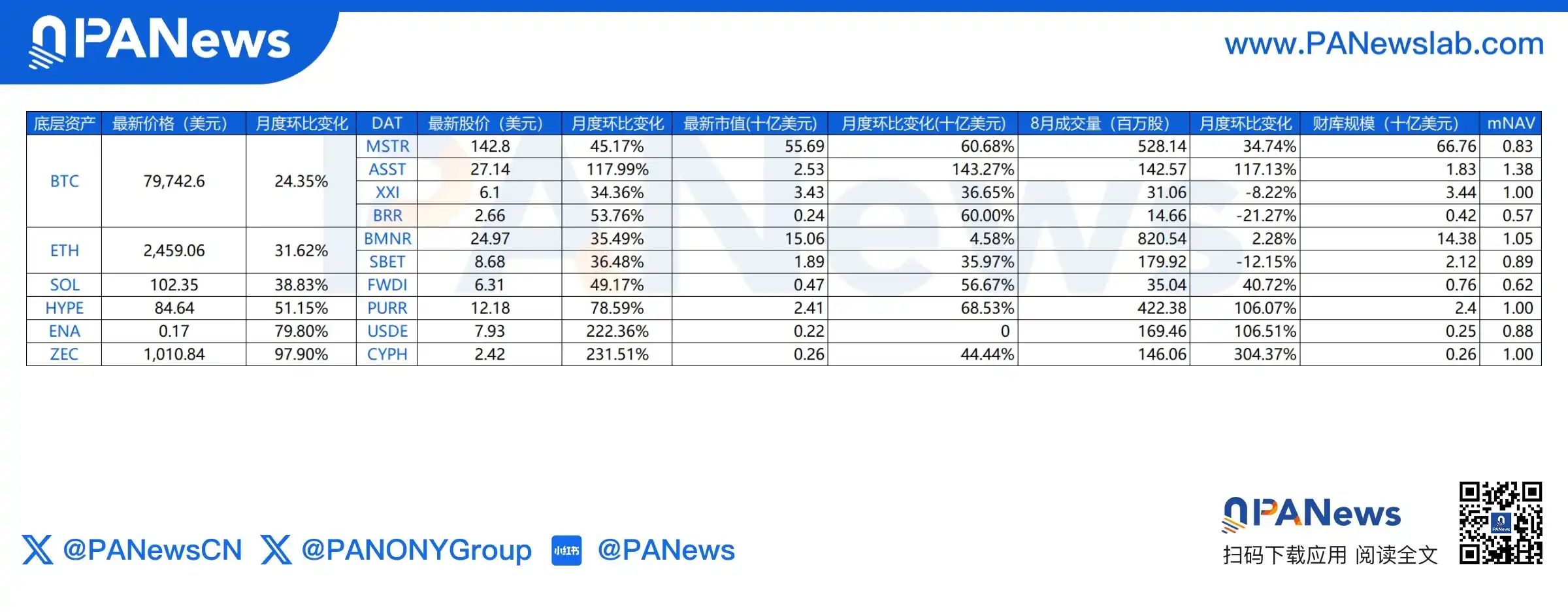
The most interesting phenomenon in this round of market action is that DAT stock gains have generally outperformed their treasury assets, exhibiting a strong "Beta+Leverage" characteristic. In terms of price performance, all 10 leading DAT stocks achieved excess returns relative to their treasury assets. Among them, three DAT stocks are particularly noteworthy:

  • ASST: Treasury asset BTC rose 24.35% during the same period, while the stock surged 117.99%, achieving an excess return of about 94 percentage points.

  • CYPH: Treasury asset ZEC rose 97.9% during the same period, while the stock surged 231.51%, achieving an excess return of about 134 percentage points;

  • USDE: Treasury asset ENA rose 79.8% during the same period, while the stock surged 222.36%, achieving an excess return of about 143 percentage points;

In contrast, the sector leader MSTR showed relative restraint, rising 45.17% in the past month with an excess return of only about 21 percentage points.

A pattern has emerged: the smaller the DAT's market cap, the lower the stock liquidity, and the newer the narrative, the greater the price elasticity relative to its treasury assets often is. This is the most obvious difference between this round of DAT action and the era of "Strategy's dominance": as DAT holdings expand from Bitcoin to more assets, mid-to-small cap stocks, with their smaller float and more diversified narratives, have shown more aggressive price action than the leading stock.

MSTR Holds Nearly 70% of Top DAT Market Cap, Treasury Leverage Creates Bidirectional Elasticity

However, Strategy remains the most mature example of the DAT model, with MSTR's market cap accounting for about 68% of the cumulative market cap of the 10 leading DAT stocks.

The fundamental business logic of a DAT is not a linear mapping of "coin up → stock up", but rather a leveraged tool that amplifies the return on treasury assets.

On August 23rd, BTC surged over 20% within a week. Strategy held 840,447 BTC at the time, with a net BTC asset value of approximately $49.68 billion. On August 31st, Strategy announced the purchase of approximately 4,603 BTC for about $370 million, at an average price of about $80,318, bringing its total holdings to 845,050 BTC.

This is precisely the capital cycle of the DAT model: BTC rises → balance sheet improves → equity financing capability strengthens → obtains more funds to buy BTC → per-share BTC exposure further increases.

This positive feedback mechanism endows DAT stocks with stronger elasticity than their treasury assets. When treasury asset prices rise, the compounded return rate of DAT stocks naturally far exceeds the simple coin price increase. This characteristic also makes DAT stocks a "return amplifier" during rebound phases.

The most attractive aspect of a DAT is leverage, and the most dangerous aspect is also leverage. The flywheel works both ways; the stronger the upward momentum, the more violent the downward move can be.

The total treasury asset size of the 10 DAT stocks is approximately $92.62 billion, while their combined stock market cap is only 88.8% of their treasury size. This means that the DAT sector does not universally trade at high premiums; in fact, some stocks are already trading below the value of their treasury assets.

It is important to note that an mNAV (market-to-net asset value) below 1 does not equate to "risk-free arbitrage." In addition to treasury assets, companies have liabilities, preferred shares, dilution risks, management fees, financing costs, asset staking, regulatory risks, operational losses, and a series of other deductions.

According to a Bloomberg report, Nakamoto, a Bitcoin DAT backed by crypto entrepreneur David Bailey, who helped turn U.S. President Trump towards supporting BTC, has seen its stock price plummet about 99% from its peak, wiping out its market premium.

The volatility of DATs stems both from the underlying coin price and from the expansion and contraction of valuation premiums, with the amplitude of the latter often being greater than the former.

From BTC to ETH/SOL, DATs Add a Layer of Staking Yield

Strategy represents the playbook of the first-generation "hodling" DAT. Another clear change is that the DAT model is expanding to more crypto assets, and its mechanics are also evolving, giving DATs the attributes of "productive assets."

Ethereum treasuries are a classic example of this evolution. Take Bitmine, for example. As of now, it holds over 5.9 million ETH, accounting for about 5% of ETH's total supply, along with 211 BTC and over $500 million in cash and tradable securities, with the combined value of crypto assets and cash reaching $15.6 billion. Among these, about 5.07 million ETH have been staked to earn on-chain yields.

SharpLink adopts a similar approach, holding over 890,000 ETH, which it consistently deploys into staking and on-chain yield strategies.

Solana treasuries followed suit. Forward Industries holds approximately 7.807 million SOL and its equivalent assets, accounting for about 1.3% of Solana's circulating supply, with almost all of it staked.

Compared to BTC treasuries, which are highly dependent on price fluctuations, ETH/SOL treasuries add a layer of value support through staking yields.

This means the valuation model for DATs is undergoing a second-order evolution:

  • Stage One: Treasury Value ≈ Asset Price × Holdings, price-driven;

  • Stage Two: Treasury Value ≈ Asset Price × Holdings + Staking/On-Chain Yields, supported by cash flow;

This model may become the main battleground for competition in the next phase of the DAT sector.

Sector Divergence Emerges, Risk Appetite Spills into Altcoin DATs

Capital is flowing from BTC and ETH treasuries into higher-Beta altcoin treasuries, with market interest in DAT stocks like HYPE and ZEC significantly increasing. This is also a signal that the market is entering its second phase: after mainstream assets attract incremental capital, funds spill over into mid-to-small cap targets, and risk appetite cascades down the hierarchy.

Altcoin DATs are smaller in scale and more prone to extreme price movements.

PURR is a prime example. As of now, it holds approximately 30.1 million HYPE, with a holding value as high as $2.54 billion. Simultaneously, the company has repurchased about 5.8 million shares of PURR, tightening the float.

More importantly, PURR's value anchor points are not just the HYPE price, but a whole suite of combined narratives: HYPE price volatility + HYPE holdings growth + Hyperliquid ecosystem growth + HYPE buyback and burn + DAT financing capability.

Among these, Hyperliquid's ecosystem revenue and token economics provide the primary value support. Over the past 12 months, the Hyperliquid ecosystem generated approximately $712 million in retained earnings, with a staggering 99% of that value flowing to HYPE holders through a buyback mechanism. Investors buying PURR are essentially betting on the growth of the Hyperliquid ecosystem.

CYPH, which holds ZEC, also possesses significant potential. As of now, it holds 323,394 ZEC, accounting for about 1.91% of Zcash's circulating supply. Subsequently, the company also entered the Zcash mining field through a related transaction with Winklevoss Capital, controlling about 18% of the network's total hashrate. CYPH's valuation incorporates ZEC treasury value, mining operations, and the privacy asset narrative.

USDE is a newcomer among DATs, listed on Nasdaq at the end of June, with ENA as its treasury asset. USDE holds approximately 3.029 billion ENA, valued at about $510 million, representing 20% of ENA's total supply. USDE's business model simultaneously covers six major segments: Ethena ecosystem infrastructure, validation nodes, LayerZero DVN, stablecoin Harness, USDe distribution, and the ENA treasury.

In other words, USDE is attempting to build a complete flywheel: Ethena ecosystem growth → infrastructure revenue increases → ENA value appreciates → capital market financing → further expands ENA treasury and its ecosystem footprint.

Ecosystem narrative + low market cap + scarce newly listed float collectively catalyzed a single-month gain of over 200%, but it appears more like a special case of a "small-cap, high-volatility, strong-narrative DAT."

Currently, divergence in the DAT market is already evident. Capital and attention are concentrating towards the top, while elasticity and imaginative potential lie with mid-to-small cap targets.

The collective outperformance of DATs relative to coin prices in the recent period sends a signal: DATs are becoming a high-beta instrument connecting traditional stock markets and crypto assets.

More worthy of in-depth investigation than the percentage gains is the source of the excess returns. If it primarily stems from genuine growth in assets per share, cash flows from staking and ecosystem businesses, then DATs are evolving into a brand-new mode of crypto asset management.

From "comparing who holds more coins" to "comparing who creates more value per share," competition in the DAT sector is entering a higher dimension. And ultimately, all leverage and premiums must be tested by the cycle.


Related Questions

QAccording to the article, what was the average monthly increase of the top 10 DAT stocks and their treasury assets in August?

AThe top 10 head DAT stocks saw an average monthly increase of about 106%, while their treasury assets only rose by about 45% on average.

QWhat is the basic business logic of DAT (Digital Asset Treasury) companies, and how does it create leverage according to the article?

AThe basic business logic of DAT companies is a leveraged mechanism to amplify the return rate of treasury assets. The model creates a positive feedback loop: crypto asset price rises -> balance sheet improves -> ability to raise capital via stock issuance increases -> more funds are used to buy crypto assets -> the crypto exposure per share further increases.

QHow are Ethereum and Solana-based DAT models evolving beyond the original Bitcoin-centric model?

ADAT models for Ethereum and Solana are evolving by incorporating staking. Companies like Bitmine and SharpLink for ETH, and Forward Industries for SOL, stake a significant portion of their holdings. This adds a layer of staking yield or on-chain revenue, giving these treasuries a value support based on cash flow, not just price appreciation.

QWhat factors contribute to the 'premium' or 'excess returns' observed in some smaller or newer DAT stocks, as exemplified by PURR, CYPH, and USDE?

AThe excess returns for smaller/newer DAT stocks like PURR, CYPH, and USDE come from a combination of factors: high-beta treasury assets (e.g., HYPE, ZEC, ENA), small market cap and low stock liquidity, and strong ecosystem narratives. Their valuations incorporate not just the underlying token price but also growth from associated ecosystems, business operations (like mining for CYPH), and economic mechanisms like token buybacks.

QWhat key risk does the article associate with the leverage inherent in the DAT model?

AThe key risk is that the leverage in the DAT model works both ways. While it can amplify gains during market upturns, it can also lead to severe losses during downturns. The article warns that the valuation premium can expand and contract, and this volatility in the premium itself is often greater than the volatility of the underlying crypto assets.

Related Reads

BTC Short-Term Bottoming and Gathering Momentum, HYPE Triple Support Faces Critical Test | Guest Analysis

Last week, the crypto market was driven by news. On Nov 4, midterm election news sparked a 3.92% Bitcoin rally above $80K, but a day later, US stock declines triggered a 5.48% drop to ~$75,222, a new low since Sept 21, with fear index near 25. HYPE also fell 15.19% weekly, erasing prior gains and returning to ~$75. Key points: Bitcoin has held above the 52-week MA for eight weeks, satisfying the "price breakout principle," but the pullback confirmation signal is not yet issued and the 52-week MA (~$76,110) remains downward-sloping. The rebound from the July 1 low of $57,820 is still classified as an oversold bounce, not a confirmed bull market. On the daily chart, price remains in a descending channel, has broken below the key MA crossover (~$77,200), but holds above the 0.382 Fibonacci level ($76,130). The correction (wave i) has run 48 trading days with a max drawdown of 15.9%; a wave ii rebound is expected but not yet started. The "Shijie Ribbon" model still signals a long market. Strategy: mid-term stay in cash; short-term use 30% position for range trading, favoring buying dips near $72,500–73,500 with strict stops. HYPE: the weekly bearish engulfing candle was driven by external shocks, not fundamentals. Three support layers: the ribbon upper band (~$74.05, lower ~$71), the box lower edge (~$75, which triggered a 20% bounce on Oct 24), and the long-term uptrend line (~$68). Key support zones: $74–75 (ribbon upper + box bottom), $71 (ribbon lower), $68 (long-term trendline). Strategy: if price stabilizes at $74–75 or $68–71, consider light long positions (≤30%) with strict stops. Special rules: set initial stop at entry; move to breakeven at +1% profit; trail stop 1% per 1% gain. All analysis is personal technical opinion, not investment advice; markets carry risk.

Odaily星球日报10m ago

BTC Short-Term Bottoming and Gathering Momentum, HYPE Triple Support Faces Critical Test | Guest Analysis

Odaily星球日报10m ago

Canton Foundation Launches Official Daml 3 Certification, Expanding Developer Access and Establishing Institutional Finance Standards

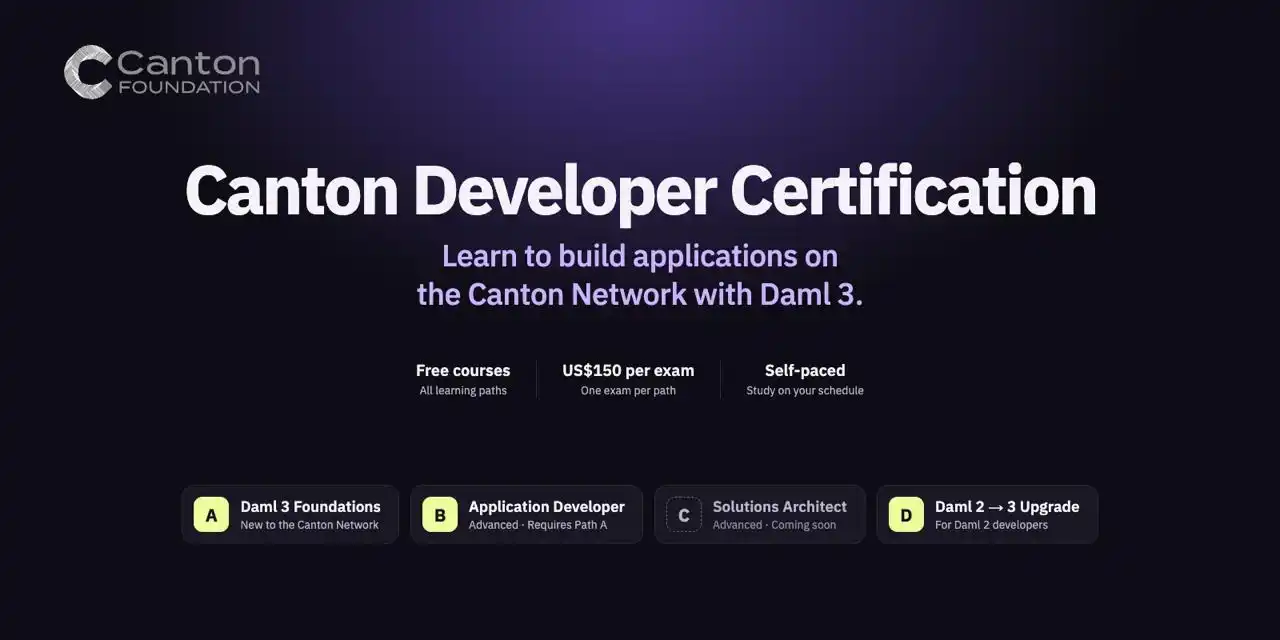
Canton Foundation has launched the Canton Developer Certification, an official certification program for Daml 3, the smart contract language of the Canton Network. Combining a self-paced course with a certification exam, it offers developers worldwide a structured path to building applications for regulated financial markets. Canton Network is a public, permissionless blockchain designed for regulated finance, with over $6 trillion in on-chain assets processed by its supported applications. Daml is built to manage who may act on a contract and who may access its terms; the certification validates practical mastery of these authorization and privacy principles, establishing a recognized standard intended to strengthen institutional confidence in applications built on the network. The program is based on Daml 3 and Canton 3.x, the current technology underlying the network, letting newcomers start on the latest stack, helping production engineers deepen expertise, enabling institutional architects to design and integrate Canton deployments, and allowing existing Daml 2 developers to migrate their skills and codebases to Daml 3, unifying the community on a single, current platform. For ecosystem partners—financial institutions, application providers, system integrators, and validators—the certification provides a common technical foundation and a consistent way to assess developers' understanding of authorization and privacy requirements. Canton Foundation COO Amanda Martin said financial institutions need confidence that the applications they rely on are built by developers who understand regulated market requirements, and that the program both opens opportunities for developers globally and establishes a shared professional standard, building a stronger foundation for Canton's future growth by bringing the community together on Daml 3. The certification is now live at certification.canton.foundation; the course is self-paced and free to all developers, and the exam costs $150 per attempt. Canton Foundation is an independent nonprofit responsible for the governance and long-term development of Canton Network's shared infrastructure, supporting transparent and decentralized governance, ecosystem coordination, and broad participation by Global Synchronizer operators and network stakeholders, while working with financial institutions, technology providers, developers, and other participants to support the network's continued global growth and adoption.

marsbit22m ago

Canton Foundation Launches Official Daml 3 Certification, Expanding Developer Access and Establishing Institutional Finance Standards

marsbit22m ago

Nvidia Faces Independent Investigation, Bernstein Maintains $400 Target Price

Nvidia's board has launched an independent investigation following reports about CEO Jensen Huang's contacts with Megaspeed executive Alice Huang, though it says there is no reason to believe U.S. national security or company secrets were compromised. Three Republican House committee chairs have requested Huang attend a closed-door briefing on November 18 to explain the contacts and Nvidia's internal procedures for countering foreign intelligence activities, and Democratic Senator Chris Coons said Congress will investigate. Some reports suggested Alice Huang may have influenced Huang's lobbying to ease chip export restrictions to China, a claim Bernstein doubts, noting Huang has long publicly pushed to expand sales in China and that revenue from mainland China and Hong Kong has fallen sharply since export controls. Only H20 and limited H200 chips were approved for China sales, well behind Nvidia's most advanced products, and Bernstein sees limited room for recovery as Chinese customers prioritize domestic alternatives. Regulatory pressure may persist, with hawkish lawmakers potentially revisiting export limits. Bernstein maintains an Outperform rating and a $400 target price, about 114% above the November 6 close of $186.64, citing data center demand and earnings growth. It projects adjusted EPS of $4.77 for FY2026, $9.20 for FY2027 and $15.80 for FY2028. The target is based on average FY2028-2029 non-GAAP EPS of $19.04 at about 21x. Bernstein also flags Huang's succession as a key risk, given his central role and roughly 60 direct reports.

marsbit31m ago

Nvidia Faces Independent Investigation, Bernstein Maintains $400 Target Price

marsbit31m ago

Two Blocks Hit in 7 Hours: Two Retail Miners Take on the Entire Network's Hashrate and Walk Away with $476,000

Two individual solo miners using home mining rigs hit two Bitcoin blocks within seven hours on November 7, earning a combined $476,000. One miner using a Canaan AvalonQ home miner with roughly 80–87 TH/s earned about $239,000; the other earned roughly $237,000. A CKPool solo platform took about 2% (0.0629 BTC) as a service fee, with the rest going directly to the miners' wallets. Given current network difficulty of about 148.4 trillion, such a rig would normally need over a century to find a block, making the win a luck value of over 10,000%. This is part of a broader trend: in 2026 so far, solo miners have found 36 blocks, nearly one lucky winner per week. Earlier examples include a 6.5 TH/s Avalon Nano 3S worth a few hundred dollars earning $250,000 on October 27, another Nano 3S earning $232,000 on May 30, and a $150 Bitaxe Gamma earning $200,000 on July 10. Home solo mining is often called "plug-in lottery": a 1.2 TH/s mini miner has about a 1-in-16,000 annual chance of winning, far better than Powerball's 1-in-292 million, but rigs cost thousands of dollars and electricity runs $400–$1,100 monthly, with zero income until a block is found. Each viral win serves as free advertising for the industry. Rig manufacturers sell the dream of "maybe I'll win too"; solo pool platforms collect a steady ~2% fee from any winner; and the Bitcoin network preserves its "anyone can participate" narrative despite mining being dominated by large farms. The people paying for it all are ordinary buyers who purchase miners and pay electricity bills hoping for a life-changing jackpot.

marsbit47m ago

Two Blocks Hit in 7 Hours: Two Retail Miners Take on the Entire Network's Hashrate and Walk Away with $476,000

marsbit47m ago

NYSE Picks Avalanche, Why AVAX May Not Capture the Settlement Flow

On November 9, Ava Labs announced that a tokenized securities trading platform affiliated with the NYSE had selected Avalanche to provide core ledger technology for its clearing firm. The platform is a regulated alternative trading system (ATS) designed for 24/7 trading, clearing, and settlement, pending regulatory approval. The Wall Street Journal reported a stronger version: the NYSE would "exclusively" use Avalanche to settle tokenized stocks, with matching still handled by existing technology and a Q4 launch target—though Ava Labs' announcement gave no launch date and did not name the clearing firm. Markets traded the headline first, with AVAX rising roughly 8–11% to near $9 intraday. But the announcement places Avalanche at the clearing-ledger layer, not the main board on a public chain—a distinction that determines whether AVAX captures narrative or verifiable demand. Matching (who trades with whom at what price) stays on the NYSE's Pillar engine; settlement (how cash and securities transfer) goes to the blockchain ledger. Ava Labs said it provides core ledger tech for the clearing firm of the NYSE-affiliated ATS, without disclosing the firm's identity, contract value, or timeline. Tokenized stocks involve three layers: issuance, matching, and settlement. NYSE digital issuance head Dennis Lee said the platform will support stocks listed across multiple chains, but the settlement ledger must be fast, reliable, permissioned, and cost-predictable. Issuance can be multi-chain; settlement converges on one controlled system. The "exclusive" label refers to the settlement ledger, not the whole value chain. ICE previously said the platform combines Pillar with blockchain post-trade systems supporting multi-chain settlement and custody. Ava Labs CBO John Nahas said the NYSE will run a custom Avalanche-based chain tailored to regulatory needs, not use the public Avalanche chain—two very different things. A permissioned chain lets the exchange control access, node deployment, and fee pricing. Founder Emin Gün Sirer cited round-the-clock atomic settlement, predictable performance and cost, and regulatory control. This explains why AVAX's price reaction outpaced fundamental certainty: brand association arrived first, while fee capture remains undisclosed—whether the custom chain uses AVAX for pricing, staking, or fees was not answered. Charles Schwab's same-day addition of AVAX to retail trading offers a competing explanation for the gains. Three unresolved variables determine the significance: regulatory approval (no public status), the clearing firm's identity (unnamed legal entity), and token economics. AVAX's economic link is distant—a custom chain does not equal public-chain lockup or AVAX becoming a settlement asset. Issuer willingness also matters; the NYSE recently expanded transfer agents for issuer-sponsored tokenized securities to six, with Broadridge handling on-chain voting and governance, but whether tokenized equities enter this ATS depends on liquidity, compliance costs, and shareholder communication. Until the platform launches and the clearing firm appears, vendor selection is a necessary step, not realized demand.

marsbit51m ago

NYSE Picks Avalanche, Why AVAX May Not Capture the Settlement Flow

marsbit51m ago

Trading

Spot
活动图片