Arbitrum Price Rises 50% in One Day — Here's the Reason and Everything You Need to Know

cryptonews.ruPublished on 2026-09-06Last updated on 2026-09-06

Abstract

Arbitrum ($ARB) surged roughly 49% in 24 hours to $0.1972, driven largely by the explosive growth of the Robinhood Chain. This Ethereum Layer 2 network, built on Arbitrum Orbit technology and launched in July 2026, directs 10% of its protocol revenue to the Arbitrum ecosystem. In July alone, this licensing fee represented 35% of the Arbitrum DAO's monthly revenue. Activity on Robinhood Chain has skyrocketed, with its daily fees and DEX trading volume sometimes surpassing those of Ethereum's mainnet. The network's popular "stock-tokens" for non-U.S. users track companies like NVIDIA and Apple. The revenue model sparked a public debate between Solana's Anatoly Yakovenko and Arbitrum's Steven Goldfeder, with Goldfeder arguing Robinhood chose to be a "landlord, not a tenant" by using Arbitrum's infrastructure. Of the 10% revenue share, 8% goes to the Arbitrum DAO treasury. Despite the sharp rally, $ARB remains about 92% below its all-time high of $2.40.

Today, Arbitrum ($ARB) demonstrated one of the most impressive price surges on the cryptocurrency market. Ranking 53rd among the largest cryptocurrencies by market capitalization, $ARB has risen approximately 49% over the last 24 hours, reaching a price of $0.1972. Although the gain at some points during the day exceeded 50%, $ARB remains roughly 92% below its all-time high of $2.40, recorded on January 12, 2024.
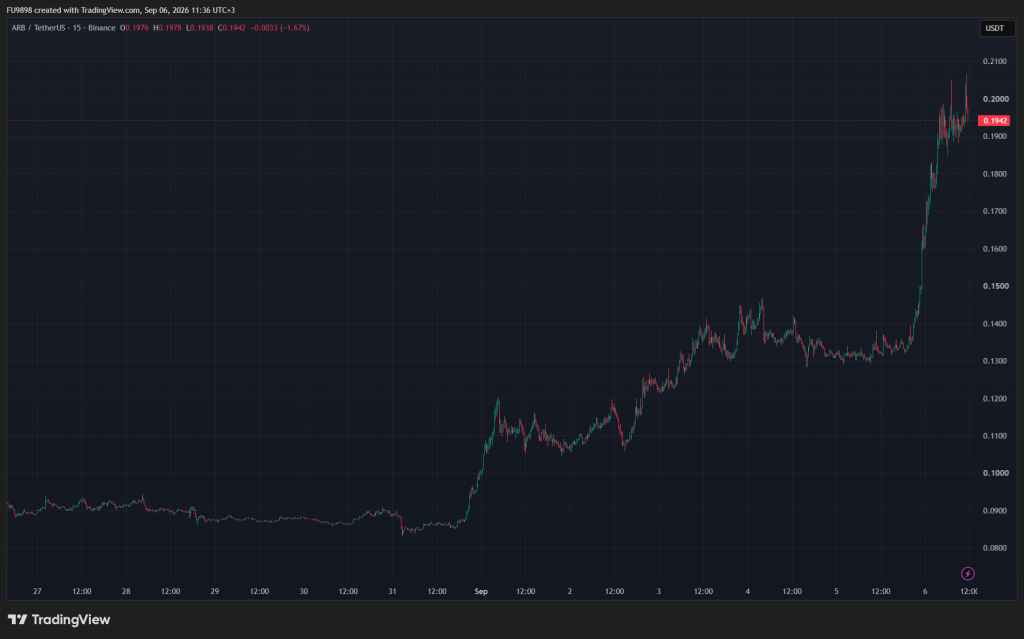
A 15-minute candlestick chart showing the recent price rise of $ARB.

One of the main catalysts for the sharp rise in $ARB is the rapid growth of Robinhood Chain, built on $ARB's technology from Robinhood. Robinhood Chain, an Ethereum Layer 2 network that launched its mainnet on July 1, 2026, uses Arbitrum Orbit infrastructure. As part of the Arbitrum expansion program, $ARB-based blockchains operating outside of Arbitrum One and Nova allocate 10% of their protocol net revenue to the Arbitrum ecosystem. According to data from the Arbitrum Foundation, in July, the first month of Robinhood Chain's operation, the $360,000 in licensing revenue received through this program accounted for 35% of the monthly revenue for the Arbitrum DAO.

The recent unprecedented surge in activity on Robinhood Chain has further heightened the importance of this revenue model for Arbitrum. Daily fee collection in the network increased to millions of dollars in early September, on some days surpassing that of the Ethereum mainnet and Coinbase's Base network. Record levels were also recorded in trading volume on Robinhood Chain's decentralized exchange: daily DEX trading volume reached billions of dollars, boosting investor interest in the $ARB ecosystem.

One of the most common use cases for Robinhood Chain is its 'Tokenized Stocks' product. Issued by Robinhood Assets Limited, these tokens track the economic performance of US companies such as NVIDIA, Apple, and Alphabet. While they do not provide users with direct legal ownership of the company shares, these products are offered in many countries outside the United States.

The economic interaction model between Arbitrum and Robinhood has also sparked notable discussion on social media between the founders of Solana and Arbitrum. Anatoly Yakovenko, co-founder of Solana, argued that the 10% of Robinhood Chain's revenue paid to the Arbitrum ecosystem is sufficient to cover roughly four times the transaction fee amount on Solana, suggesting that if Robinhood chose Solana, it could offer users significantly lower, even subsidized, transaction costs.

Steven Goldfeder, co-founder of Offchain Labs and $ARB, responded to Yakovenko, stating that Robinhood retains approximately 90% of the transaction revenue on the $ARB infrastructure, while receiving no revenue from base transaction fees on the Solana network. Goldfeder added that by choosing Arbitrum, Robinhood decided to "become a landlord, not a tenant".

In $ARB's revenue distribution model, 8% of the 10% goes to the Arbitrum DAO treasury, managed by $ARB token holders, and 2% is allocated for ecosystem development. Thus, the continuous growth in transaction volume and network revenue on Robinhood Chain, although not directly distributed to $ARB token holders, is viewed as an important factor in strengthening the revenue and economy of the Arbitrum DAO ecosystem.

*This is not investment advice.

end-content
Trending Cryptos

Related Questions

QWhat is the primary catalyst for Arbitrum's ($ARB) 50% price surge according to the article?

AThe rapid growth of the Robinhood Chain, which is built on Arbitrum Orbit technology. It contributes 10% of its net protocol revenue to the Arbitrum ecosystem, providing a significant new revenue stream.

QWhat is the 'stock token' product offered on the Robinhood Chain?

ATokens issued by Robinhood Assets Limited that track the economic performance of U.S. companies like NVIDIA, Apple, and Alphabet. They do not grant direct legal ownership of the underlying stocks.

QWhat was the core of the social media debate mentioned between the founders of Solana and Arbitrum?

AAnatoly Yakovenko of Solana argued that the 10% revenue paid to Arbitrum could subsidize lower user fees on Solana. Steven Goldfeder of Arbitrum countered that Robinhood chooses Arbitrum to 'be a landlord, not a tenant,' retaining 90% of the transaction revenue.

QHow is the 10% revenue from chains like Robinhood Chain distributed within the Arbitrum ecosystem?

A8% goes to the Arbitrum DAO treasury, governed by $ARB token holders, and 2% is allocated for ecosystem development.

QDespite the surge, how much is $ARB still below its all-time high, and when was that high recorded?

A$ARB is still approximately 92% below its all-time high of $2.40, which was recorded on January 12, 2024.

Related Reads

Aave's Half-Year Report Card: A 97-Person Team Burned $20 Million in Half a Year, What Is the DeFi Leader Up To?

Aave Labs' 180-day report (Q2–Q3 2026) reveals a 97-person team that logged ~100,000 hours, completed 6,096 tracked items, shipped 28 product or protocol deployments, and spent nearly $19.48 million (excluding token compensation), while the Aave protocol generated about $44.58 million in revenue. Total deposits grew roughly 40% in Q3 to $33.8 billion, but this followed a sharp Q2 decline driven by the rsETH bridge exploit and a broader DeFi contraction, so the rebound was largely a partial recovery. Protocol revenue actually fell about 37% quarter-over-quarter, from $27.29 million to $17.29 million, as high Q2 liquidation fees (including Chainlink SVR) dropped sharply and borrowing interest income declined, even though GHO interest, swap fees, and stablecoin utilization improved. The report also signals Aave's expansion beyond crypto-native lending. Aave V4, launched in March, reached $1.34 billion in deposits by October 1, and now supports tokenized equities via an Equities Hub on Base, custody-based institutional lending with Anchorage and Chainlink, and externally operated independent instances such as EtherFi and Sentora that share revenue with the DAO. Aave Labs is also pursuing consumer and enterprise distribution through the Aave App (over $45 million in user balances), Stable Vaults for embedded yield, and an MCP Server letting AI assistants read protocol data and prepare—but not sign—transactions. Under the Aave Will Win Framework, the DAO funds development and receives gross brand-product revenue. The core open questions are growth quality, whether new businesses generate durable revenue, and balancing concentrated execution against DAO dependence on a key service provider.

marsbit41m ago

Aave's Half-Year Report Card: A 97-Person Team Burned $20 Million in Half a Year, What Is the DeFi Leader Up To?

marsbit41m ago

Circle Partners With DBS to Expand Institutional USDC Access Across Asia

Circle, the issuer of the USDC stablecoin, has partnered with Singapore-based DBS Bank to expand institutional access to USDC across Asia. Announced on November 18, the agreement allows eligible institutional clients to mint and redeem the dollar-backed stablecoin directly through DBS, with near-instant settlement between US dollars and USDC available 24 hours a day. This gives institutions another way to access USDC without relying entirely on cryptocurrency exchanges and other secondary-market liquidity providers, supporting corporate treasury operations, payment settlement and liquidity management. Institutions can convert between dollars and USDC without being restricted by conventional banking hours or payment cut-off times. Access is limited to eligible institutional clients rather than retail customers. The agreement builds on DBS and Circle's participation in Project BLOOM, an industry initiative led by the Monetary Authority of Singapore focused on developing infrastructure for the safe and scalable use of tokenised money. DBS reported that 88% of large corporations surveyed were already deploying or piloting tokenised money applications, with more than three in five adopting or planning to adopt stablecoins. Evy Theunis, head of digital assets at DBS's Institutional Banking Group, said the partnership would give institutions more choice in managing and transferring value, while Circle Chief Commercial Officer Kash Razzaghi said it would help expand institutional access to USDC across Asia. Transaction limits, fees and a detailed country-by-country rollout schedule were not disclosed.

TheNewsCrypto52m ago

Circle Partners With DBS to Expand Institutional USDC Access Across Asia

TheNewsCrypto52m ago

From Crypto VC to Traditional VC: The Three Essential Capabilities of Venture Capital

In this article, Big Brain Holdings investor Derrick Cui reflects on his transition from crypto venture capital to traditional VC in AI, reindustrialization, and space, contrasting crypto's short liquidity cycles and narrative-driven token prices with traditional VC's decade-long capital lockups and illiquid equity. He explains why LPs still allocate to venture despite poor average returns and illiquidity: each year produces rare companies capable of returning an entire fund; business success defies checklists, rewarding subjective judgment; consensus is often wrong, so non-consensus bets offer asymmetric upside; and top investors can repeatedly generate excess returns across cycles. He describes the investor's job as deal sourcing, diligence, and pitching, noting AI tools have lowered sourcing barriers but顶级 deals still come from genuine relationships, and that likability is an underrated professional asset. He then details three core capabilities: (1) Data—separating verifiable facts from founder promises, using third-party validation to pierce polished narratives; (2) Context—building comparative, industry-wide knowledge to judge talent and technical bottlenecks, now accelerated by reasoning models that shift the key skill from reading papers to asking higher-quality questions; and (3) Storytelling—constructing a rigorous "Right to Win" narrative that explains why a company prevails across multiple possible futures, sometimes via systematic cluster bets (e.g., SMRs for AI energy demand) rather than single-company wagers. He also admits past mistakes: being "nerd-sniped" by technical brilliance that doesn't equal a great business, chasing non-consensus ideas for their own sake, and rejecting the "spray and pray" mentality. Finally, he warns that fundraising incentives—DPI substitutes, markups, co-investment halo, hot-round chasing—can distort investment decisions, and concludes that VC is a trainable skill built on data capture, better questions, and credible winning narratives.

marsbit1h ago

From Crypto VC to Traditional VC: The Three Essential Capabilities of Venture Capital

marsbit1h ago

Research Report Interpretation | Space Fund Scale Grew to $18 Billion in One Year, but In-Orbit Direct Investment Accounts for Only 3%

Barclays analysts Katherine Ogundiya and team published a 61-page report on November 16 introducing an "in-S.P.A.C.E." framework for the in-orbit economy, screening 37 commercial space activities down to 15 priority areas and 3 wildcard sectors. Global space-themed fund assets grew from $1.24 billion in Q2 2024 to over $18 billion by Q2 2026, yet only 3% is directly invested in in-orbit operations, while 47% sits in semiconductors, components, and software. Private markets are more direct: of 33 space unicorns worth about $92 billion, 9 in-orbit operators account for roughly $26 billion, or 28%. Global government space spending reached $141 billion in 2025, up 7.4%. The report identifies five physical bottlenecks—launch concentration, spectrum and network routing, orbital congestion, in-orbit servicing standards, and regulatory approval—noting China and the U.S. accounted for over 82% of orbital launch attempts from 2024 to July 2026, with SpaceX and CASC together near 71%, and Starlink performed over 207,000 collision-avoidance maneuvers between December 2025 and May 2026. Among the highest-scoring priority tracks, GEO satellite life extension offers clear economics: about 85% of GEO satellites retire from fuel depletion, and extending life five years costs roughly $65 million versus $150–300 million for a replacement. Orbital AI computing and data centers scored only 8, ranking as a wildcard due to unresolved thermal, power, and economic challenges. Barclays maps over 350 companies across four investment paths: integrated launch and space systems players like Rocket Lab (RKLB) and Firefly (FLY), bottleneck-breaking specialists such as Astroscale, MDA Space, Mynaric, and Thales, "picks and shovels" suppliers including Linde (LIN) and Air Liquide, and downstream applications like Planet Labs (PL) and AST SpaceMobile (ASTS). A heavy-lift rocket launch now consumes about 8,000 tonnes of liquid oxygen, five times a traditional large rocket's 1,600 tonnes, with Linde projecting about $1 billion in annual space revenue by 2030.

marsbit2h ago

Research Report Interpretation | Space Fund Scale Grew to $18 Billion in One Year, but In-Orbit Direct Investment Accounts for Only 3%

marsbit2h ago

Trading

Spot

Hot Articles

How to Buy ONE

Welcome to HTX.com! We've made purchasing Harmony (ONE) simple and convenient. Follow our step-by-step guide to embark on your crypto journey.Step 1: Create Your HTX AccountUse your email or phone number to sign up for a free account on HTX. Experience a hassle-free registration journey and unlock all features.Get My AccountStep 2: Go to Buy Crypto and Choose Your Payment MethodCredit/Debit Card: Use your Visa or Mastercard to buy Harmony (ONE) instantly.Balance: Use funds from your HTX account balance to trade seamlessly.Third Parties: We've added popular payment methods such as Google Pay and Apple Pay to enhance convenience.P2P: Trade directly with other users on HTX.Over-the-Counter (OTC): We offer tailor-made services and competitive exchange rates for traders.Step 3: Store Your Harmony (ONE)After purchasing your Harmony (ONE), store it in your HTX account. Alternatively, you can send it elsewhere via blockchain transfer or use it to trade other cryptocurrencies.Step 4: Trade Harmony (ONE)Easily trade Harmony (ONE) on HTX's spot market. Simply access your account, select your trading pair, execute your trades, and monitor in real-time. We offer a user-friendly experience for both beginners and seasoned traders.

8.2k Total ViewsPublished 2024.03.29Updated 2026.09.28

How to Buy ONE

Discussions

Welcome to the HTX Community. Here, you can stay informed about the latest platform developments and gain access to professional market insights. Users' opinions on the price of ONE (ONE) are presented below.

活动图片