Major Institutional Investor Dumps Altcoin! Its Market Cap Plunges 99% Today

cryptonews.ruPublished on 2026-09-10Last updated on 2026-09-10

Abstract

A major institutional investor has sold off a meme coin, causing its market value to plummet by 99% today. The altcoin, $LAPTOP, themed around Hunter Biden's laptop, crashed drastically just hours after its launch. Blockchain data shows that market maker Wintermute, which received 2.5 million $LAPTOP tokens from the project team, began selling them. So far, Wintermute has sold 466,255 tokens for approximately $2.08 million at an average price of $4.47 per token. The token's fully diluted valuation (FDV) collapsed from a brief peak of over $300 billion to around $1.8 billion within the first two hours, marking a drop of roughly 99.43%. Trading volume during this period was about $9.6 million. Separately, two new wallets earned over $647,000 by quickly selling 4,276 $LAPTOP tokens they received from an airdrop. Analytics firm Serenity commented that it was unsurprised by the more than 99% drop, stating such token launches generally do not benefit retail investors.

$LAPTOP, a memecoin launched in connection with Hunter Biden, has made headlines in the cryptocurrency market due to a sharp drop in value and on-chain sell-offs shortly after launch. Blockchain data shows that market maker Wintermute began selling part of the $LAPTOP tokens allocated to it, while the token's fully diluted valuation (FDV) fell more than 99% from its peak.

Wintermute, Which Received Tokens from the $LAPTOP Team, Has Started Selling the Altcoins.

According to data provided by the online analytics platform Lookonchain, Wintermute purchased a total of 2.5 million $LAPTOP tokens from the $LAPTOP team. It is reported that the company started selling these tokens on-chain and has so far sold 466,255 $LAPTOP tokens at an average price of $4.47. The total value of these sales is estimated at approximately $2.08 million.

The sharp drop in the price of $LAPTOP reached incredible scales just hours after the token's launch. According to data, within the first two hours after launch, the fully diluted valuation of $LAPTOP fell from a brief peak of over $300 billion to approximately $1.8 billion. Thus, the fully diluted valuation dropped by approximately 99.43%, while the trading volume for the same period was about $9.6 million.

On the other hand, it was reported that two new wallets that received tokens as part of the $LAPTOP airdrop earned over $647,000 in a short period. According to blockchain analyst data, these two addresses sold their tokens after receiving a total of 4,276 $LAPTOP tokens through Hunter Biden's Substack follower airdrop contract. One wallet reportedly earned roughly $404,000, and the other roughly $243,000.

Blockchain data also revealed an ETH transfer between two addresses. One address transferred the USDC received from selling LAPTOP to an address listed in open sources as belonging to Safe architect Florent, leading to speculation about a possible connection between the wallets and Florent. However, this link has not yet been conclusively confirmed.
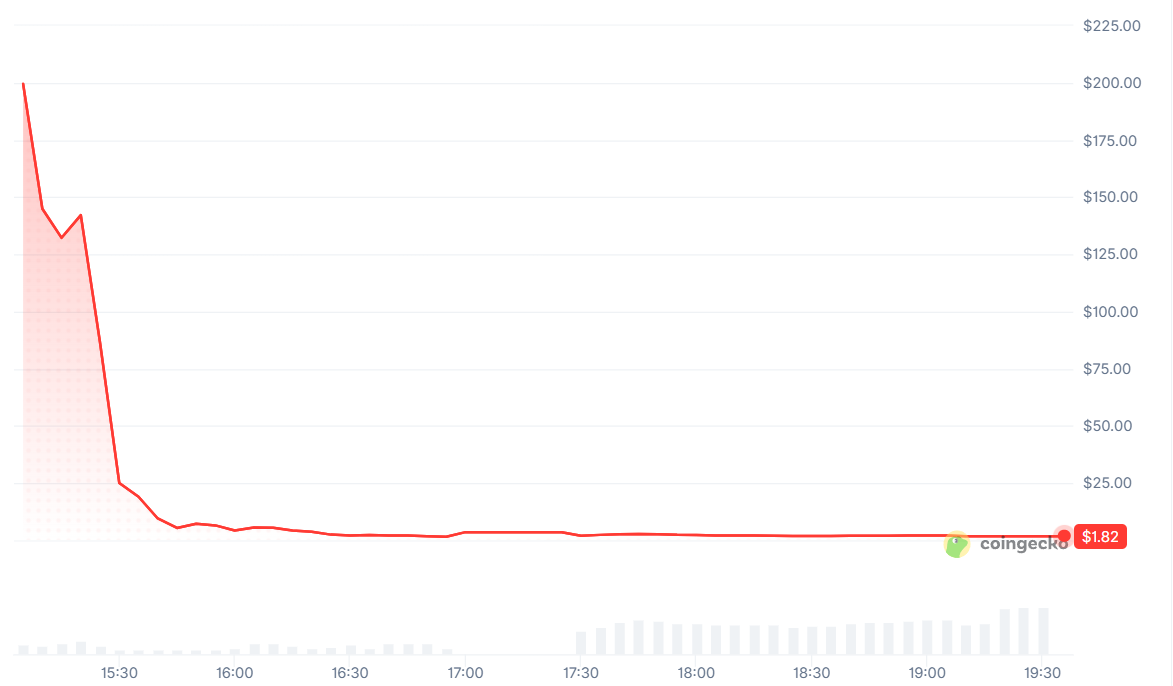
This chart shows today's decline in LAPTOP prices.

Commenting on the sharp drop in $LAPTOP's value, Serenity stated that it was not surprised by the token's decline of over 99% after its launch. Serenity argued that such token launches do not generally yield positive results for retail investors and therefore does not support similar token launches.

*This is not investment advice.

end-content

Related Questions

QWhat happened to the cryptocurrency $LAPTOP shortly after its launch?

AThe price and market capitalization of the meme coin $LAPTOP collapsed by over 99% shortly after its launch.

QWhich institutional investor is reported to have sold a large portion of the $LAPTOP tokens it received?

AThe market maker Wintermute sold part of the $LAPTOP tokens it had acquired from the token's team.

QHow much did Wintermute reportedly earn from selling $LAPTOP tokens, and how many did it sell?

AWintermute sold 466,255 $LAPTOP tokens at an average price of $4.47, earning approximately $2.08 million.

QHow did some wallets reportedly earn over $647,000 from the $LAPTOP airdrop?

ATwo new wallets sold their airdropped $LAPTOP tokens shortly after receiving them, with one earning about $404,000 and the other about $243,000.

QWhat was the stance of the company Serenity regarding the launch of tokens like $LAPTOP?

ASerenity stated it was not surprised by the token's collapse, arguing such launches do not produce positive outcomes for individual investors and therefore does not support similar token launches.

Related Reads

230k-follower “Crypto God” exposed: 30 sock puppet accounts caught harvesting fans

Cupsey, a Solana meme coin trader with over 230,000 X followers, has been exposed by on-chain analytics firm Bubblemaps for allegedly running roughly 30 secret wallets to profit off his own followers. Since May 7, these linked addresses traded over 27,000 tokens and cashed out about $1.74 million on roughly 3,000 tokens using a repeated three-step scheme: four core wallets quietly accumulate a new token and spread holdings across 12 associated wallets; Cupsey's public wallet then buys the same token and he promotes it to followers; finally, the hidden wallets sell into the incoming buy orders. In some cases the secret wallets dumped tokens while Cupsey was still drafting his recommendation posts. Because new meme coins have thin liquidity, followers' buys push prices up briefly, letting the insider wallets exit while late buyers absorb the losses. The report also links Cupsey-associated wallets to a token-issuing address starting with "3z4vj," which launched over 400 tokens and earned an estimated $1.3 million. Beyond trading spreads, Cupsey reportedly received about $331,000 in Pump.fun promotion rewards. Bubblemaps has similarly exposed other top traders such as Anglio, 0xEthan, and Solstice for front-running their own recommendations, in some cases buying about 20 seconds before posting. The firm criticizes platforms for rewarding trading volume with millions in incentives while doing little to detect bundled holdings, insider wallets, or repeat offenders, turning followers into exit liquidity. Cupsey has not yet responded to the allegations.

marsbit18m ago

230k-follower “Crypto God” exposed: 30 sock puppet accounts caught harvesting fans

marsbit18m ago

Ex-employee sues Ethereum Foundation and Vitalik Buterin over firing

A former Ethereum Foundation employee, Kayleen Fulton (known as “Nixo”), has sued the organization, co-founder Vitalik Buterin, and four others, alleging she was fired after disclosing a cancer diagnosis and organizing a staff letter challenging a directive tied to the foundation’s new mandate. Fulton, who led the protocol support team, filed the complaint on Nov. 4 in the U.S. District Court for the District of Colorado. She claims Bastian Aue, then a co-executive director, fired her on April 6, 13 days after her diagnosis disclosure, and that Buterin helped adopt and enforce the directive as a board member. Fulton and colleague Trent Van Epps organized a letter with 53 signers supporting the mandate’s goals but objecting to a requirement that employees affirm it to keep their jobs; she alleges she and Van Epps were fired 30 minutes apart days later. She alleges disability discrimination, retaliation, and interference with medical leave rights, seeking lost pay and damages. The complaint also notes some employees objected to a reference to ritual suicide in the mandate, quoting Aue saying the language was figurative. A lawyer for the foundation’s Singapore affiliate denied unlawful conduct or retaliation and said her separation agreement was binding. The foundation published its mandate in March, highlighting censorship resistance, open-source code, privacy and security, and a focus on protocol upgrades, research, and developer tools.

cointelegraph28m ago

Ex-employee sues Ethereum Foundation and Vitalik Buterin over firing

cointelegraph28m ago

Major Analog Chip Acquisition: The Account Behind Over 500 Part Numbers

On November 9, Awinic Electronics announced a trading halt to plan the acquisition of Yutai Semiconductor shares via share issuance and cash, plus supporting financing—a landmark integration in China's analog chip design sector. Both companies compete in analog chips but follow different product paths. Awinic's power management revenue reached 1.047 billion yuan in 2025 (about 37% of total), slightly down 0.03% year-on-year, deeply tied to consumer electronics like phones, AIoT, and wearables. Its real strength lies in high-performance mixed-signal chips (1.505 billion yuan, 53% of revenue), with audio power amplifiers as the core, now extending into edge AI audio for AI glasses, supplying Meta, Rokid, and RayNeo. However, consumer cyclicality and fierce 2026 price competition expose Awinic's limited coverage in industrial-grade medium/high-voltage power, telecom power, and smart meters. Yutai, founded by former Maxim designers with R&D centers in Shanghai, Silicon Valley, and Hanoi, offers over 500 product models covering DC-DC, AC-DC, LDO, battery management, and PMU. Its AC-DC line spans 5 categories and 130+ models, including PWM controllers, integrated GaN converters, synchronous rectification, and fast-charging protocols—targeting high-voltage, high-frequency, high-power-density applications like fast chargers, industrial power, and telecom equipment. Its DC-DC products, such as the ETA9121/9122 dual-phase buck converters and ETA5220 ultra-low-noise LDO (0.96μV RMS), are not commodity consumer parts. Yutai also partners with MediaTek, Intel, Spreadtrum, Rockchip, Ambarella, and NXP, covering smart meters, security, set-top boxes, and routers. The complementarity is clear: Awinic excels in low-voltage, consumer-grade, highly integrated power for phones and wearables; Yutai in medium/high-voltage, industrial-grade, full-category solutions. A merger could theoretically cover consumer to industrial communications, low to medium/high voltage, and single chips to system-level solutions. Yet product logic alone doesn't guarantee success: Saint-Gong holds 25.95% of Yutai as second-largest shareholder, potentially constraining R&D integration, customer sharing, and product roadmaps post-closing. The deal reflects China's analog chip industry moving from niche land-grabbing to platform-based consolidation. Awinic needs Yutai's industrial power lines and customer ecosystem to break consumer growth ceilings; Yutai needs Awinic's listing platform and consumer channels to offset capital and market shortcomings. But success won't be decided by synergy visions in announcements—it depends on whether the two R&D teams can work under one product definition framework after the halt ends, and how many of Yutai's 700+ part numbers truly enter Awinic's customer system and generate design wins. Products can be acquired; scenario capabilities must be digested.

marsbit38m ago

Major Analog Chip Acquisition: The Account Behind Over 500 Part Numbers

marsbit38m ago

15 Crypto Ideas That Were 'Ahead of Their Time'—Why They're Worth Rebuilding in the AI Era

Between 2014 and 2019, crypto projects like Kleros, Augur, Etherisc, and Golem tried to bring commercial arbitration, prediction markets, mutual insurance, and decentralized compute on-chain, but failed because judgment of real-world outcomes depended on slow, bribe-prone human voting, governance tokens were volatile, and settlement was expensive. After 2023, three bottlenecks broke at once: multi-model AI juries cut the cost of real-world judgment to cents, AI agents became high-frequency on-chain transactors, and stablecoins (~$310B) plus sub-second chains like Solana made micro-settlement viable. The article ranks 15 ideas worth rebuilding by revenue potential and readiness: e-commerce arbitration courts, real-world prediction market oracles for questions lacking APIs, automatic-payout insurance without claims adjusters, escrowed task labor markets, data and media licensing, machine micropayments (x402), reputation-and-bond lending, proof of personhood, constitution-enforced DAOs, curated registries, content provenance, supply chain tracking, legally binding tokenized assets, compute and infrastructure markets, and IP with real legal contracts. Top candidates combine billion-dollar markets with components buildable in a quarter using existing AI models, stablecoins, and Solana. The article also provides a general validation prompt plus per-idea prompts, and warns of four risks: AI juries may share blind spots and err collectively, evidence can be forged, regulated sectors still require licenses, and real paid demand for micropayments and DePIN remains thin.

marsbit57m ago

15 Crypto Ideas That Were 'Ahead of Their Time'—Why They're Worth Rebuilding in the AI Era

marsbit57m ago

Trading

Spot
活动图片