I. Macro Trends: Indices Closed Higher, AI Hardware Chain Saw Pullback
The three major indices closed higher for the week: the S&P 500 rose 1.15% to 7811.54, the Dow rose 0.93%, and the Nasdaq rose 0.64%. Nine of the eleven sector ETFs rose, with only Industrials and Technology falling, at -0.41% and -0.52% respectively.
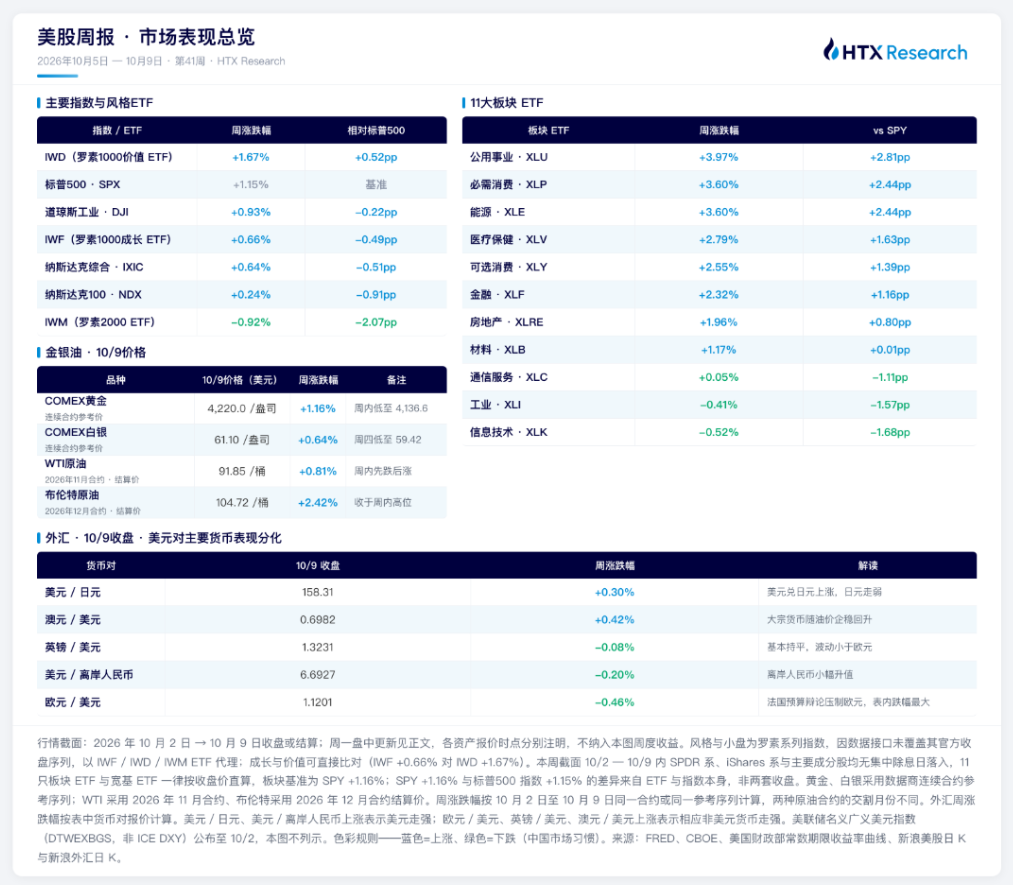
The turning point came on Thursday. On October 8th, the Financial Times cited financial documents provided to investors stating that OpenAI's annualized revenue was "close to $50 billion" as of the end of September, about $20 billion less than the roughly $70 billion circulating last month. This difference mainly involves whether cloud market sales revenue is recognized on a gross or net basis: OpenAI recognizes net revenue after deducting channel fees, while Anthropic uses a gross basis. This annualized revenue is a projection based on the current revenue run rate, not full-year realized revenue; differences in accounting methods also cannot be directly equated to a decline in AI demand. Reuters also relayed a Bloomberg report on Friday, stating OpenAI's year-end annualized revenue could reach or exceed $70 billion. It's important to distinguish between the September snapshot and the year-end expectation. On October 8th, the S&P 500 fell 0.47% for the day, the Nasdaq Composite fell 1.25%; the SOXX fell 3.35% for the day and 5.01% for the week, with Oracle and CoreWeave falling 5.48% and 7.77% respectively that day. Major indices rebounded on Friday but did not reverse the weekly losses for AI hardware stocks: Nvidia still fell 2.00% for the week, ARM fell 13.40%, and Intel fell 12.26%. As the market was simultaneously trading interest rate paths, AI capital expenditure cadence, and hardware earnings expectations that day, this report was one of the main catalysts, but not the only variable.
Economic data pointed in the other direction. The September ISM Services PMI was 54.9, down from August's 55.4, with the employment component rebounding from 47.8 to 50.1; however, the prices paid component rose from 72.6 to 74.0, the highest since July 2022, with none of the 17 service industry sectors reporting price decreases. The preliminary October University of Michigan Consumer Sentiment was 46.3, the lowest since May, with the current conditions component at 44.7 being the lowest on record. 1-year inflation expectations rose from 4.6% to 4.7%, and 5-10 year expectations rose from 3.4% to 3.5%. The August trade deficit widened to $105.6 billion, and initial jobless claims were 197,000.
The September FOMC minutes released on October 7th can serve as a reference: Staff estimates at the time put August headline PCE at 3.8% and core at 3.4%, with inflation forecast risks "skewed to the upside," not returning to 2% until 2029. The minutes also named large private debt issuance financing AI infrastructure, which competes for capital formation, as one factor pushing up term premiums at the time. It's important to distinguish that the BEA completed its annual revision on September 30th; the official August figures are headline 3.4% and core 3.0%, lower than the meeting estimates. As of the Asian session on October 12th, Reuters citing CME FedWatch shows a 17% probability of a rate hike in October and an 86% probability of a hike by December.
All three major European stock indices rose on Friday, but moved in different directions for the week: the FTSE 100 rose 0.86%, the DAX fell 0.57%, and the CAC 40 fell 1.19%. The French parliament is debating the 2027 budget bill, with finance and debt being major constraints. Canadian employment fell by 68,300 in September, with the unemployment rate rising to 6.5%. The Nikkei 225 rose 1.06% for the week, while the KOSPI fell 5.39% (October 2-8). On the policy front, the Bank of Japan had already raised rates to 1.25% in September; on October 7th, board member Ayako Sato expressed support for adjusting interest rates in phases, with the timing depending on consumption and income changes, and that a pace should not be predetermined. The South Korean benchmark rate was 3.00% as of October 8th; the government reiterated on October 7th its push for investment in future growth areas and improving the business investment environment, with policy support coexisting with short-term stock price pullbacks.
In China, industrial support policies continue to advance, but A-shares performed weakly after the holiday, while Hong Kong stocks showed relative strength. On October 9th, the "Opinions of the Central Committee of the Communist Party of China and the State Council on Developing New Quality Productive Forces" was publicly released, covering five aspects including technological innovation and industrial integration with 19 key measures, with "comprehensively implementing the 'AI+' action" listed as a separate item. The seventh part also drew a red line—"cannot depart from the real economy to pursue the virtual, seek excessive scale, create bubbles, cannot result in industrial hollowing out or industrial gaps, cannot blindly pursue novelty and neglect one aspect at the expense of another." A-shares retreated in the two trading days after the holiday, with the Shanghai Composite falling 0.74% and the ChiNext falling 2.93%; Hong Kong stocks continued to strengthen, with the Hang Seng Index rising 1.15%, and the Hang Seng Tech Index rising 3.05% on Friday alone; the onshore yuan closed at 6.69210.
II. Market Liquidity: Treasury Cash Balance Declines, Reserves Significantly Replenished
H.4.1 data shows the weekly average reserve balance rose from $2.9481 trillion to $3.0297 trillion, an increase of $81.57 billion; the Wednesday point-in-time figure rose from $2.8817 trillion to $3.0221 trillion. The source is concentrated: the weekly average Treasury General Account (TGA) balance decreased by $68.42 billion to $880.3 billion, the main contributor to the replenishment, while Federal Reserve credit increased by only $3.94 billion on a weekly average basis. The simplified point-in-time calculation (Federal Reserve credit minus TGA minus money market ON RRP Others) rose from $5.7052 trillion to $5.8127 trillion.
There were no signs of overnight funding stress. SOFR remained between 3.87% and 3.90% from October 5th to 8th, the effective federal funds rate was stable at 3.88%, corresponding to an interest on reserve balances rate of 3.90% and a target range of 3.75%–4.00%. The September minutes also disclosed that, as reserves remain in ample supply, the New York Fed's trading desk had suspended reserve management purchases, emphasizing this is a monthly decision, not a preset path.
U.S. Treasury yields declined across the curve: the 10-year fell 4 bps to 5.24%, the 30-year fell 3 bps to 5.60%, the 2-year fell 3 bps to 4.80%; within the week, the 10-year yield fluctuated between 5.31% on October 5th and 5.22% on October 8th. The credit side did not improve in sync; the ICE BofA High Yield Index OAS widened from 3.10% to 3.15%, while the VIX fell from 15.31 to 14.84. The U.S. dollar showed mixed performance against major currencies: stronger against the euro (EUR down 0.46%) and yen (JPY down 0.30%), while the Australian dollar rose 0.42% against USD, and the offshore yuan appreciated 0.20%.
III. Hot Sectors: AI Hardware Yields, Defensive and Cyclical Sectors Take Over
Weekly performance diverged between AI hardware and large-cap tech stocks. The SOXX fell 5.01% for the week, SMH fell 4.32%; among representative stocks, ARM fell 13.40%, CoreWeave fell 8.41%, and Nvidia fell 2.00%. Over the same period, Amazon rose 4.34% and Microsoft rose 3.39%, with large-cap tech stocks showing relative resilience. The stock price performance indicates the market's pricing adjustment for the computing hardware chain is more pronounced; a single week's returns are insufficient to distinguish between changes in valuation multiples and adjustments to earnings expectations.
Funds flowed to defensive and cyclical sectors. Utilities, Consumer Staples, and Energy all rose over 3.5%, while Healthcare rose 2.79%. The latter had a specific catalyst: Moderna rose 14.21% on Friday to $225.00, hitting a 52-week high, as its inclusion in the Nasdaq-100 index took effect pre-market that day (announced October 1st). The same day, The New York Times reported an NIH-led public-private partnership plan to accelerate personalized cancer vaccine development, launching in December. However, the broad sector rise during the week resembled reallocation more than being solely attributable to Moderna. Style performance also shifted. Based on closing prices from October 2nd to 9th, the Russell 1000 Value ETF (IWD) rose 1.67%, the Growth ETF (IWF) rose 0.66%, with value outperforming by 1.01 percentage points. The S&P 500 Equal Weight ETF (RSP) rose 1.58%, while the market-cap-weighted ETF (SPY) rose 1.16%, with equal weight leading by 0.42 percentage points.
Chinese stocks performed strongly: KWEB rose 4.48% for the week, Alibaba rose 5.21%, and the Nasdaq Golden Dragon China Index rose 4.25%. Market reports linked Friday's rebound to investor expectations of restrictions on selling and policy support funds stepping in, though such rumors have not been officially confirmed; the New Quality Productive Forces policy released on October 9th provides medium-to-long-term support for AI applications and industrial upgrading. Both short-term policy expectations and long-term industrial support could affect pricing, so the week's gains cannot be entirely attributed to a single piece of news on Friday. Optical communications failed to sustain last week's overall strength, turning mixed — Ciena rose 14.93%, Arista rose 4.53%, Lumentum rose 1.65%, while Coherent fell 7.25% and Corning fell 4.57%.
The crypto market also faced pressure. Based on U.S. stock closing prices from October 2nd to 9th, IBIT and Coinbase fell 2.47% and 1.97%, respectively. BTC recovered on Friday and over the weekend after Thursday's decline, but still closed lower for the week. Regarding industry funds, U.S. spot Bitcoin ETFs had a combined net outflow of approximately $679 million from October 5th to 9th, with a net outflow of about $485 million on Wednesday and a return to a slight net inflow of $21.1 million on Friday. The coexistence of price recovery and weekly ETF net outflows is insufficient to confirm a sustained improvement in institutional demand; ETF net flows and secondary market price returns should be observed separately.
IV. Trend Outlook: Earnings Reports vs. Inflation Data, Who Makes Way for Whom
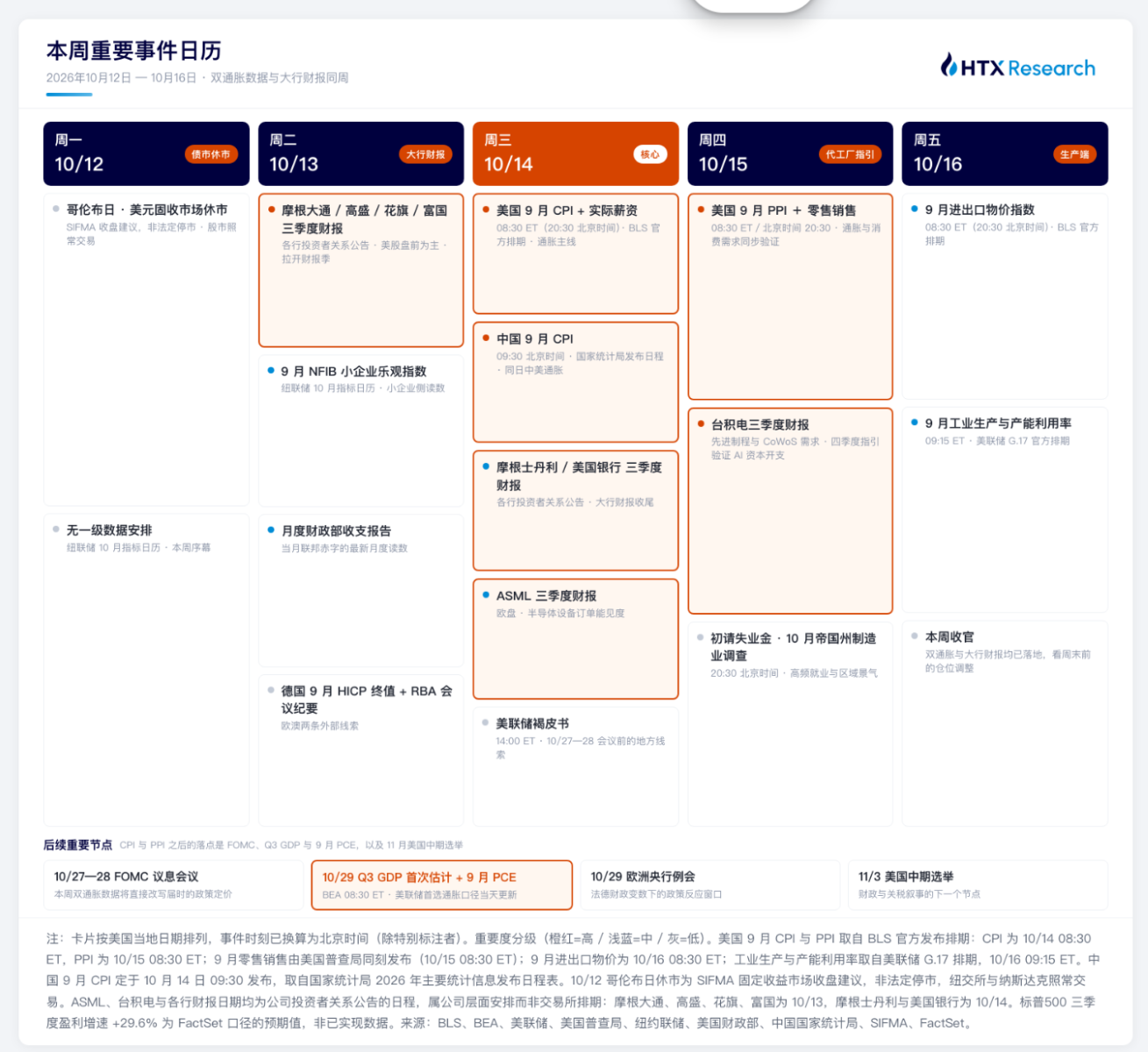
The main events this week are on Wednesday and Thursday: U.S. September CPI on Wednesday, PPI on Thursday, and China's September CPI also on Wednesday; U.S. September Retail Sales will also be released at 08:30 ET (20:30 Beijing Time) on Thursday, requiring simultaneous observation of inflation and consumer demand. Bank earnings season kicks off concurrently — JPMorgan Chase, Goldman Sachs, Citigroup, and Wells Fargo report on October 13th; Morgan Stanley and Bank of America report on October 14th. According to FactSet, S&P 500 Q3 earnings growth is projected at 29.6%, which would mark the third consecutive quarter exceeding 25%.
The most critical verification this week remains within the AI hardware chain, with two direct test points: ASML reports on October 14th and TSMC reports on October 15th. Last week already presented two counterarguments — Samsung on October 8th preliminarily reported a record Q3 operating profit of 107.4 trillion won (approx. $802 billion), and TSMC on the same day reported September revenue growth of 54.6% year-over-year and record Q3 revenue of NT$1.49 trillion (approx. $468 billion), showing recent revenue and profit strength remain robust; however, revenue announcements and profit pre-announcements alone do not prove that orders and capacity utilization have not weakened. ASML's orders and demand for advanced node equipment, TSMC's demand for advanced nodes and CoWoS packaging, and Q4 guidance will verify whether the AI capital expenditure chain is still expanding and influence whether hardware stocks can recover.
The second direction is the potential successors outside AI. Utilities and Consumer Staples led gains last week, consistent with the judgment of funds reallocating towards defensive sectors, but the flow and drivers require more evidence; sustainability should be judged in conjunction with earnings reports, valuations, and interest rate changes. The Energy sector rose 3.60%; higher oil prices benefit upstream oil & gas company revenues, but cash flows still depend on costs, capital expenditures, and business structure. The third direction is Chinese stocks — the weekly strength in Alibaba and the Golden Dragon Index contrasted with A-shares' post-holiday performance. A-shares resumed trading on October 8th; this week's focus is observing whether post-holiday trends and policy expectations can resonate.
Geopolitical developments still require distinguishing between statements and implementation: Trump stated on Sunday that Russia and Ukraine reached an "energy ceasefire"; Ukraine said it awaits details, while Russia has not publicly responded. Arrangements for Russian diesel supply are also promises and cannot yet be considered delivered. Oil prices retreated: according to Reuters, as of 09:54 Beijing Time on October 12th, WTI crude futures were at $90.31 per barrel and Brent crude futures at $103.18 per barrel, down 1.68% and 1.47% respectively from the previous day's settlement. Attacks on Riyadh airport and an oil tanker over the weekend added supply-side risks.
Risk Alert: The ISM Services Prices Paid at 74.0 and the simultaneous rise in both University of Michigan inflation expectations; if Wednesday's CPI or Thursday's PPI exceed expectations, year-end rate hike pricing (CME FedWatch as of the Asian session on October 12th shows an 86% probability of a hike by December) could further intensify, potentially pressuring growth stocks and gold via interest rates; gold is also influenced by safe-haven demand and USD movements. High-yield bond OAS has widened to 3.15%, and AI infrastructure heavily relies on private debt financing, which the September minutes already listed as a factor pushing up term premiums. Credit tightening could raise financing costs and pressure companies reliant on external funding or with high valuations. The VIX closed at 14.84, indicating low implied volatility; intensive data and earnings releases could still bring volatility, but a low VIX itself does not prove the market is underestimating risk. According to media citing industry sources, ASML plans to raise component prices for South Korean clients by 10% starting January 2027; tracking company confirmation and its actual cost impact is still necessary. Brent crude above $100 per barrel still faces two-way risks from escalating geopolitics and supply recovery. Position management takes priority over directional bets.
Disclaimer
This report is prepared by HTX Research for reference only and does not constitute any investment advice or offer. Information and data in the report are sourced from public channels; while we strive for accuracy and completeness, we do not guarantee it. Markets involve risks; decisions require caution.