Bezos' Third Startup Still Can't Avoid Musk

marsbitPublished on 2026-06-17Last updated on 2026-06-17

Abstract

Jeff Bezos Returns as CEO for Third Venture, Still Can't Avoid Musk After stepping down as Amazon CEO in 2021, Jeff Bezos has returned to the front lines as co-CEO of Prometheus, an AI startup he founded. In a recent CNBC interview, Bezos described the experience as "Type 2 fun"—exhausting but ultimately rewarding. Founded less than a year ago, Prometheus has already raised over $18 billion in two funding rounds, achieving a staggering $41 billion valuation. Prometheus aims to develop a "General Engineer AI" to accelerate the entire "invention loop"—design, simulation, testing, and manufacturing—for complex physical products like jet engines, spacecraft, and medical devices. This positions the company at the intersection of Bezos's past experiences: Amazon's platform-building scale and Blue Origin's rigorous physical engineering. This marks Bezos's third major venture, following Amazon and Blue Origin. His co-CEO is Vik Bajaj, bringing expertise from life sciences and hard tech. Bezos now dedicates most of his time to Prometheus, signaling his belief in its transformative potential. The move also comes as Bezos's space company, Blue Origin, faces challenges, including a recent test explosion delaying its New Glenn rocket. Meanwhile, Elon Musk's SpaceX achieved a record-breaking IPO, surpassing Amazon's market cap. While Musk focuses on AI for executing physical tasks (like Tesla's robots and SpaceX's engineering), Bezos is betting on AI to *invent* in the physical world. ...

By | 字母AI

Seven months after announcing his return to an executive role and founding the AI startup Prometheus, Jeff Bezos rarely discusses how he feels about sitting back in the CEO chair.

In a recent CNBC interview, Bezos admitted that he hadn't planned to be CEO again.

After stepping down as Amazon's CEO in 2021, Bezos handed daily management to Andy Jassy, taking on more of a role as founder, chairman, and investor.

He remained behind Amazon, Blue Origin, and The Washington Post, just no longer personally managing the day-to-day operations of a company as its CEO.

But for Prometheus, he returned to the front lines, resuming the life of a startup. Bezos described this state as "Type 2 fun"—the process is exhausting, but looking back, it feels worth it.

Prometheus has been in existence for less than a year with only about 150 employees, but its valuation has already reached a staggering $41 billion.

This is Bezos's first hands-on venture into a completely new future since leaving Amazon.

Although, this future still revolves around his old rival, Musk.

Prometheus

In Greek mythology, Prometheus is the Titan who brought fire to humanity. He is not only associated with "fire" but is often interpreted as a symbol of craftsmanship, creation, civilization, and foresight.

On June 11, Axios reported that Prometheus had completed a $12 billion Series B funding round, valuing the company at $41 billion. The investor lineup almost encompasses Wall Street and top global venture capital firms, including JPMorgan Chase, BlackRock, Goldman Sachs, internet investment giant DST Global, and life sciences and hard tech investment firm Arch Venture Partners. Bezos himself also participated in the investment.
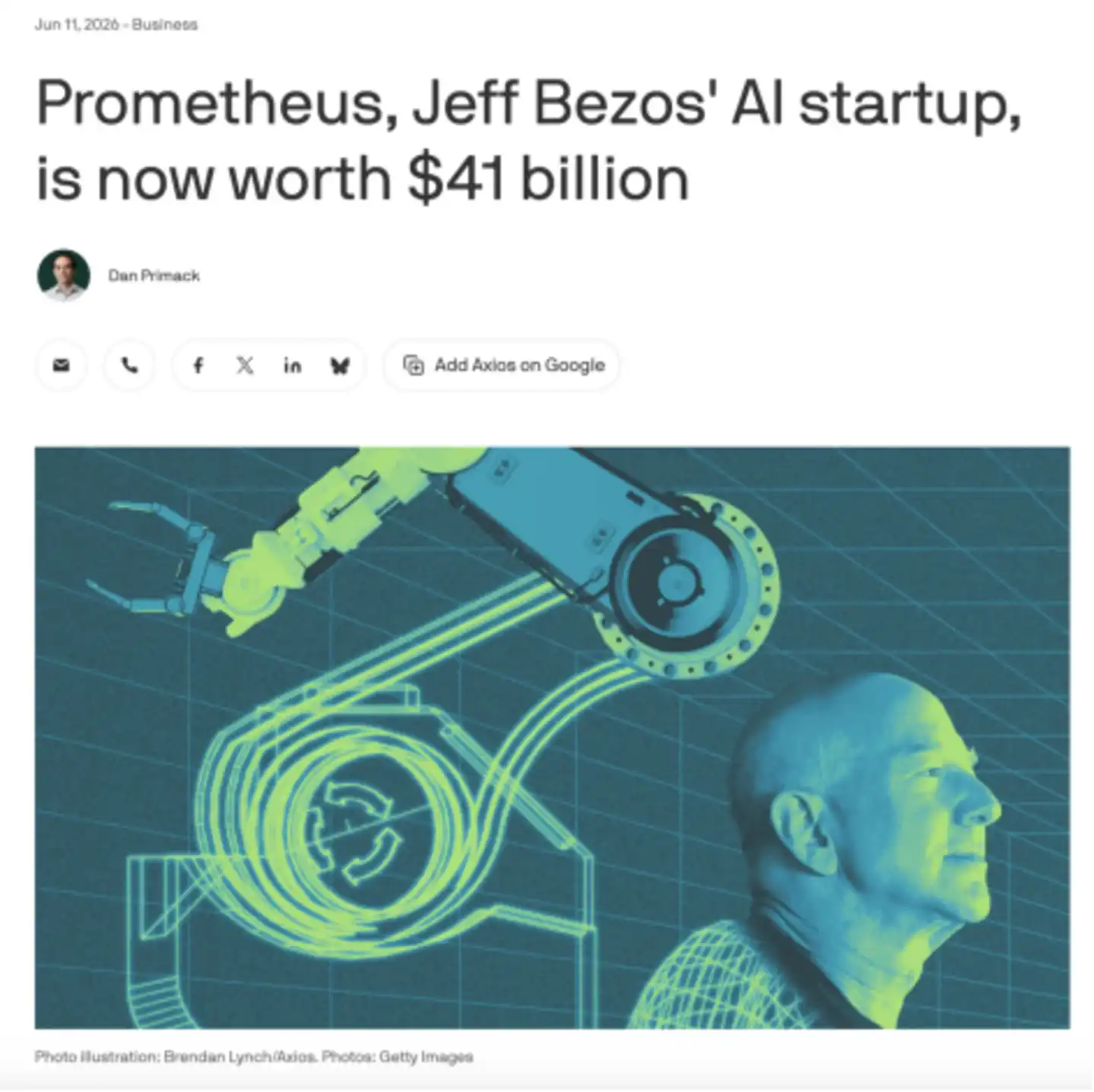
Last November, the company raised $6.2 billion in Series A funding upon its launch; just seven months later, it completed a $12 billion Series B, with the single-round funding amount almost doubling, and cumulative funding exceeding $18 billion across the two rounds.

In other words, it stepped onto the valuation peak of physical world AI as soon as it went public.

Humanoid robot company Figure AI announced over $1 billion in Series C funding in September 2025, with a post-money valuation of $39 billion;

Robot "brain" company Skild AI announced $1.4 billion in Series C funding this January, with a valuation exceeding $14 billion;

Another robot general intelligence company, Physical Intelligence, has a confirmed valuation of $5.6 billion, with reports suggesting its new funding round valuation may exceed $11 billion.

But Prometheus, in less than a year, has surpassed the valuations of these embodied AI star companies.

According to Bezos, Prometheus is not building robots but a kind of Artificial General Engineer AI.

Simply put, Prometheus aims to have AI participate in the design, simulation, testing, and manufacturing of complex real-world products.

Jet engines, spacecraft, chips, cars, medical devices, pharmaceuticals, consumer electronics, robots... The R&D cycles for these products often take years. A design goes through repeated simulation, prototyping, testing, failure, modification, and starting over.

What Prometheus wants to compress is this process—it aims to accelerate not a single task, but the entire "invention cycle": from design to simulation, from testing to manufacturing, and back to the next round of design.

More importantly, industrial AI remains a largely unexplored ocean, a blue ocean full of potential.

This direction is not without players. Robot companies are working on embodied intelligence, engineering software companies on simulation and design optimization, NVIDIA is pushing its physical AI platform, and manufacturing giants are also integrating AI into their production processes.

But it hasn't yet produced a truly benchmark product.

This relates to the complexity of industrial AI itself. It deals not with text and code on a screen, but with real-world materials, structures, temperature, energy consumption, cost, supply chains, and safety margins.

Here, AI can't just give an answer that looks plausible.

It must withstand simulation, pass testing, and ultimately be manufactured in reality.

Prometheus's $41 billion valuation is not buying a proven, mature company. It's buying an as-yet-unverified but potentially enormous possibility.

Prometheus stole fire, giving humanity the tools to change the world.

Bezos's Prometheus wants to hand the fire of AI to engineers in the real world.

Bezos's Third Hands-On Venture

If we exclude asset-type investments like acquiring The Washington Post, Prometheus counts as Bezos's third truly hands-on venture.

The first was Amazon.

In 1994, he left Wall Street and founded Amazon in Seattle. It started as just an online bookstore. Later, the company grew into one of the world's largest e-commerce platforms. In 2024, Amazon's annual revenue exceeded $630 billion; its AWS also became one of the most important players in the global cloud computing market.

Bezos built a set of infrastructure supporting modern commerce: warehousing, logistics, cloud computing, advertising, membership systems, and the operational machinery built around these systems.

The second was Blue Origin.

In 2000, Bezos founded Blue Origin. If Amazon belonged to the digital world, then Blue Origin faces the physical world. There is no "fail fast" here, only repeated design, manufacturing, testing, and launching.

Blue Origin isn't a paper-based space dream either. New Shepard has completed multiple suborbital flights and sent tourists to space; the BE-4 engine became the main engine for ULA's new Vulcan rocket; New Glenn is Blue Origin's core product for entering the heavy-lift orbital launch market.

Rockets aren't pure software products. They must ignite, undergo test fires, launch, and be tested for physical stability and manufacturing precision in the real world.

Amazon gave Bezos the experience of "turning complex systems into platforms," Blue Origin gave him the experience of "doing complex engineering in the physical world." With Prometheus, these two lines of experience converge.

Bezos mentioned in the CNBC interview that he was initially just a founding investor. Later, seeing the project's progress, he realized "I couldn't sit on the sidelines" and took on the co-CEO role himself.

Because Prometheus isn't a business suitable for remote betting. It's not building a lightweight application, but a complex system for the real industrial world. It requires both AI capabilities and engineering understanding; it needs to understand both models and manufacturing; it needs software speed but also respect for the constraints of the physical world.

And this falls precisely at the intersection of Bezos's experience over the past three decades.

Prometheus has Amazon-style platform ambitions and Blue Origin-style engineering difficulty. Bezos's return to the CEO role isn't just because he saw a new AI trend; it's more like he saw a familiar problem finally having a new solution.

Moreover, this time Bezos isn't diving in alone.

Prometheus's other co-CEO, Vik Bajaj, was an early core figure in Google's life sciences business, co-founding Google Life Sciences, later Verily; he later served as Chief Scientific Officer at cancer early detection company Grail.

In other words, Bajaj's past work has always been at the intersection of science, engineering, data, and real industry.

This co-CEO duo is interesting: Bezos brings Amazon-style platform capabilities and Blue Origin-style engineering experience; Bajaj brings experience in life sciences, hard tech, and complex R&D systems.

Two people, one better at turning complex systems into large-scale platforms, the other more familiar with pushing scientific problems into real industry.

Bezos said in the CNBC interview that Prometheus now occupies most of his time, followed by Blue Origin, and then AI-related work within Amazon.

In a sense, this is somewhat abnormal—over the past year, many well-known CEOs have chosen to step back, citing precisely that the AI era has arrived and the company needs someone more suited to lead the transformation.

But Bezos went in the opposite direction, and not to manage a mature giant like Amazon, but to invest most of his time in an AI startup less than a year old.

For a 61-year-old billionaire to return to the office, there must be a special reason. Perhaps he has already seen that the next opportunity to change the world is right there.

From "Blue Sky" to "Blue Ocean"

Blue Origin still exists. But it must be admitted that the "blue sky" of commercial space has been captured by SpaceX.

Last week, SpaceX completed its IPO, initially raising $75 billion. Subsequently, underwriters exercised the over-allotment option, increasing total fundraising to $85.7 billion, making it the largest IPO in global history. On its first trading day, SpaceX's stock rose about 19%, with its market cap breaking $2 trillion, pushing Musk to the position of "the world's first trillionaire."

SpaceX captured not just the launch market, but also the sexiest story in commercial space: reusable rockets, satellite internet, the Mars vision, massive valuation, employee wealth creation, and an IPO record-breaking enough to rewrite capital markets.

In contrast, while Blue Origin has New Shepard, BE-4, and New Glenn, these achievements aren't enough to change the seating at the table. The definition of commercial space has already fallen to SpaceX.

Moreover, Blue Origin was recently sharply reminded by the physical world.

On May 28, the New Glenn rocket exploded during a static fire engine test at Cape Canaveral, Florida, damaging the launch pad and potentially delaying subsequent launch plans by months.
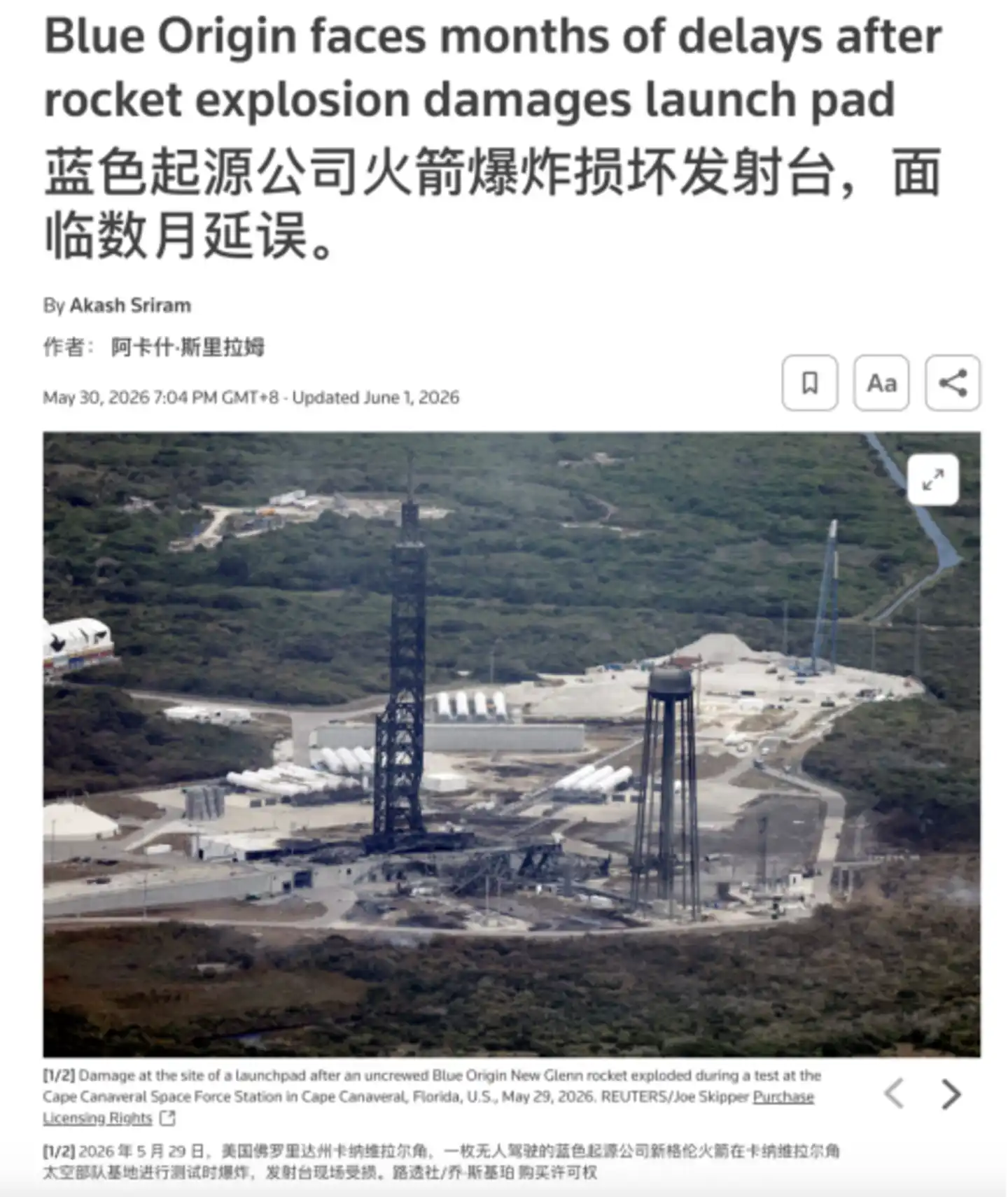
Space is harsh. Even if a company has money, patience, vision, and a founder like Bezos, rockets won't fly on schedule just because of that.

Reuters' latest report on June 16 shows SpaceX's stock continued to rise, closing at $201.80, with a market cap reaching approximately $2.655 trillion, already surpassing Amazon and briefly exceeding Microsoft. In other words, Musk not only won the definition in commercial space but also let SpaceX step on Amazon, the company Bezos built, in the capital markets.

This gives Bezos a somewhat "being overshadowed everywhere, might as well forge a new path" vibe.

Unfortunately, Musk seems to be "capable of everything from heaven to earth," making it hard to avoid him even after switching battlefields, as if the old rivals are just opening a new game.

Tesla works on autonomous driving, the humanoid robot Optimus; SpaceX works on highly engineered rocket manufacturing; xAI tries to integrate model capabilities into Musk's own company ecosystem... It can be said that Musk's AI path was never just about staying on the screen from the start. He wants AI to enter cars, robots, factories, and rockets, ultimately taking over more physical labor in the real world.

But there is a difference. If Musk is betting on "how AI executes tasks in the real world," then Bezos is betting on "how AI participates in real-world invention."

The industrial AI track is not short of players. OpenAI is supplementing robotic capabilities, Anthropic is entering industrial scenes, NVIDIA is building the Physical AI foundation—it's truly a time of fierce competition. But who will become the gateway to the industrial AI era remains unknown.

Prometheus wants to seize this position. It's not treating industrial AI as just a business direction, but as the entire company's proposition. What it wants to compete for is the human engineering of the AI era.

This time, Bezos doesn't want to chase behind Musk again.

Related Questions

QWhat is Prometheus, and what is its unique focus in the AI landscape?

APrometheus is an AI startup founded by Jeff Bezos and Vik Bajaj. Unlike many AI companies focusing on digital tasks or specific robotic applications, Prometheus aims to develop an Artificial General Engineer (AGE). Its unique focus is on using AI to accelerate the entire invention cycle for complex physical products—such as jet engines, spacecraft, chips, and medical devices—by participating in their design, simulation, testing, and manufacturing processes.

QWhy did Jeff Bezos decide to return to a CEO role for Prometheus?

ABezos stated he initially didn't plan to be a CEO again after stepping down from Amazon. However, as he saw the progress of Prometheus, he realized he couldn't remain on the sidelines. He was drawn back because the company's mission sits at the intersection of his two major prior experiences: building Amazon's scalable digital platforms and managing Blue Origin's complex physical engineering challenges. Prometheus combines both, requiring deep understanding of both AI and real-world industrial constraints.

QHow does Prometheus's funding and valuation compare to other major AI companies in the physical world?

APrometheus has achieved a remarkably high valuation very quickly. After a $6.2 billion Series A in November and a $12 billion Series B in June, its valuation reached $41 billion within less than a year. This surpasses other well-funded physical AI companies: Figure AI (valued at $39B), Skild AI (valued at over $14B), and Physical Intelligence (reportedly heading for a >$11B valuation). This indicates immense investor confidence in its potential to dominate the industrial AI space.

QHow is Jeff Bezos's new venture, Prometheus, still connected to his rivalry with Elon Musk?

AAlthough Prometheus represents a new direction in industrial AI design, it still intersects with Elon Musk's domains. Musk's companies (Tesla with Optimus robots and self-driving, SpaceX with rocket engineering, xAI) are also focused on deploying AI in the physical world to perform and execute tasks. While Musk focuses on 'how AI executes tasks,' Bezos's Prometheus focuses on 'how AI participates in invention.' Their competition has essentially shifted from commercial space (Blue Origin vs. SpaceX) to defining the future of AI's role in engineering and the physical economy.

QWhat challenges does the field of Industrial AI present that Prometheus must overcome?

AIndustrial AI faces significant complexity because it must operate within the constraints of the real physical world, not just digital environments. Key challenges include: AI outputs must be rigorously verifiable through simulation and real-world testing; designs must account for materials, thermodynamics, structural integrity, cost, supply chains, and safety; and the technology must integrate into existing, often slow, multi-year engineering and manufacturing cycles. Prometheus's goal is to reliably compress this entire 'invention loop,' a task that requires a deep fusion of AI capability and practical engineering knowledge.

Related Reads

Why Is the World Nervous About Japan Raising Interest Rates?

In June 2026, the Bank of Japan raised its policy rate to 1%, marking its first hike to this level since 1995. While this rate remains low compared to global peers like the US and Europe, the move signals a profound shift for a nation that has been a global source of ultra-cheap funding for decades. Japan's long-standing near-zero or negative interest rates had facilitated massive "yen carry trades," where international investors borrowed low-cost yen to invest in higher-yielding assets worldwide, such as US tech stocks and emerging market bonds. This made Japan a critical, often overlooked, source of global liquidity. Japan's ultra-loose policy stemmed from structural challenges post-1990s asset bubble: aging demographics, chronic low inflation/deflation, and high public debt. Recent shifts, including sustained wage growth (exceeding 5% in recent years) and inflation consistently above the 2% target, have created a "wage-price spiral" possibility, prompting the policy normalization. The global market's concern lies not in the absolute rate but in the potential unwinding of the yen carry trade. As Japanese borrowing costs rise, the economics of these leveraged global investments change, potentially triggering deleveraging and capital outflows from risk assets. Market anxiety focuses on the end of a thirty-year consensus that Japan would perpetually provide cheap funding. Ultimately, the global impact will depend on the interplay with US monetary policy. While Japan is tightening, the significant interest rate differential with the US remains. The key future dynamic is whether simultaneous Japanese hikes and eventual US rate cuts will narrow this gap, forcing a major recalibration of global capital flows and asset pricing built on an era of abundant, cheap yen liquidity.

marsbit1h ago

Why Is the World Nervous About Japan Raising Interest Rates?

marsbit1h ago

Research Report Analysis: MRVL's Optical AI Booming, Why High Valuation Keeps Morgan Stanley's Star Analyst Sidelined?

Report Recap: MRVL Optical AI Boom - Why High Valuation Led Morgan Stanley's Star Analyst to Stay Neutral? Morgan Stanley analyst Joseph Moore maintained an "Equal-weight" (Neutral) rating on Marvell Technology (MRVL) on May 28, raising the price target from $172 to $195, below the trading price. This stance comes despite Marvell reporting a record quarter and significantly raising its full-year outlook (FY27 revenue ~$11.5B, up ~40%). Moore's neutral view is based on valuation. The $195 target implies ~40x CY2027 P/E. He contrasts MRVL with NVDA: both trade near ~$200, but Nvidia's forward EPS is more than double Marvell's. For MRVL's valuation to hold, it needs consistent earnings upgrades, proof of networking market share gains, or certainty on large-scale custom AI chip shipments—none of which are confirmed yet. Growth is driven by two pillars: **1) Optical Interconnect** (the faster runner): Moore raised FY27 growth expectations to >70%, with the optical module product line nearing a $1B annualized run rate. **2) Custom AI Chips** (the climber): Confidence in FY28 is growing, but a major new customer project only ramps in FY28, with no current revenue visibility. Key risks are the underperforming Storage, Enterprise, and legacy Networking segments. Moore acknowledges the real AI opportunity but believes the current price already reflects it. For the stock to work from here, investors need to see the optical business hit its targets, custom chips ramp as planned, and a recovery in the weaker business units.

marsbit2h ago

Research Report Analysis: MRVL's Optical AI Booming, Why High Valuation Keeps Morgan Stanley's Star Analyst Sidelined?

marsbit2h ago

qinbaFrank: Review and Outlook of the AI Computing Power Wave — From the Three Debates on NVIDIA to Optical Interconnect and SpaceX IPO, How is Capital Rotating?

**Summary: Retrospective and Outlook on the AI Computing Wave - A Framework for Capital Rotation** Based on a presentation by investor qinbaFrank, this analysis reviews the AI computing market trajectory since 2023 and outlines a forward-looking framework. **Key Phases and Market Debates:** The AI bull market progressed through three major debates: 1) The necessity of massive capital expenditure (late 2023). 2) The sustainability of tech giants' spending (early 2024-early 2025). 3) Potential overestimation of compute needs (early 2025). Consensus solidified in late 2025 as model capabilities and utility demonstrably improved. **Core Thesis: Penetration Rate Drives Commercialization.** Unlike the 2000 dot-com bubble, the current AI wave benefits from mature digital infrastructure, enabling faster adoption. The critical threshold is 10% penetration; surpassing it (with recent enterprise intent surveys showing ~18%) indicates entry into a rapid growth "golden period" where user scale and willingness to pay increase simultaneously. **AI vs. Internet: A Fundamental Difference.** While the internet enhanced connection efficiency, AI directly substitutes human cognition and labor. Once AI performance exceeds the "societal average" human level, its commercial value scales exponentially as payment shifts from human labor costs to AI service fees. **Investment Logic Evolution in the Compute Chain.** The focus has expanded from GPUs to a systemic re-rating of the entire hardware stack: storage/HBM, CPUs, interconnects, power, and advanced packaging. The framework is: **short-term "scarcity pricing," mid-term "upgrade pricing" (e.g., optical interconnects, power networks), and long-term "Physical AI" pricing** (edge computing, robotics). **Market Focus Shift and Adjustment Framework.** The market is transitioning from "hardware scarcity" to "commercialization validation." The ultimate anchor for the narrative is sustained high growth in model providers' Annual Recurring Revenue (ARR) and cloud business revenue, which justifies continued capital expenditure. Adjustments are categorized into three levels: * **L1 (Minor):** Driven by valuation compression or macro noise (e.g., single CPI print). Fundamentals intact. * **L2 (Moderate):** Triggered by significant macro events requiring risk repricing. Requires new data for confidence restoration. * **L3 (Major):** Involves a reset of the core industrial narrative or macro regime (e.g., AI commercialization growth stalling). The **crucial dividing line** is whether AI commercialization growth slows. Without a slowdown, pullbacks are likely L1/L2 "repricing" events. A genuine growth deceleration would signal an L2/L3 narrative reset. **Conclusion: A Foundational Civilizational Leap.** AI represents a foundational upgrade to "intelligence" itself—akin to humanity mastering fire—rather than a single-point industrial revolution. This底层能力跃迁 (underlying capability leap) will spawn successive waves of innovation (Agent, robotics, industry workflow重构). The journey will be波浪式的 (wavelike), driven by cycles of scarcity, technological upgrades, and远期兑现 (long-term realization).

marsbit2h ago

qinbaFrank: Review and Outlook of the AI Computing Power Wave — From the Three Debates on NVIDIA to Optical Interconnect and SpaceX IPO, How is Capital Rotating?

marsbit2h ago

Trading

Spot
Futures
活动图片