Author: Nico Pei, Founder of Supernova
Compiled by: Felix, PANews
Editor's Note: How can new stablecoin issuers stand out in the gap between Tether and Circle? The founder of Supernova, which focuses on on-chain interest rate swaps, points out that building synthetic foreign exchange on top of USDT/USDC to provide global users with a local currency experience is the most realistic and efficient path. Below are the key takeaways.
Key Points:
- Stablecoin neo-banks are the next major growth area for mass retail adoption of cryptocurrency, and foreign exchange is becoming a core part of their underlying architecture.
- Tether and Circle have spent over a decade building massive liquidity, distribution channels, and network effects around USDT/USDC. This is extremely difficult for new foreign exchange stablecoin issuers to replicate.
- Instead of competing by issuing spot foreign exchange stablecoins, adopt synthetic foreign exchange: users continue to hold the underlying USDT/USDC, while their account balances are denominated in their preferred local currency.
Stablecoin neo-banks are moving beyond crypto-native banking to disrupt how global consumers and businesses transact. Over the past year, roughly $6 billion in venture capital has poured into this space.
However, given the current on-chain foreign exchange infrastructure, stablecoin neo-banks have effectively become "banks where you can only open a US dollar account." This limitation, however, presents a massive opportunity, as 95% to 99% of the world's population uses non-USD currencies for accounting.
Consumption Grows 24x in a Year, Evolving from Trading Tool to Everyday Currency
A friend from Tether once mentioned that diversifying its holder base is one of the company's three most important goals. If the holder base is dominated by whales, USDT's TVL would experience unpredictable volatility. All stablecoin issuers want to win over retail and business users who use stablecoins for daily transactions and banking, not more traders/whales.
"1 billion people holding $10 worth of USDT each is far better than one whale holding $100 billion."
Stablecoin neo-banks provide the perfect opportunity for stablecoins to reach everyday retail and business users. Beyond trading, mainstream users will experience the convenience and superiority of stablecoins as transactional, savings, and investment currencies, thereby overcoming the current transaction-dominated scale bottleneck.
Here's a snapshot of the momentum behind stablecoin neo-banks: In 2025, crypto card spending surged 525%, jumping from $14.6 million to $91.3 million, with ether.fi leading at $55.4 million. Single-day spending on the ether.fi card reached $3.7 million. This implies an annualized stablecoin spend of $1.35 billion, a 24x increase from last year.
When something grows 24x in less than a year, you have to pay close attention. Meanwhile, ether.fi launched their Euro (EUR) product last week.
Stablecoin neo-banking is a new battlefield, and there is no clear winner yet. From 2018 until now, the best stablecoin was seen as the one with the best fiat on/off-ramp liquidity and wide acceptance on CEXs, capturing the lion's share of growth benefits. So, how do you win this new battle? What kind of stablecoin is suitable for neo-banking?
Stablecoin Neo-Banks Can Hardly Win with Only USD Accounts
Historically, neo-banks focused on a single currency have struggled to gain market traction. Major fintech giants like Wise, Revolut, and Airwallex all started with foreign exchange. When PayPal went public in 2002, foreign exchange accounted for over 40% of its revenue.
Cross-border money movement is significantly more difficult than domestic, which is why these successful neo-banks had the opportunity to shine in forex and establish market dominance within specific payment corridors or consumer/business segments.
Therefore, stablecoin neo-banks offering only USD accounts may face significant hurdles in growth and differentiation, let alone compete with existing fiat neo-banks. 95% to 99% of businesses globally account in non-USD currencies. Currently, stablecoin neo-banks cannot serve these businesses or consumers.
A 700x Scale Difference: Why Are Foreign Exchange Stablecoins Struggling to Rise?
Although many excellent teams and blockchain ecosystems (especially Base and Codex) are eyeing the opportunity in the foreign exchange market, the harsh reality is: the sum of all foreign exchange stablecoins is just a fraction of the USD stablecoin scale. It's approximately $600 million versus $400 billion—a 700x difference.
Tether's success proves that stablecoins are a business with extremely strong network effects. Tether is the highest quality stablecoin precisely because of the vast network built around it.
Given the very limited TVL of foreign exchange stablecoins, most face the following dilemmas:
- Insufficient liquidity leading to peg instability. (For example, the de-pegging incident that happened to Paxos Gold on 10/10 could happen to any foreign exchange stablecoin with limited liquidity and TVL. PAXG had $1.2 billion TVL at the time, almost three times that of the largest forex stablecoin, EURC).
- Not accepted by fintech companies or CEXs.
- Even if accepted, their fiat on/off-ramp liquidity is very limited.
- Insufficient liquidity for important trading pairs (including USDT/USDC).
- Almost no yield opportunities.
- Complex compliance/licensing processes in different regions.
- Most importantly, due to untested peg mechanisms, stablecoins struggle to be adopted by stablecoin neo-banks and broader fintech companies unless they reach a certain scale. This is a "chicken-and-egg" problem that may take a long time and significant resources to solve.
High-Quality Stablecoin
A top-tier banking stablecoin must excel in all of the following areas:
- On/off-ramp channel liquidity
- Strong peg stability independent of overall market liquidity
- Yield opportunities
- Major trading pair liquidity
- Broad centralized finance / traditional finance / payment acceptance
- Strong presence on low-Gas chains
- Brand / code recognition
Insights from TradFi Forex: Rely on Derivatives, Not Spot
According to the Bank for International Settlements (BIS), only about 31% of global foreign exchange turnover comes from spot transactions, while roughly 69% comes from derivatives markets. This indicates that the modern forex market is primarily driven by synthetic exposure, hedging, and financing activities, not physical currency exchange.
Hence, the daily average notional turnover for forex swaps is as high as $4 trillion.
One of the most important non-spot forex instruments is the Non-Deliverable Forward (NDF): a cash-settled foreign exchange forward where no physical exchange of the underlying currencies occurs. The two parties do not deliver the underlying currencies but only settle the profit and loss difference in USD.
NDFs are particularly common where currency convertibility is restricted, offshore channels are fragmented, or offshore liquidity is insufficient for effective physical settlement, as the synthetic USD-settled exposure is operationally more convenient compared to obtaining and settling the local currency.
For example:
- A company wants exposure to Swiss Francs for the next 3 months.
- Instead of acquiring and settling physical Swiss Francs, the company enters a CHF NDF contract, effectively denominating its account in CHF while holding USD.
- At maturity, only the profit/loss difference (compared to the agreed-upon rate) is settled in USD.
Many modern NDF structures also incorporate a Mark-to-Market (MtM) mechanism, where unrealized profits and losses are collateralized or settled periodically during the contract's life, reducing counterparty risk and improving capital efficiency. Mark-to-Market Non-Deliverable Forward (MtM NDF) effectively allows an account to maintain USD funding while economically and efficiently denominating its balance and P&L in another currency.
The Shortest Path to On-Chain Forex: NDF Forex, Not Spot
For currencies lacking deep or efficient spot liquidity, MtM NDFs are an effective solution. This instrument is already widely used in TradFi for pairs like USD/CHF, USD/KRW, USD/INR, USD/BRL, and USD/TWD. Corporations, banks, and offshore investors frequently use them to gain synthetic forex exposure without physically settling the local currency.
Cryptocurrency faces similar structural issues:
- Not all currency pairs have deep spot liquidity;
- It's operationally challenging to maintain fully collateralized local currency stablecoins;
Therefore, the MtM NDF structure is perfectly suited for crypto-native foreign exchange systems.
Users can:
- Keep their accounts funded with USDT/USDC
- Simultaneously go long a foreign currency via an MtM NDF structure while shorting USD;
- Efficiently denominate account value and P&L in the target currency without leaving the USD settlement rail.
Advantages include:
- Oracle-based strong peg: exposure tracks reliable forex reference rates, not relying on fragmented local spot liquidity.
- Retain USD stablecoin rails and yields: users continue holding USDT/USDC, accessing the deepest on-chain liquidity and yield opportunities.
- Superior liquidity and access channels: USDT/USDC have the strongest global on/off-ramps, exchange integrations, and trading liquidity across crypto markets.
- Cross-currency scalability: any currency with a reliable USD oracle can be synthetically supported. No need to connect to local banking infrastructure, local custodians, or purchase sovereign bonds like traditional fiat-backed stablecoin issuers.
- Capital efficiency: only settling or collateralizing forex P&L differences periodically, without full notional spot conversion.
This aligns closely with how today's off-chain institutional forex market operates: layering synthetic exposure and cash-settled risk transfer on top of the dominant USD funding and collateral system.
Who Will Use NDF Forex On-Chain?
The simplistic "forex is the next frontier" narrative won't work. The devil is in the details, and getting a foreign exchange stablecoin to 10-12 figure TVL is not easy. Teams working in this direction cannot assume holders will magically appear once the product is built. It's crucial to be very clear about three things:
- Who are your holders
- Why do they hold it
- How to distribute to them
1. Neo-Banks, Custodians, and Wallets Need Multi-Currency Accounts
Total deposits are one of the most important metrics for neo-banks and stablecoin chains. Without native forex infrastructure, international businesses cannot easily hold funds on-chain and are forced back into local banking systems. As a result, many stablecoin neo-banks and stablecoin chains risk becoming mere pass-through corridors for funding, not true financial operating systems.
MtM NDF infrastructure changes this dynamic.
Stablecoin neo-banks, custodians, wallets, and payment platforms can integrate APIs to offer synthetic forex denominated services directly on top of the USD stablecoin rails. For end-users, the experience becomes a simple toggle:
- Switch the account's currency display from USD to EUR, CHF, SGD, HKD, etc.
- Or hold balances denominated in multiple currencies within a single account.
- While the underlying settlement, collateral, and liquidity infrastructure remains USDT/USDC.
Stablecoin neo-banks, custodians, and wallets are highly aligned with MtM NDFs:
- Expanding international user base
- Increasing deposits and stickier balances
- Reducing user outflow to traditional banking systems
- Supporting multi-currency accounts for competitive differentiation and PR highlights.
Thus, international corporate/retail users can:
- Keep funds fully on-chain
- Continue enjoying USD stablecoins' deep liquidity and yields
- Simultaneously hold forex exposure economically and efficiently via the synthetic forex market
This product benefits from a strong macro tailwind, with the USD depreciating roughly 10-12% against the Euro over the past year, increasing demand for non-USD exposure while users still hold USD stablecoins.
2. Forex Carry Trade Yields Will Far Exceed Ethena
Forex derivatives are also extensively used for carry trades, one of the largest global macro strategies. The classic example is the Yen carry trade:
- Borrow in low-yielding JPY.
- Go long a high-yielding currency (e.g., Brazilian Real BRL).
- Capture the interest rate differential, the "Carry."
BRL rates are often in the double digits, making it one of the most popular carry currencies for hedge funds and macro investors. These trades are typically executed via NDFs, forwards, and FX swaps, not physical spot exchange.
Compared to crypto basis trade products like Ethena:
- Forex carry is tied to sovereign interest rate differentials, not crypto funding rates
- The market is larger and more institutionalized
- Trade capacity is also larger due to the scale of the global forex derivatives market
- Yields are typically lower than crypto carry trade peaks but have historically been more stable and scalable
This creates a massive opportunity for on-chain forex carry vaults: users hold USDT/USDC as collateral, synthetically gain foreign currency exposure via MtM NDFs, and earn sovereign forex carry on-chain without leaving the USD stablecoin rails.
3. Corporate Global Payments
Over the past year, Bridge has allowed enterprise clients to accept fiat payments in Euro (EUR), Mexican Peso (MXN), Brazilian Real (BRL), Colombian Peso (COP), and British Pound (GBP), with funds automatically converted to USDC.
However, forex can currently only be received, not held on-chain. For businesses that do financial or accounting in currencies like Swiss Franc (CHF) or Singapore Dollar (SGD), this means they still need to interface with local banking systems. This is crucial when serving global businesses, and Tempo is actively pushing for such enterprise adoption and scaling.
Stripe supports NDF-like forex hedging in its fiat global payments. If a merchant wants to settle in currency A, but a customer pays in currency B, the merchant can hedge forex risk over a specified period, offering the customer a stable, locked local currency price.
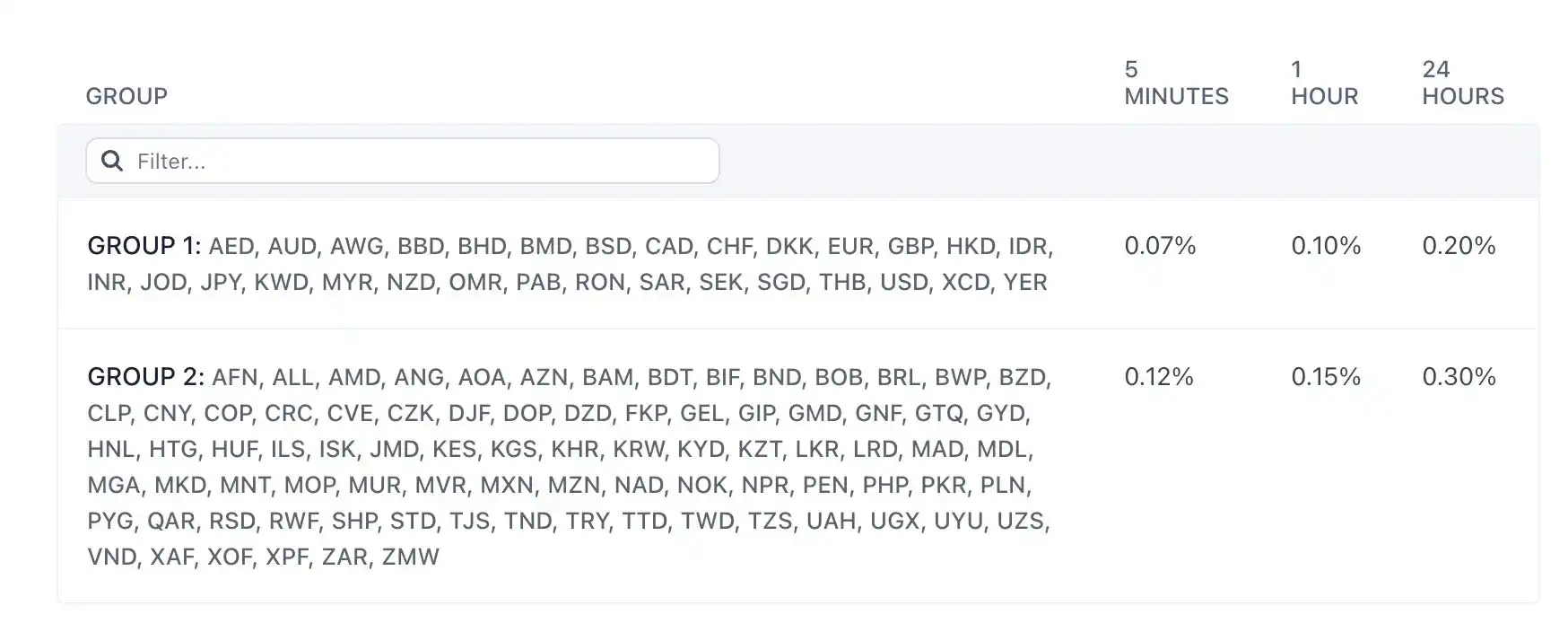
Stripe's NDF Forex API for fiat payments
A similar on-chain model can be applied to stablecoin payments: users continue holding and transacting with USD stablecoins, while merchants or wallets synthetically hedge their preferred local currency without relying on spot forex liquidity or local stablecoin issuance.
Notably, the margin on Stripe's forex product is exceptionally high, with an annualized hedging cost around 73%.
Despite this product serving mostly corporate and retail payment flows, which are typically low-risk and highly predictable, it still charges roughly 20 basis points per transaction. Annualized, this implies a ~73% hedging cost—an exceptionally high fee rate for forex risk transfer. This highlights both the profitability of this business and the price inelasticity users have for seamless global payments and currency certainty.
Related Reading: Building Stablecoin Forex Infrastructure: Decoding the Three Innovative Paths of Numo, Mento, and ViFi