Thailand crypto ETFs may see slow start despite new rules: CoinShares

cointelegraphPublished on 2026-10-15Last updated on 2026-10-15

Abstract

Thailand's new rules allowing Bitcoin and Ether ETFs to list on the Stock Exchange of Thailand have taken effect, potentially offering retail investors local access. However, CoinShares' Head of Research James Butterfill anticipates a slow start, with initial inflows likely in the "tens of millions of US dollars" rather than billions. He cites Hong Kong, a major financial hub, as a cautionary example, as it holds only 0.42% of global crypto ETP assets. Existing investment options may also limit demand, as Thai investors already have access to Bitcoin through foreign funds or direct trading. Butterfill identifies MFC Asset Management and ONE Asset Management as firms to watch for potential local ETF launches, though neither company's plans or timelines are confirmed. MFC already offers a fund tracking BlackRock's iShares Bitcoin Trust. The first locally listed Thai crypto ETFs still require regulatory approval and necessary custody arrangements before trading can begin.

Thailand’s first crypto exchange-traded funds (ETFs) may get off to a slow start despite Bangkok’s efforts to expand access to regulated digital asset investments.

“I would expect modest inflows initially, with tens of millions of US dollars across the first products a more realistic starting expectation than billions,” James Butterfill, head of research at digital asset investment firm CoinShares, told Cointelegraph.

The country opens a new route for crypto exposure on Friday as its rules for Bitcoin (BTC) and Ether (ETH) ETFs to list on the Stock Exchange of Thailand take effect.

The rules will allow retail Thai investors to access locally listed crypto ETFs, while restricting overseas crypto ETF investments through domestic brokers to institutional and ultra-high-net-worth investors.

Thailand’s first crypto funds will need regulatory approval and the necessary custody and distribution arrangements before trading can begin.

Hong Kong offers a cautionary comparison

Butterfill pointed to Hong Kong as an example of how even a major financial center can struggle to attract substantial crypto ETF inflows.

Hong Kong accounts for just 0.42% of assets in global crypto exchange-traded products (ETPs) despite the city’s status as an international financial hub, he said.
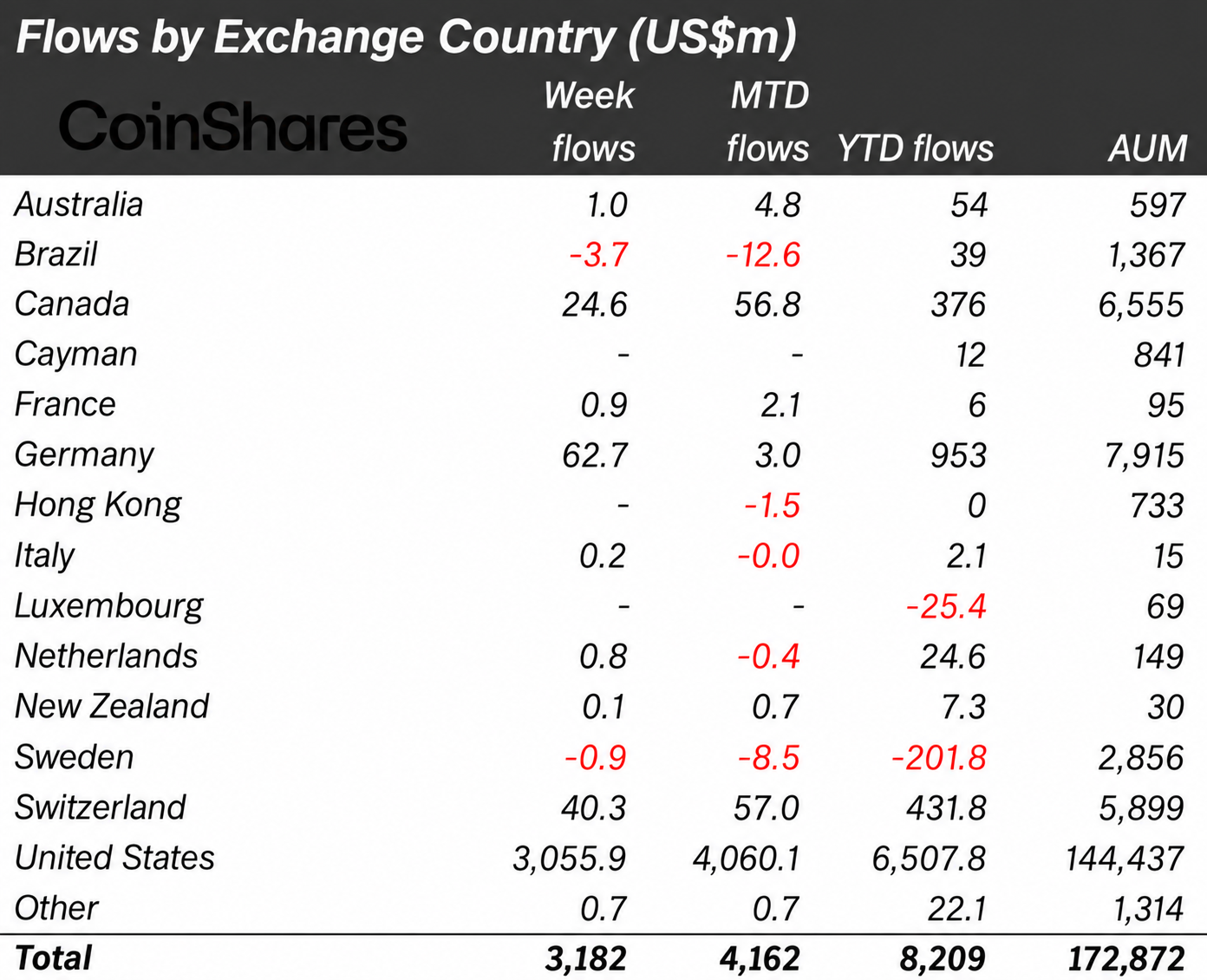
Crypto ETP flows by country as of Sept. 25, 2026. Source: CoinShares

Global crypto investment products held $172.9 billion in assets under management, including $733 million in Hong Kong, according to CoinShares data as of late September.

First Thai crypto ETF launches remain uncertain

Butterfill said that existing investment options may limit demand for new Thai ETFs, as some investors already gain Bitcoin exposure through foreign funds or direct crypto trading.

Thailand’s MFC Asset Management, which Butterfill identified as a firm worth watching for potential ETF launches, introduced its Bitcoin ETF Tracker Fund (MBTCETF-UI) in 2024. The fund invests in BlackRock’s iShares Bitcoin Trust (IBIT), the world’s largest spot Bitcoin ETF by assets under management.
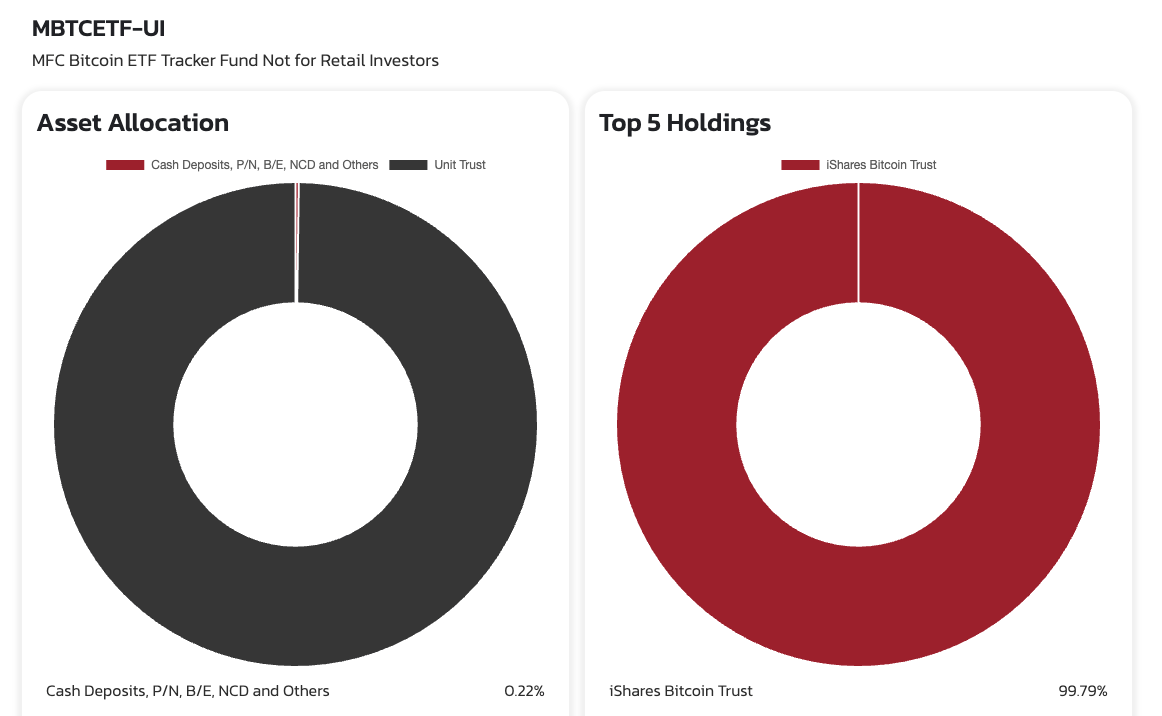
The MFC Bitcoin ETF Tracker Fund. Source: MFC Asset Management

“Local ETFs therefore need to attract new investors or offer a compelling reason to switch,” Butterfill said.

Apart from MFC, Butterfill pointed to ONE Asset Management as another potential ETF issuer worth watching. In 2024, ONE became the first Thai asset manager to receive approval for a Bitcoin ETF-linked fund.

Related: Bitcoin ETFs shed $261M as XRP funds buck weekly outflow trend

Butterfill said he hadn’t confirmed either company’s plans to launch a locally listed crypto ETF or when the first products might begin trading.

Cointelegraph contacted Thailand’s SEC, ONE Asset Management and MFC Asset Management about potential ETF launches but had not received responses by publication time.

Magazine: China’s P2P stablecoin wallets surge 43x, Korea’s $450B crypto economy: Asia Express

Related Questions

QAccording to CoinShares' research head, what are the expected initial inflows for Thailand's first crypto ETFs?

AJames Butterfill expects modest inflows initially, with tens of millions of US dollars across the first products being a more realistic starting expectation than billions.

QWhat restriction do Thailand's new rules impose on overseas crypto ETF investments via domestic brokers?

AThe rules restrict overseas crypto ETF investments made through domestic brokers to institutional and ultra-high-net-worth investors, while allowing retail investors to access locally listed crypto ETFs.

QWhy does James Butterfill use Hong Kong as a cautionary comparison for Thailand's crypto ETF prospects?

AHe points to Hong Kong as an example of how even a major financial center can struggle to attract substantial crypto ETF inflows, noting it accounts for only 0.42% of assets in global crypto ETPs.

QWhich two Thai asset management firms does the article identify as potential issuers of locally listed crypto ETFs?

AThe two firms identified are MFC Asset Management and ONE Asset Management.

QWhat existing investment vehicle might limit demand for new Thai crypto ETFs, and what does it invest in?

AMFC Asset Management's Bitcoin ETF Tracker Fund (MBTCETF-UI), introduced in 2024, might limit demand. This fund invests in BlackRock's iShares Bitcoin Trust (IBIT).

Related Reads

Altman Empathizes with Jensen Huang: 'Heroes Have Flaws,' But Does He Support His Return as NVIDIA CEO...

At the Semafor Silicon Valley Summit on November 16, OpenAI CEO Sam Altman publicly addressed Nvidia founder Jensen Huang's resignation as CEO after 33 years, expressing strong personal empathy. Altman called Huang "a hero of mine" and said it's hard to imagine the AI revolution without him, acknowledging that "heroes have flaws." Nvidia's stock fell about 15% within a week, wiping out over $570 billion in market value, and 180,000 people signed a petition urging his reinstatement—echoing Altman's own 2023 board ouster and dramatic return. Altman noted that Nvidia and OpenAI bet on each other early on. On business matters, he dismissed concerns that Nvidia's commitments—including a $105 billion financial guarantee for an OpenAI data center in Ohio—would lose credibility, saying the company is now a massive giant whose backing remains trusted. He also expressed optimism that the AI industry will keep advancing without Huang, given strong market demand and validated AI value. Altman identified scientific research as the next major AI breakthrough area, citing progress in math and physics, and predicted AI will take over repetitive, process-driven enterprise work. He also clarified his controversial memory chip remarks (saying he actually supports consumers upgrading their own PCs), explained that chip demand projections from multiple suppliers overlap even though real data center demand is solid, said OpenAI has not yet launched fully autonomous recursive self-improvement due to safety concerns, and stated OpenAI is in no rush to IPO despite Anthropic's filing, noting investor demand far exceeds quality supply.

marsbit3m ago

Altman Empathizes with Jensen Huang: 'Heroes Have Flaws,' But Does He Support His Return as NVIDIA CEO...

marsbit3m ago

If you lose money helping a friend trade cryptocurrency, will it be deemed fraud?

When friends entrust you with money to trade cryptocurrency on their behalf and the market turns against them, two distinct legal questions arise: whether you must compensate them, and whether your conduct constitutes fraud. These are separate issues. Civil liability depends on the nature of the relationship—whether it was a loan, a委托 investment, or a joint venture—and on the validity of any agreement. Under Chinese policy, virtual currency investment activities are treated as illegal financial activities, and civil acts involving them that violate public order and good morals are void, with losses generally borne by the parties themselves. Courts have reached different outcomes: in one case, an investor's claim for full repayment was rejected because the loss stemmed from market risk; in another, the operator was ordered to bear 20% of the loss for failing to recognize compliance risks, while the investor bore 80%. Fraud, by contrast, requires proof of deceptive conduct and intent to illegally possess the funds—mere trading losses or refusal to repay do not establish fraud. However, fabricating trade records, misappropriating funds, or secretly using leverage contrary to instructions can change the analysis. If a dispute escalates or police become involved, the priority is to preserve complete records of the agreement, fund flows, and trading history, avoid making unauthorized repayment promises, and cooperate truthfully with authorities while seeking professional legal advice.

marsbit3m ago

If you lose money helping a friend trade cryptocurrency, will it be deemed fraud?

marsbit3m ago

Stop Asking, I Just Love Money! The Naked-Quit Genius Researcher Backtracks, May Want to Return to Big Tech

Jacob Coxon, a 27-year-old Cambridge mathematics graduate and former pretraining researcher at both OpenAI and Anthropic, publicly reversed his stance just two months after a high-profile resignation. Speaking at a Stanford University event hosted by professor Rob Reich, Coxon admitted he is unsure whether leaving was the right decision and suggested he might return to a top AI lab. When pressed on why he still holds OpenAI stock options despite describing frontier labs as existential threats, he candidly replied, "I like money, brother. I admit it's blood money," and deflected further questions by blaming the host for raising the issue. He also said he remains anxious about no longer seeing frontier progress from the inside and feels he is "shouting into the void," questioning whether staying inside a lab would have been more influential. On technical matters, he argued that pretraining is not hitting a wall—compute efficiency is following a "super-exponential" curve—that recursive self-improvement requires only one narrow technical capability rather than broad mastery, and that deceptive or uncontrolled behavior in models originates solely from reinforcement learning during post-training, a loop labs cannot escape because RL remains the only effective tool for making models follow complex instructions. The episode, in which he clings to valuable equity while warning of AI risk, is seen as a candid portrait of Silicon Valley's AI culture.

marsbit7m ago

Stop Asking, I Just Love Money! The Naked-Quit Genius Researcher Backtracks, May Want to Return to Big Tech

marsbit7m ago

Acquisition Complete: Fei-Fei Li Officially Leads Team into AMD, Lisa Su Personally Welcomes Her

AMD has completed its acquisition of World Labs, the spatial intelligence startup co-founded by AI pioneer Fei-Fei Li, in an all-stock deal valued at approximately $8.2 billion (about 14.98 million shares). The transaction, signed September 28 and closed November 13—just 46 days later—marks AMD's second-largest acquisition after Xilinx in 2022. Li now serves as AMD Executive Vice President and Chief Scientist, reporting directly to CEO Lisa Su, while co-founders Justin Johnson and Ben Mildenhall remain to lead an independent frontier research group. World Labs, founded in 2024, focuses on spatial intelligence and 3D world models rather than large language models. Its Atlas world model, released September 2026, uses camera pose-conditioned prediction ("Viewpoint Is All You Need") and topped blind tests with over 500,000 human evaluations, generating coherent 1440p videos over 60 seconds. The company also acquired robotics firm Scenix and opened Atlas to the public on November 12. The deal deepens AMD's push into physical AI and robotics—a market Su calls a multi-trillion-dollar opportunity—allowing Li's team to co-design future Instinct chips and the ROCm software stack. AMD positions this against Nvidia's integrated hardware-software dominance, emphasizing an open AI ecosystem. AMD shares dipped about 5% on announcement day amid a broader semiconductor pullback.

marsbit7m ago

Acquisition Complete: Fei-Fei Li Officially Leads Team into AMD, Lisa Su Personally Welcomes Her

marsbit7m ago

Hackers inject credit card, crypto-stealing malware into 178 major websites

Cyber attackers planted cryptocurrency and credit card-stealing malware on websites associated with Ledger, Coinpass and scores of other major businesses in an attack exploiting website optimization platform Optimizely on Monday. Dubbed "Optimjack" by researcher Amirul Iman, the campaign delivered malicious code through scripts hosted by Optimizely. The malware could replace legitimate cryptocurrency wallet addresses with attacker-controlled alternatives when visitors copied addresses, and it also captured credit card details entered into website forms, according to a separate analysis by cybersecurity firm StepSecurity. The campaign affected website scripts belonging to 178 organizations, including hardware wallet Ledger, OANDA / Coinpass and trading platforms IG, Interactive Investor and TMS Brokers, according to Report URI's investigation. Other affected brands included IKEA, Salesforce, Zoom, the BBC and CNN, websites that collectively attract millions of visitors a day. BBC was among the first websites observed to serve the Optimizely injection at around 4:21 am UTC on Monday. By 9:52 pm UTC, most of the malicious code had been removed, with Ledger's snippet cleaned at about 8:41 pm UTC. Cointelegraph reached out to Ledger, Coinpass, and a number of other major businesses reported to be impacted by the malicious injection. This is a developing story, more information will be added as it becomes available.

cointelegraph18m ago

Hackers inject credit card, crypto-stealing malware into 178 major websites

cointelegraph18m ago

Trading

Spot
活动图片