Organized & Compiled: Deep Tide TechFlow
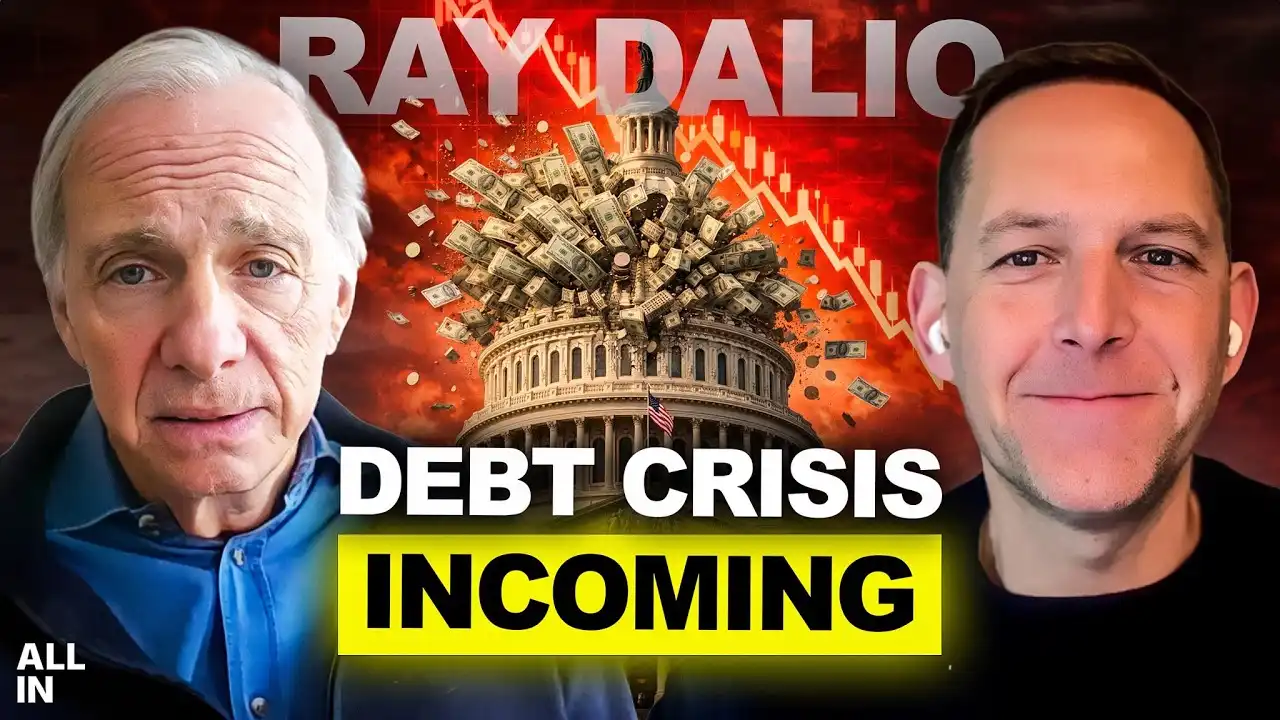
Guest: Ray Dalio, Founder of Bridgewater Associates
Host: David Sacks
Podcast Source: All-In Podcast
Original Title: Ray Dalio: "AI Is Eating Everything - and It Might Eat Itself"
Broadcast Date: March 3, 2026
Key Summary
In his third appearance on the All-In Podcast, renowned investor Ray Dalio provided an in-depth analysis of the severity of the U.S. debt crisis and made predictions about its potential future trajectory. He discussed in detail the five major forces reshaping the global order, the structural limitations faced by the Government Efficiency Department, the driving factors behind gold prices hitting new historical highs, the reasons for Bitcoin's underperformance, and the real story behind tariffs and trade deficits. He also explained why he believes the U.S. might be on the brink of collapse.
Highlights
On the Nature of Debt and the Economy
- The issue of the debt cycle is like the circulatory system of the human body. When the cost of servicing debt grows relative to income and becomes unpayable, it's like plaque building up in the arteries, squeezing out other expenditures.
On the Dilemma of Government Reform
- In an efficient government, making it even more efficient is not easy. Trying to reform in a 'surgical' manner—doing it efficiently and quickly while also not provoking too much opposition—is almost impossible.
On the Underlying Logic of Money
- Mechanically, money is essentially a debt. When you hold money, you are actually holding a debt instrument, which is just a promise that someone will give you money. When central banks have too much debt, their power is to print money.
On the Irreplaceability of Gold
- Gold is the only long-term historical asset that can be transferred, cannot be manufactured in large quantities, and does not rely on the promise of others. In other words, most currencies, debts, stocks, etc., are just promises from someone to deliver purchasing power.
On the Difference Between Bitcoin and Gold
- Bitcoin lacks privacy; its transactions can be monitored and may even be indirectly controlled. Central banks do not want to buy or hold Bitcoin. Additionally, there are questions about the development of new technologies, such as whether quantum computing will impact Bitcoin.
On the Misunderstanding of Tariffs and Inflation
- A common mistake economists make is not including taxes in inflation. I mean, if your tax burden increases, that is also inflation. Why should this be any different from the impact of rising house prices on you?
On the Three Keys to a Nation's Success
- First, educate the children well. Second, society needs to provide an orderly, civilized environment. Third, you must avoid war. If these three things are achieved, the country will succeed. This is a fact repeatedly proven by history.
On the Endgame of Social Division
- We are moving towards that 'war'; in fact, we are already in it. When the positions people support become more important to them than the system itself, the system faces a crisis.
On the Paradox of AI 'Eating Itself'
- Artificial intelligence seems to be eating everything, but it might 'eat itself.' It may not generate enough profit... China might view AI as infrastructure like electricity, making it free for everyone to use. In that case, how do we compete?
On the Metaphor for the Current U.S. Situation
- This is exactly our problem—the need for instant gratification and ignorance about whether certain things will be productive.
The Five Forces Determining America's Future
David Sacks: Looking back at the past year of governance, congressional action, and economic performance, I want to ask you: Are we on the right path now? Or has nothing much changed compared to a year ago? Or, are we moving too slowly?
Ray Dalio:
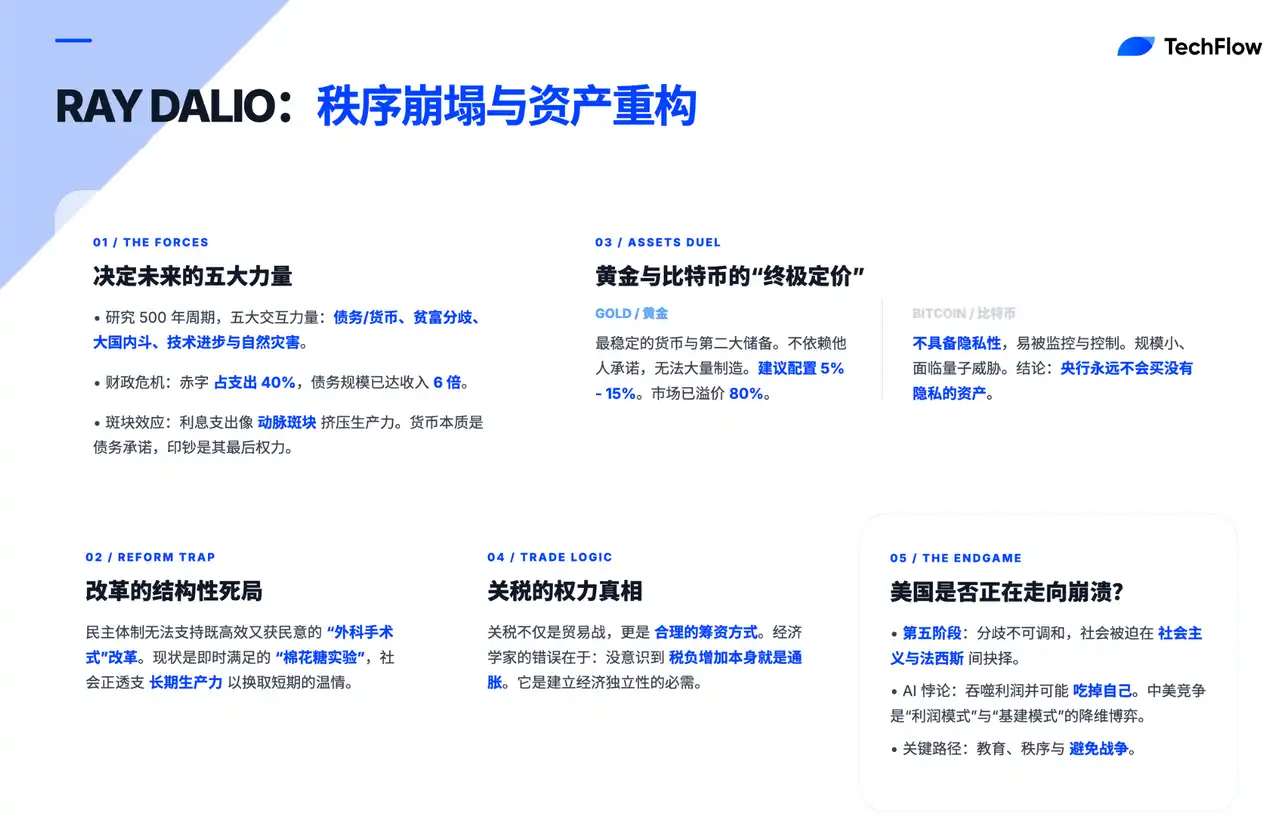
I have studied the major cycles of the last 500 years and found that five forces intertwine to determine the answer to your question. The first is the debt and money problem which I will specify later. The second is domestic fragmentation, including wealth and value gaps. These gaps lead to irreconcilable differences between the left and the right, which in turn affect tax policy, democracy, and how everything operates. The third is great power conflict internationally. This is the classic pattern of a 'rising power challenging the existing power,' changing the global order. The fourth is technological advancement. In every historical cycle, technology has played an important role. Finally, there are natural disasters, including droughts, floods, and pandemics.
When we talk about order, we mention monetary order, and all monetary orders eventually collapse for the same reasons. Similarly, all political orders, domestic and international, also change. The U.S. political order has been relatively stable for the past 250 years, but it has experienced one civil war. Internationally, order changes more frequently, such as the shift from a unipolar to a multipolar world, and technology is constantly changing the world.
Now, since these factors exist, let me further explain the government's fiscal situation and answer your question. A country's economy basically operates like a company's or an individual's economy, except the government has the ability to print money. If you view the government as a company or an individual, its spending is about $7 trillion, while its income is only $5 trillion, so the deficit is 40% of spending. The U.S. has been running a deficit for a long time, and the current debt is 6 times income; you can make predictions based on this.
The problem of the debt cycle is like the circulatory system of the human body; the capital market delivers credit to different parts of the economy. If this credit is used to increase productivity and generate enough income to pay the debt service cost, then it is a healthy process. But the problem is that when the debt service cost grows relative to income and becomes unpayable, it's like plaque building up in the arteries, squeezing out other expenditures.
Currently, the U.S. has a $2 trillion deficit, half of which is interest payments, and we also need to roll over $9 trillion in maturing debt. If you put this situation on a company or an individual, it's clearly a problem. To stabilize the situation, a deficit of 3% of GDP might be a reasonable level. But the current situation is very unhealthy, not only because it squeezes spending, but also because there is a problem with the supply and demand of debt.
We need to roll over $9 trillion in maturing debt and additionally sell $2 trillion in debt. So who are the buyers of this debt? Partly domestic buyers, and partly foreign buyers, about one-third. From their perspective, this situation is riskier.
First, dollar-denominated debt already represents a high proportion of their portfolios, possibly beyond prudent investment levels, and there is also geopolitical risk. For example, you can imagine potential conflict with China, or even tensions with Europe. Europeans might worry about being sanctioned, such as debt service payments being stopped due to sanctions, and the U.S. also needs to worry about whether it can attract enough capital.
The dynamics I'm describing have happened repeatedly in history. For example, we saw similar dynamics between 1929 and 1945. So, this fiscal situation itself is unhealthy for the U.S. government, but the bigger problem is that other factors exacerbate these issues.
Why Government Reform Is Almost Impossible
David Sacks: You mentioned this problem before and offered a diagnosis: if we could reduce the deficit to 3% of GDP, it would mitigate the impact. But that hasn't happened. At this time last year, we had high hopes for Elon Musk's decision to lead the Government Efficiency Department; he planned some drastic reforms, including cutting government spending, cracking down on fraud, etc.
Do you think the failure of this reform was due to problems with the actions taken themselves, or because at this stage of the cycle, the entire system is already unchangeable? Is it because there is too much capital flow in the economy, the entire economy is too dependent on this capital, too many individuals and businesses also depend on it, making us unable to escape this situation structurally? Does this attempt tell us whether government reform is even possible at this stage?
Ray Dalio:
In an efficient government, making it more efficient is not easy. Especially when you must act quickly because there is election pressure, and people generally don't like these reforms; ultimately, you might lose popular support. Furthermore, in a society like ours, whatever you do will be criticized and questioned. This also raises the question: Can democracy and our system really support an administrative leadership model that is both efficient and acceptable to everyone?
For example, when we talk about cutting spending, programs like school lunch programs get cut. Trying to reform in a 'surgical' manner—doing it efficiently and quickly while also not provoking too much opposition—is almost impossible.
If you look back at history, from a political perspective or just common sense, you'll find that finding an administrative leadership model that satisfies the majority and can push reforms quickly is a very difficult challenge.
David Sacks: There was also a major news story recently suggesting massive potential fraud in public funds in Illinois. For example, some non-existent daycare centers received billions of dollars. Do you see this as a symptom of the current cycle stage? How do you view this situation in relation to the issues we're discussing?
Ray Dalio:
Yes, this is indeed a manifestation of this cycle stage. If you want a well-managed government, you must ask yourself: How well can the government actually be managed? For example, go to the Department of Motor Vehicles, and you'll see how big, complex, and chaotic the system is. So, are you surprised when you see these inefficiencies? You probably aren't.
Gold vs. Bitcoin
David Sacks: You mentioned before that part of your portfolio is in gold, and the price of gold has risen from $2,900 to $5,200 per ounce. How has gold performed over the past year? Is it because the market has finally realized the cycle stage you've been talking about for years, or because China has structurally abandoned the dollar and U.S. Treasuries in favor of holding more gold? Or because other central banks are also turning to gold? Or because individual speculators and market participants have greatly increased their interest in gold?
Ray Dalio:
This is related to the big cycle. What we need to understand is that gold is not just a speculative precious metal as most people think. Gold is one of the oldest and most stable currencies and the second-largest reserve currency held by central banks. Therefore, for various reasons—economic supply and demand, politics, geopolitics, etc.—central banks themselves are buying gold to increase reserves. At the same time, individuals and other investors are looking for an alternative currency.
The question is, what is money? Mechanically, money is essentially a debt. I mean, when you hold money, you are actually holding a debt instrument, which is just a promise that someone will give you money. As I mentioned before, when central banks have too much debt, their power is to print money. If you understand this, then you can understand what is happening now. The key question, David, is what kind of money do you think is safe?
David Sacks: I want a currency backed by an asset, an asset with actual physical limitations.
Ray Dalio:
Especially an asset that can be transferred from one place to another. After all, money is both a medium of exchange and a store of wealth. If a country's central bank or government wants to pay another government, it needs real money, not fixed assets like buildings. If you want to trade, you must trade with something that can be transferred. And gold is the only long-term historical asset that can be transferred, cannot be manufactured in large quantities, and does not rely on the promise of others. In other words, most currencies, debts, stocks, etc., are just promises from someone to deliver purchasing power.
Wealth and money need to be distinguished. Wealth can exist in forms like stocks, buildings, companies, etc., but you can't spend this wealth directly. When you want to spend, you need to convert wealth into money. And now, the amount of wealth we have relative to money is very high. The problem is that when you try to convert wealth into money, they might choose to print money. This has been happening since we had fiat currency.
David Sacks: So, when you communicate with market participants, are they converting wealth or money into gold? In the market cycle of dollar-denominated gold value, how much room for growth is left?
Ray Dalio:
I usually observe who holds which assets, including the assets held by central banks, and the composition of these assets. I look at the ratio of wealth to money, or wealth to gold. We can see that the total amount of wealth and the amount of other currencies held by central banks are very large relative to hard currency gold.
The price of gold has risen from a very low level to a high level, and this price increase and change in asset composition have almost returned to historical average levels, though not completely. However, because the total wealth relative to money is still very high, this remains a major issue.
As a practical example, a wealth tax is a potential risk. Someone might ask: "Are we in a bubble now?" For example, is there a bubble in AI-related stocks and other similar stocks? But we know that a characteristic of a bubble is that it creates a demand for money, which forces people to sell assets to obtain funds to meet this demand.
Typically, this demand comes from borrowing money to buy assets, and asset prices rise accordingly. But this cannot be sustained because the debt service cost must be paid, and the assets themselves do not generate enough cash flow to pay these costs. Eventually, people have to start selling assets to repay debt or to liquidate for a wealth tax.
Whether people support a wealth tax or not, the tax itself could cause wealth to flow into cash. And the only way to get cash is to sell assets or borrow against assets, which can cause cash flow problems. Additionally, the social impact of the wealth gap makes this issue politically more complex.
Therefore I believe that whether individuals, companies, or even countries, they should worry about whether they hold enough gold. Even if you have no particular view on gold, you should allocate 5% to 15% of your portfolio to gold. Because gold has a negative correlation with the performance of other assets; when the economy has problems, gold usually performs well, while other assets often perform poorly.
David Sacks: Why hasn't Bitcoin shown a trend similar to gold? After our last conversation, gold rose 80%, while Bitcoin fell 25%. What do you think about Bitcoin's performance and why it hasn't become the safe-haven asset many thought it would be?
Ray Dalio:
Bitcoin and gold have some key differences. First, Bitcoin lacks privacy; its transactions can be monitored and may even be indirectly controlled. Central banks do not want to buy or hold Bitcoin. Therefore, not only individuals, but institutions and central banks are unlikely to use Bitcoin as a reserve asset. Additionally, there are questions about the development of new technologies, such as whether quantum computing will impact Bitcoin.
Bitcoin's market size is relatively small and easier to control. Although Bitcoin attracts a lot of attention, as a currency, its size is still small compared to gold. So, these are the dynamic differences between Bitcoin and gold.
David Sacks: What about silver? The price of silver has also risen significantly over the past year. Is this a derivative of gold? Or are people just following the gold trend and speculating on silver?
Ray Dalio:
Silver is a by-product in production, and its supply is difficult to increase. Historically, for example, the British pound was pegged to silver, and silver was also considered a currency, but silver has gradually become a speculative asset, so people chase it because of its popularity.
David Sacks: Last time we met, you talked about the importance of keeping interest rates low to cope with the impact of the current economic cycle stage. What is your view today on the level of interest rates and the actions taken by the Fed over the past year? Have these measures been sufficient to mitigate the impact we face at this stage of the cycle?
Ray Dalio:
Interest rates are one of the three main considerations in economic management, the other two being taxes and government spending. But we cannot artificially push interest rates too low because one person's debt is another person's asset. If interest rates are too low, creditors are affected, which leads to the dynamics we are familiar with: more borrowing is put into various things, fueling bubbles.
At the same time, interest rates cannot be too high, or else debtors will be overly squeezed and unable to bear it. Therefore, a balance is needed: interest rates must be high enough to satisfy creditors' needs, but not so high that debtors cannot bear it. When there is a large amount of 'dead assets' and liabilities in the economy (because every dead asset corresponds to a debt burden), this balance becomes very difficult.
This situation is more complex in the so-called 'K-shaped economy.' In other words, some parts of the economy have bubble phenomena, like people asking: "Who will be the next trillionaire?" This involves the top 1% richest people. Meanwhile, another part of the economy is in trouble, like 60% of Americans reading below a sixth-grade level. Making these people more productive, especially when we also face labor substitution problems, is an extremely challenging task.
When the scale of assets and liabilities is too large, and there is huge inequality in the economy, this balance becomes even more difficult to achieve, making monetary policy formulation extremely complex.
David: Over the past year, there have been many reports that many global central banks have stopped buying U.S. Treasuries and are instead investing in gold. Given this change in the global market, will the Fed be forced to start buying Treasuries again and expand its balance sheet? At this stage of the economic cycle, do you think the re-expansion of the Fed's balance sheet is inevitable?
Ray Dalio:
I think in the long run, this situation is possible. Currently, the Fed is dealing with this issue by shortening debt maturities, which of course increases the risk of debt rollover. The government is trying to reduce long-term debt issuance, keep short-term rates low, and thereby suppress the rise of long-term rates. At the same time, the government might use diplomatic means to persuade other countries to buy or hold U.S. Treasuries, or attract other forms of capital into the U.S.
Economists' Misjudgment on Tariffs
David Sacks: Over the past year, there has been strong opposition from many economists regarding tariffs, worrying that tariffs would lead to inflation and reduced consumption, potentially negatively impacting GDP growth. The President and the government implemented a series of tariff policies based on the Emergency Economic Powers Act, although the Supreme Court overturned this act in recent weeks. Looking back at the impact of tariffs on the economy, what do you think economists got right and wrong in their predictions about the effects of tariffs? Did they overlook or misunderstand some basic issues?
Ray Dalio:
First, an important aspect of tariffs is tax revenue. A common mistake economists make is not including taxes in inflation. If your tax burden increases, that is also inflation. Through history, we can see that for most of history, tariffs were a major source of government revenue. For many countries, tariffs are a completely reasonable way to raise funds, and we should take this into account; additionally, foreigners also pay part of the tariff cost.
But from the perspective of the big cycle, a big problem we face is that our economy is not independent. We have experienced the 'hollowing out' of manufacturing and the middle class, which is an important issue. The question now is, do we try to rebuild these industries? Do we continue to maintain a huge trade deficit? The U.S. trade deficit is unsustainable; it relies on foreign capital to cover the deficit, and this dependence is unsustainable, so we need to find some way to correct this problem.
Tariffs can be part of the solution, and I think they are completely reasonable. But this is not a single solution; it needs to be part of a larger plan. This includes developing the industries we need, building infrastructure, and attracting related industries. Doing this is not only an economic necessity but also a geopolitical consideration.
We are entering a world of increasing conflict, shifting from a multilateral world order to a power-based adversarial global economy. In this environment, threats between countries are increasing, from goods wars to the possibility of capital wars. Therefore, we must establish economic and political independence; this is part of building the future world.
David Sacks: In this week's State of the Union address, President Trump shared his vision that tariffs could completely replace U.S. income tax. Do you think this is a feasible path? Can tariffs become an effective tax tool, even completely replacing other forms of taxation?
Ray Dalio:
I don't think this is realistic. Mainly because of the scale of tariffs and their combined impact. Tariffs are a regressive tax, and we also need to deal with the wealth gap. In my view, the wealth gap is not only a major social problem but also a productivity problem. We must make the majority more productive by developing infrastructure, etc.; I think this is an important issue that needs to be addressed.
David Sacks: According to my analysis, almost half of Americans work directly or indirectly for the government, or for government service providers. Over the past year, the federal workforce has been reduced by about 317,000 people, 14% of the total federal workforce. This administration has downsized some agencies and laid off some employees. Do you think these people will enter the private sector and become more productive, or will they be absorbed by other government agencies and continue to do work that does not substantially contribute to economic growth?
Ray Dalio:
I've studied this data, but I don't think I can fully answer this question. Overall, government efficiency is very low. Although the government has its important roles, even these roles are executed very inefficiently. Some other countries might manage better in areas like education; what we need is fundamental reform.
For example, education is one of the most worthwhile areas to invest in. Wherever these government personnel go, the issue of their relocation and role, and the inefficiency of the system itself, are problems. One good thing about the capitalist system is that if something is not worth investing in or cannot be profitable, it cannot survive, but even so, the system is full of inefficient manpower and inefficient mechanisms.
David Sacks: Is there currently a lack of productivity-driven economic growth sufficient to provide more people with opportunities to increase income, wealth, and living standards? Or are people's own abilities and education insufficient to make them productive, so the system itself has failed them?
Ray Dalio:
The key to success lies in the following three points. First, educate the children well, giving them the ability to be part of productivity, while also teaching them to interact with others civilly. Second, society needs to provide an orderly, civilized environment where people can compete and cooperate, thereby achieving productivity gains and benefiting the majority. Third, you must avoid war, including civil war and international war. If these three things are achieved, the country will succeed. This is a fact repeatedly proven by history.
David Sacks: Are these the countermeasures to solve current social problems? For example, the rise of unions, increased support for socialist movements, and discussions about wealth tax—can these phenomena be resolved through education, a civilized environment, and avoiding war?
Ray Dalio:
We need to stop internal fighting; the current situation is that we face irreconcilable differences. When the positions people support become more important to them than the system itself, the system faces a crisis. Our system is in danger because people will not accept the existing system or alternatives; they will choose to fight.
David Sacks: How does this affect productivity?
Ray Dalio:
When we try to build a good education system, we face chaos and inefficiency, and no one is really in control. If you look back at history, Plato wrote about the cycle of democracy and its threats around 350 BC. The current situation is similar to that of Rome during the time of Julius Caesar, who was assassinated in the Senate.
We need a strong leader to push reforms and make the country function well. But the problem is how to make these divided groups stop fighting and focus on increasing productivity. This requires a tough leader who can force everyone to act differently, to stop fighting each other and focus on common goals.
Is the U.S. Heading for Collapse?
David Sacks: It sounds like we are on an inevitable path, eventually having to choose between some form of socialism and some form of fascism. Is this the nation's current situation?
Ray Dalio:
I think yes, we are moving towards that 'war'; in fact, we are already in it, what I call the 'fifth stage.' When a country's fiscal situation is bad, accompanied by huge wealth and value gaps, irreconcilable differences, and facing internal and external threats, this dynamic emerges. I think this is exactly our current situation.
I am like a mechanic; my goal is not ideological consideration but from a practical perspective, trying to make money in the market and describe what is happening. From my perspective, this is the current state.
David Sacks: What about the AI bubble? Many people think that when they invest in technology, they are actually investing in these companies' stocks. Do you think this is a misunderstanding?
Ray Dalio:
This is indeed a common misunderstanding; there is a big difference between technology and company performance. Typically, many startups cannot survive; only a small number of companies succeed, while the technology itself continues to develop and get better. I want to emphasize that this dynamic has an important impact on the market. We can look back at the tech bubble of 2000, or even the situation in the late 1920s; technology will continue to develop, but companies may not survive.
Currently, artificial intelligence seems to be eating everything, but it might 'eat itself'; it may not generate enough profit. We cannot just look at this from a domestic perspective; we also need to pay attention to China because the economic philosophy there is different from that of the U.S. The U.S. economy is mainly profit-based, while China might consider profit only a secondary consideration. For example, they might view AI as infrastructure like electricity, making it free for everyone to use, even open-sourcing it. In this way, they might achieve higher usage rates, thereby increasing productivity through use.
In this case, how do we compete? Suppose their technology is almost as good as ours, and it's free and open-source, while we need to be profitable to sustain. This systemic difference also brings potential risks to AI, and of course there are many unknowns here.
David Sacks: Looking back at U.S. history, I often ask myself: How did we get here? Whether it's the scale of debt, government spending, or the role of the central bank and the risks we face now, these seem to be things that could have been avoided if different decisions had been made earlier. If you could go back in time and become one of America's founders, redrafting the Constitution, what different choices would you make? What clauses would you add to the Constitution to avoid our current predicament?
Ray Dalio:
This question reminds me of the 'marshmallow test,' where a child is choose between eating one marshmallow now or waiting 20 minutes to eat two; those who choose to wait 20 minutes often have better decision-making abilities in life. This is exactly our problem—the need for instant gratification and ignorance about whether certain things will be productive.
However, I must also say that this system has shown amazing adaptability. We have experienced crises, cleaned up debt, and eventually come out; we always find some way to get through. But balancing fiscal prudence and innovation is a difficult problem. For example, with AI now, none of us know what the outcome will be or whether it will bring returns. It is indeed difficult to write clauses into the law to ensure fiscal prudence and control without restricting innovation and entrepreneurial spirit.
Perhaps the main point I would suggest is: Read history. Understand these patterns and strive to find balance in all aspects. The key to everything is balance—whether it's the pain of failure or the pain of investing in failed projects, finding balance is the most important thing.