Author: Eric, Foresight News
Starting from the weekend of September 5th, a public debate surrounding Robinhood Chain's fee model brought the ideological clash between the Solana and Arbitrum camps—"racing to lower gas fees" versus "seeking sustainable business models"—to the forefront.
The story begins with Robinhood Chain. On July 1, 2026, this former "internet-famous brokerage" officially launched its independent L2, Robinhood Chain, built on Arbitrum Orbit, focusing on tokenized U.S. stocks, perpetual contracts, and other financial products. Since its launch, this L2's popularity has grown day by day, with daily transaction fees once exceeding millions of dollars.
As trading volume increased, in early September, the average gas fee on this L2 rose to around $0.4, over a hundred times the transaction cost on Solana, and even twice the cost on the Ethereum mainnet.
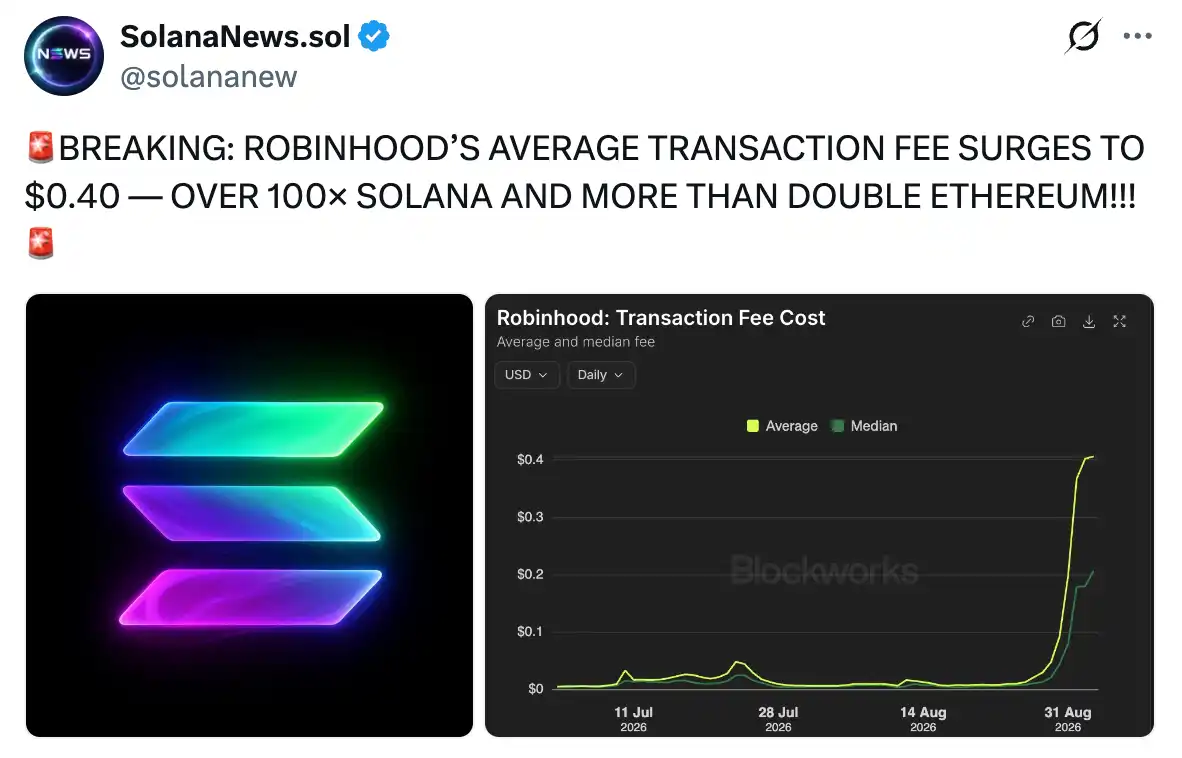
Solana co-founder Anatoly Yakovenko retweeted this post, commenting that Robinhood Chain allocates 10% of its net protocol revenue to the Arbitrum ecosystem (8% to the DAO treasury, 2% to the development fund), while Robinhood itself retains about 90%. Toly calculated that this 10% share would be enough to cover transaction fees four times the volume on Solana. If built on Solana, Robinhood could have provided users with an almost gas-free experience instead of making users pay for network congestion. He criticized this "profit-from-congestion" model as uneconomical, arguing that front-end applications should charge users themselves, while the underlying layer should pursue extreme low costs.
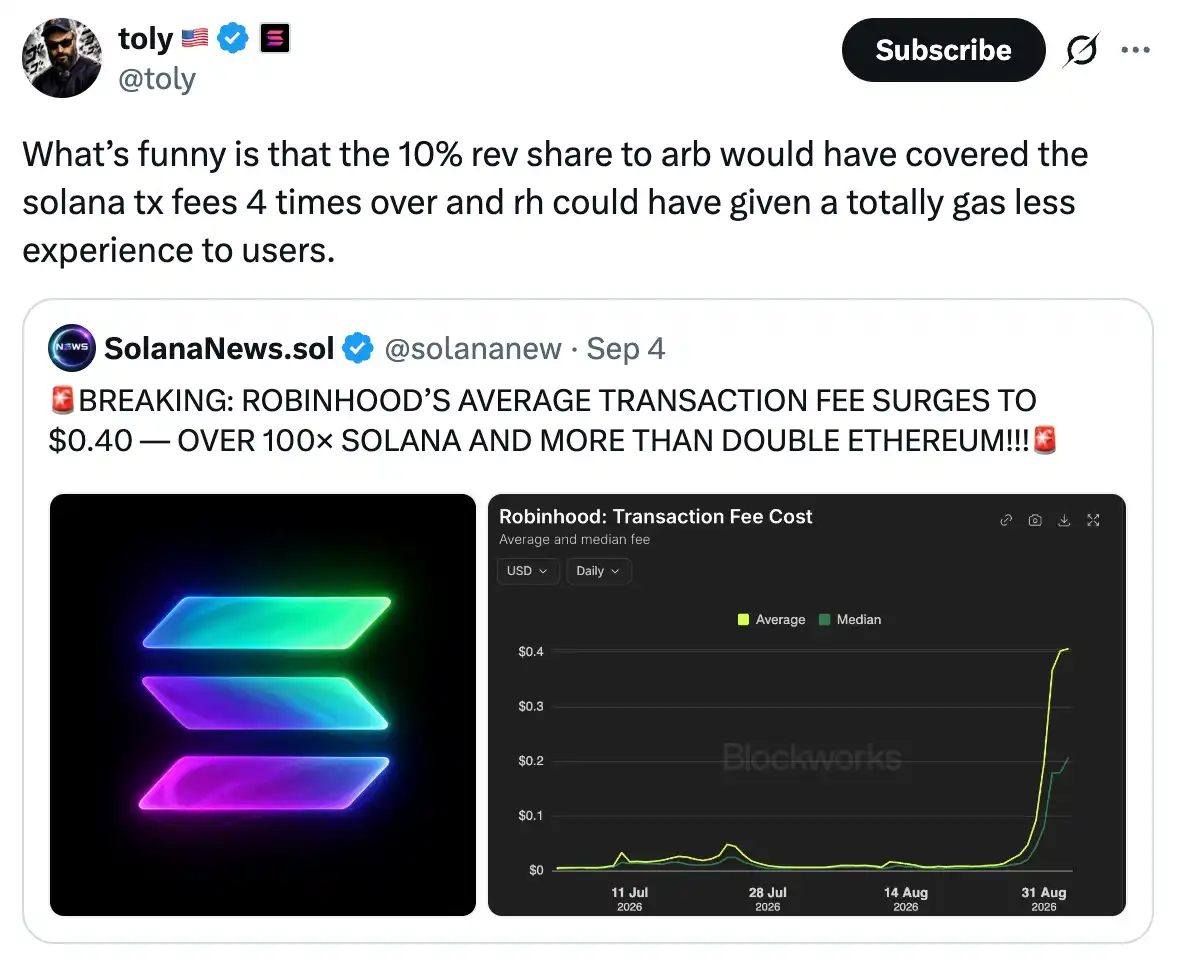
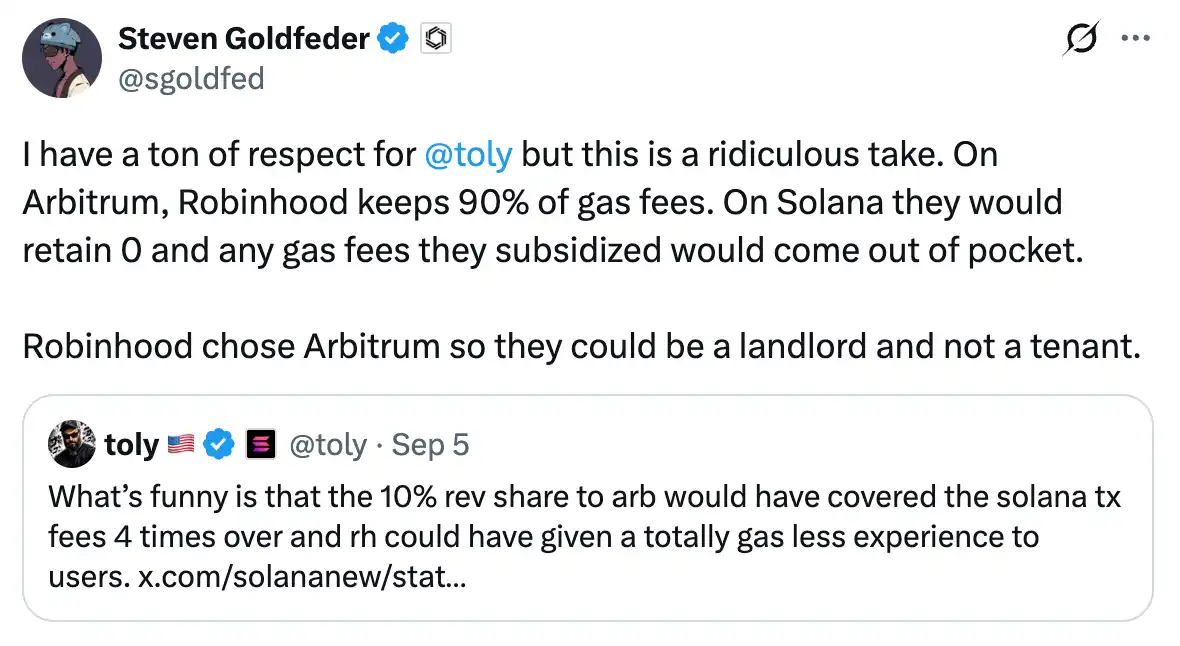
Offchain Labs co-founder Steven Goldfeder responded swiftly. He expressed respect for Toly but called the view "ridiculous." Under the Arbitrum architecture, Robinhood retains 90% of the gas revenue; if deployed on Solana, the underlying transaction fees go to validators, leaving Robinhood with nothing. If it still wanted to subsidize user gas, it would have to pay out of its own pocket. Goldfeder succinctly summarized: Robinhood chose Arbitrum to be a "landlord," not a "tenant." Operating its own sequencer and controlling most of the revenue is how one truly turns infrastructure into a sustainable business.
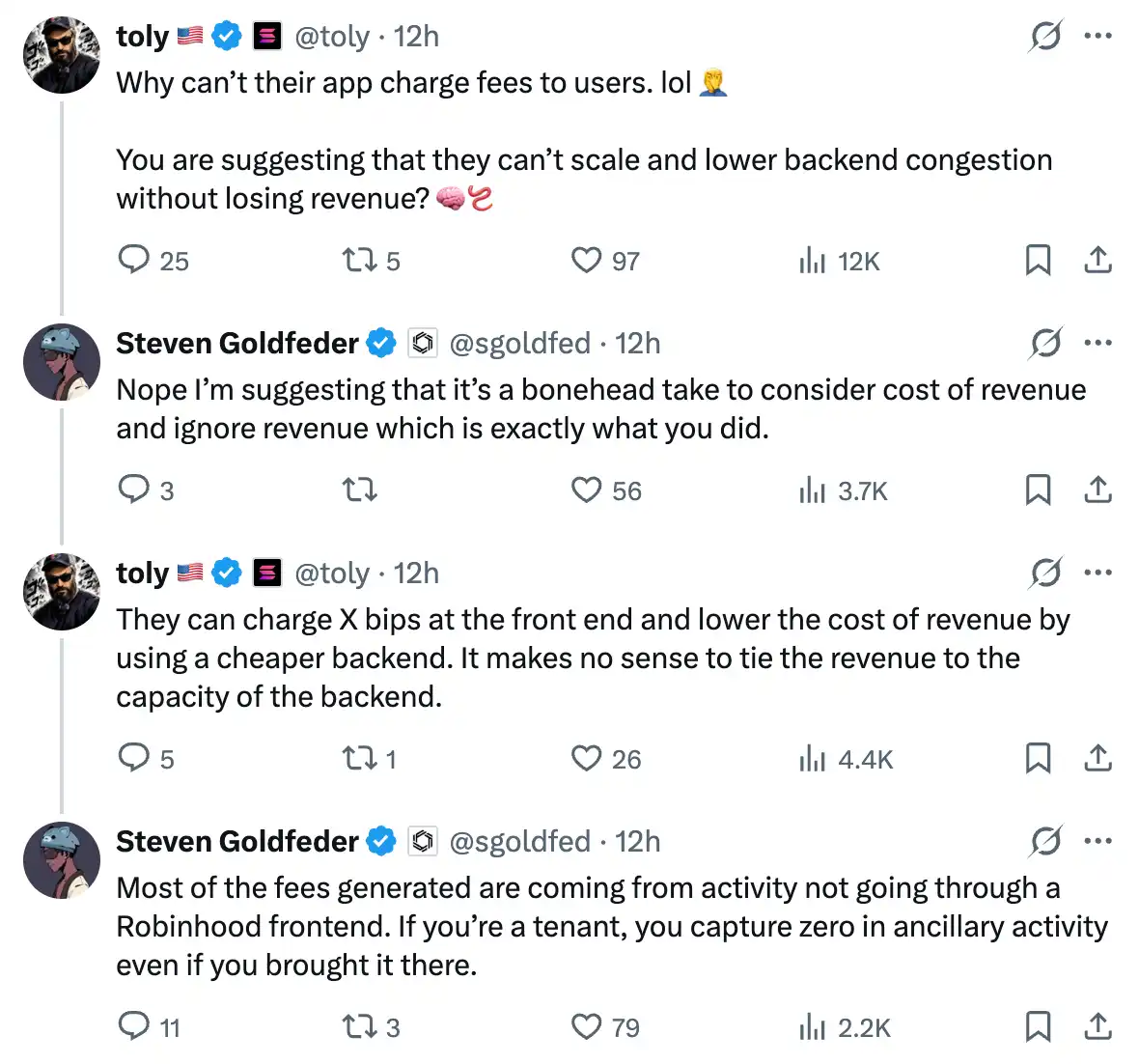
Under Steven Goldfeder's reply, the two continued debating whether the model should be "the chain itself charging fees" or "the chain being free, with applications charging."
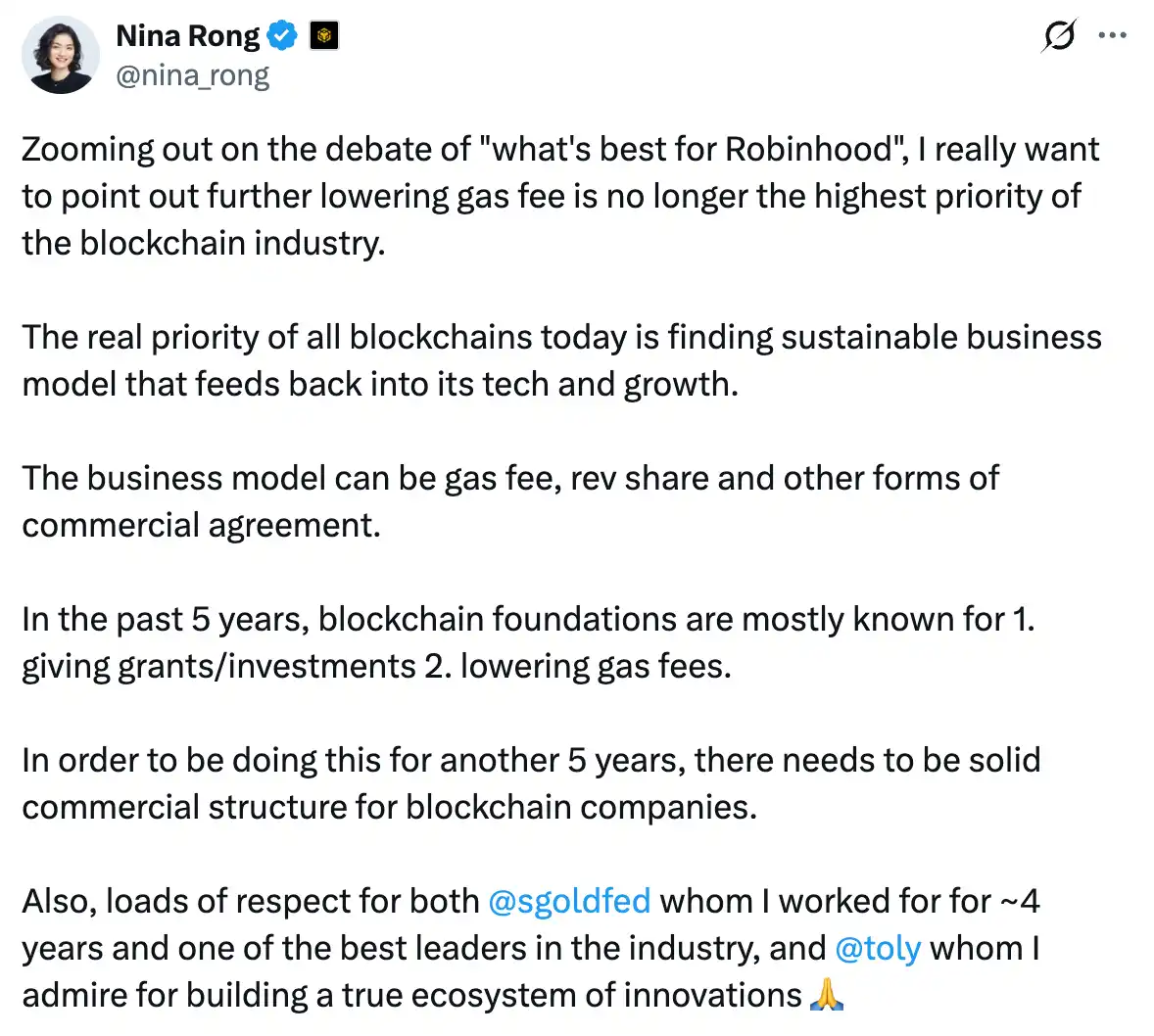
Subsequently, BNB Chain Growth Lead Nina Rong, who had previously worked at Arbitrum for about four years, moved beyond the specific argument over "what's better for Robinhood." She pointed out that further reducing gas fees is no longer the top priority for the blockchain industry. The real priority is finding sustainable business models that can feed back into technological development and growth, whether through gas fees, revenue sharing, or other commercial agreements. Over the past five years, blockchain foundations have largely been labeled by distributing grants and lowering gas fees; but to last another five years, solid business structures must be established.
Chinese community user @lanyihou responded to Nina with more direct data: trading a token worth around $200 on Robinhood Chain might incur about $21 in gas plus tax. Discussing business models in such an environment is "even harsher than drug dealing." Nina responded that fees can be lowered immediately if desired (just a matter of changing a number), but this doesn't solve the fundamental industry problem—precisely in such an environment, it's even more crucial to find models users accept and platforms don't lose money on, or even profit. She cited products like GMGN as examples, showing that users are willing to pay for truly valuable services.
Sustainability of the Chains Themselves
The core of this debate is actually two different value capture paths.
One is "extreme low cost + ecosystem flywheel." Solana has long adhered to high throughput and low fees, attracting a large number of applications and users, with the network itself maintaining security and incentives through base fees, MEV, and other mechanisms. If application providers want to offer gas-free experiences to users, they need to bear the costs themselves or monetize through front-end fees, ads, subscriptions, etc. The advantage is an极致 user experience; the disadvantage is that application providers can't directly benefit from underlying congestion.
Solana indeed relied on low costs and fast transaction confirmations to lead the pack in the meme wars of recent years, and innovative products like propAMM emerged in the frenzy of traffic. This is a proven path.
The other is "customizable application chains + revenue sharing." Arbitrum Orbit allows projects to launch their own dedicated chains, controlling their sequencers and most fee revenue, while paying a fixed share to the parent ecosystem. For large entities like Robinhood, this turns their user traffic and transaction behavior into predictable infrastructure revenue while still leveraging Ethereum's security and Arbitrum's tech stack. The advantage is a clearer commercial闭环; the drawback is potentially higher user-side fees.
Not only Arbitrum, but also Optimism and ZKsync, and even Avalanche's earliest subnet (now independent L1s), have been developing based on this logic.
The approach of relying solely on foundations burning money for grants and infinitely lowering gas fees is certainly feasible, but for a chain to survive long-term, there must be a positive cash flow mechanism to support R&D, security audits, ecosystem incentives, and market expansion. Whether L1 or L2, they ultimately must answer the same question: who pays for the network's long-term maintenance? Users, application providers, or the protocol itself through reasonable pricing?
This is Arbitrum's viewpoint and also the underlying logic of the current BNB Chain Growth Lead.
Sustainability does not equal high fees. The key lies in whether the fee structure is transparent, matches real value, and can form a positive cycle. Excessively high fees drive users away; excessively low fees turn infrastructure into a tragedy of the commons. The current high fees on Robinhood Chain reflect both the true demand after early subsidies end and expose the space for optimizing dynamic pricing and capacity management.
Neither approach is absolutely right or wrong. In times of overall market prosperity, Solana gathers attention and liquidity due to low costs; during overall market downturns, users don't mind paying a bit more for rare profitable opportunities. Solana's model might rely more on operational capabilities, while Ethereum's ecosystem's closed-loop mechanisms ensure "artisans don't starve in lean years."
"Only Ethereum is Taking the Hit"
There is a potentially overlooked but poignant fact in this debate: although Robinhood Chain settles on Ethereum, most of the value does not flow back to the Ethereum mainnet.
According to public data and protocol arrangements, of the gas fees users pay, the vast majority are retained by Robinhood as the chain operator (about 90%), about 10% is allocated to the Arbitrum ecosystem (DAO and development fund), while the portion truly used for Ethereum data availability and结算 is极低, at its lowest even just slightly above one ten-thousandth. In other words, Ethereum provides the security foundation but only receives a thin layer of "toll."
This is the structural reality of the current Ethereum L2 ecosystem: application chains and dedicated L2s capture most of the execution layer value for themselves, with the mainnet playing more of a "结算 and data availability layer" role. For Ethereum itself, this is both a success of scaling (transactions are分流, mainnet congestion eased) and a challenge of value capture: the security budget ultimately still relies on the mainnet's own fees and staking rewards. When a large amount of high-value activity migrates to L2s or even independent application chains, how the mainnet can sustainably obtain sufficient incentives becomes a long-term issue that must be faced.
Related discussions have persisted for years, and the emergence of Robinhood Chain pushes this issue to the forefront again.
In fact, Ethereum noticed this issue很早 but hasn't rushed to "capture value," maintaining strategic patience and betting on the long-term growth trend of blob demand. For Ethereum, as long as ETH is still used to pay gas fees, and as long as the finality of L2s still requires mainnet结算, it can always expect long-term value realization.
Conclusion
The clash between Toly and Goldfeder points to the formation of an industry consensus: blockchain has moved past the pure technology race phase of "just being cheaper" and entered the deep waters of business models and ecosystem sustainability.
For application providers, choosing to be a landlord or a tenant depends on their own traffic scale and monetization ability; for public chains and L2s, how to design mechanisms that both attract builders and form positive cash flows will determine生死 in the next five years. And Ethereum, as the largest security provider, also needs to continuously contemplate how to secure more reasonable value回流 for the mainnet itself amidst L2 prosperity.
There is no absolute winner in this debate. The core is that the triangular balance between user experience, infrastructure profitability, and underlying security incentives is far more complex than "whose gas is lower." The real winners will be those participants who can find sustainable solutions within this triangle.