Morgan Stanley Report Analysis: Foldable iPhone Expected to Contribute $14 Billion, Pro Models to See Price Increase Over $200

marsbitPublished on 2026-09-04Last updated on 2026-09-04

Abstract

Morgan Stanley Research Report Summary: Foldable iPhone and Pro Price Hikes Morgan Stanley's pre-iPhone 18 launch report maintains an Overweight rating on Apple with a $360 target. The key takeaway is the introduction of a foldable iPhone, seen as the most significant hardware change since the iPhone X, set to contribute approximately $14 billion in revenue in its first December quarter. The Pro models are expected to see their largest price increases in years, driven by rising memory costs, with the iPhone 18 Pro starting at $1,299—a $200 increase. The foldable iPhone, with a predicted base price of $2,399, is forecast to have strong initial demand. It features design trade-offs like an in-display fingerprint sensor instead of Face ID and a dual-camera system. The hardware launch coincides with new CEO John Ternus's debut as the keynote presenter. For the iPhone 18 Pro series, the core upgrade is the move to a 2nm A20 Pro chip, promising significant performance and efficiency gains to support advanced on-device AI. However, memory supply constraints pose a potential risk to production volumes. Overall, Morgan Stanley believes the combination of a lengthening iPhone upgrade cycle, global AI feature rollout, and the new foldable form factor will accelerate iPhone growth. The report highlights Ternus's presentation, the foldable's user experience, and Apple's pricing strategy as critical factors for the stock's performance post-launch.

Author: Rita

Apple's September 9th event will unveil its first foldable iPhone, while the Pro series sees its largest price hike in years. On September 1st, Morgan Stanley released its iPhone 18 launch preview report, maintaining an Overweight rating with a $360 price target. Morgan Stanley considers this the most significant iPhone hardware transformation since the iPhone X. The foldable model is projected to have initial production of 7 to 8 million units in the second half of 2026, with its first product cycle potentially reaching 20 million units, contributing approximately $14 billion in revenue in the December quarter alone.

This event holds another layer of significance: Tim Cook will no longer host, marking the first stage appearance for new CEO John Ternus. Morgan Stanley believes that Ternus's performance, the user experience of the foldable device, and how Apple balances price increases with market demand will determine the direction of Apple's stock price through the end of the year.

Foldable: The Biggest Hardware Shift Since iPhone X

Apple is entering the foldable phone market seven years later than Samsung. Morgan Stanley views this as the most significant change in hardware form factor since the iPhone X and the greatest test of Apple's pricing power. Market expectations for the foldable's starting price range from $2300 to $2500, with Morgan Stanley's base case forecast at $2399 (for the 512GB model). Every 1% penetration of the foldable model in overall iPhone shipments is expected to lift the Average Selling Price (ASP) by about 1.5 percentage points.

The foldable model makes some hardware trade-offs: it replaces Face ID with a fingerprint sensor, and the rear camera system includes only wide and ultra-wide lenses, omitting a telephoto lens. Its thickness when folded is thinner than the iPhone Air, and advanced hinge and screen technology nearly eliminate the crease.

Morgan Stanley's consumer survey indicates significant interest in foldable devices among iPhone users, particularly in the Chinese market. Market feedback for the Samsung Galaxy Z Fold 8 (starting at $1899) also suggests genuine demand for the book-style foldable form factor. Morgan Stanley expects the foldable iPhone to sell out quickly, with strong demand and constrained initial supply.

2nm Chip is the Real Upgrade for Pro Series

Hardware changes for the iPhone 18 Pro series are relatively conservative. The biggest upgrade comes from the chip: the first application processor, the A20 Pro, manufactured using TSMC's 2nm process. TSMC data indicates that the 2nm process offers a 10% to 15% performance increase at the same power consumption, or a 25% to 30% power reduction at the same performance level.

Apple's recently released M6 chip (also using 2nm) provides a reference point. Compared to the 3nm M5, the M6 adds two "super CPU cores" for the first time, increases GPU cores by two, and boosts Neural Engine peak performance by up to 100%. The A20 Pro is confirmed to use Wafer-Level Chip-on-Wafer (WLC) packaging technology, offering greater design flexibility, improved speed, and better thermal management compared to the Integrated Fan-Out (InFO) packaging used over the past decade.

Morgan Stanley believes the computational power boost from the 2nm chip will support two key Apple narratives: more powerful on-device AI capabilities (Siri AI) and higher product pricing.

Largest Price Hike, Memory Cost is Core Variable
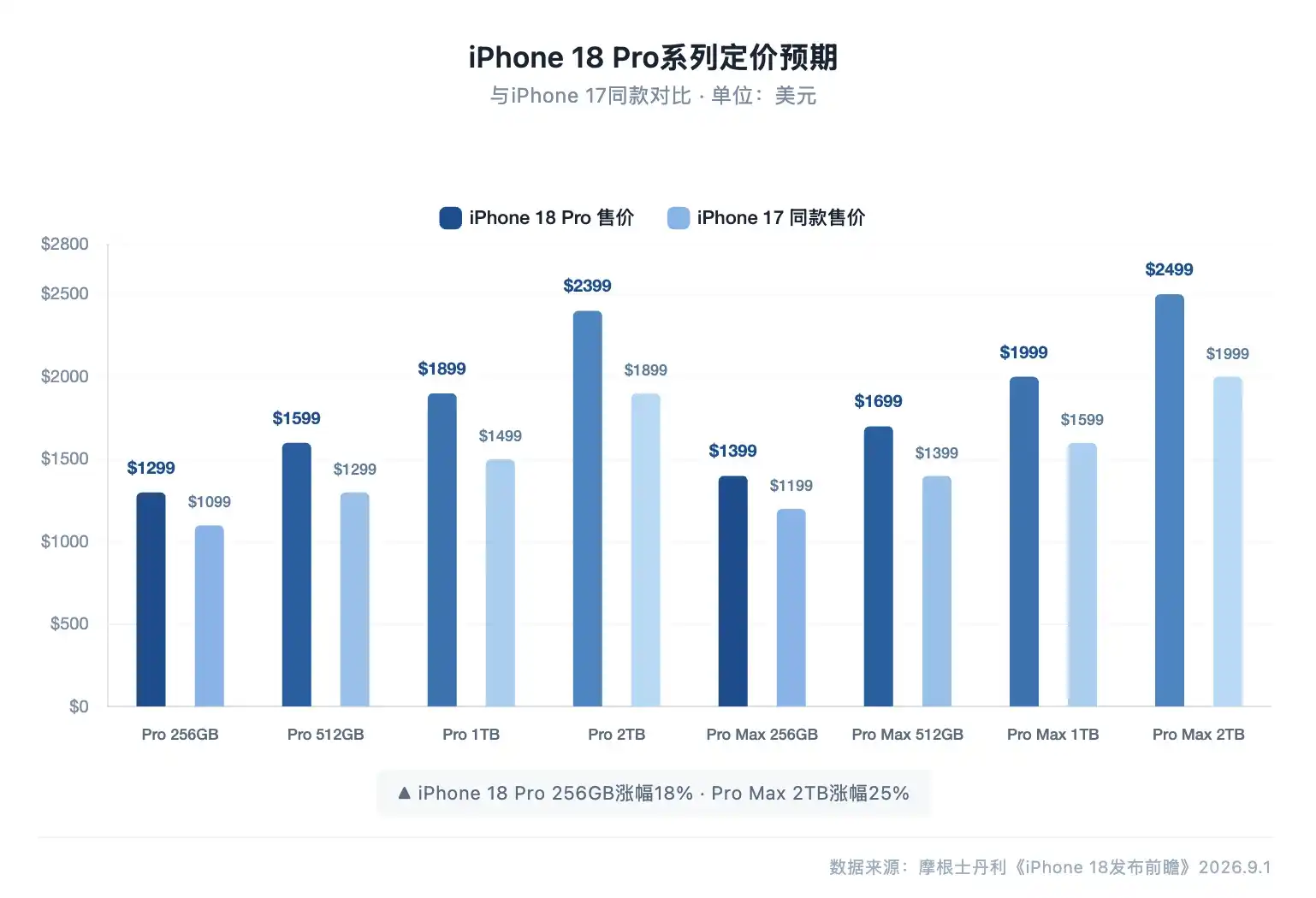
The Pro series is set for its most substantial same-model price increase in years. Morgan Stanley expects the iPhone 18 Pro (256GB) to start at $1299, a $200 (18%) increase from the iPhone 17 Pro's $1099 starting price. The iPhone 18 Pro Max (256GB) is forecast to start at $1399, also a $200 (17%) increase from the previous generation's $1199. Price hikes for the 1TB and 2TB models are even larger, with the Pro Max 2TB seeing a 25% increase.

The primary driver of the price increase is rising memory costs. Apple's DRAM consumption for iPhone production in the first half of 2026 grew nearly 50% year-over-year, while NAND consumption grew over 30%. Morgan Stanley calculates that the $200 price increase is sufficient to cover the memory cost inflation and maintain a gross margin of approximately 40%.

Morgan Stanley acknowledges the price hike is not without risk. Consumer price sensitivity, changes in trade-in values, and the prevalence of installment payment plans will all impact demand elasticity. Apple's supply chain plans suggest the company is currently more concerned about securing enough components than finding enough buyers.

Supply is the Bottleneck, Memory May Constrain Production

Apple's total component orders for 2026 iPhones are projected at 265 to 270 million units, representing 5% to 7% year-over-year growth. Combined production for the iPhone 18 Pro, Pro Max, and foldable models in the second half is estimated at around 81 million units. In the past week, TSMC's 2nm wafer orders saw a slight increase and pull-in, equivalent to adding an extra 2 to 3 million iPhone units to production. It is uncommon to increase supply chain forecasts before a product launch, especially when existing plans already reflect the company's internal "bull case" scenario.

Memory supply remains the biggest uncertainty. If Apple fully executes its current component order plan, DRAM consumption in the second half of 2026 would increase by about 15% year-over-year, and NAND by about 25%. This is an aggressive target given that the consumer memory market is already tight. Morgan Stanley has not yet incorporated the recent wafer order increase into its iPhone shipment forecasts, awaiting post-launch sales data for confirmation.

Recommendations and Risks

Morgan Stanley maintains an Overweight rating on Apple with a $360 price target, based on a price-to-earnings ratio of approximately 35x on its fiscal year 2027 earnings per share estimate of $10.30. The longest iPhone replacement cycle, the global rollout of AI features, and the new hardware form factor are expected to jointly drive accelerated iPhone growth.

Upside risks include the iPhone 18 exceeding expectations, higher-than-expected adoption of Apple Intelligence, new product line launches, and re-acceleration in services growth. Downside risks include consumer spending weakness limiting replacement rates, rising memory costs, slow progress in AI features, geopolitical tensions, and tighter App Store regulation.

The September 9th event carries narrative significance beyond hardware, marking the debut of the Ternus era. Morgan Stanley will closely watch three variables: Ternus's performance under the spotlight, whether the foldable's software and hardware experience can catalyze demand, and how Apple balances price increases, profit margins, and demand for new versus legacy models.

Disclaimer

This article is a compilation and interpretation by ChaoXiang Research of a third-party brokerage research report (Morgan Stanley, September 1, 2026), combined with publicly available market information. The ratings, price targets, earnings forecasts, and related judgments cited herein represent the views of the respective brokerage analysts, reflecting their institutional positions. They do not represent the views of ChaoXiang Research and do not constitute any investment advice.

The market involves risks, and decisions should be made independently. This article should not serve as the basis for buying or selling any securities.


Related Questions

QAccording to the Morgan Stanley report, what are the key factors that will determine Apple's stock price trajectory through the end of the year following the September 9th event?

AAccording to the Morgan Stanley report, the key factors are: 1) The performance of new CEO John Ternus in his first keynote presentation. 2) The user experience of the new foldable iPhone hardware and software. 3) How Apple balances the significant price increases with market demand.

QWhat is Morgan Stanley's rationale for the iPhone 18 Pro series price increase of over $200?

AMorgan Stanley states the primary driver of the price increase is rising memory costs. Apple's DRAM consumption for iPhone production in H1 2026 grew nearly 50% year-over-year, and NAND grew over 30%. The $200 price hike is calculated to cover these increased memory costs while maintaining Apple's gross margin around 40%.

QWhat does Morgan Stanley identify as the single biggest hardware form factor change for the iPhone since the iPhone X?

AMorgan Stanley identifies Apple's entry into the foldable phone market with the new foldable iPhone as the single biggest hardware form factor change since the iPhone X.

QWhat is the potential revenue contribution Morgan Stanley forecasts for the foldable iPhone in its first product cycle, specifically for the December quarter?

AMorgan Stanley forecasts that the foldable iPhone could contribute approximately $14 billion in revenue in just the December quarter of its first product cycle.

QWhat specific technological advancement is highlighted as the core upgrade for the iPhone 18 Pro series, and what are its expected benefits?

AThe core upgrade is the A20 Pro application processor, which will be Apple's first chip built on TSMC's 2nm process. TSMC data suggests the 2nm process offers a 10-15% performance increase at the same power, or a 25-30% power reduction at the same performance. This advancement is seen as foundational for more powerful on-device AI capabilities and justifying higher product pricing.

Related Reads

Changelly to give away 200 hardware wallets and offer up to 57% off this Black Friday

Changelly has launched its Black Friday sale, offering up to 57% off selected hardware wallets from Marketplace partners including Ledger, Trezor, SafePal, Tangem, ELLIPAL, CoolWallet, Digital Shield, NGRAVE and DCENT. The campaign runs from November 16 to November 30, 2026, and Changelly will also give away 200 hardware wallets to 100 winners, with two wallets per winner—one to keep and one to gift to a friend. Users can take a free 30-second quiz that asks about their crypto habits and recommends a suitable hardware wallet, with results linking directly to partner offers in the Changelly Marketplace. To enter the giveaway, participants must complete the quiz and submit their email address on the results page before November 30 at 10:00 UTC. No purchase, crypto swap, social media share or referral is required, though eligibility restrictions apply. Changelly will randomly select 100 winners from eligible entries and notify them by email within seven days after the campaign ends. Winners will have five days to respond, and each participant can win only once. Prize models are selected by Changelly and may differ from those recommended in the quiz. Wallet partners handle checkout and shipping for discounted purchases. Changelly is an instant crypto exchange platform serving over 12 million users worldwide. Founded in 2015, it offers crypto-to-crypto and fiat-to-crypto exchanges for 1,200+ coins across 200 blockchains, with 24/7 live customer support and 840+ partners through its exchange and fiat on-/off-ramp APIs.

cointelegraph50m ago

Changelly to give away 200 hardware wallets and offer up to 57% off this Black Friday

cointelegraph50m ago

Xsolla ZK Introduces a Gas Token Designed to Let Digital Items Move Between Games and Players

Xsolla ZK, Inc. has introduced Xsolla Gas (XLA), the native token of Xsolla ZK, an Ethereum Layer 2 ZK rollup network for games. XLA is designed to pay network fees when players transfer or share eligible digital items on the network. Players who prefer not to set up a separate wallet can buy XLA-NT, a non-transferable gas credit usable only for network fees on Xsolla ZK, through Xsolla Gas Station using familiar payment methods. XLA is also available on crypto exchanges including Kraken, LBank, and Biconomy in supported markets. The initiative addresses a key limitation: most digital items today live on a single game's backend and cannot be transferred to friends or used in other games, and they become inaccessible if a game shuts down. Blockchain-backed items stay with players, but transferring them typically requires a separate wallet and the right token. Xsolla ZK aims to lower these barriers. Players use Xsolla Backpack, an inventory for owned digital items; items issued in transferable form are designed to remain available even if the issuing game shuts down, and players can give them to others. Players sign in with their usual account, without needing a seed phrase or separate wallet setup. Chris Hewish, President of Xsolla (USA), said players should be able to share and gift digital items they own anytime, anywhere, with anyone they know, and that developers gain a new way to monetize games while players gain items that are theirs to keep. Developers and partners can also use XLA to pay network fees for their item activity. More than 1,500 game teams use Xsolla's tools, and Xsolla Backpack and Xsolla Gas Station are available without additional development for teams using compatible Xsolla products, integrating with existing player and payment flows. XLA is an ERC-20 token on Ethereum mainnet with a total supply of 1 billion and becomes the base token of Xsolla ZK through the canonical bridge.

TheNewsCrypto2h ago

Xsolla ZK Introduces a Gas Token Designed to Let Digital Items Move Between Games and Players

TheNewsCrypto2h ago

Hyperliquid API Wallet Permissions Keep Expanding: Once an AI Agent Is Attacked, It Could Drain the Main Account

As personal AI agents take over everyday financial decisions, Hyperliquid is seen as an ideal decentralized trading foundation thanks to its deep liquidity and composability. However, the API wallets that underpin automated trading have quietly seen their security boundaries erode across network upgrades over the past year. Lacking fine-grained permission policies, a compromised API wallet can even trigger staking slashing, spot locking, and priority fee burning, exposing the main account to total loss. The article traces how API wallets—originally scoped to prevent direct withdrawals or external transfers—have accumulated expanded permissions through successive upgrades, with no cap on margin exposure. A maliciously altered API wallet controlling an account with over ~$40M could buy 500,000 HYPE, stake it, link it to a malicious HIP-3 market, invite slashing, and lock the main account's funds for 183 days. Because API wallets are now the default trading method across the Hyperliquid frontend and third-party apps, and agents must interact with untrusted internet environments, prompt injection or key leakage can let attackers drain funds without ever stealing a private key. Existing fine-grained control via HyperEVM smart contracts introduces too much latency for high-frequency trading, while custodial solutions outsource trust to centralized middleware. The proposed fix is a lightweight bitmap permission field set at API wallet creation, recording which operation types the wallet may trigger—mirroring the mechanism already used in HIP-3 deployer sub-lists. Validating the signer against the main account's bitmap adds negligible overhead, and critically, old API wallets would never auto-inherit new permissions from future L1 upgrades. This would safely unlock staking and transfer interfaces, remove reliance on centralized custody, and pave the way for large-scale personal AI agent adoption on HyperCore.

marsbit2h ago

Hyperliquid API Wallet Permissions Keep Expanding: Once an AI Agent Is Attacked, It Could Drain the Main Account

marsbit2h ago

Trading

Spot
活动图片