Vancouver Mayor’s Bitcoin Reserve Dream Hits Legal Wall

bitcoinistPublished on 2026-03-06Last updated on 2026-03-06

Abstract

Vancouver city staff have recommended that Mayor Ken Sim's Bitcoin motion be dropped, citing that Bitcoin is not an allowable investment asset under the Vancouver Charter. The motion, passed in December 2024, aimed to explore accepting BTC payments and creating a Bitcoin reserve for city funds. However, provincial legislation does not recognize cryptocurrency as a valid payment method or permitted reserve asset. Staff have advised concluding the initiative to align with legal and financial priorities. The council will review the recommendation on March 10, forcing Mayor Sim to decide whether to defend or abandon his proposal.

Vancouver city staff have recommended that councillors drop Mayor Ken Sim’s Bitcoin motion, which ordered work on accepting payments in BTC and exploring a Bitcoin reserve for part of the city’s funds.

Bitcoin: “Not An Allowable Investment Asset”

In a report released on March 2 reviewing outstanding council directions, the Vancouver staff has deemed Bitcoin as a “not an allowable investment asset for the City”, suggesting that the Mayor Sim’s motion to turn Vancouver into a “Bitcoin friendly city” should be concluded. The report also asks council to de-prioritize some of the 78 motions passed since 2019 part of a broader clean‐up of outstanding directions.

The rationale for this, as stated by the report, is a “reprioritization of staff and resources” and the need for “coordinating and aligning work with related initiative(s)”: the goal is to reduce the city’s spending by optimizing internal capacity.

City staff back these conclusions with the Vancouver Charter, the provincial law that sets out how municipal funds can be invested.

Inside The Vancouver Charter

The B.C. Ministry of Municipal Affairs has clarified that the Community Charter and the Vancouver Charter “don’t recognize cryptocurrency as payment for municipal services or other transactions,” so cities shouldn’t treat BTC like normal money on their balance sheets.

The ministry has also stated that local governments “are not permitted to hold financial reserves in cryptocurrency” because crypto is not on the listed of permitted investment vehicles laid out in the provincial legislation.

Under section 183 of the Community Charter, which the province applies to local governments’ funds, eligible investments are cited as things like Municipal Finance Authority securities, pooled funds, federal or provincial bonds, guaranteed bank products and similar high‐grade instruments. There is simply no legal category that would cover Bitcoin or other volatile digital assets, which doesn’t mean that it’s prohibited: it simply doesn’t exist in the law.

The Bitcoin Dream: A Bitcoin Friendly City

Mayor Sim’s Bitcoin motion pushed through in December 2024. Sim, who’s an investor in a cryptocurrency exchange, said he believed investing in Bitcoin was “the financially responsible” thing to do amidst inflation and market volatility. He went so far as to pledge a personal 10,000‐dollar Bitcoin donation to seed a municipal reserve, publicly lauding BTC as one of the most important financial innovations of the era.

It would be irresponsible for the City of Vancouver to not look at the merits of adding bitcoin to the city’s strategic assets to preserve the city’s financial stability.

What’s Next?

The staff was supposed to report back to council in the first quarter of 2025, but until the cited report, no other was made public.

The Vancouver city staff recommendation will land at council on March 10. Mayor Sim will be forced to decide whether to burn political capital defending his BTC agenda or watch his Bitcoin dreams be shelved and dismissed by his own administration.
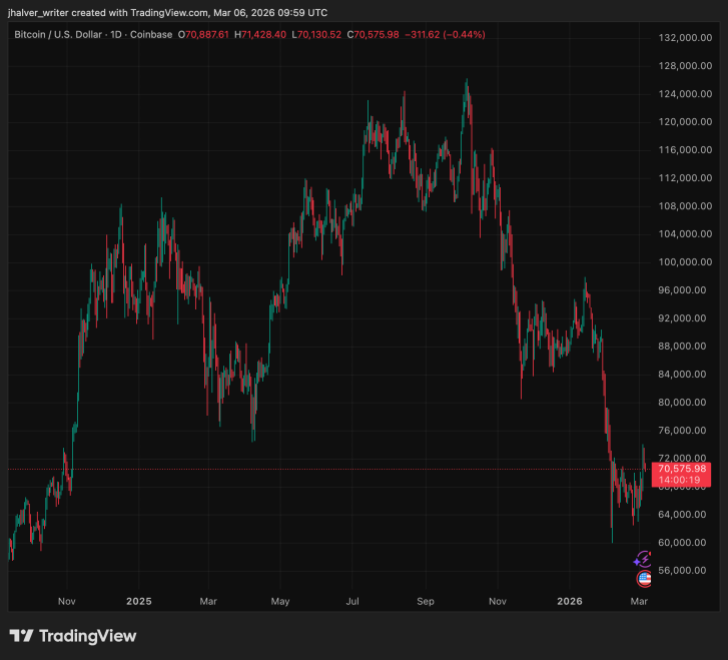
BTC's price trends to the downside on the daily chart. Source: BTCUSD on Tradingview

Cover image from ChatGPT, BTCUSD chart from Tradingview

Related Questions

QWhat was the main recommendation from Vancouver city staff regarding Mayor Ken Sim's Bitcoin motion?

AVancouver city staff recommended that councillors drop Mayor Ken Sim's Bitcoin motion, which involved accepting BTC payments and exploring a Bitcoin reserve, deeming Bitcoin as 'not an allowable investment asset' for the city.

QWhich legal document did city staff cite to support their conclusion against Bitcoin as a municipal investment?

ACity staff cited the Vancouver Charter, the provincial law that sets out how municipal funds can be invested, which does not recognize cryptocurrency as a permissible investment or payment method.

QWhat reason did the staff report give for de-prioritizing the Bitcoin motion and other council directions?

AThe report cited a 'reprioritization of staff and resources' and the need for 'coordinating and aligning work with related initiative(s)' to reduce city spending by optimizing internal capacity.

QWhat did Mayor Ken Sim personally pledge to support the municipal Bitcoin reserve idea?

AMayor Ken Sim pledged a personal $10,000 Bitcoin donation to seed a municipal Bitcoin reserve, calling it 'the financially responsible' action amid inflation and market volatility.

QWhen will the Vancouver city staff recommendation on the Bitcoin motion be presented to the council for a final decision?

AThe Vancouver city staff recommendation will be presented to the council on March 10, forcing Mayor Sim to decide whether to defend his agenda or accept its dismissal.

Related Reads

Don't Just Focus on Iran, the US Private Credit Crisis is Step by Step Repeating the 'Subprime Crisis'

Amidst geopolitical tensions, a private credit crisis is rapidly unfolding within the US financial system, drawing parallels to the 2008 subprime mortgage crisis. Major asset managers are facing significant stress: BlackRock restricted redemptions from its $26 billion HPS Corporate Lending Fund (HLEND), capping repurchases at 5% despite 9.3% redemption requests to avoid forced asset sales. Similarly, Blackstone’s $82 billion private credit fund (BCRED) saw a record 7.9% in redemption demands, prompting internal capital injections to avoid gating. Blue Owl Capital, whose stock fell below its $10 SPAC IPO price, sold $1.4 billion in loans to manage redemptions, exacerbating liquidity fears. PIMCO issued a stark warning, predicting a "full default cycle" for direct lending due to relaxed underwriting standards, overexposure to the software sector (vulnerable to AI disruption), and insufficient liquidity compensation for investors. The crisis highlights structural vulnerabilities: semi-liquid funds offering quarterly redemptions are backed by long-duration private loans, creating a mismatch. Redemptions force asset sales, driving down valuations and triggering further withdrawals—a vicious cycle reminiscent of 2008. With the private credit market valued at $1.8 trillion, systemic risks from opacity, concentration, and liquidity mismatches are now under severe strain.

比推Há 46m

Don't Just Focus on Iran, the US Private Credit Crisis is Step by Step Repeating the 'Subprime Crisis'

比推Há 46m

Trading

Spot
Futures

Hot Articles

Discussions

Welcome to the HTX Community. Here, you can stay informed about the latest platform developments and gain access to professional market insights. Users' opinions on the price of S (S) are presented below.

活动图片