Iranian Crypto Outflows Hit $10.3 Million After US‑Israeli Airstrikes, Chainalysis Finds

bitcoinistPublicado a 2026-03-04Actualizado a 2026-03-04

Resumen

Following joint US-Israeli airstrikes on February 28, Iranian cryptocurrency exchanges experienced significant outflows totaling approximately $10.3 million, according to Chainalysis data. The report highlights crypto's critical role in Iran's sanction-hit economy, serving both ordinary citizens and state-affiliated entities. With traditional banking access severed due to sanctions, Iranians increasingly rely on Bitcoin and stablecoins as hedges against hyperinflation and capital controls. Notably, half of Iran's $7.78 billion in crypto activity is attributed to the Islamic Revolutionary Guard Corps, underscoring digital assets' dual function as both economic lifeline and sanctions-evasion tool. The incident demonstrates crypto's rapid responsiveness to geopolitical shocks and ongoing regulatory challenges.

On‐chain data shows that in the days after joint US‐Israeli airstrikes on February 28, Iranian exchanges saw a sharp spike in withdrawals, with roughly 10.3 million dollars in crypto fleeing.

Iran’s Crypto Use Amidst Economical Collapse

Crypto has become a financial lifeline for both ordinary households and state‐affiliated networks in Iran, according to an article posted on our sister website NewsBTC. Years of US and EU financial and oil sanctions have strained the economy, cutting Iranian banks off from SWIFT and dollar funding, and now even targeting Iran‐linked crypto platforms through recent US Treasury designations. Add to this cocktail a runaway inflation and a collapsing rial, and it becomes clear why many Iranians increasingly look to Bitcoin and stablecoins as an alternative store of value and cross‐border payment rail.

A Lifeline Of Hope For Ordinary Folk?

Chainalysis has estimated that Iran’s crypto activity reached roughly 7.78 billion dollars in 2025, with usage spiking around protests, bombings and other security crises as people rush to move funds off local platforms and into self‐custody.

In its latest report, Chainalysis visualizes this idea with a series of charts that track hourly outflows from major Iranian exchanges before and after the February 28 airstrikes.
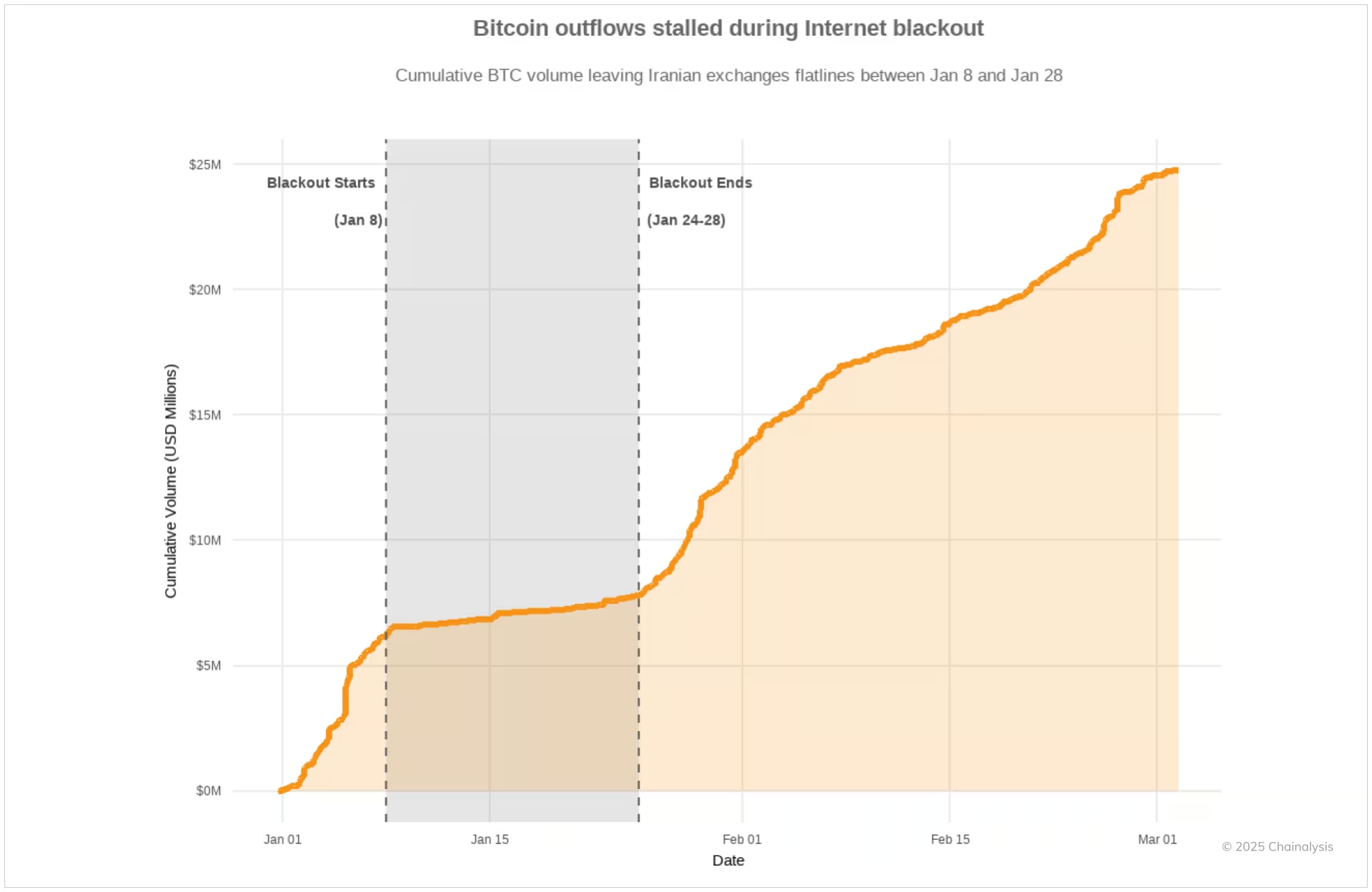
Bitcoin outflows stalled during Internet blackout. Source: Chainalysis

The graphs show relatively modest, choppy activity in the hours leading up to the strikes, followed by a sudden jump where hourly withdrawals approach or exceed roughly 2 million dollars and cumulative outflows climb to about 10.3 million dollars by March 2.
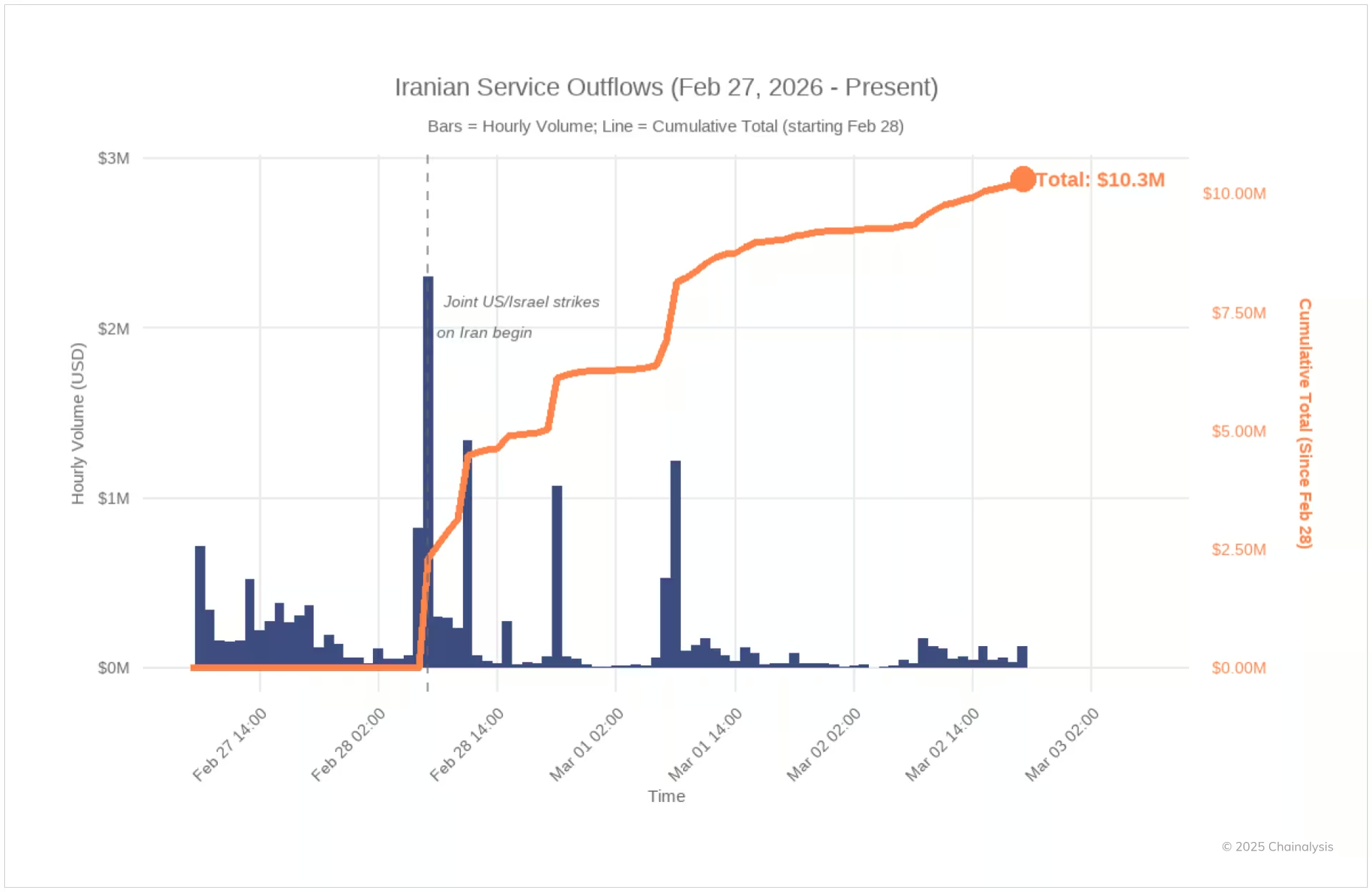
Iranian service outflows (Feb 27, 2026 - Present). Source: Chainalysis

For many ordinary Iranians, Bitcoin and stablecoins now function as a hedge against currency collapse and capital controls, while addresses tied to the Islamic Revolutionary Guard Corps (IRGC) account for roughly half of on‐chain activity, highlighting crypto’s dual role as both a survival tool and a sanctions‐evasion channel.

However, it is worth noting that while some observers praise Chainalysis for helping exchanges and regulators track hacks, scams, and sanctions evasion, civil‐liberties advocates criticize its tools as opaque and potentially overreaching in terms of financial surveillance.

What This Means For The Future Of Iranians

For ordinary users, digital assets may remain a pressure valve against inflation and capital controls, even as regulators tighten the screws on Iran‐linked platforms and wallets. For policymakers, the question now is whether new rounds of enforcement will meaningfully curb sanctions evasion or imply push more of Iran’s crypto activity into harder‐to‐track channels.

What is for sure is that the the latest spike in Iranian exchange outflows comes to show, once more, how quickly crypto reacts to geopolitical shocks and sanctions risk: the market is, after all, in the hands of the people.
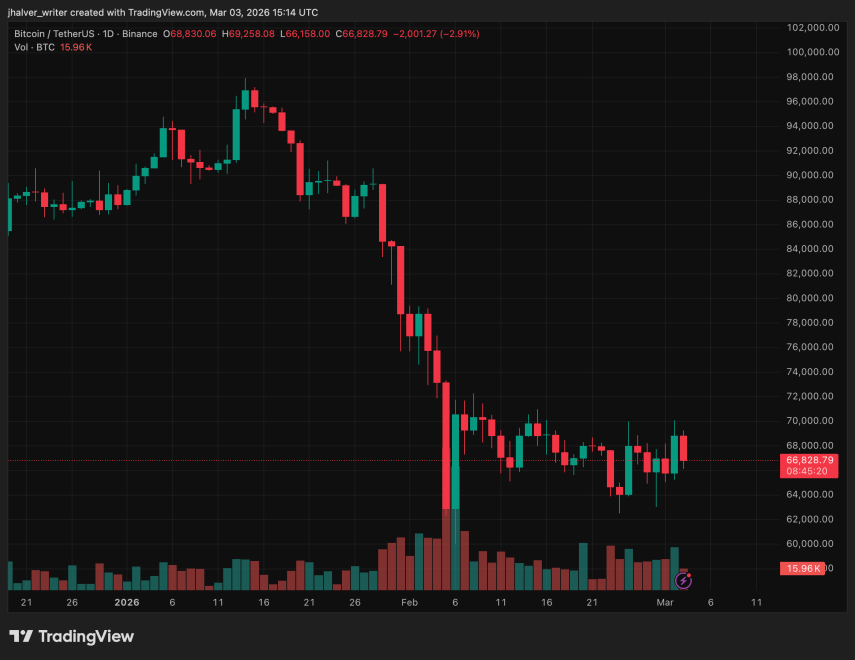
BTC's price trends to the downside on the daily chart. Source: BTCUSDT on Tradingview

Cover image from ChatGPT, BTCUSDT chart from Tradingview

Preguntas relacionadas

QWhat was the total value of crypto outflows from Iranian exchanges following the US-Israeli airstrikes on February 28, according to Chainalysis?

A$10.3 million

QWhy have many Iranians turned to Bitcoin and stablecoins, according to the article?

AAs a hedge against currency collapse, capital controls, and as an alternative store of value and cross-border payment rail due to economic strain from sanctions, runaway inflation, and a collapsing rial.

QWhat two contrasting roles does cryptocurrency play in Iran, as highlighted in the report?

AIt serves as a survival tool for ordinary households and as a sanctions-evasion channel for state-affiliated networks like the Islamic Revolutionary Guard Corps (IRGC).

QWhat event caused a temporary stall in Bitcoin outflows, as shown in one of the Chainalysis charts?

AAn Internet blackout.

QWhat is the central question for policymakers regarding new enforcement on Iran-linked crypto platforms?

AWhether new enforcement will meaningfully curb sanctions evasion or simply push more activity into harder-to-track channels.

Lecturas Relacionadas

"Threat" Harvests Before "Action": How Geopolitical Risk Prices the Crypto Market—Transmission Mechanisms and Outlook

Abstract: Geopolitical risk (GPR), particularly the "threat" phase, acts as a key driver of risk premium repricing in financial markets, with significant implications for crypto assets, which now behave as high-beta risk assets deeply embedded within the global macro cycle. The GPR index, which quantifies risk through media analysis, shows that negative effects are primarily driven by threats rather than actual acts of conflict. GPR impacts crypto through several transmission channels: risk aversion (rising VIX), inflation and rate cut fears (via oil price shocks), and market structure amplifiers (24/7 trading, high leverage, and endogenous liquidity loops). These mechanisms explain crypto’s high-beta nature—often correlating positively with Nasdaq—and its tendency toward violent deleveraging and liquidity contraction during stress. Three scenarios are outlined: base case (震荡修复) – slow recovery if risks stabilize; pessimistic (二次探底) – renewed selloff if conflict escalates and inflation spikes; optimistic (高波动超额反弹) – sharp rebound if risks fade and macro conditions improve. Key insights: 1) Markets price GPR threats early via risk-off shifts; 2) Crypto’s high volatility is structurally inherent; 3) Bitcoin behaves more like a high-beta tech asset than digital gold under most macro conditions, with its safe-haven narrative only materializing during severe sovereign or cross-border stress. Investors must integrate GPR into macro frameworks to dynamically assess risk premiums and liquidity conditions.

marsbitHace 10 min(s)

"Threat" Harvests Before "Action": How Geopolitical Risk Prices the Crypto Market—Transmission Mechanisms and Outlook

marsbitHace 10 min(s)

A Depegging and a Tweet: When the U.S. President Begins to "Legislate Escort" for His Family Business

A brief depegging incident involving the USD1 stablecoin, issued by Trump-affiliated World Liberty Financial (WLFI), and a subsequent push for crypto legislation by former President Trump have raised questions about the intersection of his political power and family business interests. On February 23, 2026, USD1 briefly depegged to $0.994 amid what WLFI called a "coordinated attack" involving social media hacks and market manipulation. Shortly after, WLFI transferred over $17 million worth of its native tokens to centralized exchanges, sparking market speculation about potential selling. Concurrently, on March 4, Trump publicly urged Congress to pass the GENIUS Act, a key stablecoin regulatory bill, while accusing banking lobbyists of undermining U.S. crypto competitiveness. The situation is complicated by the fact that the Trump family stands to benefit directly from the bill's passage. WLFI, which launched USD1 in March 2025, has seen rapid growth, partly fueled by political connections, including a major investment from an Abu Dhabi sovereign fund. However, the project faces scrutiny. A U.S. House investigation is probing a secretive $500 million sale of a 49% WLFI stake to an entity linked to an UAE royal, a deal signed just days before Trump's second inauguration. Critics, including Senator Elizabeth Warren, have raised concerns about potential national security risks and conflicts of interest. The episode highlights a grey area in modern governance: a sitting president simultaneously advocating for policies that could directly enrich his family's business, while that business faces both market pressures and congressional investigations. The existing legal and regulatory framework appears insufficient to address this novel overlap of political power and private commercial interest.

marsbitHace 3 hora(s)

A Depegging and a Tweet: When the U.S. President Begins to "Legislate Escort" for His Family Business

marsbitHace 3 hora(s)

Trading

Spot
Futuros
活动图片