Bithumb hit with $25M fine and 6-month suspension after 6.6M compliance breaches

ambcryptoPublished on 2026-03-16Last updated on 2026-03-16

Abstract

South Korea's Financial Intelligence Unit (FIU) has imposed a $25 million fine and a six-month partial business suspension on crypto exchange Bithumb. The penalty follows the discovery of over 6.6 million violations of financial compliance rules, primarily failures in customer identity verification and transaction monitoring. The exchange's CEO received a formal reprimand and its reporting officer was suspended for six months. Despite the enforcement action, Bithumb's trading remains strong, with Korean won pairs dominating over 92% of its $724 million 24-hour trading volume.

South Korea’s Financial Intelligence Unit [FIU] has imposed a 36.8 billion won ($25 million) fine and a six-month partial business suspension on crypto exchange Bithumb. This comes after regulators uncovered more than 6.6 million violations of the country’s financial reporting and compliance rules.

The enforcement action follows regulatory inspections conducted between 2024 and 2025 across South Korea’s five major exchanges—Upbit, Bithumb, Coinone, Korbit, and Gopax—and signals the country’s continued push to tighten oversight of digital asset trading platforms.

Authorities said the violations were linked primarily to failures in customer identification and transaction monitoring obligations under South Korea’s Act on Reporting and Use of Specific Financial Transaction Information.

FIU identifies millions of compliance breaches by Bithumb

According to the reports, investigators identified approximately 6.65 million violations tied to compliance failures on Bithumb’s platform.

The breakdown includes:

  • 3.55 million breaches related to failures to verify customer identities properly
  • 3.04 million violations involving failures to restrict certain transactions as required under the law

The regulator said the sanctions were determined after reviewing the scale of the violations, the extent of legal responsibility, and the operational impact on financial compliance requirements.

Disciplinary measures were also imposed on senior personnel at the exchange.

Bithumb’s CEO received a formal reprimand, while the exchange’s reporting officer was suspended from duty for 6 months.

Partial business suspension imposed

The penalty reportedly includes a six-month partial suspension of operations. However, regulators did not indicate that the exchange would be completely shut down.

South Korea maintains one of the strictest regulatory frameworks for digital asset exchanges, requiring platforms to implement robust Know-Your-Customer (KYC) and anti-money laundering (AML) controls.

Under the Special Financial Information Act, exchanges must identify customers, monitor transactions, and restrict suspicious activity linked to potential illicit financial flows.

Violations of these obligations can result in financial penalties, executive sanctions, and operational restrictions, as seen in the Bithumb case.

KRW trading remains dominant on the exchange

Despite the regulatory action, trading activity on Bithumb remains dominated by Korean won markets.

Data from Coingecko shows KRW-denominated trades account for more than 92% of total trading volume, underscoring the strength of domestic crypto demand in South Korea.

Among the most actively traded pairs were:

  • XRP/KRW – 14.68% of volume
  • BTC/KRW – 11.15%
  • ETH/KRW – 10.83%
  • USDT/KRW – 10.44%

Other markets, including SOL/KRW, G/KRW, and DOGE/KRW, accounted for smaller portions of overall activity.

The exchange also recorded approximately $724 million in 24-hour trading volume, highlighting continued market participation despite the regulatory penalty.
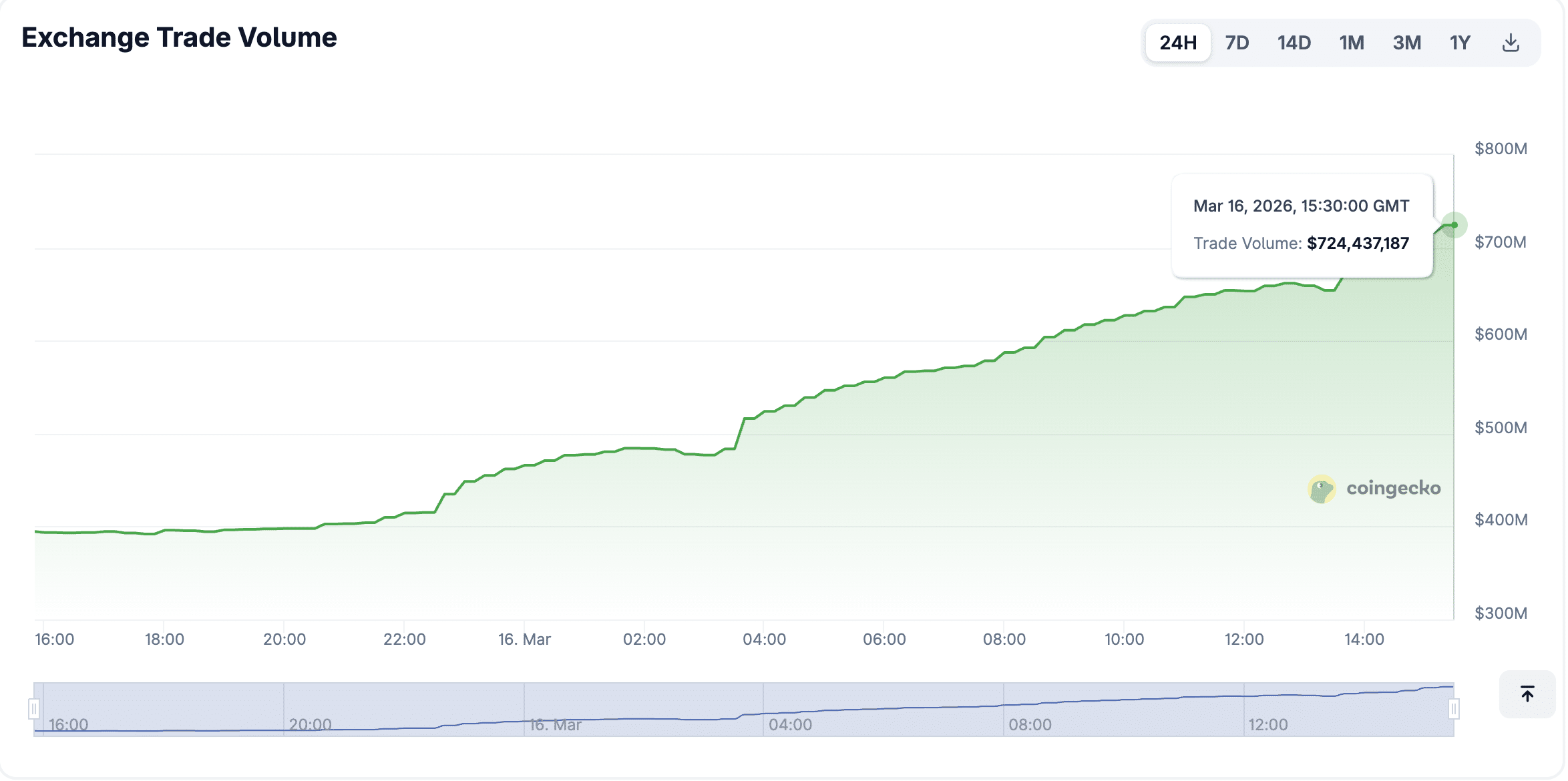
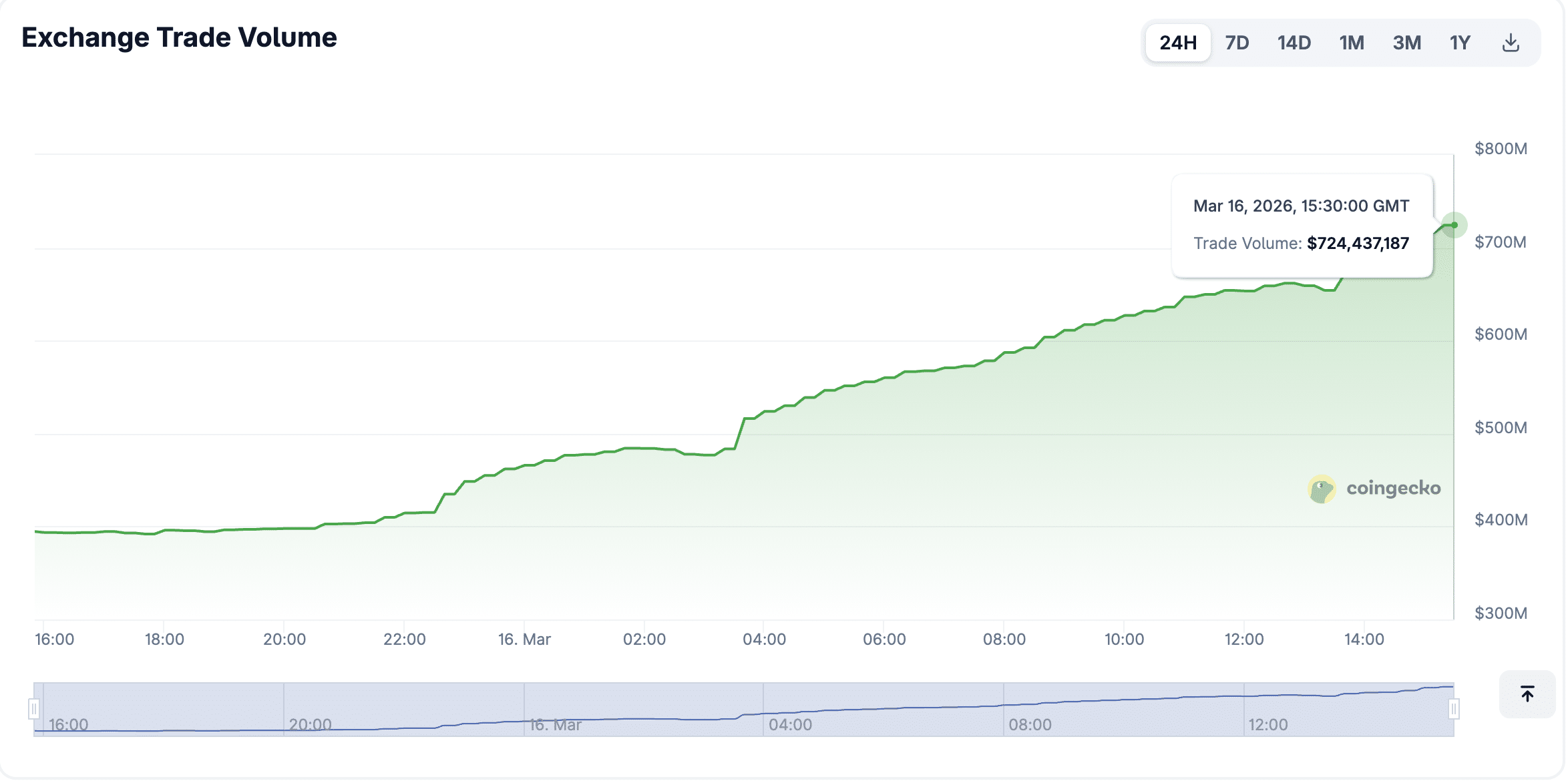
Source: CoinGecko

Final Summary

  • South Korean regulators fined Bithumb $25 million and imposed a six-month partial suspension after identifying more than 6.6 million compliance violations.
  • Despite the enforcement action, KRW-denominated trading remains dominant, highlighting strong domestic participation in South Korea’s crypto market.


Related Questions

QWhat penalties did South Korea's FIU impose on Bithumb and why?

ASouth Korea's FIU imposed a $25 million fine and a six-month partial business suspension on Bithumb due to over 6.6 million violations of financial reporting and compliance rules, primarily failures in customer identification and transaction monitoring.

QHow many compliance violations were identified on Bithumb's platform and what were the main types?

AApproximately 6.65 million violations were identified, including 3.55 million breaches related to failures to verify customer identities and 3.04 million violations involving failures to restrict certain transactions as required by law.

QWhat disciplinary actions were taken against Bithumb's senior personnel?

ABithumb's CEO received a formal reprimand, and the exchange's reporting officer was suspended from duty for 6 months.

QDespite the penalties, what does the trading data reveal about Bithumb's market activity?

ADespite the penalties, KRW-denominated trades account for over 92% of Bithumb's total trading volume, with $724 million in 24-hour trading volume, indicating strong domestic participation.

QWhich cryptocurrency trading pairs were the most active on Bithumb according to the data?

AThe most actively traded pairs were XRP/KRW (14.68% of volume), BTC/KRW (11.15%), ETH/KRW (10.83%), and USDT/KRW (10.44%).

Related Reads

The Migration of Settlement Power: B18 and the Institutional Starting Point of On-Chain Banking

The article "The Migration of Settlement Power: B18 and the Institutional Starting Point of On-Chain Banking" discusses how traditional finance relies on settlement—not just transactions—to determine ownership of funds. While transactions are instantaneous, settlement requires time, counterparties, and system confirmation, during which users do not fully control their funds. In contrast, early DeFi (decentralized finance) focused on trading and liquidity while avoiding the fundamental question of who defines settlement in the absence of banks. B18, built on Coinbase’s on-chain infrastructure and operating on Base, aims to address this gap by transforming blockchain into a system that handles time, accounting, clearing order, and finality—functions traditionally managed by banks. B18 is not a typical DeFi protocol but an attempt to decouple banking from institutions and encode it into executable rules. Its capital structure reflects this ambition, with support from Paradigm and Wintermute Ventures at the protocol level, GSR Capital for market liquidity, FuturePay for real-world payment integration, and Base Ecosystem Fund builders who design the rules for fund recording, profit recognition, and liquidation conditions. Together, these layers form a new on-chain financial order where code, not institutions, governs settlement—shifting the power dynamics of finance. B18 represents the starting point of this migration. (Note: This is a submitted article and does not represent the views of ChainCatcher or constitute investment advice.)

marsbitHá 51m

The Migration of Settlement Power: B18 and the Institutional Starting Point of On-Chain Banking

marsbitHá 51m

From Tencent and Circle: Looking at the Easy and Hard Questions of Investment

The article contrasts the investment prospects of Tencent and Circle in the AI era, framing the decision as a choice between "easy" and "hard" problems, inspired by Charlie Munger's philosophy. Tencent's stock has declined despite strong earnings, as the market shifted from fearing insufficient AI investment to worrying about excessive spending. The author argues this pessimism is overdone. WeChat's nascent AI agent, Yuanbao, is seen as a prototype for a future, more powerful system-native agent. Crucially, this agent would have system-level permissions to seamlessly interact with the massive Mini Program ecosystem (housing apps like Meituan, Didi, etc.), making it a practical, usable product for billions. The author believes the high-probability success of this inevitable development makes investing in Tencent an "easy" decision that the market is currently overlooking. Conversely, Circle's recent rise is fueled by the AI narrative, specifically the belief that AI agents will require blockchain-based stablecoins for settlement, with USDC as the leading compliant option. The author deconstructs this bullish thesis, identifying high uncertainties in its core assumptions: whether AI transactions will *necessarily* use stablecoins (vs. other protocols like Google's UCP), USDC's ability to maintain its lead against competitors like Tether or PayPal, and whether stablecoins even possess strong network effects in an agent-dominated world where cost and friction are paramount. The compounding uncertainty makes investing in Circle a "hard" problem, riskier than market sentiment suggests. In summary, the author posits that Tencent presents a clear, high-probability opportunity (easy), while Circle's future is built on a chain of speculative assumptions (hard).

marsbitHá 53m

From Tencent and Circle: Looking at the Easy and Hard Questions of Investment

marsbitHá 53m

Trading

Spot
Futures

Hot Articles

Discussions

Welcome to the HTX Community. Here, you can stay informed about the latest platform developments and gain access to professional market insights. Users' opinions on the price of S (S) are presented below.

活动图片