SUI Price Falls to Support Level Around $0.72, Traders Anticipate Rebound from Gaussian Channel

cryptonews.ruPublicado em 2026-07-27Última atualização em 2026-07-27

Resumo

Cryptocurrency SUI has dropped to a key support level near $0.72, touching the lower band of the Gaussian Channel—a technical analysis tool used to identify potential trend reversals. Traders are watching to see if this level holds, as a bounce with sufficient buying volume could signal a move toward the channel's midpoint. Currently trading at $0.7206 with a market cap of roughly $2.92 billion, SUI remains down approximately 86% from its all-time high of $5.35 in January of last year. Despite the price struggles, the Sui network continues to see institutional adoption. Recent developments include Mubadala Capital tokenizing a $75 million private markets fund on Sui and other chains, as well as the launch of the Hashi testnet, which enables Bitcoin to be used as collateral without wrapping. The network also reported significant stablecoin transaction volume following a protocol update. The immediate focus for SUI is whether it can maintain support at the Gaussian Channel's lower band; failure to do so may lead to a test of lower price levels.

Crypto trader Soka Data highlighted this situation in an X post over the weekend, noting that $SUI had once again descended to the lower boundary of its Gaussian Channel and asked followers if the token could breach the midpoint in the near future.

The Gaussian Channel is a technical analysis tool based on the statistical concept of normal distribution. It plots three bands — upper, middle, and lower — around an asset's price to help traders identify trend changes and potential reversal points. Another trader named El Tigre responded to the post, adding:

"$SUI returning to the Gaussian Channel's lower band is a classic support zone; if it holds and volume appears, a move up to the midpoint seems quite plausible."

The upper and lower bands of the Gaussian Channel typically serve as dynamic support and resistance levels, with a bounce from the lower band often interpreted by traders as an early signal of a potential reversal. The indicator smooths price data using an adaptive moving average, making it more sensitive to volatility changes than a standard moving average, although the predictions of both traders do not guarantee that a rebound will actually occur.

A Challenging Period for $SUI

Currently, $SUI is trading at $0.7206, with a market capitalization of approximately $2.92 billion, making it the 30th largest cryptocurrency by this metric. The token's 24-hour trading volume is around $135 million, with a circulating supply slightly over 4 billion $SUI.
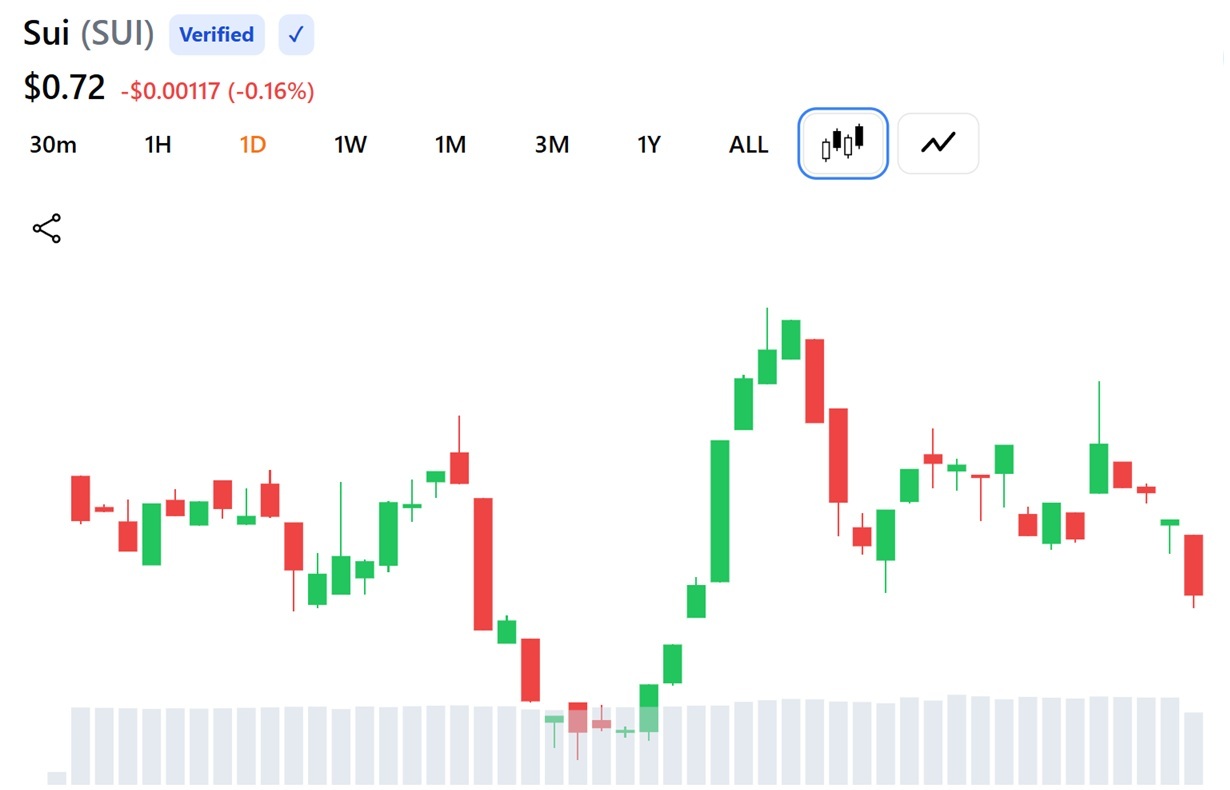
This price represents a sharp decline compared to $SUI's all-time high of $5.35 reached in January last year. The current price level is about 86% below that peak, indicating a steeper drop than most large-cap tokens over the same period.

Nevertheless, despite ongoing price challenges for $SUI, the underlying network continues to attract institutional users. For instance, the Abu Dhabi sovereign wealth fund Mubadala Capital tokenized a $75 million private markets fund, which operates primarily on Coinbase's Base network, on Solana and Sui, and also has additional share classes on Ethereum, Avalanche, Polygon, and Sei. Details about the multi-chain solution launch and Coinbase's direct participation in the fund via its balance sheet were revealed on July 23, 2026.

Bitcoin.com News reported on this event, noting that access to the fund remains limited to qualified institutional and accredited investors, with a minimum investment of around $100,000. Product management is handled by KAIO — a UAE-based tokenization infrastructure provider, which first partnered with Mubadala Capital in December 2025.

Steady Growth of Sui Networks.

Last week, the Sui Foundation and Mysten Labs launched the Hashi testnet, enabling the use of Bitcoin as loan collateral without the need to "wrap" it; the protocol is already being tested by over 25 institutional partners, including BitGo and Ledger. This followed a May protocol change that made stablecoin transfers free — which, according to Sui, helped stablecoin transaction volume exceed $65 billion in the following weeks.

The most immediate test for $SUI now is whether buyers will step in at the Gaussian Channel's lower band with sufficient volume to confirm the support analysts mentioned. Failure to hold this zone would likely open the path to retesting lower levels.

end-content

Criptomoedas em alta

Perguntas relacionadas

QWhat technical analysis tool are traders using to assess SUI's price movement near the $0.72 level?

ATraders are using the Gaussian Channel tool. It is a technical analysis indicator based on the statistical concept of normal distribution, plotting upper, middle, and lower bands around an asset's price to identify potential trend changes and reversal points.

QAccording to the trader El Tigre, what needs to happen for SUI's price to move towards the middle of the Gaussian Channel?

AAccording to trader El Tigre, for SUI's price to move towards the middle of the Gaussian Channel, the price needs to hold at the lower band (support zone) and there must be an increase in trading volume.

QHow does the current price of SUI compare to its all-time high, and what was that peak value?

AThe current price of SUI is $0.7206, which is approximately 86% below its all-time high of $5.35, which was reached in January of the previous year.

QWhat recent development involving Abu Dhabi's sovereign wealth fund demonstrates institutional interest in the Sui network?

AAbu Dhabi's sovereign wealth fund Mubadala Capital tokenized a $75 million private markets fund that operates primarily on Sui (among other networks like Base and Solana). This fund launch, which also involves Coinbase's direct participation, was announced on July 23, 2026.

QWhat two major protocol upgrades or launches for the Sui network were mentioned in the article?

A1. The launch of the Hashi testnet, which allows Bitcoin to be used as collateral for loans without needing to be 'wrapped'. 2. A prior protocol change in May that made stablecoin transfers free, which reportedly helped stablecoin transaction volume exceed $65 billion in the following weeks.

Leituras Relacionadas

"Money Is Useless"? Why Musk's 2036 Prediction Could Completely Reshape Bitcoin's Fate

Elon Musk Predicts "Money Will Be Irrelevant" by 2036, Potentially Reshaping Bitcoin's Future In a recent interview with The Economist, billionaire Elon Musk, CEO of SpaceX and Tesla, made a startling prediction: money will become "irrelevant" within a decade as the world transitions to a state of "unbelievable abundance." He argues that if robots and AI can provide goods and services exceeding all human consumption, the purpose of money would vanish. This prediction coincides with a critical juncture for Bitcoin. While the cryptocurrency has been trading sideways and below its all-time highs, it is approaching what some see as a major turning point. Musk's views are closely watched due to his past statements equating "energy" with true currency—a concept that resonates with Bitcoin proponents, as Bitcoin's security model is deeply tied to energy-intensive mining. His companies, SpaceX and Tesla, collectively hold nearly $2 billion worth of Bitcoin. Although Musk's public enthusiasm for crypto has moderated since its peak, he maintains support for Bitcoin and his favored Dogecoin. He has criticized government-issued fiat currencies as "hopeless" and suggested a preference for Bitcoin. His latest prophecy, envisioning a post-scarcity future driven by AI and robotics, refocuses attention on Bitcoin's potential role as a value anchor in a world where traditional money may lose its meaning.

Foresight NewsHá 14m

"Money Is Useless"? Why Musk's 2036 Prediction Could Completely Reshape Bitcoin's Fate

Foresight NewsHá 14m

Storj Labs Files for Bankruptcy Protection: Can Token Holders Exchange for Company Equity?

Storj Labs, parent company of decentralized cloud storage platform Storj, filed for Chapter 11 bankruptcy protection on July 26 in the U.S. District Court for the Northern District of West Virginia. The company stated its network will operate normally and token functions will be unaffected. Notably, Storj plans to propose a mechanism in its reorganization plan allowing STORJ token holders a path to equity in the restructured company—an unprecedented offer in the crypto industry. However, its feasibility depends on whether any residual value remains after creditor repayments, as token holders are low in the legal priority hierarchy. Founded in 2014, Storj is an early decentralized infrastructure project. It reported a 7x increase in Annual Recurring Revenue (ARR) to approximately $30 million in 2024. In October 2025, it was acquired by Inveniam Capital Partners. Less than a year later, the merged entity entered bankruptcy proceedings. Storj attributed the filing to historical debts from past operations and acquisitions, stating they were too large to be absorbed by business growth. The company also plans to refocus on its core decentralized storage business, likely divesting Valdi, a GPU computing company acquired in 2024. The proposed token-to-equity conversion faces significant legal hurdles. Under U.S. bankruptcy law, creditors are paid before equity holders, and utility token holders are not automatically recognized as equity members. The details—such as eligibility, allocation ratio, and mechanics—are yet to be determined and require court approval. Another factor is token concentration, with Storj Labs itself holding roughly 30% of the total 425 million STORJ supply. In the broader decentralized storage landscape, Storj is a smaller player compared to giants like Filecoin and Arweave. Its key advantage is faster retrieval speeds for "hot" data. The bankruptcy process introduces risks, including potential client and node operator migration to competitors. STORJ price fell roughly 11.2% following the news. Key points for token holders to watch are the specific terms of the equity conversion plan, court approval progress, the treatment of the company's own token stash, and whether the refocused core business can sustain value post-reorganization.

Foresight NewsHá 18m

Storj Labs Files for Bankruptcy Protection: Can Token Holders Exchange for Company Equity?

Foresight NewsHá 18m

Perpetual Futures 'Landing in the US' Hits Roadblock: Why is CME Suing the CFTC in Court?

Perpetual crypto futures, which dominate global crypto derivatives trading, are entering the U.S. market. The CFTC approved KalshiEX to launch a true Bitcoin perpetual contract (BTCPERP) and issued rules allowing licensed exchanges to convert expiring crypto futures into perpetual ones. This move was challenged when CME Group sued the CFTC, arguing that perpetuals should be regulated as "swaps" under stricter rules, not as futures. The lawsuit's outcome will significantly impact the legal foundation of the nascent U.S. perpetuals market. Currently, two legal structures exist in the U.S.: true perpetuals (like Kalshi's) and long-dated futures (like Coinbase's) that mimic perpetuals via frequent funding rate settlements. These funding rates, paid between longs and shorts, keep contract prices anchored to spot. The proliferation of U.S. perpetuals creates fragmented liquidity across platforms (Kalshi, Coinbase, CME), with different rules on leverage, margining, and clearing. This fragmentation reduces capital efficiency, as collateral cannot be shared across products. Key competitive battlegrounds will be cross-product margin efficiency and the response of these new markets to extreme volatility. A pending Coinbase proposal to allow USDC stablecoin as futures margin could improve capital efficiency. Ultimately, the market's evolution hinges on two factors: how U.S. perpetuals behave during sharp Bitcoin price moves, and the court's ruling on whether they are futures or swaps.

Foresight NewsHá 18m

Perpetual Futures 'Landing in the US' Hits Roadblock: Why is CME Suing the CFTC in Court?

Foresight NewsHá 18m

Trading

Spot

Artigos em Destaque

Como comprar DATA

Bem-vindo à HTX.com!Tornámos a compra de DATA Network (DATA) simples e conveniente.Segue o nosso guia passo a passo para iniciar a tua jornada no mundo das criptos.Passo 1: cria a tua conta HTXUtiliza o teu e-mail ou número de telefone para te inscreveres numa conta gratuita na HTX.Desfruta de um processo de inscrição sem complicações e desbloqueia todas as funcionalidades.Obter a minha contaPasso 2: vai para Comprar Cripto e escolhe o teu método de pagamentoCartão de crédito/débito: usa o teu visa ou mastercard para comprar DATA Network (DATA) instantaneamente.Saldo: usa os fundos da tua conta HTX para transacionar sem problemas.Terceiros: adicionamos métodos de pagamento populares, como Google Pay e Apple Pay, para aumentar a conveniência.P2P: transaciona diretamente com outros utilizadores na HTX.Mercado de balcão (OTC): oferecemos serviços personalizados e taxas de câmbio competitivas para os traders.Passo 3: armazena teu DATA Network (DATA)Depois de comprar o teu DATA Network (DATA), armazena-o na tua conta HTX.Alternativamente, podes enviá-lo para outro lugar através de transferência blockchain ou usá-lo para transacionar outras criptomoedas.Passo 4: transaciona DATA Network (DATA)Transaciona facilmente DATA Network (DATA) no mercado à vista da HTX.Acede simplesmente à tua conta, seleciona o teu par de trading, executa as tuas transações e monitoriza em tempo real.Oferecemos uma experiência de fácil utilização tanto para principiantes como para traders experientes.

109 Visualizações TotaisPublicado em {updateTime}Atualizado em 2026.07.01

Como comprar DATA

Discussões

Bem-vindo à Comunidade HTX. Aqui, pode manter-se informado sobre os mais recentes desenvolvimentos da plataforma e obter acesso a análises profissionais de mercado. As opiniões dos utilizadores sobre o preço de DATA (DATA) são apresentadas abaixo.

活动图片