In 2026, "World Model" is one of the least consensual terms in the AI community.
A video that can be continuously generated is called a world model; a digital environment that changes in real-time with mouse and keyboard operations is also called a world model; a system that predicts future states in latent space, as well as a policy that directly outputs robotic actions, also use this name.
These models are all processing information about the world, but their capabilities vary widely. The visuals in a generated video can be realistic enough, yet violate real-world physical laws; a robot can perform a grasp, but may only be familiar with the specific objects, camera angles, and motion trajectories in a lab. Whether a system has learned visual correlations, physical structures, or the relationship between actions and outcomes is difficult to answer from a demo alone.
Conceptual confusion increases the difficulty of technical judgment. Image quality, geometric accuracy, predictive capability, and task success rates are often mixed together in comparisons. Different teams appear to be competing in the same race, but they might actually be answering different questions.
Therefore, world model research is returning to a fundamental question: what capabilities must a model possess to move from generating content to understanding and changing the world?
Fei-Fei Li and World Labs categorize world models by function into renderers, simulators, and planners, which output pixels, world states, and actions respectively.
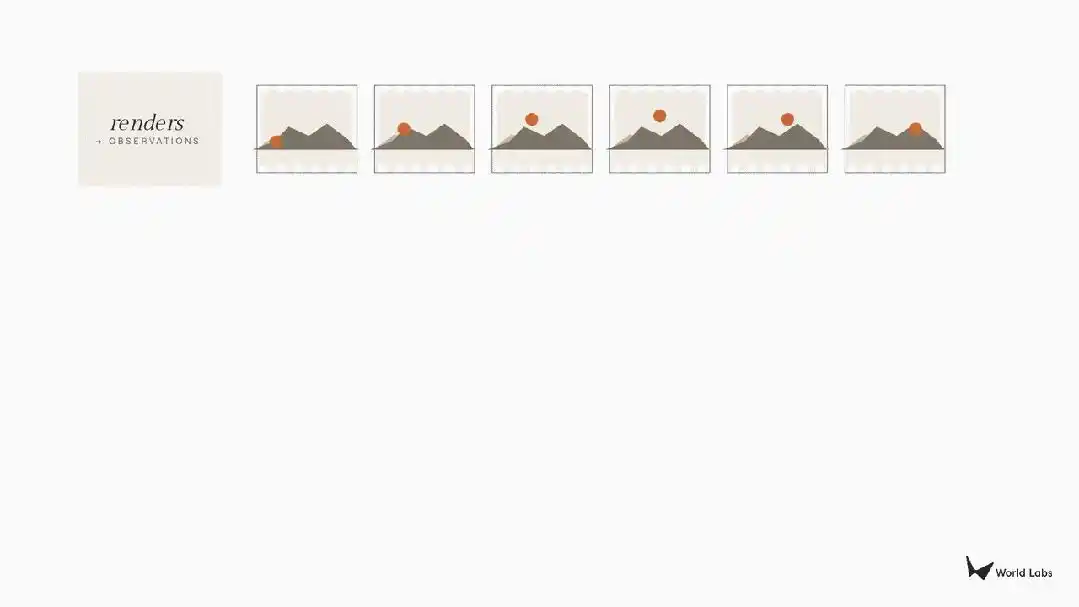
Link:https://www.worldlabs.ai/blog/taxonomy-of-world-models
LeCun advocates for learning a predictable world structure in an abstract latent space, allowing the model to retain information useful for understanding, reasoning, and planning.
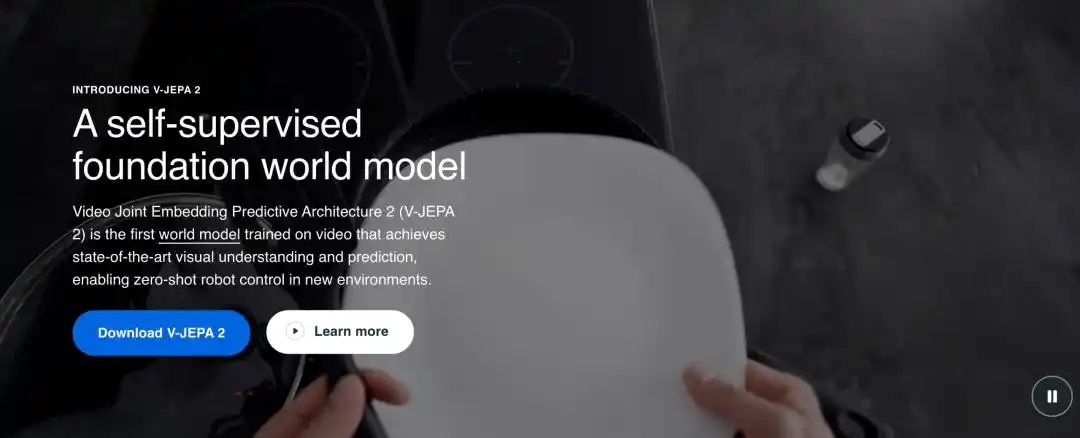
Link:https://ai.meta.com/research/vjepa/
Jun Zhu from Tsinghua University offers a third perspective. Back in December of last year when Motus was released, he publicly elaborated on the overall conception of a "General World Model." In March of this year, he further positioned it as the foundation connecting the digital and physical worlds. A few months later, Jun Zhu and his team refined this framework in their paper "General World Models from First-Principles," defining core capabilities from first principles and providing a five-level evolutionary roadmap.
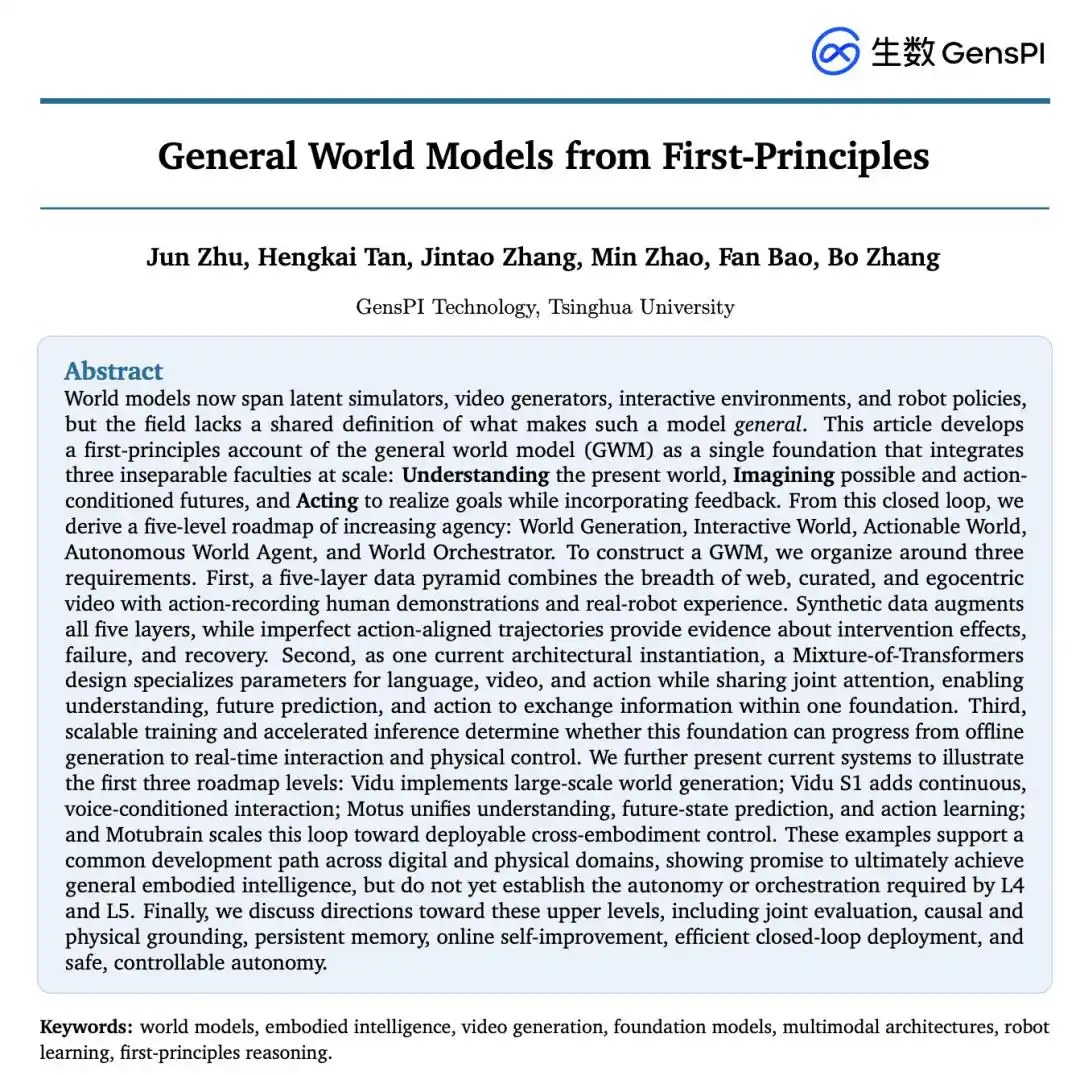
Paper Link: https://www.shengshu.com/assets/gwm-principles-and-roadmap.pdf
Technical Report: https://www.shengshu.com/zh/general-world-model/
The paper summarizes the core capabilities of a General World Model as understanding, imagination, and action. The model needs to form a judgment about the current world from historical observations, reason about possible futures resulting from different choices, take action, and then use new observations to correct itself.
Along this framework, video generation, real-time interaction, latent space prediction, and robot control can be seen as different stages on the same path of capability development.
The question of how far world models are from general intelligence has also been transformed into more concrete problems: Can it maintain a coherent world? Can it predict the consequences of interventions? Can it learn from real feedback? And can it gradually form goals and organize more complex actions?
The First Principles of World Models
Many people have experience learning to ride a bicycle.
At the beginning, the body always wobbles. Seeing the handlebars veer to one side and feeling the body's center of gravity begin to sink, the person immediately adjusts direction and continues correcting based on new feedback. With increased practice, the brain gradually learns to anticipate the results of certain actions.
This is the most basic meaning of a world model.
In 1943, Kenneth Craik proposed that humans form "small-scale models" of reality in their minds to reason about the possible results of different actions. POMDP in reinforcement learning further describes this process: the agent receives partial observations, estimates the world state, takes action, and then updates its judgment based on new observations.
Jun Zhu's team summarizes this logic as the three core capabilities of a General World Model, which connect to form a continuously updated loop:
Understanding: Integrating information like vision, language, sound, touch, or robot sensors into an internal judgment about the current world;
Imagination: Reasoning from the current state to multiple possible futures, especially "what would happen if I take action A instead of action B?";
Action: Turning predictions into interventions in digital or physical environments, and allowing new observations after the action to test and correct the model.
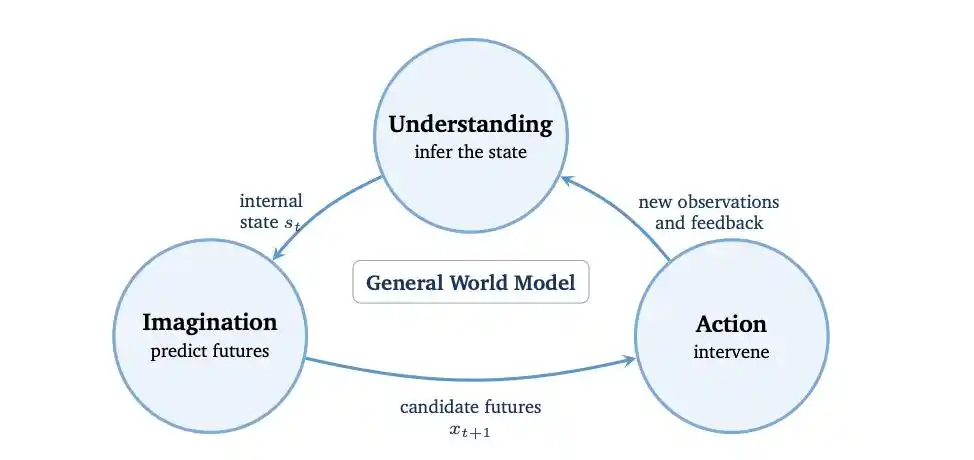
The three core capabilities of the General World Model form a closed loop: understanding infers the current state, imagination predicts possible futures, and action changes the world, providing new evidence for the next round of understanding.
This is also why video generation does not equal the entirety of a world model.
A video model can answer what the next scene might look like, but to move towards a General World Model, it also needs to answer predictive questions with action conditions like "How would the world be different if I change this condition, move this object, or apply this action?" Such predictions touch upon causality, counterfactuals, and executable decisions.
How Do Understanding, Imagination, and Action Form a Closed Loop?
To describe the evolution of world models, Jun Zhu's team further proposes a five-level roadmap, progressing from L1 Generating the World, L2 Interacting with the World, and L3 Acting in the World, gradually advancing towards L4 Autonomous World Agent and L5 World Organizer.
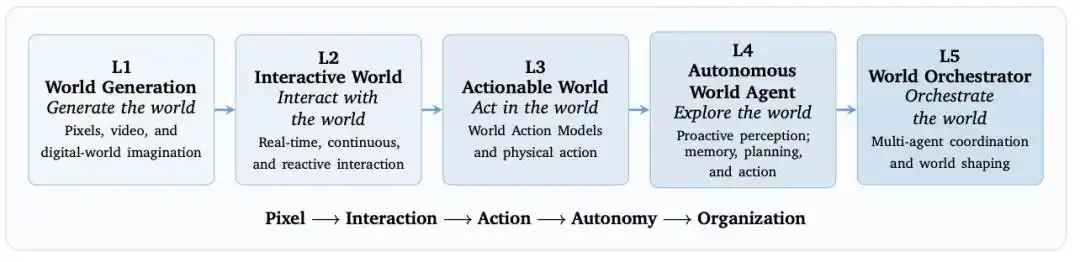
Using a glass cup pushed to the edge of a table for understanding makes it more intuitive.
An L1 model can generate continuous images of the cup sliding, falling, hitting the ground, and shattering; an L2 model can continue evolving this world after the user changes the viewpoint or the direction of the push; at L3, the model needs to judge whether the cup will fall, predict whether reaching out is fast enough, and output a grasping action that a robot can actually execute. Only after taking action will it know if its judgment about the cup's weight, friction, and grasping timing was correct.
Going further up, L4 no longer just waits for human instructions; it must be able to discover risks, actively observe, gather more information, and revise strategies after failure. L5 further deals with multi-agent collaboration, such as who grabs the cup, who avoids obstacles, who coordinates tools, and how to rearrange tasks when the environment changes.
The significance of this roadmap is that it transforms "world model" from a noun into a set of questions that can be examined level by level.
L1 checks if generated trajectories are coherent, L2 checks if the world can continuously respond, L3 checks if the model can change the physical environment, L4 checks if the system can actively explore and continuously learn, and L5 checks if it can organize multi-agent collaboration in open environments.
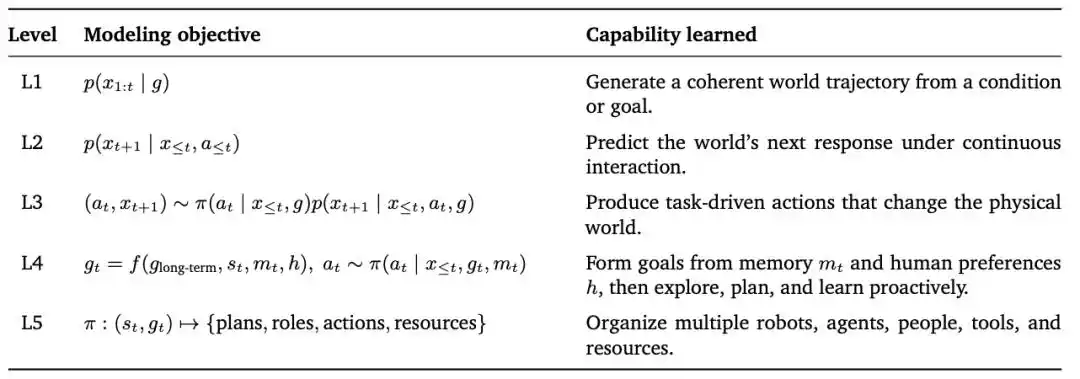
The formal modeling objectives and acquired capabilities of the General World Model (GWM) five-level roadmap.
According to the paper's assessment, existing systems have already touched the first three levels, while L4 and L5 remain open problems, with major gaps including causal and physical grounding, persistent memory, online learning, efficient deployment, and safety control. Evaluation also needs to compare predictions with real outcomes and examine the model's transfer ability to unfamiliar tasks, environments, and embodiments.
From Video to Embodiment: Two Validations of the Same Hypothesis
The difficulty of world models is not only in algorithms.
Internet videos are vast in scale, recording a wide range of objects, people, scenes, and movements. Models can learn spatial structure, object persistence, human behavior, and how events typically unfold from them, but videos rarely synchronously record the actions, forces, and intentions that cause changes. Robot trajectories can connect observations, actions, and outcomes, but the collection cost is much higher and they are easily tied to specific hardware and tasks.
The path proposed by Jun Zhu's team is to place these two types of data into a data pyramid progressing from observation to action.
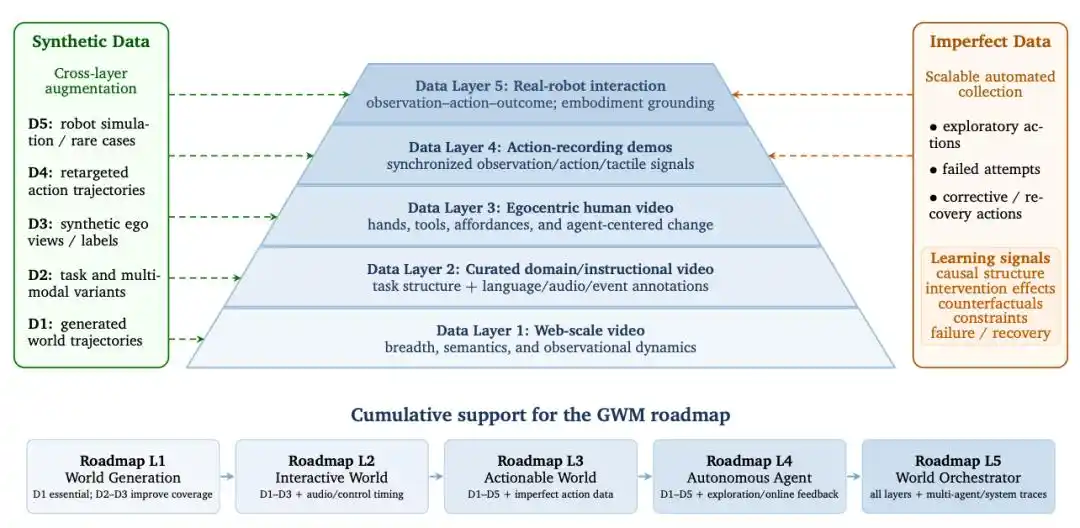
The data pyramid of the General World Model (GWM) and its relationship to the five-level capability roadmap.
The base layer consists of internet-scale videos, used to acquire world knowledge and dynamic priors. Moving upward, there are domain-specific videos, first-person human videos, human demonstrations with action records, and at the top, real robot interaction data. The higher you go, the scarcer and more costly the data becomes, but the correspondence between actions, tasks, and the robot embodiment also becomes clearer.
This explains why Shengshu is simultaneously advancing video generation and embodied intelligence: videos provide the breadth of world knowledge, while robot data completes action grounding.
On the digital world side, the Vidu series continues to explore the generation of and interaction with the visual world. Video is not the end goal of world models, but it is an important starting point, allowing models to learn how objects, scenes, motion, and events evolve amidst large-scale spatiotemporal changes. Vidu S1 further advances from one-time generation to real-time response, allowing user input to continuously alter subsequent content, testing whether the model can maintain state continuity during interaction.
On the physical world side, Motus and Motubrain connect environmental understanding, state prediction, and robot actions into the same pipeline. The model needs to perceive the environment, predict the consequences of intervention, translate its judgment into executable actions, and accept validation from real-world results.
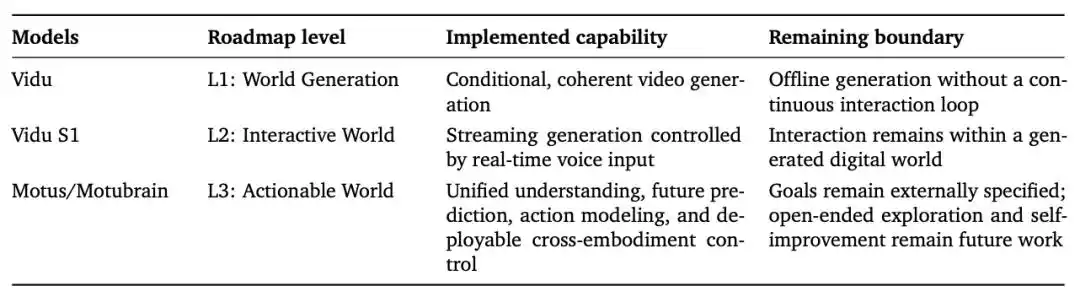
Existing representative systems achieving L1 to L3.
Thus, the two product lines form two validations of the same world model hypothesis. The digital environment tests whether the model can understand and imagine the world, while the physical environment tests whether this knowledge can support action and be corrected through feedback.
To enable these two types of validation to share underlying capabilities, images, videos, language, and robot actions need to be computed collaboratively around the same world state. Traditional modular systems pass information step-by-step, easily losing geometric, temporal, and uncertainty information at interfaces. Having all modalities completely share parameters might also cause training conflicts, allowing massive video data to overwhelm scarce robot signals.
The MoT (Mixture-of-Transformers) architecture proposed by Jun Zhu's team attempts to strike a balance between the two. Different modalities retain their own expert parameters while exchanging context through a shared attention mechanism. Vision informs the model about what's happening in the environment, language provides goals and constraints, actions bring interventions to the environment, and these three types of information collectively update the model's judgment of the world.
MoT provides a foundation for unified computation, but issues like physical laws, cross-embodiment transfer, real-time reasoning, and safety control still need to be addressed through data, training, and systems engineering. Its target is clear: a General World Model needs a world state that can be read, written, and continuously updated by different modalities.
Motus2:
Letting Robots Test in Their Own World
Before They Act
If Motus and Motubrain advanced Shengshu's world model exploration to L3, enabling robots to generate actions based on environmental understanding and future predictions, then the recently proposed Motus2 further incorporates outcome evaluation and strategy feedback, attempting to give the action loop self-improvement capabilities.
Motus2 does not build action generation, future simulation, and outcome evaluation as three independent systems. Instead, it uses a single set of shared-parameter video-action models, exposing three control interfaces:
Policy (World-Action Model): Proposes candidate actions that can be executed;
Simulator (Action-Conditioned World Model): Predicts the visual-world consequences these actions might cause;
Evaluator (Value Model): Judges which outcome is closer to the task goal and uses this judgment for selection and improvement.
Think of it as genuine "mind first, dexterity second."
The robot no longer just sees an object and directly outputs an action. Instead, it first proposes several candidate plans, pre-simulates the visuals and task progress each would bring about in the model, and then selects the better step. After execution, successful, failed, and suboptimal outcomes are no longer just discarded data waste but become evidence for the next round of dynamics modeling and value learning.
Action, prediction, evaluation, feedback, and re-action thus enter the same decision-making and learning loop, which is also the closed-loop self-evolution emphasized by Motus2.
On the data side, Motus2 employs a hierarchical training path, expanding from monocular first-person videos to synchronized binocular first-person data, and then completing embodiment adaptation through robot data. Its training uses approximately 130,000 hours of human first-person recordings and over 100 hours of robot trajectories and human-robot alignment data.
This path is about first allowing the model to accumulate shared experience about how humans interact with the world, then letting it learn through robot data how this body transforms understanding into action.
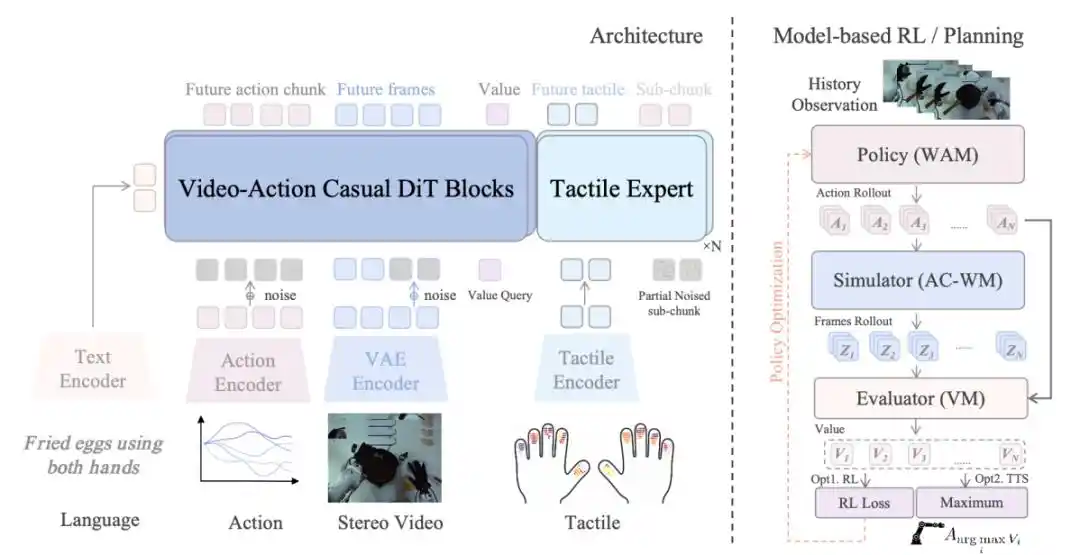
On the execution side, Motus2 also uses an independent, lightweight tactile expert to refine short actions about to be executed and predict force feedback upon contact. Vision is good at seeing where objects are and roughly how the world changes, while touch supplements the most difficult "last centimeter" when contact occurs, giving the model, beyond "seeing," an additional layer of immediate correction for delicate operations like pressing, touching, grasping, and twisting.
Motus2 is still in a stage extending from L3 towards L4. Current validation mainly focuses on specific robots and manipulation tasks. Autonomous goal formation, persistent memory, open-environment generalization, long-term online learning, and safety control remain areas for further exploration.
Its main progress is integrating policy generation, future simulation, value evaluation, and tactile feedback into the same system, allowing the robot to pre-simulate consequences before acting and use results to improve strategies after acting, providing a verifiable path towards L4 Autonomous World Agents.
From Probabilistic Learning to World Intelligence
A Chinese Technical Path
The framework of the General World Model also continues the long-accumulated research direction of Jun Zhu and Tsinghua TSAIL.
Professor Jun Zhu has long researched Bayesian methods, probabilistic machine learning, generative models, and reinforcement learning, dealing with uncertainty, data distribution, future generation, and action decision-making respectively.
TSAIL has also cultivated and influenced a group of researchers who have joined global frontier teams. Siyan Song collaborated with Jun Zhu on Bayesian learning research during his undergraduate years. Jiaming Song also participated in related work during his undergraduate studies and later made significant contributions in the areas of score-based generative models and DDIM.
From probabilistic modeling to generation and decision-making, this academic lineage also reflects two types of entry points for AGI development. One starts from language, gradually enhancing reasoning, tool use, and task execution capabilities; the other starts from vision and the dynamic world, moving towards real-time interaction and embodied action.
In the landscape of China's AGI industry, Zhipu AI and Shengshu can be seen as representatives of these two paths. Zhipu starts from language models, continuously enhancing reasoning, coding, and agent capabilities; Shengshu starts from video generation, further entering real-time interaction, embodied action, and strategy optimization.
The two routes are now permeating each other. Language agents need visual feedback and environmental models, and world models also need language to express goals, rules, and plans. Different entry points ultimately point towards the common modeling of language, world state, and action.
Conclusion
The competition in world models will ultimately shift from the impressiveness of demos to the system's ability to withstand feedback.
Visuals can create a credible first impression, but geometry and physics determine whether this world can be used repeatedly. Action brings the model's judgment into reality. Whether a prediction holds true can only be confirmed after intervention occurs; whether a task is successful must also be tested in unfamiliar scenarios, over long-term operation, and amidst continuous change.
The paper by Jun Zhu's team does not provide a final answer to the debate on world models, but it offers a set of questions that can continue to be examined: What does the model understand, how far can it imagine, and can it correct itself after taking action?
Over the past decade, the most important AI advancements have come from learning patterns in language and data. In the next stage, models must also face continuously changing environments. When models can continuously form judgments, bear the consequences of actions, and continuously learn in such environments, world models will gradually evolve from a crowded technical term into a foundation for achieving general intelligence.
This article is from WeChat Official Account "Almost Human" (ID: almosthuman2014), Author: Yang Wen