Author: 0xSammy
Compiled by: Deep Tide TechFlow
Deep Tide Guide: Bittensor subnet Templar has completed the largest decentralized LLM pre-training in history—Covenant-72B with 72 billion parameters. Its performance is reportedly comparable to LLaMA-2-70B, and the entire training process was based on consumer-grade internet hardware.
This is not a proof of concept but a delivered product. It elevates Bittensor's narrative from "subnets can exist" to "subnets can produce outputs that compete with centralized alternatives."
At the same time, AWS released the complete x402 technical reference architecture. These two events combined drove the DeAI sector up 12% in a single week.
Full Text Below:
Headline of the Week: TAO and Covenant-72B
On March 10, Templar (Bittensor Subnet 3) completed the largest decentralized LLM pre-training in history: Covenant-72B. 72 billion parameters. Approximately 1.1 trillion tokens. Fully trained on consumer-grade internet hardware within Bittensor's permissionless network. Anyone with a GPU can freely join or leave. Performance is reportedly comparable to LLaMA-2-70B.
This upgrades Bittensor's core thesis from "subnets can exist" to "subnets can produce outputs that compete with centralized alternatives."
A permissionless network of consumer-grade GPUs, achieving synergy on a scale previously associated only with hyperscale cloud providers. Before Covenant-72B, decentralized training was just a promise on the roadmap; now, it is a delivered product.
Within 24 hours of the announcement, TAO rose 19%, with a weekly gain of +39.8%. Templar's post on X received 1.7 million views:
Three ecosystem subnets (SN3 Templar, SN4 Targon, SN39 Basilica) ranked among the top eight gainers on CoinGecko that day. The structural dynamics between TAO and subnets amplify buying pressure: investors need TAO to acquire subnet tokens, so concentrated demand for any single subnet cascades into accumulation of the underlying asset.
The price action is now anchored to a verifiable technical milestone. Covenant-72B is a fully trained model. Grayscale's Bittensor Trust SEC filing (December 2025) is still pending approval; xTAO continues to accumulate as the largest corporate holder. Institutional access is being built in parallel.
A) DeAI Total Market Cap Analysis
This week, the total DeAI market cap increased by $1.9 billion (+12%), reaching $16.2 billion:
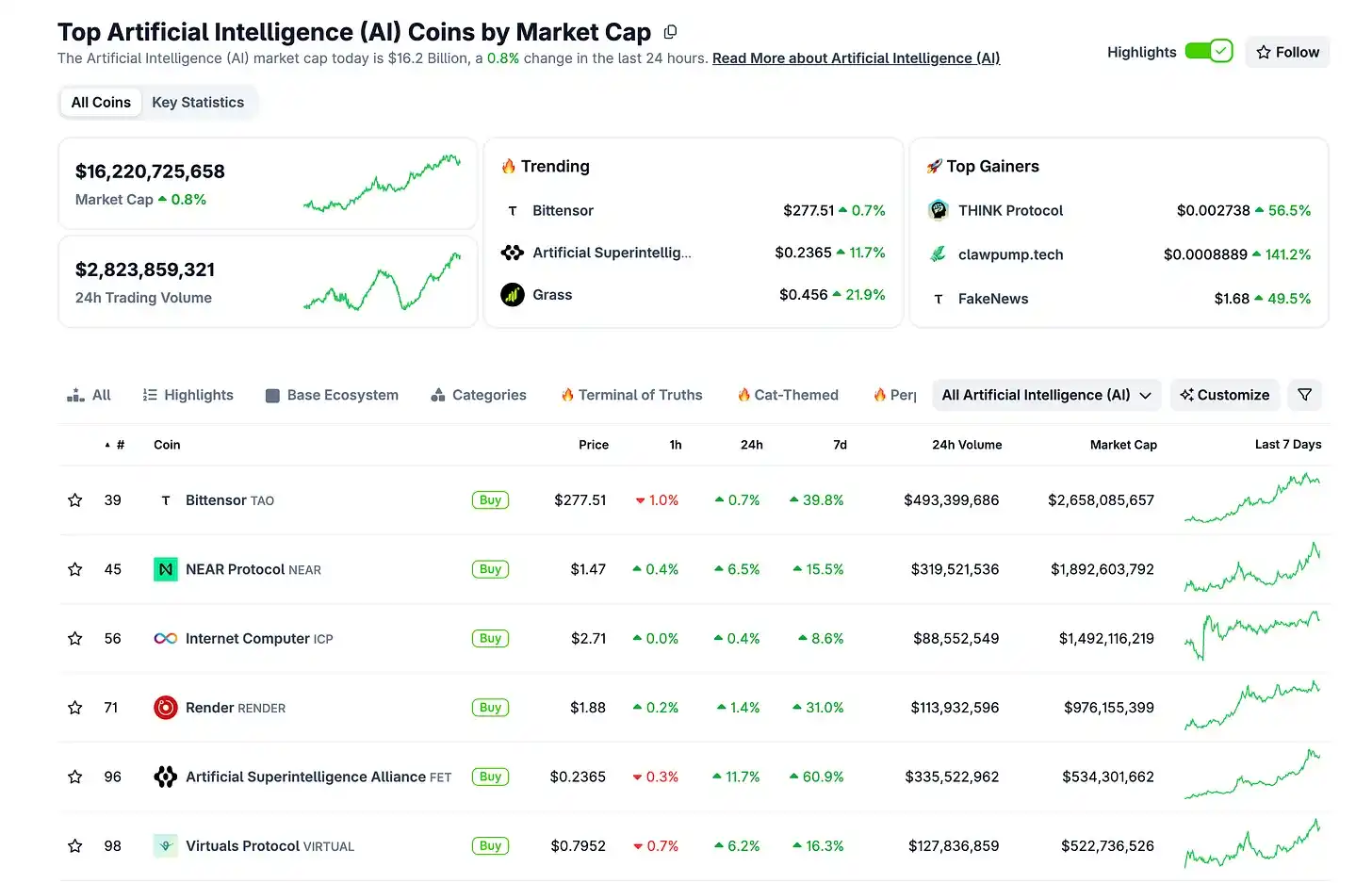
The core news this week was Templar's Covenant-72B (details above). The overall AI sector benefited from Bittensor's catalyst effect and continued institutional narrative momentum around Agent infrastructure.
TAO (7-day +40%): $277.51, market cap $2.66 billion. Catalyst: Covenant-72B; structural dynamics from subnets to TAO amplified gains.
FET (7-day +61%): $0.2365, market cap $534 million. The strongest weekly gainer among top DeAI assets. The Artificial Superintelligence Alliance benefited from sector rotation catalyzed by TAO, with capital broadly flowing into AI tokens.
RENDER (7-day +31%): $1.88, market cap $976 million. Covenant-72B proves distributed GPU networks can train competitive models, providing a tailwind for the decentralized computing narrative.
NEAR (7-day +16%): $1.47, market cap $1.89 billion. IronClaw (a security-hardened rewrite of OpenClaw in Rust, deployed on TEE) and NEARCON 2026 catalysts continue to have an effect. NEAR's positioning as enterprise-grade OpenClaw infrastructure keeps it in AI buying interest.
ICP (7-day +9%): $2.71, market cap $1.49 billion. Caffeine AI, a self-writing application platform on DFINITY's ICP platform, continues to attract developers (reportedly hundreds of thousands of monthly unique visitors according to Dominic Williams). Version V3 is upcoming, featuring Claude Code integration. The "Mission 70" tokenomics proposal aims to reduce annual inflation by 70% by the end of 2026, with Caffeine-driven compute burning as a key mechanism. Over the past 30 days, ICP ranked first in code development activity among AI/Big Data crypto projects.
VIRTUAL (7-day -16%): $0.7952, market cap $523 million. Pullback following AGDP-driven rally. But the more interesting story for VIRTUAL this week is in the x402 facilitator data: Virtuals have already ranked among the top three facilitators by transaction volume on x402 via ACP.
B) Robotics Total Market Cap Analysis
This week, the total Robotics sector market cap increased by $44 million (+6%), reaching $811 million:
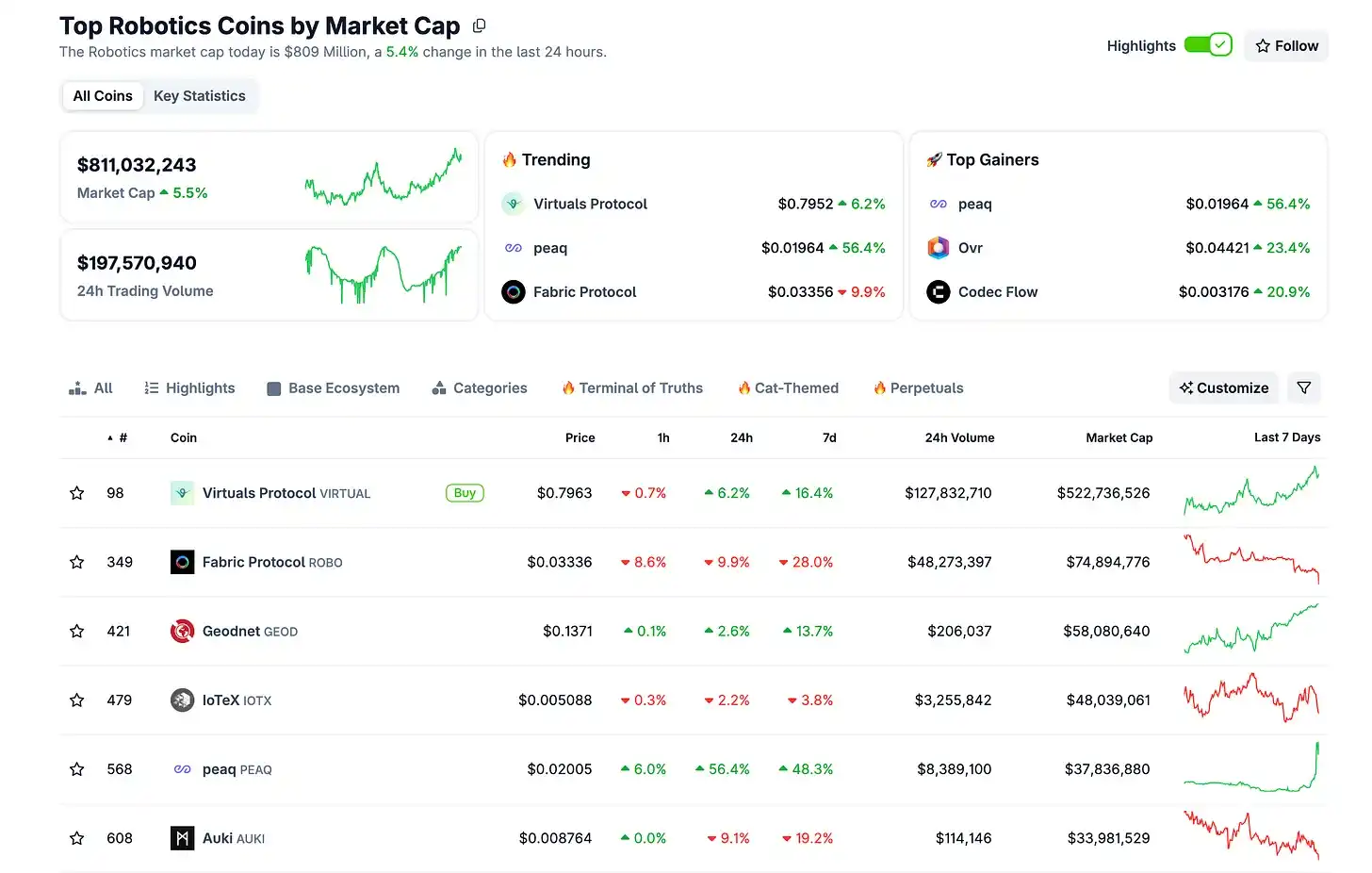
PEAQ (7-day +48%): $0.02005, market cap $37.8 million. The standout performer. peaq released a new video explaining the robotics narrative and its Robotics SDK (compatible with ROS 2, enabling any robot to obtain a peaq ID, perform on-chain payments/receipts, and data verification). Hashkey Capital's "Machine Economy" research report listed peaq as the foundational L1 for machine identity, payments, and governance. Over 60 DePIN projects across 22 industries are operational on the network; the Dubai VARA regulatory sandbox is open for on-chain robotics businesses.
ROBO (7-day -28%): $0.03336, market cap $74.9 million. Fabric Protocol (OpenMind/Fabric Foundation) is finding price equilibrium after initial listing enthusiasm. Still a relatively new player in the robotics category.
GEOD (7-day -14%): $0.1371, market cap $58.1 million. 24-hour trading volume only $206k, despite GEO-SWARM being live on Kickstarter and GEOD coverage added by Solana/Blockworks' Lightspeed institutional platform, which is expected to improve institutional visibility over time.
Crypto AI Agent Sector
a) Nansen DEX Fund Flows (All Traders, 7-Day)
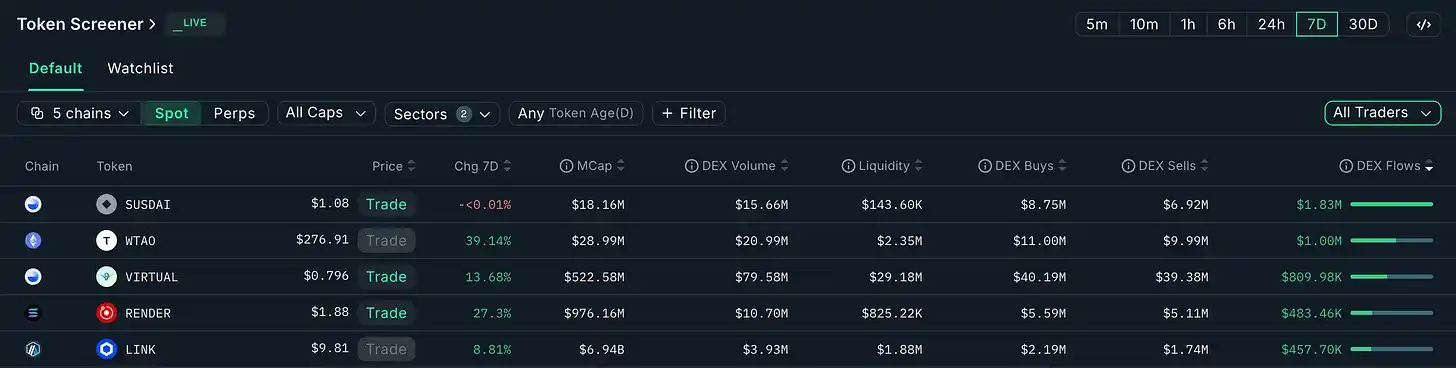
sUSDAI (+$1.83M net inflow): Largest net inflow in the AI sector. The yield layer for USDai, a GPU-collateralized stablecoin protocol (Permian Labs; backed by Dragonfly, Coinbase Ventures, YZi Labs). Lends against physical GPU infrastructure, returning yield via sUSDAI. PayPal/PYUSD integration; peak TVL $658M. CHIP governance token launched via CoinList in late February; capital is rotating into the yield layer. DeFi capital meets physical AI infrastructure financing.
WTAO (+$1.00M net inflow): $11.0M bought vs $10.0M sold. Confirms Covenant-72B drove real DEX accumulation behavior.
VIRTUAL (+$810k net inflow): Net inflow remained positive despite a 16.3% weekly price drop. $40.19M bought vs $39.38M sold. Smart money buying the dip. This group has the deepest liquidity at $29.18M.
RENDER (+$483k net inflow): Slight positive. Sector tailwinds, no specific catalyst. Render Con 2026 is upcoming.
LINK (+$458k net inflow): Noteworthy that Chainlink appears in the AI sector filter. Chainlink Runtime Engine is the connective tissue for Agent infrastructure; explicitly referenced in an AWS blog post this week regarding CRE integration.
b) Nansen Public Figure Fund Flows (7-Day)

DRV (+$264k net inflow, 7 traders): Derive, a decentralized derivatives protocol based on OP Stack. +48.84% in 7 days, market cap $111M. Institutional staking goes live on March 23; 25% of fees used for DRV buybacks.
FAI (+$187k net inflow, 4 traders): Freysa AI, a sovereign Agent stack on Base. Market cap $62M. Uses TEE and zkTLS, enabling Agents to hold their own keys. Similar to OpenClaw but approaches from a cryptographic sovereignty angle.
WTAO (+$105k net inflow, 3 traders): Corroborates the signal around Covenant-72B seen among all traders.
c) x402 Analysis
i) Transaction Count Down, Transaction Value Up
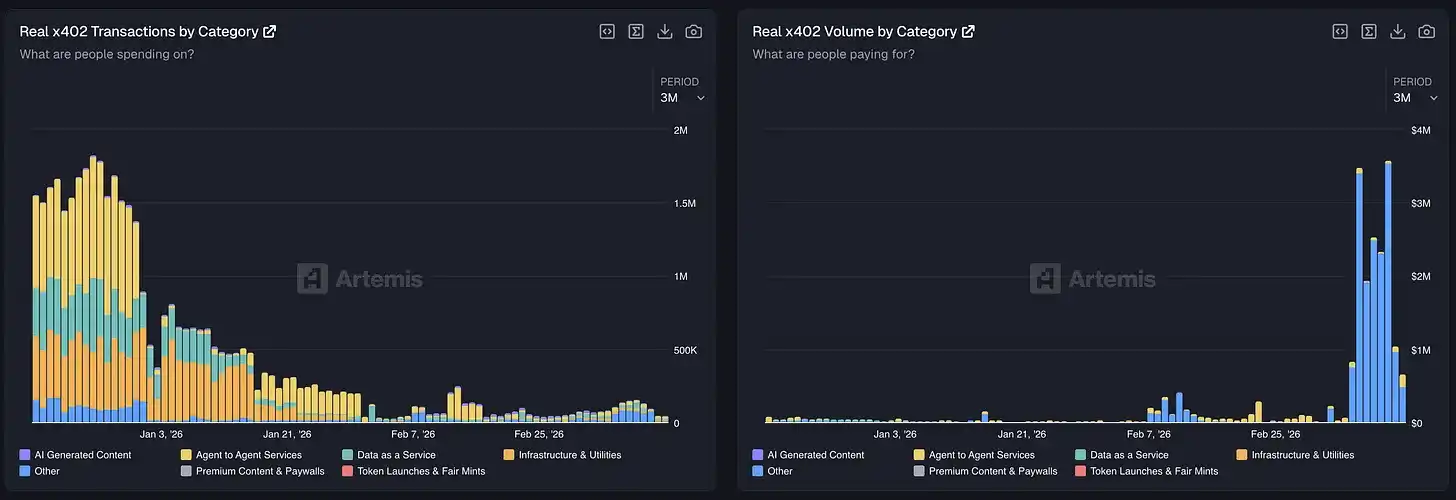
Artemis data tells two stories:
Transaction Count (Left Chart): Significant decline from Dec/Jan peaks. Daily average transactions dropped from over 1.5-2 million to the hundreds of thousands.
Transaction Value (Right Chart): Sharp uptick after a plateau in Jan/Feb, pushing daily average transaction value to $3-4 million. Concentrated in Infrastructure & Utilities and Data-as-a-Service categories, with Agent-to-Agent Services contributing secondarily.
This divergence is the most important signal for x402 currently. Decreasing transaction count with increasing transaction value means the average transaction size is growing. Fake transactions are being washed out; what remains are fewer, higher-value real commercial transactions.
Based on the current merchant landscape, the dominant categories likely represent: Agents paying for compute (cloud GPU, inference nodes, Chutes); API data source access (Firecrawl, StableEnrich, market intelligence data); browser sessions (Browserbase); and content generation (Freepik).
Agent-to-Agent Services is structurally the most interesting: autonomous Agents paying other Agents to complete subtasks.
AI-generated content and token issuance, which dominated early transaction counts, have largely been washed out.
ii) a16z and the Data Measurement Gap
a16z partner Noah Levine pointed out that "real" transaction volume is significantly lower than the inflated numbers caused by fake activity earlier this year. Bloomberg reported x402's 30-day payment volume at $24 million (data from x402.org); Allium Labs' data was around $3 million; Artemis, filtering out wash trading, estimated real volume at about $1.6 million.
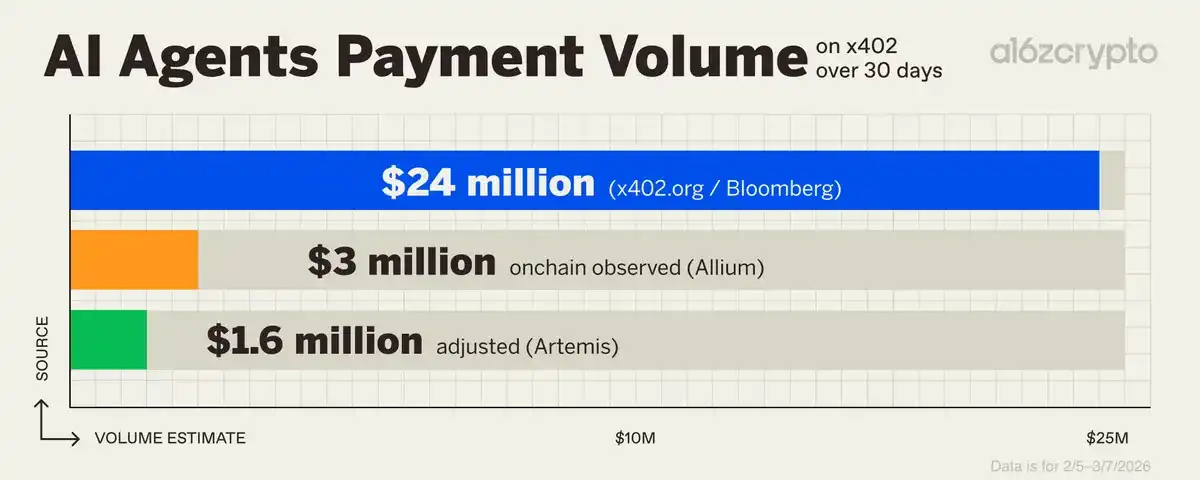
But this gap reveals how early the measurement infrastructure is—especially as more mature institutions begin adopting this open protocol: Stripe, Cloudflare, Vercel, and Google have all integrated x402.
These institutions are betting not on the current $1.6 million per month, but on what that number becomes when Agents become the default buyers.
iii) Top Facilitators Ranking (Past 7 Days)
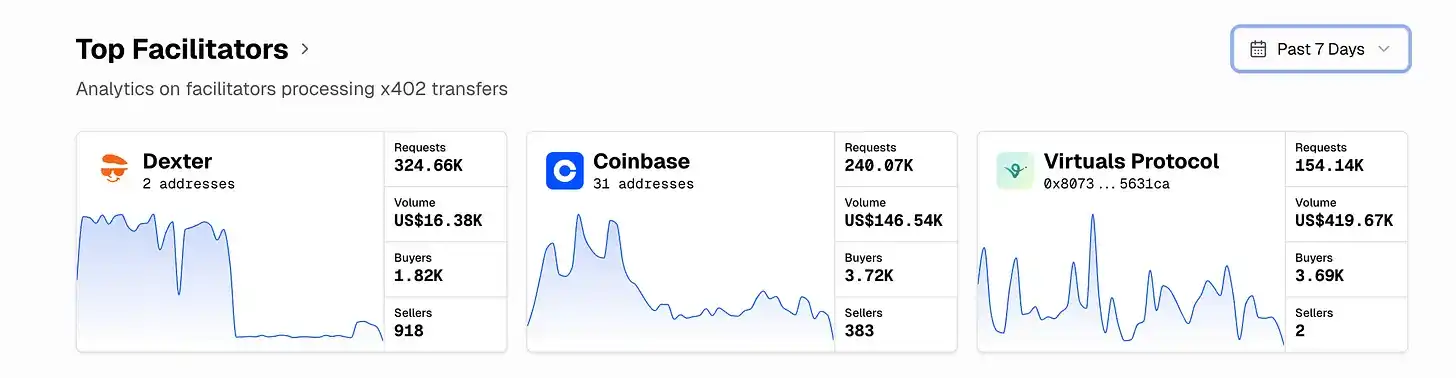
The facilitator ranking is diversifying: high-frequency micro-payments (Dexter), institutional API access (Coinbase), structured Agent commerce (Virtuals/ACP).
Virtuals Protocol (144.14k requests, $419.67k volume): Ranked third by request count, but highest by transaction value. Average price per request ~$2.72 (5x Coinbase's, 54x Dexter's). 3,690 buyers对应仅 2 sellers.
This is ACP settling structured Agent-to-Agent commercial transactions: a few service Agents completing high-value tasks for thousands of buyers.
On March 10, Virtuals and the Ethereum Foundation dAI team jointly submitted ERC-8183, formalizing the trusted Agent commercial transaction lifecycle alongside x402 (payments) and ERC-8004 (identity/reputation).
iv) AWS Releases Full x402 Reference Architecture
On March 15, AWS published "x402 and Agent Commerce: Redefining Autonomous Payments in Financial Services" on its industry blog, including a complete technical reference architecture.
When AWS releases a production-grade reference architecture with open-source code for a native crypto payment standard, the protocol moves from the conceptual stage to the infrastructure stage.
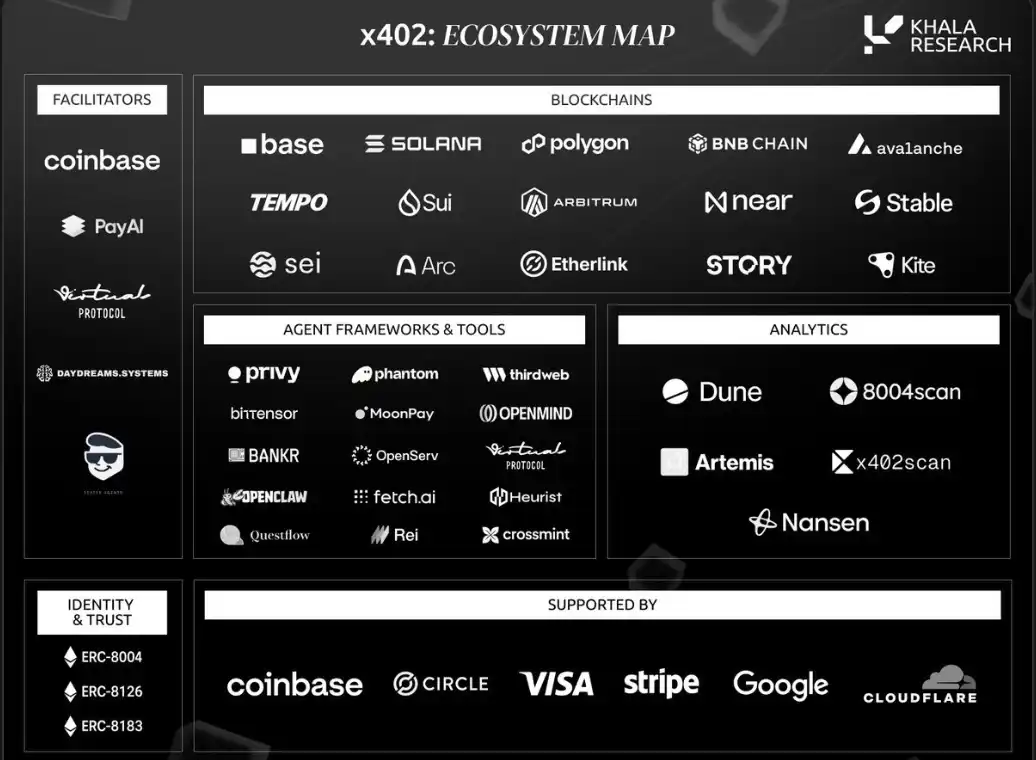
To learn more about x402's trajectory, follow Khala Research, as we will release a full report later this week. Below is the current ecosystem map:
Disclaimer: The content covered in this communication should not be considered investment or financial advice. It is for informational and educational purposes only.
Disclosure: I hold some of these assets and have cooperative relationships with certain projects mentioned in this communication.