Unreal Engine CEO Watches the Latest World Model: Code-Driven, Video Models Generate Scenes

marsbitPublished on 2026-09-07Last updated on 2026-09-07

Abstract

Recent advances in video generation models have improved visual quality, temporal consistency, and controllability, enabling the synthesis of coherent sequences from text, images, or user inputs. However, merely continuing a visual sequence is not equivalent to simulating a dynamic world. Complex worlds involve high-level semantics such as goals, rules, relationships, and causal consequences that persist over time, often beyond the immediate visual frame. Existing models that directly map actions to pixels struggle to explicitly maintain this state and reasoning. This article introduces the Code World Model (CWM), a novel paradigm developed by researchers from Westlake University and Nanyang Technological University. CWM decouples world simulation from visual rendering. A coding agent (powered by a large language model) acts as the "brain," writing and modifying executable code to maintain and update the world's state based on goals, rules, and events. This code handles infrequent, complex decisions and deterministic state updates (e.g., positions, collisions). A key innovation is the use of a "proxy"—a lightweight, coarse visual representation compiled from the current world state. The proxy, rendered at a lower resolution, specifies spatial-temporal constraints like entity locations, trajectories, camera motion, and scene layout. A separate video model then generates the final high-fidelity RGB video, conditioned on this proxy and textual descriptions, adding rich texture...

In recent years, video generation models have rapidly advanced in clarity, temporal consistency, and controllability. Given text, images, camera trajectories, or player actions, models are now capable of synthesizing coherent subsequent frames, bringing the concept of "interactive video worlds" from theory to observable, operable prototypes.

However, continuing the visual sequence does not equate to running a world. Movement and collision within the frame are only the most intuitive layer of interaction; in more complex environments, characters have goals, identities, and relationships, events are constrained by rules, and actions have causal consequences that span longer timeframes. Many states occur even off-screen yet still alter subsequent plots and actions. Predicting the next segment of observation based solely on local pixels makes it difficult to explicitly maintain these high-level semantics.

Complex worlds first require "understanding why." Goals, rules, memory, and causal chains are often not directly readable from the current frame, yet they determine how the world should change next. Language models, with their capabilities in knowledge retrieval, reasoning, planning, and programming, are well-suited to handle these low-frequency but high-complexity decisions and translate them into executable rules.

Another often overlooked fact is: game video is not the world itself, but the pixel projection of a program's execution after rendering. Currently, games and simulators still constitute the primary source of interactive data for video world models. If only actions and pixels are retained, and a video model is tasked with directly learning the mapping between them, it bypasses the originally existing program, rules, and explicit world state, instead requiring the model to reverse-engineer the entire program behavior from visual outcomes. This learning path is not only inefficient but also couples "how the world evolves" and "how the world is presented" into a single model.

Based on this observation, a research team from the Westlake University AGI Lab and Nanyang Technological University proposed Code World Model, a novel world model paradigm with a language model as its "brain." Its core idea is to have a coding agent continuously write, invoke, and modify code to maintain and update an executable world state; the state relevant to the current observation is then converted into proxies to guide a video model in generating detailed visual scenes.

Paper Link:https://arxiv.org/abs/2608.25927

Project Page:https://buaacyw.github.io/cwm/

Code Repository:https://github.com/buaacyw/code-world-model

Here, the language model does not replace the video model. Code World Model redefines their responsibilities: knowledge, goals, rules, and long-term causality are handled by the coding agent and code; appearance, motion details, lighting, and texture are handled by the video model. In other words, the former determines *what* happens in the world, the latter determines *how* it all looks.
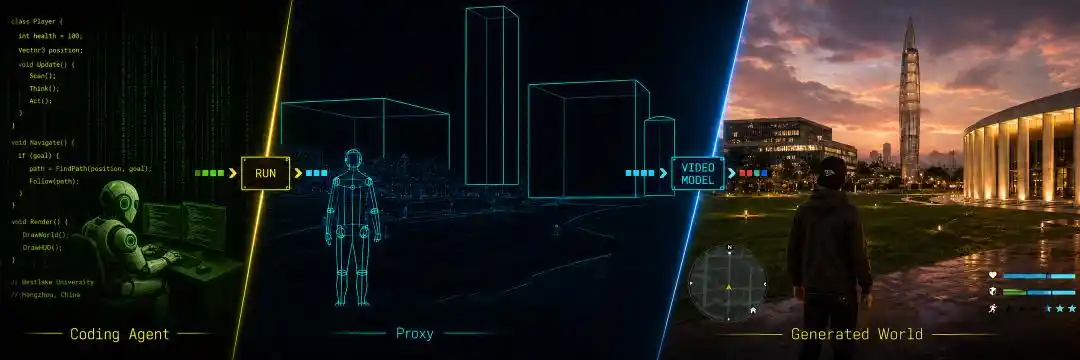
Figure 1: The core division of labor in Code World Model: the coding agent evolves the world state through code, proxies convert relevant states into visual conditions, and the video model generates the final scene.

Method Overview

Building on this division of labor, Code World Model decomposes the world's operation into three interconnected parts.

Coding Agent: Understands player intent and new events, invokes world knowledge, infers potential consequences, and decides which mechanisms need to be executed, combined, or modified.

Code: Executes deterministic updates such as position, attributes, collision, cooldowns, and event triggers at a higher frequency, turning high-level decisions into inspectable, reusable, and continuously executable rules.

Video Model: Reads the evolved state conditions and leverages the appearance, motion, and interaction priors learned from large-scale visual data to generate visual observations rich in texture, lighting, and local dynamics.

This division also corresponds to different computational frequencies. The coding agent only needs to make sparse decisions when new goals, complex events arise, or existing mechanisms are insufficient; once decisions are written into code, the program can continuously execute dense state updates.

More importantly, the coding agent can rewrite not just numerical values at a given moment, but also the operational rules the world follows thereafter.
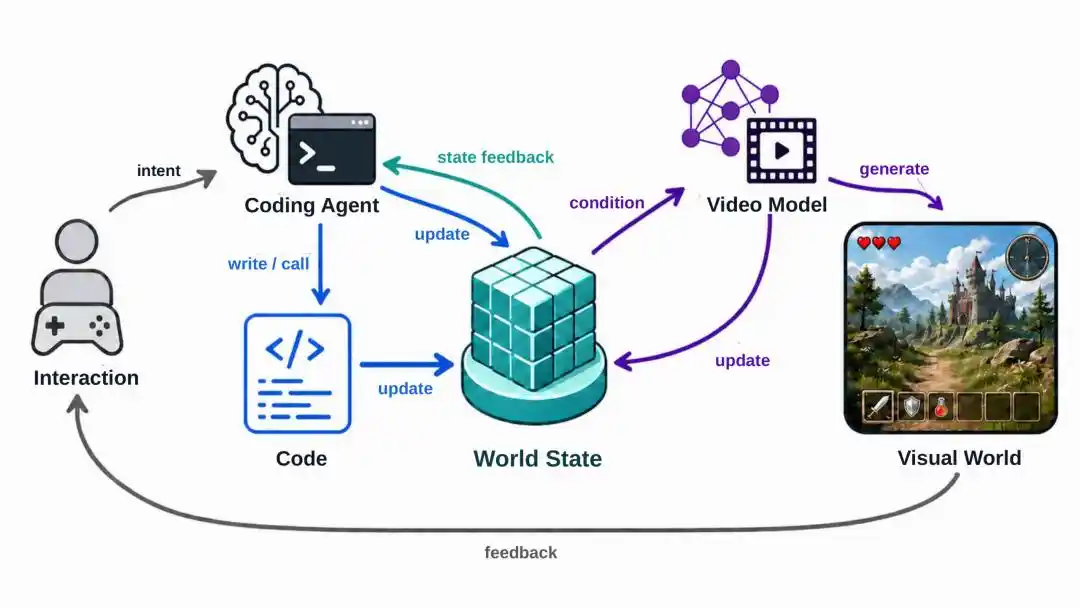
Figure 2: Overall framework of Code World Model. The complete vision includes visual feedback; the current prototype focuses on validating the forward path: coding agent / code → world state → proxy → video model.

Proxy: Connecting Executable State to Video Generation

After dividing responsibilities, a key interface problem remains: the coding agent and code maintain an executable state, but the video model receives text, images, or video tokens. A common language is needed that is both easy to construct programmatically and can provide per-frame spatial constraints.

Structured text is flexible but struggles to stably describe per-frame entity positions, relative relationships, motion trajectories, and precise camera changes for each frame; fully constructing and rendering a 3D world offers stronger control but reintroduces the high cost of assets, geometry, materials, animation, and rendering pipelines.

To address this, this work introduces a proxy. It extracts from the world state the information truly needed for the current observation and organizes it into a coarse-grained visual representation. A lightweight, deterministic compiler renders the proxy into a proxy video, which is then fed into the video model along with structured text.

Text is responsible for specifying "who, what, and what to do," while the proxy dictates "where, how to move, and how the camera shoots."

The proxy can express camera and viewpoint, entity positions and orientations, scale and trajectories, scene layout and occlusion, and the coarse-grained state needed for current interactions; texture, materials, detailed lighting, and full local motion are intentionally left to the video model. The paper summarizes this design principle as: retain only the minimally sufficient state required for the current observation, striking a balance between control capability and state encoding cost.

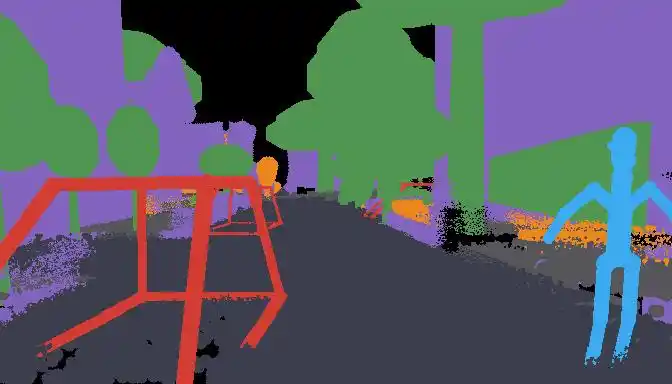
In the current implementation, the proxy's width and height are only one-quarter of the target video's, with approximately 1/16th the pixel count. It is composed of simple, reusable geometric primitives, requiring no production-quality assets, yet it provides a per-frame, editable spatiotemporal skeleton.

Obtaining Strictly Aligned Data from Game Runtime Recordings

For the video model to learn to understand the proxy, training samples need to simultaneously contain proxy video, structured text, and target RGB video, with strict alignment in time, camera, and entity identity between the proxy and RGB.

Game runtime recordings naturally preserve this correspondence. The research team synchronously recorded RGB, camera state, entity identity, position and orientation, approximate scale, scene layout, and interaction state from the same gameplay execution, then compiled the proxy offline via code. Since both originate from the same execution, a one-to-one correspondence can be established for each frame, and identities can be consistently mapped across frames.
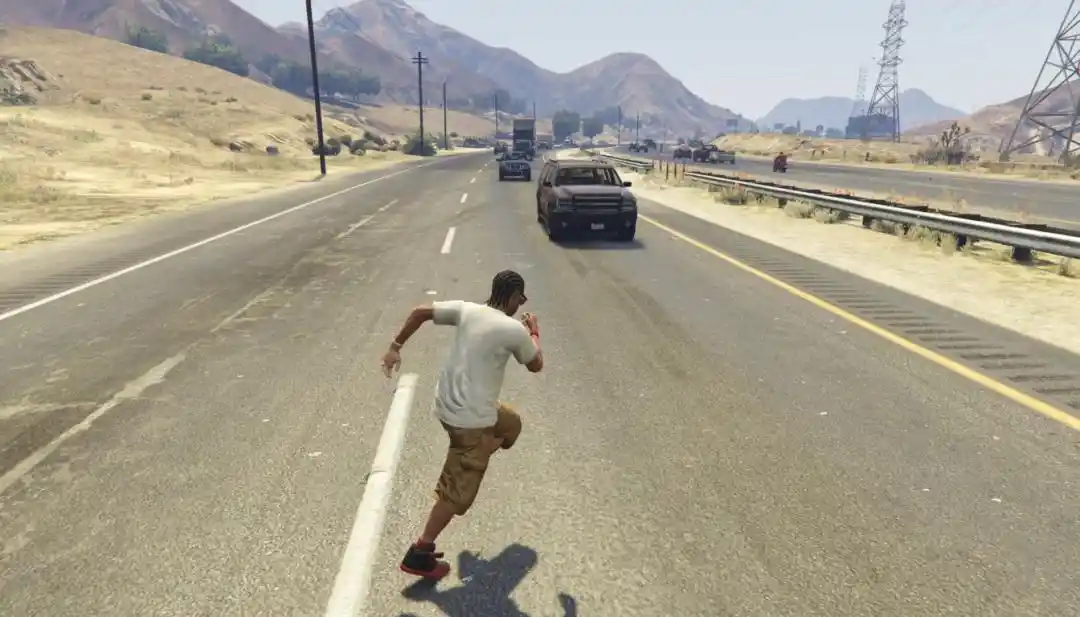
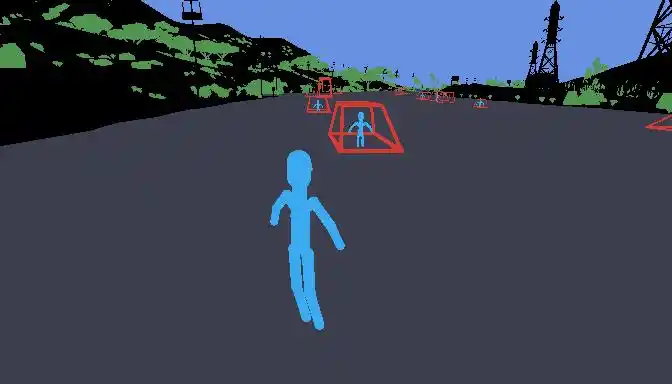
Figure 3a: Target RGB (top) and same-frame proxy (bottom) from game data.

Figure 3b: Target RGB from real video (top), and proxy constructed offline using camera calibration, 3D reconstruction, and object annotation (bottom).

The gameplay data used in the paper comprises 157 recordings, totaling approximately 5.6 hours of source video. The research team sampled at 2-second intervals, obtaining 9,420 training clips of 5 seconds each; each RGB target contains 124 frames at a resolution of 1344×768, 24 FPS. The corresponding proxy also contains 124 frames at a resolution of 336×192, combined with fixed-log depth and categorical semantic-ID maps.

The same runtime recording can be recompiled into proxies with different coverage and information granularity without needing to re-record RGB.

The paper also demonstrates an offline construction pipeline for proxy-observation pairs from real videos using KITTI-360 to illustrate the potential for extending this interface to real data; the current video model adaptation still only uses paired gameplay data.

How Does the Prototype System Operate?

The current prototype uses the Ref2VA backbone of MiniMax-H3 as the video model, applying rank-128 LoRA adaptation to all 50 transformer blocks, with approximately 596 million trainable parameters. Training was conducted on 8 NVIDIA H800 GPUs for 3 epochs and 3,534 optimization steps.

During inference, GPT-5.6 Sol serves as the coding agent. The system provides it with basic player controls, collision handling, runtime update loops, existing game-engine scene and gameplay logic templates, and the proxy primitives used during training. The coding agent can combine, extend, and rewrite this code to construct simple, executable, player-controllable worlds; the coarse-grained 3D geometry is used solely to express the proxy, not as the final visual output.

For each 5-second clip, GPT Image 2 generates an appearance anchor based on the first proxy frame and text; MiniMax-H3 then combines the first frame, the full proxy sequence, and text to generate a 124-frame, 1344×768, 24 FPS RGB video.

Longer videos are generated via a sliding window with a 34-frame overlap: the latter window inherits the RGB context from the end of the previous window and reuses the same appearance anchor to maintain local continuity and overall identity appearance.

Experimental Results

Qualitative results show that even with LoRA adaptation using only about 5.6 hours of gameplay source video, the model can still follow the character positions, action trajectories, scene layouts, and camera movements specified by the proxy, while complementing them with rich textures, lighting, and local dynamics, even when character, environment, and style significantly deviate from the training appearance.

Figure 4: The proxy provides character position and action trajectory; the video model renders the same coarse skeleton into characters of different identities and artistic styles. Top: proxy; Bottom: generation results.

Figure 5: Simple geometric primitives constrain complex objects and camera movements. Top: proxy; Bottom: generation results.

For example, the same coarse human primitive can be rendered as characters with completely different identities and artistic styles; wireframes or boxes can constrain the position and approximate motion of vehicles, boats, and other complex objects; the same proxy interface can also express running, dancing, swimming, falling, and camera orbiting.

This demonstrates that the proxy fixes the necessary spatiotemporal skeleton for the current observation, not the assets and style of the training game.

The project page also provides video comparisons with action- or camera-conditioned video world models.

This comparison focuses on the granularity of control and visual results: the proxy directly provides per-frame entity motion and viewpoint changes, thus enabling finer-grained, more direct spatiotemporal constraints; the paper does not present this set of results as an inference latency comparison.
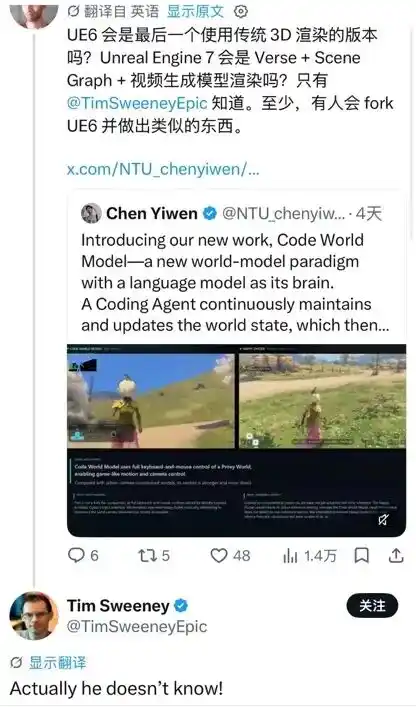
A netizen commented, "Will Unreal Engine 6 be the last engine to create games using traditional 3D methods? Perhaps Unreal Engine 7 will use a similar technical approach. Only Unreal Engine CEO Tim knows the answer."

Tim then came to view it and said, "I don't know either!"

Conclusion: First Decide What Happens in the World, Then Generate How It Looks

Previous video world models mainly learned "how observations continue." Code World Model pushes the problem a step further: before generating the next segment of observation, first maintain what the world currently is, which rules it follows, and why the consequences of an event persist.

A truly open generative world requires both the visual imagination of video models and an execution mechanism capable of maintaining knowledge, goals, rules, relationships, and causal consequences. The core of Code World Model can be condensed into one sentence: let code decide what happens in the world, and let the video model decide how it all looks.

Reference: https://arxiv.org/abs/2608.25927

This article is from the WeChat public account "New Zhiyuan," author: New Zhiyuan; Editor: LRST

Related Questions

QWhat is the core idea proposed by the researchers for the 'Code World Model' paradigm?

AThe core idea is to decouple high-level semantics from visual rendering: a coding agent uses a language model as a 'brain' to maintain and update executable world states through writing and modifying code, which then guides a video model via proxies to generate the detailed visual observations. In short, code determines what happens in the world, and the video model determines how it looks.

QWhat problem does the 'proxy' component aim to solve in the Code World Model framework?

AThe 'proxy' component serves as an interface that bridges the gap between the executable world state maintained by code and the visual inputs required by the video model. It extracts coarse-grained spatial-temporal information (like entity positions, camera trajectory, layout) from the world state and renders it into a low-resolution proxy video, providing necessary constraints for the video model without the high cost of full 3D rendering.

QWhy is game runtime recording particularly suitable for training the video model in this research?

AGame runtime recordings provide naturally and strictly aligned pairs of RGB video, camera states, entity identities, positions, and other interactive states from the same gameplay execution. This allows for the offline compilation of perfectly synchronized proxy videos and target RGB videos, ensuring precise temporal and spatial correspondence essential for training the video model to understand the proxy conditions.

QAccording to the article, what are the different roles and computation frequencies of the coding agent and the executable code in the system?

AThe coding agent handles sparse, high-complexity decisions—like understanding new goals, events, and reasoning about consequences—and determines what mechanisms need to be written or modified. Once its decisions are encoded into executable code, that code runs at a high frequency to perform dense, deterministic updates of positions, attributes, collisions, and event triggers, continuously evolving the world state.

QWhat key advantage does the Code World Model approach claim over traditional video prediction models?

ATraditional video world models primarily learn 'how observations continue' based on pixels. The Code World Model advances this by first explicitly maintaining and reasoning about the world's state, rules, goals, relationships, and causal consequences *before* generating the next visual observation. This separation allows for more coherent long-term narratives and complex interactions that depend on high-level semantics not directly visible in pixels.

Related Reads

ICP Cloud Engine Heats Up: "20% of Revenue Used for Burn", How Far is it From Token Revaluation?

The ICP community is discussing Cloud Engines, a product enabling enterprises to run private subnets on the Internet Computer. It is linked to the "Mission 70" deflationary plan, where node providers allocate 20% of Cloud Engines revenue to buy and burn ICP tokens, aiming to reduce ICP's inflation rate from 9.72% to 2.92%. This narrative connects enterprise adoption to token scarcity and potential price appreciation for ICP, which is down 99.6% from its peak. Cloud Engines functions as a "custom data center," offering businesses dedicated, sovereign infrastructure without vendor lock-in, using the same underlying protocol as the public ICP network. Key selling points include data sovereignty and hardware choice. However, critical features like SEV-encrypted nodes (for enhanced security) and operator-controlled upgrades are still on the roadmap, not yet live. Early adopters include Pakistan's national cloud engine and a UNDP pilot. The "Mission 70" goal relies on two pillars: supply-side reductions (like cutting node rewards) and demand-side increases in token burns from Cloud Engines revenue. While supply-side changes can be enacted via governance, the demand-side depends entirely on market adoption. Current daily burn rates are far below the levels needed to achieve the 26% deflation target attributed to increased burns. Analysts remain cautious, viewing the 20% burn mechanism as a forward-looking narrative. The product is in early access, and significant, scalable enterprise adoption is unproven. Near-term price catalysts are more likely to come from implementable supply-side governance proposals. The Cloud Engines story represents a longer-term bet on ICP capturing a segment of the enterprise cloud market, with token revaluation contingent on the product generating substantial, quantifiable burn data.

marsbit12m ago

ICP Cloud Engine Heats Up: "20% of Revenue Used for Burn", How Far is it From Token Revaluation?

marsbit12m ago

Bank of America's Hartnett: Interest Rate Hikes Become the Biggest Positive, Bond-Ending Bubble Logic Is Spreading

In a recent note, Bank of America strategist Michael Hartnett argues that aggressive central bank tightening, including a potential Fed hike in October, could paradoxically be the most bullish near-term catalyst for risk assets. His core thesis is "the bond bubble is bursting." While stocks remain resilient due to strong US data, solid earnings expectations, and robust AI-related capital expenditure plans, bonds are already showing severe stress, with government bonds down 4.4% year-to-date. The logic is that a proactive Fed hike could help anchor runaway long-end yields (the 10-year recently touched 5.36%), preventing a disorderly surge toward 6%. Without such action, the pressure from rising term premiums could continue unabated. The damage from higher rates is already visible in the most rate-sensitive areas: South Korean retail brokers, French government bonds (with the France-Germany spread hitting 140 bps, reminiscent of the 2012 crisis), and CCC-rated credit. Hartnett highlights that the $8 trillion in money market funds is unlikely to flow into equities without a clear shift to monetary easing. Furthermore, the upcoming US midterm elections pose a key risk; a Democratic sweep (currently a 64% probability) could trigger a >10% equity sell-off due to fears of higher taxes and regulation. Near-term strategy involves positioning for a peak in yields (e.g., long 30-year Treasuries) and risk contraction ahead of the elections, while maintaining exposure to commodities and EM assets. Key levels to watch include 10-year yields at 6%, the France-Germany spread at 150 bps, and a Bull & Bear Indicator below 8 for a potential risk rebound.

marsbit15m ago

Bank of America's Hartnett: Interest Rate Hikes Become the Biggest Positive, Bond-Ending Bubble Logic Is Spreading

marsbit15m ago

Silicon Valley AI Status: Whoever Has the Compute is the Boss

The Silicon Valley AI Power Crunch: Compute is King Silicon Valley's race for AI dominance has devolved into a desperate scramble for computing power. The situation has become so extreme that even top executives are resorting to unusual measures. Anthropic's CEO Dario Amodei was reportedly turned down by Meta's Mark Zuckerberg when seeking additional GPU resources, leading to a deal where SpaceX acts as a broker, reselling Nvidia GPUs to Anthropic. This venture reportedly generated $2.561 billion in quarterly AI revenue for SpaceX. The shortage is reshaping the industry's dynamics, creating a new "compute economy" where GPU access is the ultimate currency. This scarcity is causing internal strife at major firms and altering competitive landscapes. A high-profile example is Noam Shazeer, a key AI scientist whom Google re-hired for $2.7 billion, only for him to leave for OpenAI reportedly due to insufficient compute resources for his team. Similar frustrations over resource allocation have been cited within Google and DeepMind. For AI startups, the challenge is existential. Cloud providers are now demanding multi-year contracts with large upfront payments, making flexible, on-demand access nearly impossible. This has spurred innovative workarounds, including a new market for "global compute prospecting"—companies scavenging for underutilized server capacity worldwide—and venture capital firms like Y Combinator and Radical Ventures directly acquiring and allocating GPU clusters for their portfolio companies. The root causes are complex: explosive growth in AI model complexity and the shift from simple chatbots to persistent "Agent" systems dramatically increase compute demands. While tech giants are building new data centers, supply cannot keep pace with immediate needs. Rental prices for critical chips like the Nvidia H100 have surged nearly 40% in months. The consequence is a consolidation of power. Compute access is becoming the definitive barrier to entry, significantly strengthening large companies with their own infrastructure and creating a lucrative "picks and shovels" market for those who control the hardware supply. In today's Silicon Valley, compute isn't just a resource—it's the foundation of survival and competitive advantage.

marsbit41m ago

Silicon Valley AI Status: Whoever Has the Compute is the Boss

marsbit41m ago

Even Losing Money Requires Waiting in Line, How Far Can PaperTrade's 1000x Leverage Experiment Go?

PaperTrade, a synthetic perpetual contract platform built on HyperEVM, launched on October 10th. Its defining feature is offering up to 1000x leverage and rewarding users with its native token, PAPER, for trading losses or liquidations—a mechanism dubbed "losing money to mine." This sparked initial frenzy, with users queuing to execute trades and generate losses for PAPER rewards. Within 24 hours, nominal trading volume exceeded $678 billion. The platform operates without traditional order books; users trade directly against a shared USDC liquidity pool. Profits are paid from this pool, but if insufficient funds exist, payments queue on a first-in, first-out basis. PAPER has zero initial supply, minted solely from qualifying user losses, and can be staked for a share of protocol revenue. However, controversies emerged quickly. Smaller orders faced longer execution queues compared to larger ones. More critically, PaperTrade's reliance on Hyperliquid's mid-price for asset pricing made it vulnerable to market manipulation. Reports indicated that actors potentially moved prices on Hyperliquid to profit from large, highly leveraged positions on PaperTrade. The team acknowledged this as a known risk, exacerbated by high initial position limits, and has since tightened limits to reduce the attack surface. After the initial surge, open interest and margin deposited have significantly declined. The platform's long-term viability hinges on whether the value and revenue share from PAPER can justify the initial "loss-mining" strategy for users, moving beyond speculative hype to sustainable returns.

marsbit1h ago

Even Losing Money Requires Waiting in Line, How Far Can PaperTrade's 1000x Leverage Experiment Go?

marsbit1h ago

Trading

Spot
活动图片