SpaceX IPO Unlock Timeline

marsbitPublicado a 2026-06-17Actualizado a 2026-06-17

Resumen

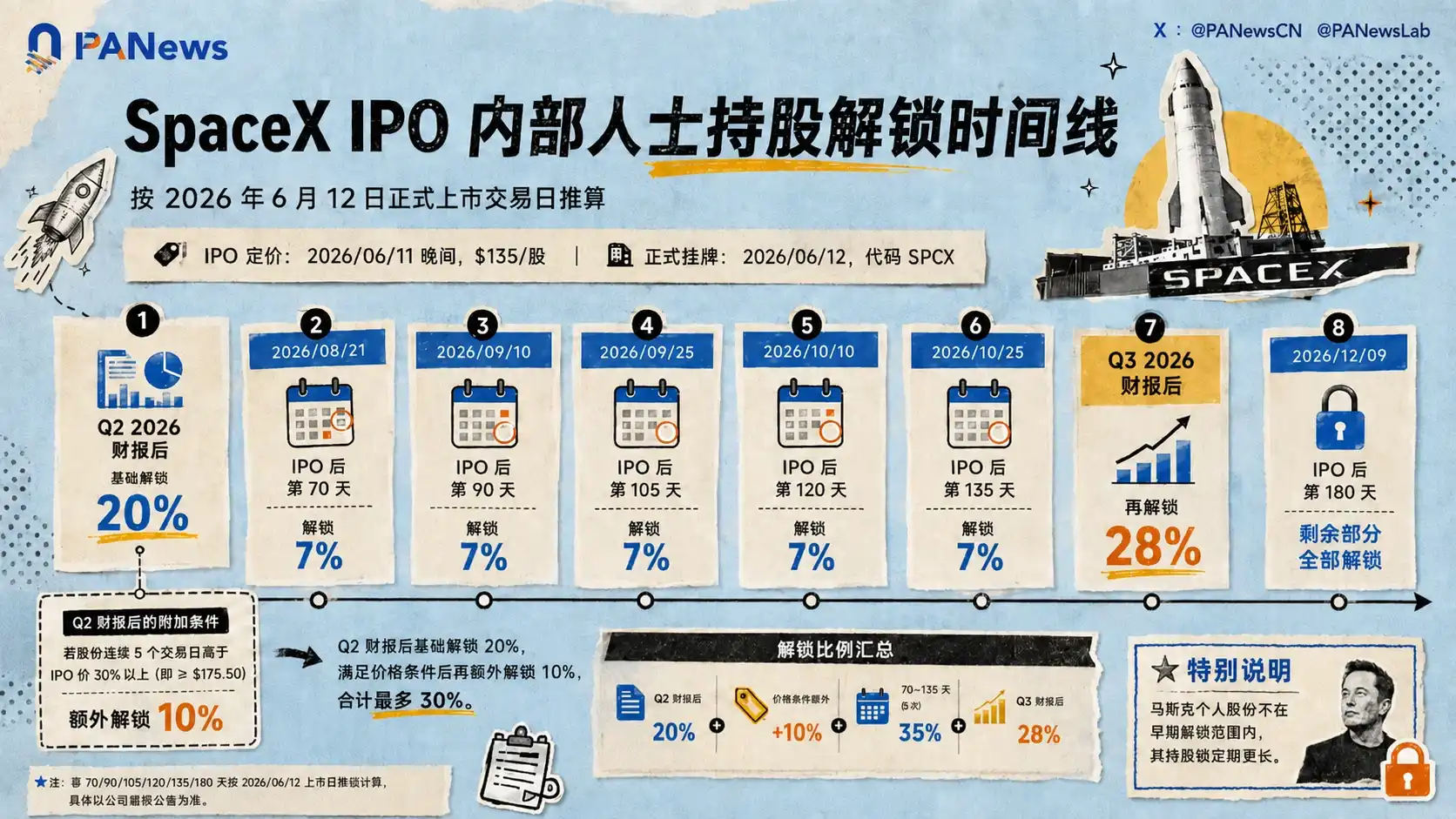
SpaceX (stock symbol: SPCX) shares have been rising strongly since its IPO, largely due to extremely low immediate float. Currently, only about 4.2% of total shares are freely tradable, locking approximately 96% of the equity. However, a series of share unlock events are scheduled, which could increase selling pressure. After the Q2 earnings report, up to 30% of locked shares may be released. Following that, an additional 7% is set to unlock approximately every 15 days. After the Q3 earnings report, another 28% will be released. The final remaining locked shares are scheduled for full release on December 9th, which is 180 days after the IPO. It is noted that Elon Musk's personal holdings are subject to a longer lock-up period and are not included in these early unlock phases.

SpaceX (SPCX) has been continuously rallying since its listing. The reason might be simple: currently, only about 4.2% of the total outstanding shares are floating, with 96% of the shares still unable to be sold.

But the pressure of unlocking is already counting down: Up to 30% will be released after the Q2 earnings report, followed by an additional 7% unlocked approximately every 15 days. Another 28% will be released after the Q3 earnings report. The remaining portion will be fully unlocked on December 9th (the 180th day after the IPO).

Elon Musk's personal holdings are not included in the early unlock scope and have a longer lock-up period.

Preguntas relacionadas

QWhat is the approximate percentage of SpaceX's total shares currently available for trading after its IPO?

AApproximately 4.2% of SpaceX's total shares are currently in the float and available for trading.

QAccording to the article, what is the main reason suggested for SpaceX's post-IPO stock price rally?

AThe main reason suggested is the extremely low float, with only about 4.2% of total shares initially available for trading, creating limited supply.

QWhat is the maximum percentage of locked shares that could be released after the Q2 earnings report?

AUp to 30% of the locked shares could be released after the Q2 earnings report.

QHow often will additional share unlocks occur after the initial post-Q2 release, and what is the size of each subsequent unlock?

AAfter the initial release, an additional 7% of shares will unlock approximately every 15 days.

QAre Elon Musk's personal shares subject to the same early unlock schedule as described in the article?

ANo, Elon Musk's personal shares have a longer lock-up period and are not included in the early unlock schedule.

Lecturas Relacionadas

A Country That Mined Bitcoin for 8 Years Has Built Its Own Dedicated Crypto Bank

A country that has been mining Bitcoin for eight years has established its own dedicated crypto bank. DK Bank, located in Bhutan's newly developed GMC special administrative zone, aims to fill the significant banking service gap for the cryptocurrency industry. Its CEO, Zheng YD, explained that most banks avoid crypto businesses due to a lack of risk management frameworks for decentralized and anonymous protocols. Operating under a unique "one country, two systems" governance model separate from mainland Bhutan, GMC aspires to become a financial hub for South Asia. DK Bank differentiates itself by offering integrated multi-currency accounts where users can manage both fiat currencies and stablecoins like USDT and USDC in one place, alongside services like Bitcoin-backed loans. The bank faces technical challenges in merging traditional banking systems with 24/7 crypto markets and implements rigorous on-chain and off-chain transaction monitoring for risk control. GMC's regulatory framework draws from Singaporean common law and Abu Dhabi's ADGM rules, offering a fast-track licensing process for already licensed firms while maintaining high standards. The initiative is part of Bhutan's longer-term crypto strategy, which includes Bitcoin mining since 2018. The focus, however, is on building a diversified institutional-grade crypto ecosystem—including custody and asset management—rather than retail speculative tokens. Proponents argue such sovereign crypto infrastructure is necessary, and Bhutan's early, measured approach exemplifies the thoughtful integration needed in global finance.

Foresight NewsHace 1 min(s)

A Country That Mined Bitcoin for 8 Years Has Built Its Own Dedicated Crypto Bank

Foresight NewsHace 1 min(s)

Unveiling the Whales of the World Cup Prediction Market: Smart Money Stumbles on the Pitch, 'Buy No' Outperforms 'Buy Yes'

**Title: Unveiling the Whales of the World Cup Prediction Market: "Smart Money" Stumbles on the Pitch as "Buying No" Outperforms "Buying Yes"** An analysis of pre-match trades over $5,000 on Polymarket for 20 completed group stage matches reveals a counterintuitive finding: large "smart money" bets were not consistently accurate. Aggregated pre-match buying volume was $89.55 million, with a weighted hit rate of only 48.5%. Holding these positions would have resulted in an estimated net loss of about $1.76 million (ROI -2.0%), challenging the notion that big money reliably predicts outcomes. The data highlights several key dynamics. Draws proved to be a major risk, significantly impacting bets on favored teams, as seen in Belgium-Egypt and Spain-Cape Verde. Markets were more efficient for clear mismatches (e.g., Germany's big win) but became prone to bias when favorites were overvalued. Notably, buying "No" shares (betting against a specific outcome) significantly outperformed buying "Yes," with hit rates of 62.4% vs. 37.5%. This suggests the market often overprices popular narratives, creating value in contrarian positions. Individual trades showed extreme volatility. One wallet (mintblade) earned an estimated $6.77 million by betting against Iran, while another (LEEEROYJENKINS) lost roughly $8.39 million on a Belgium win. The market favors high-risk, high-reward information trading rather than steady arbitrage. For sustained insight, wallets with consistent performance across multiple matches (e.g., swisstony) are more telling than one-off big bets. Ultimately, the Polymarket acts less as a crystal ball and more as a mirror, reflecting crowd bias and the inherent unpredictability of football. True "smart money" may lie not in predicting the future, but in identifying and exploiting market mispricings while respecting risk.

marsbitHace 25 min(s)

Unveiling the Whales of the World Cup Prediction Market: Smart Money Stumbles on the Pitch, 'Buy No' Outperforms 'Buy Yes'

marsbitHace 25 min(s)

Bezos' Third Startup Still Can't Avoid Musk

Jeff Bezos Returns as CEO for Third Venture, Still Can't Avoid Musk After stepping down as Amazon CEO in 2021, Jeff Bezos has returned to the front lines as co-CEO of Prometheus, an AI startup he founded. In a recent CNBC interview, Bezos described the experience as "Type 2 fun"—exhausting but ultimately rewarding. Founded less than a year ago, Prometheus has already raised over $18 billion in two funding rounds, achieving a staggering $41 billion valuation. Prometheus aims to develop a "General Engineer AI" to accelerate the entire "invention loop"—design, simulation, testing, and manufacturing—for complex physical products like jet engines, spacecraft, and medical devices. This positions the company at the intersection of Bezos's past experiences: Amazon's platform-building scale and Blue Origin's rigorous physical engineering. This marks Bezos's third major venture, following Amazon and Blue Origin. His co-CEO is Vik Bajaj, bringing expertise from life sciences and hard tech. Bezos now dedicates most of his time to Prometheus, signaling his belief in its transformative potential. The move also comes as Bezos's space company, Blue Origin, faces challenges, including a recent test explosion delaying its New Glenn rocket. Meanwhile, Elon Musk's SpaceX achieved a record-breaking IPO, surpassing Amazon's market cap. While Musk focuses on AI for executing physical tasks (like Tesla's robots and SpaceX's engineering), Bezos is betting on AI to *invent* in the physical world. Prometheus enters a crowded industrial AI field with players like OpenAI, NVIDIA, and Tesla's Optimus. Its lofty valuation bets on the unproven but massive opportunity to become the foundational platform for engineering in the AI era—a "blue ocean" Bezos hopes to define before Musk does.

marsbitHace 28 min(s)
Bezos' Third Startup Still Can't Avoid Musk

marsbitHace 28 min(s)

Trading

Spot
Futuros
活动图片