Unitas is Committed to Building a Global Savings Layer for Digital Assets and Compliant High-Yield Stablecoins

marsbitPublished on 2026-01-12Last updated on 2026-01-12

Abstract

Unitas introduces a new market-neutral yield infrastructure standard, aiming to establish a global savings layer and compliant high-yield stablecoin ecosystem. It provides a modular yield service platform that decouples capital access, asset custody, and yield execution, serving both individual and institutional users without taking directional market risk. The core strength lies in its self-developed and self-operated yield engine, which manages the full lifecycle of signal generation, execution, and risk response. Unitas runs multiple market-neutral strategies under a unified risk framework, including delta-neutral liquidity strategies and basis arbitrage, ensuring returns come from market activity rather than price speculation. Built-in risk controls monitor exposures and hedging deviations in real-time, prioritizing stability over speed during volatility. Backed by 24/7 human oversight, the system demonstrated strong performance with a 16.7% net APY and only -0.16% max drawdown in 2025, including zero loss during extreme market conditions. Unitas emphasizes transparency through real-time disclosure of collateral and risk parameters. Future plans include expansion into TradFi, integration with RWA like tokenized stocks and commodities, and serving as a foundational yield layer connecting DeFi and traditional finance.

The digital asset infrastructure innovation team Unitas has announced the launch of a new market-neutral yield infrastructure standard. By constructing a "Yield Layer" for digital assets, Unitas is committed to providing professional market-neutral returns to global users based on full transparency and institutional-grade risk control.

Modular Architecture: Reshaping the Accessibility of Yield Services

Unitas provides a modular yield service platform designed to achieve sustainable capital growth without taking on market directional risk. Through a unified infrastructure, the platform decouples capital access, asset custody, and yield execution, serving not only individual investors but also meeting the stringent security and compliance requirements of corporate and institutional treasuries.

Proprietary Core Engine: Mastering the Full Lifecycle of Yield Execution

Different from the "strategy outsourcing" model that relies on third-party protocols, Unitas's core competitiveness lies in its self-developed, self-operated, and self-managed yield engine. Unitas controls the entire lifecycle from signal generation and trade execution to real-time monitoring and risk response.

Currently, the platform operates multiple market-neutral strategies in parallel under a unified risk framework:

  • Liquidity-Driven Delta Neutral Strategy: Captures real transaction fees and incentives in on-chain liquidity pools, supplemented by dynamic hedging, ensuring returns stem from market activity rather than price fluctuations.

  • Funding Rate and Basis Arbitrage: Captures structural price differences between spot and futures in derivative markets.

By integrating these strategies within a single system, Unitas achieves yield diversification while maintaining extremely high control over exposure, leverage, and liquidity.

System-Embedded Risk Control: Robust Performance in Extreme Market Conditions

Unitas deeply embeds risk control into the strategy execution layer. The system monitors net exposure, margin utilization, and hedge deviation in real-time, using them as hard constraints for position adjustments.

Its execution mechanism prioritizes "robustness" over mere response speed. During periods of severe market volatility, the system proactively limits adjustment frequency to avoid slippage risk and combines it with a "24/7 manual real-time supervision" model to ensure precise human-machine collaborative intervention under abnormal conditions.

Practical Data Validation: Exceptional Resilience Across Cycles

Data statistics show that throughout 2025, with a deployment scale of approximately $25 million, Unitas achieved an average net annualized yield of 16.7%, with a Maximum Drawdown of only -0.16%.
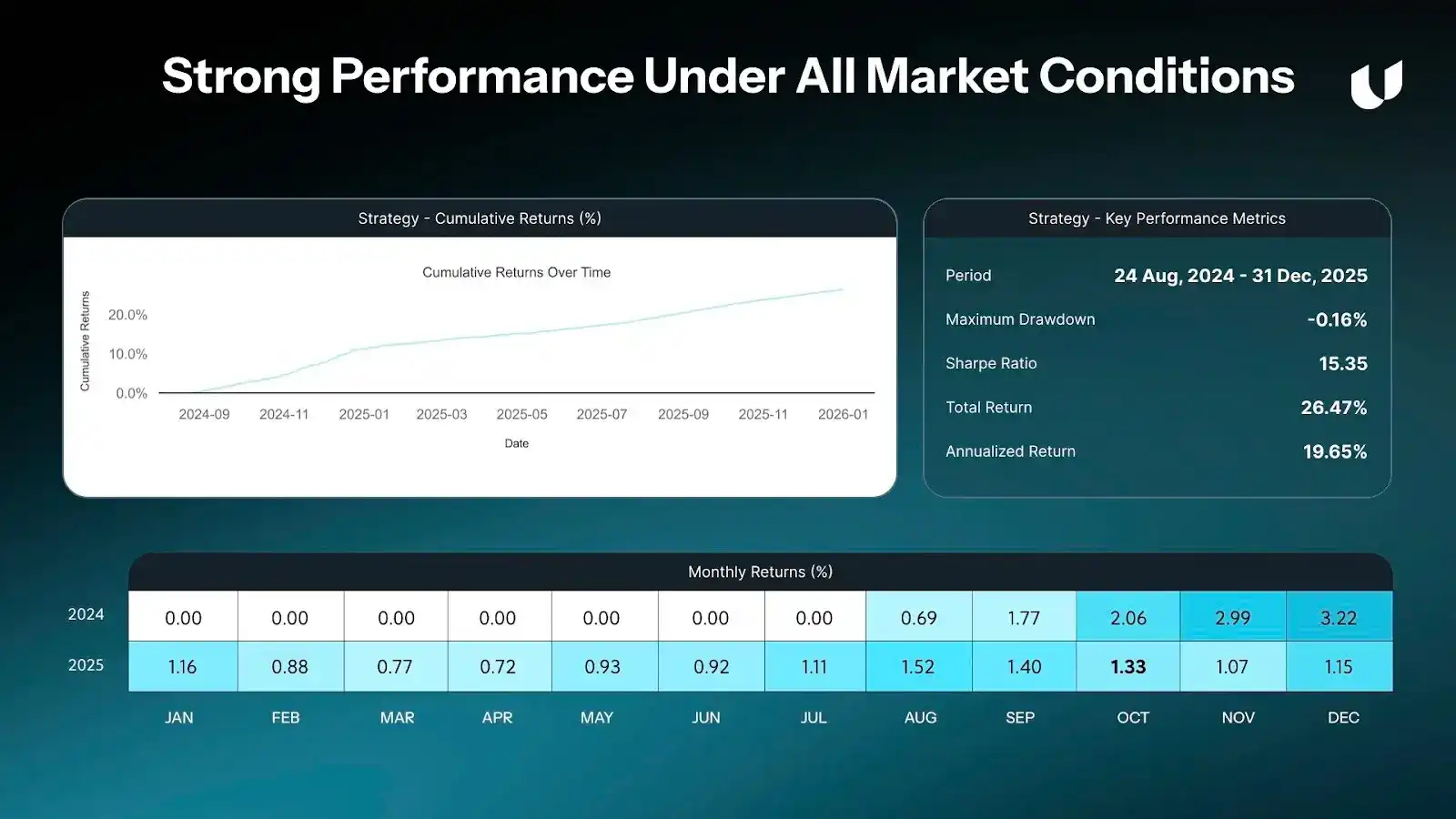
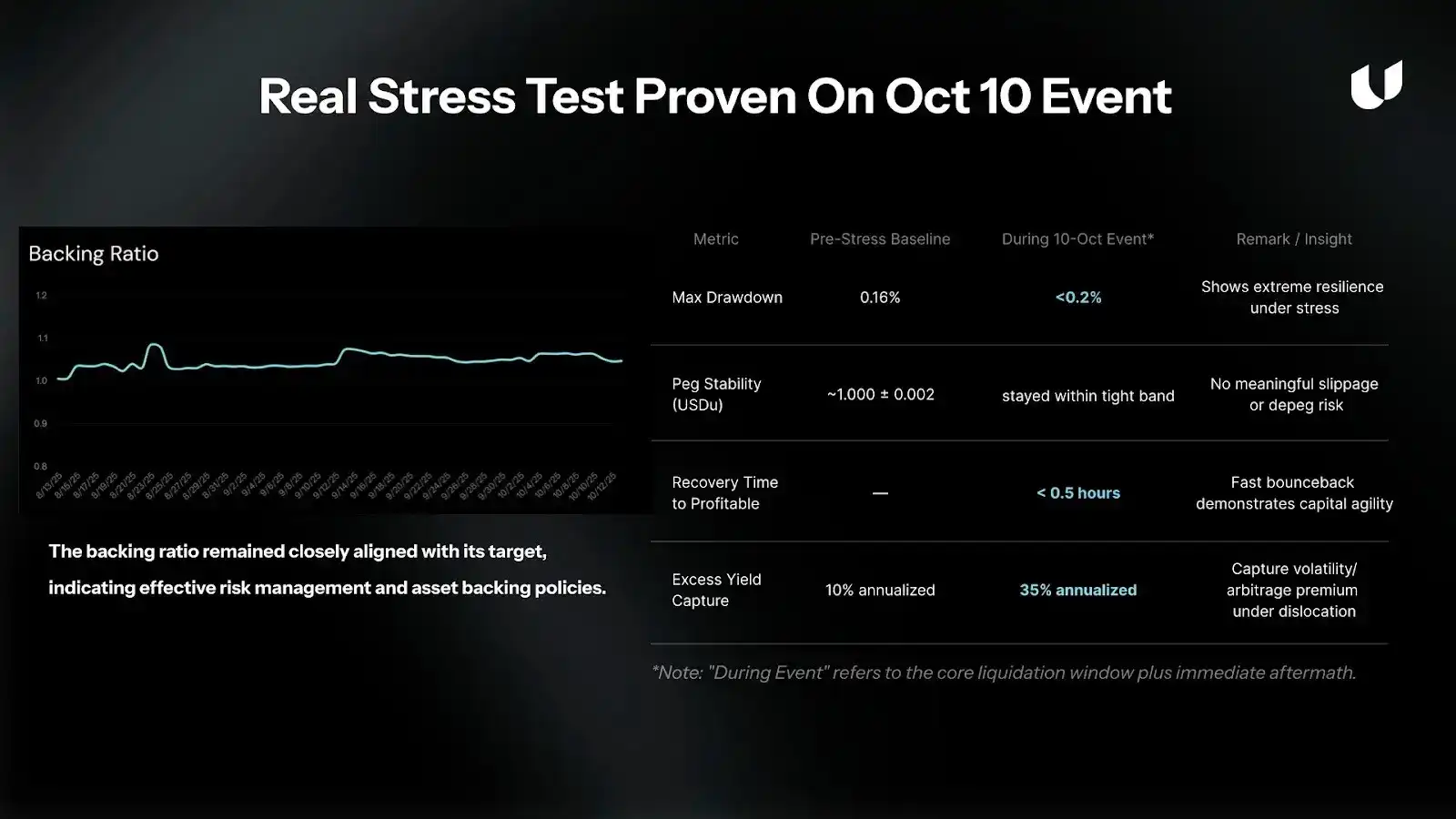
Especially during periods of extreme market volatility, such as on October 10, 2025, Unitas achieved zero actual losses through disciplined execution, with drawdowns始终控制在 0.2% 以内. This performance strongly demonstrates its实战 capability under real market depth and risk constraints, not just in experimental environments.
Transparency and Future Vision: Bridging Web3 and Traditional Finance

Unitas adheres to a high degree of audit transparency. Yield distribution is based entirely on actual performance, and collateral status and risk parameters are disclosed in real-time, eliminating "black box" concerns for users seeking long-term stable returns.

Looking ahead to 2026, Unitas's vision will extend further into the traditional finance (TradFi)领域. The platform plans deep integration with compliant institutions, treasury management platforms, and settlement systems. Its roadmap includes expanding the yield engine to real-world assets (RWA), such as tokenized stocks, commodities, and other structured notes, while maintaining consistent market-neutral logic and risk control standards.

By decoupling yield generation and distribution, Unitas aims to become the underlying cornerstone supporting savings, treasury management, and cross-border settlement, building a unified yield infrastructure spanning decentralized and traditional financial systems.


Related Questions

QWhat is the core mission and vision of Unitas as described in the article?

AUnitas aims to build a global savings layer for digital assets and provide compliant, high-yield stablecoins. Its vision is to create a market-neutral yield infrastructure standard, offering professional, transparent, and institutionally risk-managed returns to users worldwide.

QHow does Unitas's modular platform differentiate itself in terms of risk and accessibility?

AUnitas provides a modular yield service that decouples capital access, asset custody, and yield execution. It operates without taking directional market risk and is designed to serve not only individual investors but also meet the stringent security and compliance needs of corporate and institutional treasuries.

QWhat is a key technological advantage of Unitas's yield engine compared to 'strategy outsourcing' models?

AA key advantage is that Unitas's core yield engine is self-developed, self-operated, and self-managed. It controls the entire lifecycle from signal generation and trade execution to real-time monitoring and risk response, unlike models that rely on third-party protocols.

QWhat were the key performance metrics achieved by Unitas in 2025, as stated in the article?

AIn 2025, with approximately $25 million in deployed capital, Unitas achieved an average net annualized yield of 16.7% while maintaining a maximum drawdown of only -0.16%.

QWhat is Unitas's future roadmap, particularly concerning integration with Traditional Finance (TradFi)?

AIn 2026, Unitas plans to deeply integrate with compliant institutions, treasury management platforms, and settlement systems. Its roadmap includes expanding its yield engine to Real World Assets (RWA) like tokenized stocks, commodities, and structured notes, all while maintaining its market-neutral logic and risk control standards.

Related Reads

Who Are the Real Winners in the 'Tokenization' Narrative?

The article explores the real beneficiaries of the tokenization narrative and concludes that nearly everyone stands to gain, though the timing, reasons, and mechanisms differ significantly. Retail investors benefit through democratized access, as tokenization removes systemic barriers that previously excluded them from high-yield assets like private credit. They can now invest with small amounts, trade 24/7, access global assets, and use programmable capital in DeFi strategies. Issuers gain from faster, cheaper, and broader fundraising. Tokenization reduces settlement times from weeks to minutes, lowers operational costs through smart contracts, and enables innovative product designs like tranched risk products and dynamic yield mechanisms. Institutions are drawn to tokenization for its operational efficiencies: near-instant settlement (T+0) reduces counterparty risk, frees up capital, and cuts costs. Major players like BlackRock, JPMorgan, and Goldman Sachs are already implementing tokenized solutions for these advantages. Infrastructure builders—such as custodians, compliance providers, and data oracles—are positioned to become the foundational layer of a multi-trillion-dollar market, akin to "picks and shovels" in a gold rush. Emerging markets experience a transformative impact, as tokenization and stablecoins offer financial inclusion to billions. They provide access to dollar-denominated assets, inflation-resistant savings, low-cost remittances, and real-time payroll, often for the first time. Risks remain: tokenization doesn’t eliminate asset quality risks, guarantee liquidity, or replace sound legal structures. Success depends on robust infrastructure, regulation, and operational integrity. In the short term, institutions and issuers benefit most from efficiency gains. Mid-term, infrastructure providers will capture value. Long-term, retail investors and emerging market users gain the most through full financial inclusion.

marsbit20m ago

Who Are the Real Winners in the 'Tokenization' Narrative?

marsbit20m ago

Trading

Spot
Futures

Hot Articles

How to Buy LAYER

Welcome to HTX.com! We've made purchasing Solayer (LAYER) simple and convenient. Follow our step-by-step guide to embark on your crypto journey.Step 1: Create Your HTX AccountUse your email or phone number to sign up for a free account on HTX. Experience a hassle-free registration journey and unlock all features.Get My AccountStep 2: Go to Buy Crypto and Choose Your Payment MethodCredit/Debit Card: Use your Visa or Mastercard to buy Solayer (LAYER) instantly.Balance: Use funds from your HTX account balance to trade seamlessly.Third Parties: We've added popular payment methods such as Google Pay and Apple Pay to enhance convenience.P2P: Trade directly with other users on HTX.Over-the-Counter (OTC): We offer tailor-made services and competitive exchange rates for traders.Step 3: Store Your Solayer (LAYER)After purchasing your Solayer (LAYER), store it in your HTX account. Alternatively, you can send it elsewhere via blockchain transfer or use it to trade other cryptocurrencies.Step 4: Trade Solayer (LAYER)Easily trade Solayer (LAYER) on HTX's spot market. Simply access your account, select your trading pair, execute your trades, and monitor in real-time. We offer a user-friendly experience for both beginners and seasoned traders.

3.2k Total ViewsPublished 2025.02.11Updated 2025.03.21

How to Buy LAYER

Discussions

Welcome to the HTX Community. Here, you can stay informed about the latest platform developments and gain access to professional market insights. Users' opinions on the price of LAYER (LAYER) are presented below.

活动图片