Dogecoin reclaims $0.10: Will whale demand sustain DOGE’s upside?

ambcryptoPublished on 2026-03-17Last updated on 2026-03-17

Abstract

Dogecoin (DOGE) extended its bullish momentum, reclaiming the $0.10 resistance level and reaching a local high of $0.104. The rally was supported by strong whale accumulation between $0.092 and $0.097, as indicated by sustained spot demand and a positive Spot Taker CVD for seven consecutive days. Exchange netflows also turned negative, signaling aggressive spot buying. However, futures traders derisked, with net outflows of $22.06 million, reflecting bearish sentiment in derivatives markets. Technical indicators show DOGE in overbought territory with a bearish crossover on the Stochastic RSI, suggesting potential near-term volatility. If spot demand holds, DOGE could target $0.11; otherwise, a drop to $0.095 is possible.

Dogecoin [DOGE] extended its week-long bullish streak, reclaiming the $0.10 resistance. The memecoin touched a local high of $0.104 before slightly retracing to $0.1003.

With the bullish move, DOGE crossed above 20 and 50 EMAs, indicating strong short-term strength.

Dogecoin whales step in to defend higher levels

After DOGE reclaimed $0.09 and strengthened above that level, whales increased their accumulation.

The memecoin saw increased demand from large players between $0.092 and $0.097, laying the groundwork for the trend’s continuation. Spot Average Order Size data showed sustained whale orders across these price levels.
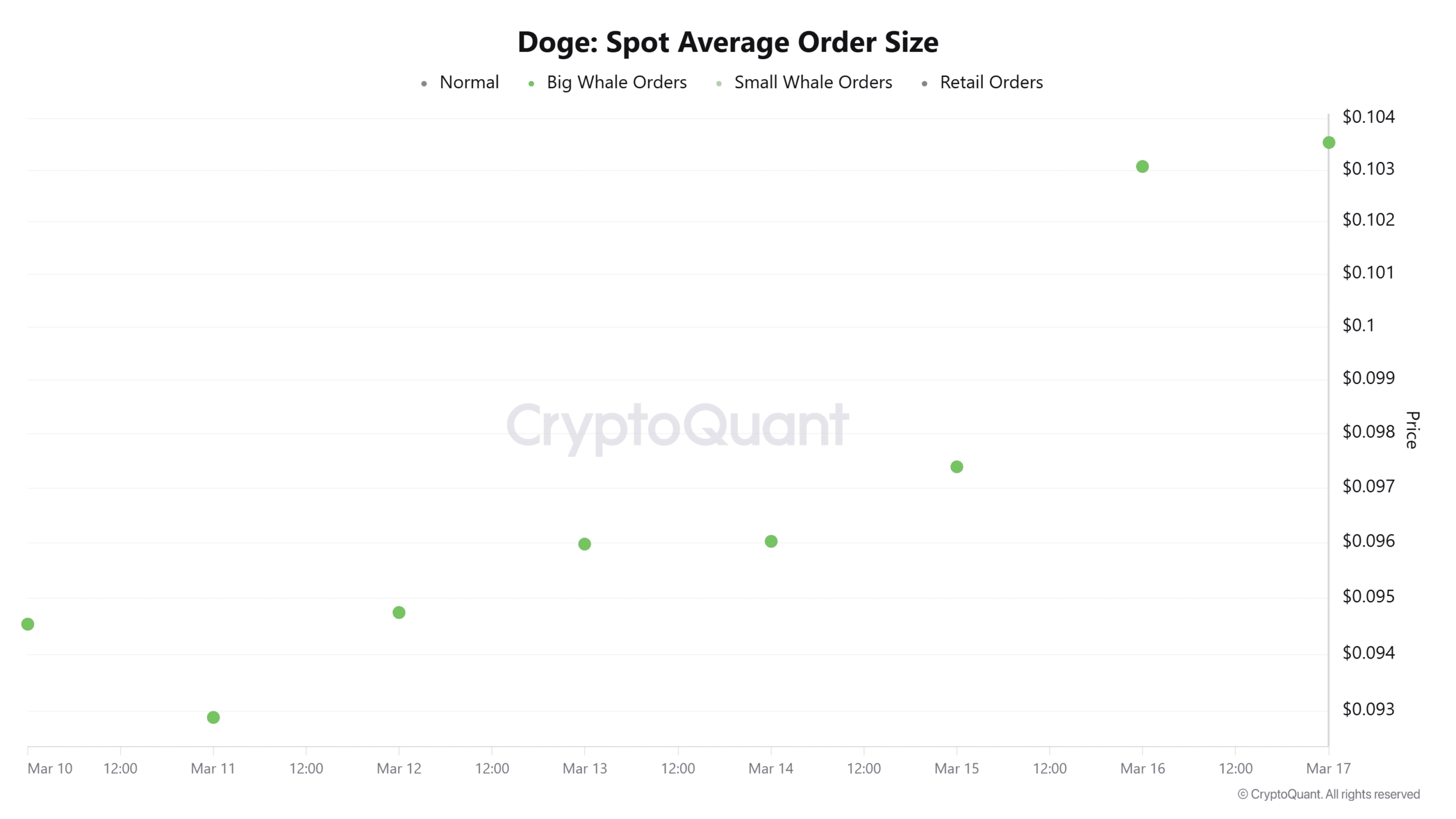
Source: CryptoQuant

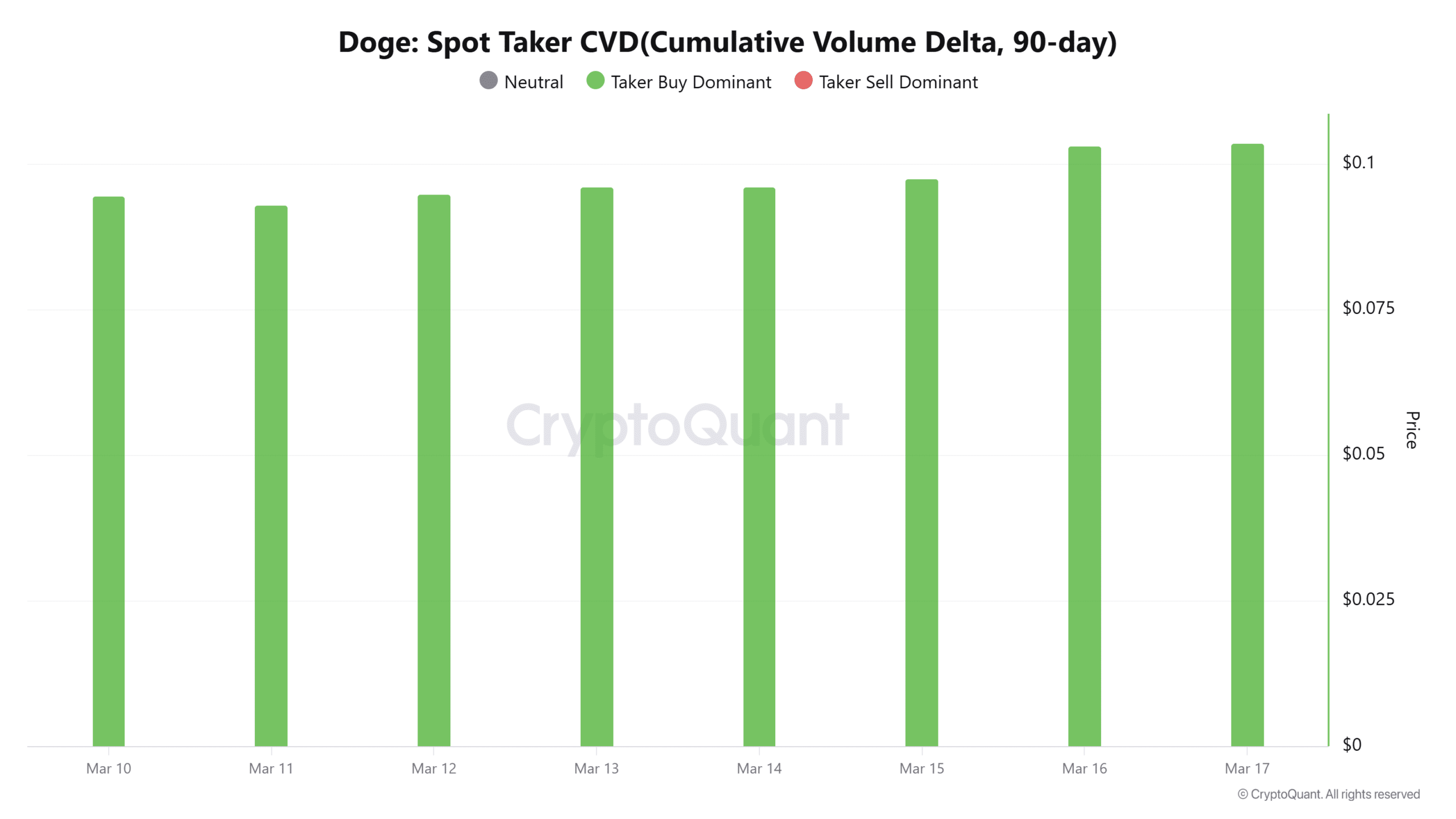
Such activity indicated increased whale participation in the market, but on the demand side, as evidenced by the Spot Taker CVD. This metric has remained positive for seven consecutive days.

A positive Taker CVD indicates that buyers have mostly dominated the market, validating the buyer’s presence.
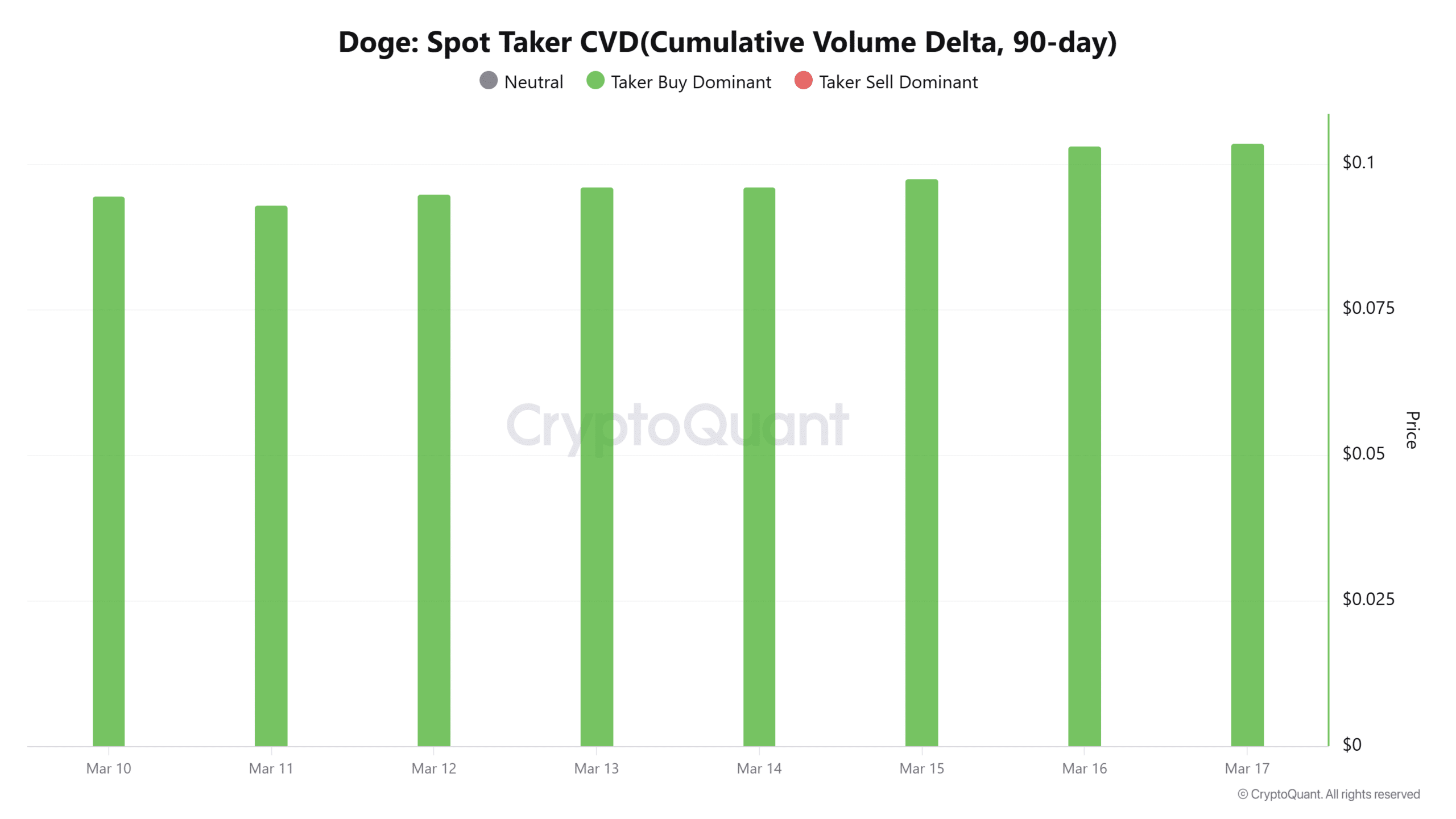
Source: CryptoQuant

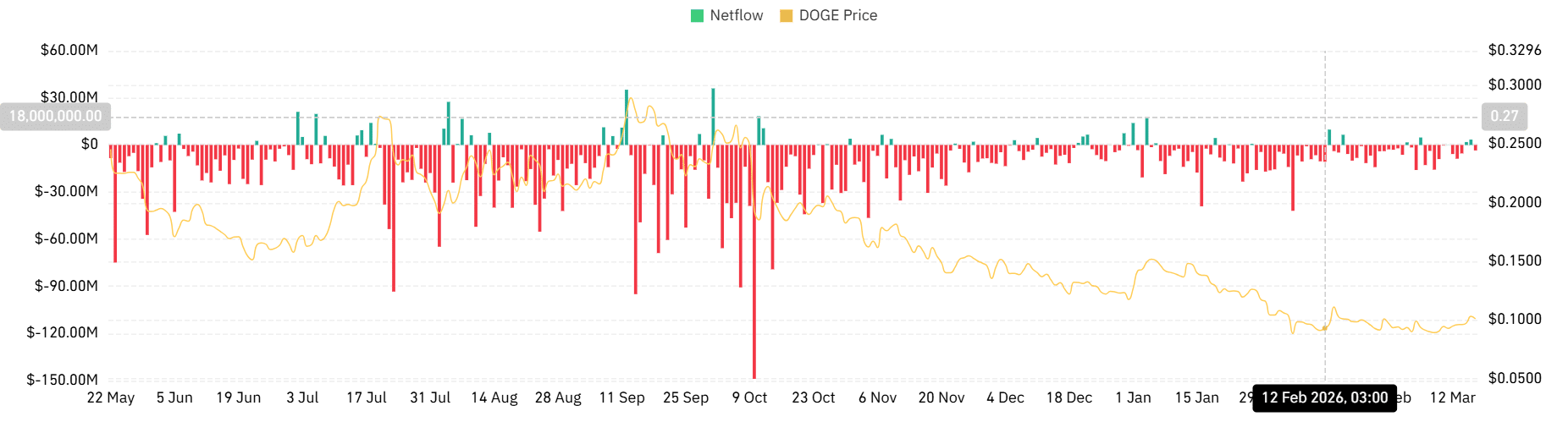
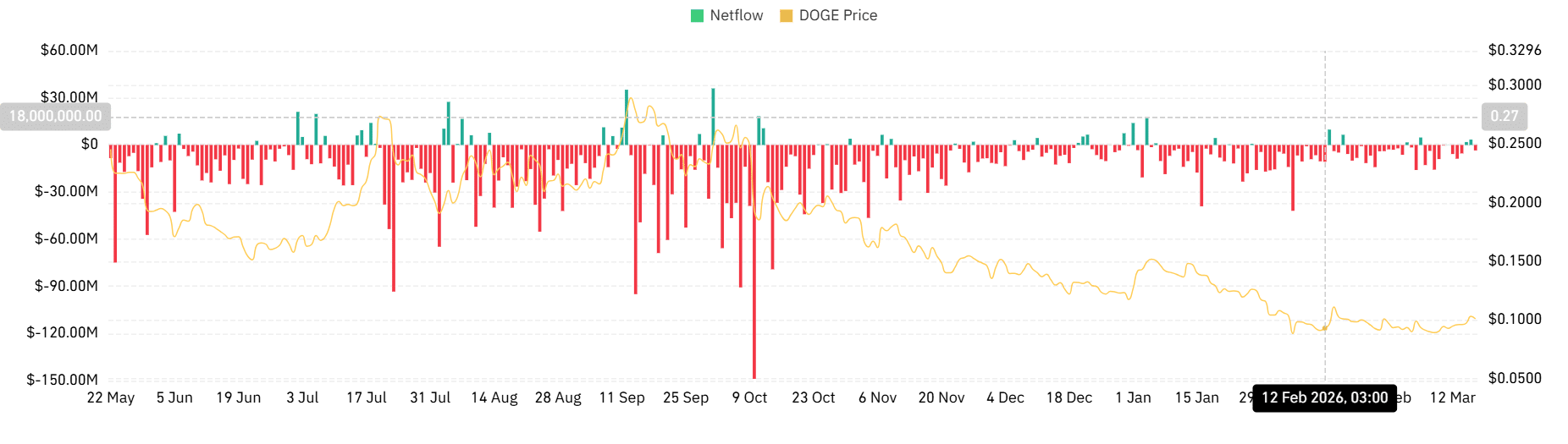
Furthermore, exchange activity echoed these market conditions, as netflow turned negative for the first time in two days.

According to CoinGlass data, $193.7 million flowed out of exchanges compared to $184.9 million in inflows. As a result, Spot Netflow dropped 239% to $-$8.77 million, at press time, a clear sign of aggressive spot accumulation.
Source: CoinGlass

Traditionally, increased whale accumulation has accelerated upside momentum, leading to higher prices.

Futures traders are aggressively derisking.

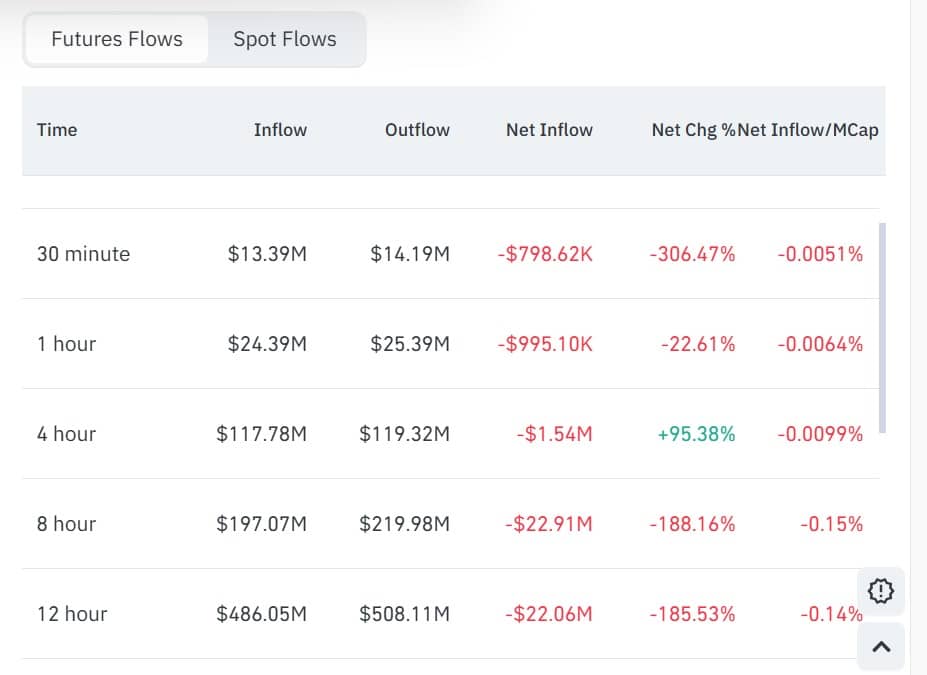
Although whales on the spot side have shown higher determination, futures participants remain bearish. After DOGE reclaimed $0.1, Futures outflows skyrocketed, reaching $508.1 million over the past 12 hours.

Over the same period, Futures inflow declined to $486 million. As a result, Futures Netflow dropped 185% to -$22.06 million.
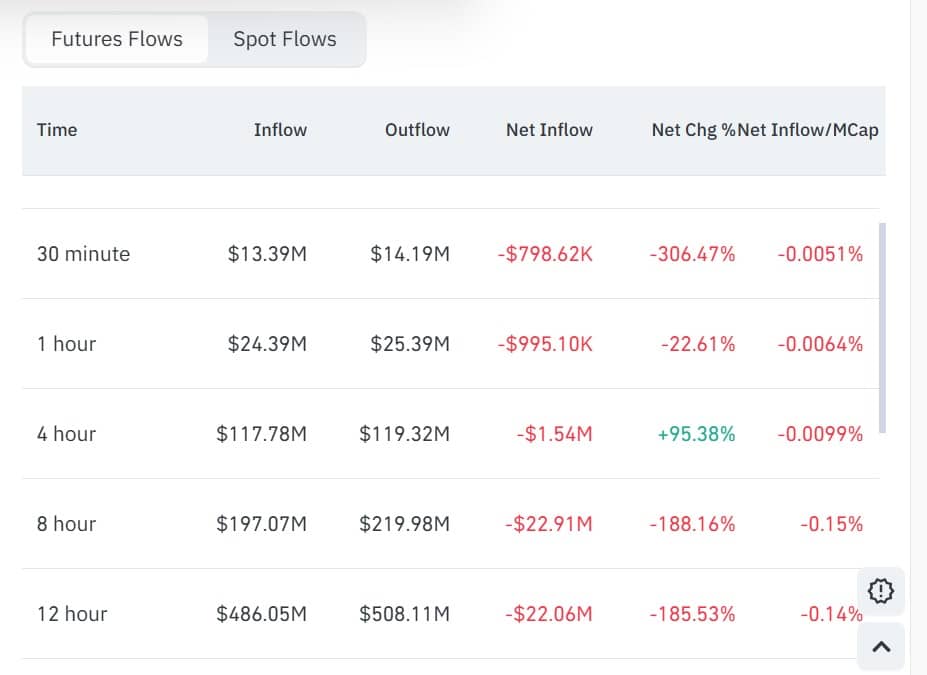
Source: CoinGlass

When Futures netflow dips into negative territory, it suggests increased market exits, with traders aggressively pulling capital out of the market. Such market behavior implies fear, as traders derisk.

Often, reduced futures capital could lead to a more stable uptrend as the market becomes less aggressive.

What’s next for DOGE?

Dogecoin reclaimed $0.1, largely driven by spot demand arising from whales. At the same time, Futures traders withdrew capital as they derisked.

With the spot demand holding steady, the memecoin’s upside momentum remained elevated, as evidenced by Stochastic RSI. At press time, the momentum indicator rose to overbought territory but formed a bearish crossover, falling to 93.
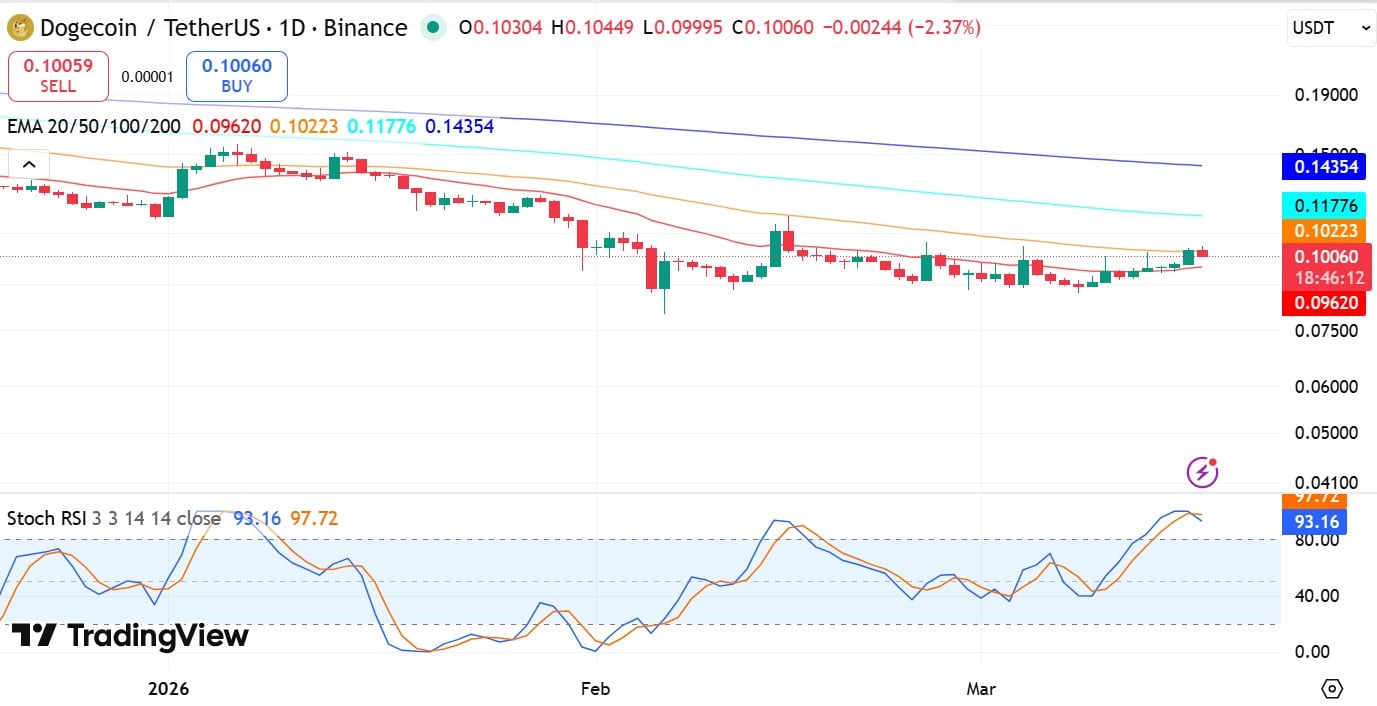
Source: TradingView

Still, it remained in an overbought zone, showing increased buying pressure in the market. Furthermore, DOGE flipped its short-term Moving Averages, indicating a stronger trend.

Therefore, if recent demand holds, DOGE could hold $0.1 and eye its long-term resistance at $0.11. However, if traders continue to abandon futures, lower capital could pose downside risk and cause another drop to $0.095.


Final Summary

  • DOGE showed upside momentum, flipping short-term MAs to reclaim $0.1 resistance.
  • Dogecoin upside momentum continued, largely driven by whale demand on the spot.

Related Questions

QWhat key price level did Dogecoin reclaim and what was the local high it touched?

ADogecoin reclaimed the $0.10 resistance level and touched a local high of $0.104.

QWhat does a positive Spot Taker CVD indicate for the Dogecoin market?

AA positive Spot Taker CVD indicates that buyers have mostly dominated the market, validating strong buyer presence and demand.

QHow did Futures Netflow change after DOGE reclaimed $0.10, and what does this suggest?

AFutures Netflow dropped 185% to -$22.06 million, suggesting increased market exits and traders aggressively derisking by pulling capital out of the futures market.

QWhat are the potential price targets for DOGE if recent demand holds versus if futures traders continue to withdraw?

AIf recent demand holds, DOGE could hold $0.10 and target the long-term resistance at $0.11. If futures traders continue to withdraw, lower capital could cause a drop to $0.095.

QWhat technical indicator showed that DOGE was in an overbought zone but formed a bearish crossover?

AThe Stochastic RSI rose to overbought territory but formed a bearish crossover, falling to 93, though it remained in the overbought zone.

Related Reads

Meta Spent $90 Billion to Close the Metaverse, $2 Billion to Let AI Live in Your Computer

Meta spent $90 billion to build the metaverse, only to shut down its flagship VR platform, Horizon Worlds, on June 15. The virtual world, launched in 2021 with great fanfare, failed to attract a meaningful user base despite massive investment. Its closure marks a symbolic end to Meta’s ambitious—and costly—bet on the metaverse, which accumulated nearly $90 billion in losses over seven years. Simultaneously, Meta is aggressively pivoting to AI. It acquired AI startup Manus for $2 billion, which recently launched a desktop version allowing AI to operate directly on users' local machines—reading files, running apps, and executing commands. In contrast to the metaverse’s weak adoption, Manus reached one million paid users within eight months. The shift is stark: Meta is cutting 20% of its workforce—around 15,000 jobs—and reallocating nearly its entire $115–135 billion capital expenditure budget toward AI infrastructure. This abrupt turn reflects industry-wide FOMO (fear of missing out) on AI, similar to the metaverse hype half a decade ago. Companies like Block, Shopify, and Amazon are also slashing jobs to fund AI investments. While Meta faces internal challenges—including delayed AI models and executive departures—its drastic realignment underscores a broader trend: the consensus has shifted from virtual worlds to ambient AI. The question remains whether this new bet will prove more sustainable than the last.

marsbit1h ago

Meta Spent $90 Billion to Close the Metaverse, $2 Billion to Let AI Live in Your Computer

marsbit1h ago

SpaceX Holds Nasdaq at the Negotiating Table, Hyperliquid Has Already Flipped the Table

Summary: The article examines the shifting power dynamics in global capital markets, driven by the rise of private funding and decentralized finance (DeFi). It begins by contrasting the 1971 launch of Nasdaq's electronic system with the current landscape, where companies like SpaceX can demand unprecedented concessions—such as accelerated inclusion in major indices—as a condition for their public listing. This reflects a fundamental change: massive private capital from funds like SoftBank's Vision Fund now allows firms like Revolut ($75B valuation) and Stripe ($159B valuation) to delay or de-prioritize IPOs, as they no longer rely on public markets for primary funding. However, public listing remains crucial for employee liquidity and VC exits. A new, critical motivator is the immense, stable capital from passive index funds. With passive assets now exceeding active management in the U.S., inclusion in indices like the Nasdaq 100 guarantees perpetual, non-discretionary buying pressure. SpaceX's negotiation for fast-track index inclusion highlights this strategic leverage. Simultaneously, traditional exchanges face disruption from DeFi. The piece cites Hyperliquid, a decentralized exchange with 2025 volumes (~$3T) double that of Coinbase. Its growth in tokenized traditional assets (e.g., S&P 500 perpetual contracts) and 24/7 trading attracts professional traders, eroding the monopolies of institutions like NYSE and Nasdaq. In response, NYSE's parent ICE is investing in crypto platforms (e.g., OKX, Polymarket), acknowledging that future competition may come from DeFi protocols, not just rival exchanges. The conclusion is that the market structure is layering: old systems adapt (Nasdaq changing rules, ICE investing in crypto) while new, decentralized infrastructures grow, creating a future where the most powerful companies may not need to "knock on the door" of traditional exchanges at all.

marsbit1h ago

SpaceX Holds Nasdaq at the Negotiating Table, Hyperliquid Has Already Flipped the Table

marsbit1h ago

Trading

Spot
Futures

Hot Articles

Discussions

Welcome to the HTX Community. Here, you can stay informed about the latest platform developments and gain access to professional market insights. Users' opinions on the price of S (S) are presented below.

活动图片