Dogecoin shows accumulation signs – Will DOGE still fall to $0.080?

ambcryptoPublicado em 2026-02-07Última atualização em 2026-02-07

Resumo

Dogecoin (DOGE) is showing signs of accumulation near the $0.095 support level, accompanied by a TD Sequential buy signal on the daily chart. Despite a 6.3% rebound, the broader downtrend remains intact, with key resistance at $0.117 and primary support at $0.080. Market data indicates buyer dominance in spot trading and sustained exchange outflows, suggesting reduced selling pressure and potential supply tightening. However, rising open interest near current levels increases volatility risk. While conditions support short-term stabilization or a relief bounce, a confirmed breakout above resistance is needed to signal a meaningful trend reversal. Until then, the market favors volatility over conviction.

Dogecoin [DOGE] has drifted toward the lower boundary of its descending structure as a TD Sequential buy signal prints on the daily chart near $0.095. The signal appears after weeks of controlled selling rather than panic-driven liquidation.

DOGE has spent months trending lower from its September peak, yet selling pressure has gradually lost intensity. Recent candles exhibit shorter bodies and slower follow-through, suggesting potential exhaustion.

However, this signal does not invalidate the broader trend. Instead, it flags a potential pause or tactical rebound within a dominant downtrend.

Therefore, the setup invites caution rather than optimism, especially while DOGE price remains below key resistance levels.

Downtrend structure still caps Dogecoin rebounds

At press time, Dogecoin traded near $0.096 after rising roughly 6.3% over the past 24 hours, reflecting a reaction off structural support rather than a trend reversal.

Dogecoin prices continue to follow a descending regression channel that has controlled movement for months.

On the downside, the $0.080 zone remains the primary support, where previous selloffs stalled. Above the current price, $0.117 stands as the key resistance that has repeatedly rejected recovery attempts since November.

Any sustainable rebound must reclaim this level first. Beyond it, $0.153 marks the next upside target aligned with prior distribution and the channel’s upper boundary.

Buyers stay active beneath the surface

Spot Taker CVD remains buyer‐dominant despite prolonged price weakness.

Aggressive market buys continue to outweigh sells, showing demand is absorbing available supply rather than exiting. This contrasts sharply with panic selloffs, where CVD typically turns deeply negative.

Instead, DOGE shows steady bid absorption near local lows. However, buyers are not chasing prices higher. They are stepping in quietly as sellers lose urgency.

Therefore, CVD supports the idea of accumulation through absorption rather than speculative momentum.

This dynamic strengthens the relevance of the TD Sequential signal, since both point toward slowing downside pressure rather than immediate trend reversal.

Dogecoin exchange outflows hint at tightening supply

Spot netflows reinforce this narrative. DOGE continues recording net-negative exchange flows, including a recent daily outflow of approximately $7.7 million as of writing.

Tokens leaving exchanges during weakness suggest holders are not positioning for immediate distribution.

Instead, sell-side availability appears to shrink near local lows. However, these flows do not yet confirm aggressive accumulation.

They simply show reduced willingness to sell into weakness. Combined with buyer-dominant CVD, this trend limits downside acceleration unless new selling catalysts emerge.

Therefore, while bearish structure persists, liquidity conditions no longer strongly favor sustained forced selling from current levels.

Leverage rebuilds near support, raising volatility risk

At the time of writing, Open Interest (OI) climbed by over 5%, pushing total derivatives positioning to around $1.04 billion while price remains compressed. This increase shows traders re-entering leverage near support rather than abandoning positions.

However, rising OI without a structural breakout increases volatility risk instead of directional clarity.

Both long and short positioning appear active, suggesting traders anticipate expansion rather than continuation. Therefore, the current zone carries heightened liquidation sensitivity.

A decisive move beyond resistance or below support could trigger sharp, leverage-driven follow-through in either direction.

To conclude, Dogecoin’s TD Sequential buy signal aligns with channel exhaustion, buyer absorption, and reduced exchange supply, but the broader downtrend still dominates price structure.

While conditions support a short-term stabilization or relief bounce, confirmation depends on DOGE reclaiming key channel levels.

Until then, the setup favors volatility over conviction, with downside risk fading but not fully resolved.


Final Thoughts

  • Dogecoin’s current structure favors recovery attempts as accumulation replaces reactive selling near long-term support.
  • A confirmed move above resistance would likely shift sentiment from defensive positioning toward trend continuation trades.

Perguntas relacionadas

QWhat is the significance of the TD Sequential buy signal appearing on Dogecoin's daily chart near $0.095?

AThe TD Sequential buy signal suggests a potential pause or tactical rebound within the dominant downtrend, indicating slowing downside pressure rather than an immediate trend reversal.

QWhat are the key resistance and support levels for Dogecoin mentioned in the article?

AThe primary support is at the $0.080 zone, while the key resistance level is at $0.117, which has repeatedly rejected recovery attempts since November.

QHow does the Spot Taker CVD (Cumulative Volume Delta) indicator reflect buyer activity for DOGE?

AThe Spot Taker CVD remains buyer-dominant, showing that aggressive market buys continue to outweigh sells, indicating demand is absorbing available supply rather than exiting, which points to accumulation through absorption.

QWhat do the net-negative exchange flows for Dogecoin suggest about holder behavior?

ANet-negative exchange flows, including a recent daily outflow of approximately $7.7 million, suggest that holders are not positioning for immediate distribution and that sell-side availability is shrinking near local lows, reducing willingness to sell into weakness.

QHow does the increase in Open Interest (OI) near support levels affect Dogecoin's market dynamics?

AThe increase in Open Interest by over 5% to around $1.04 billion, shows traders are re-entering leverage near support, which raises volatility risk and liquidation sensitivity, as both long and short positioning are active, anticipating expansion rather than continuation.

Leituras Relacionadas

AI Agents Are About to Take Market Share from Visa

Artificial intelligence agents are poised to disrupt Visa's business model by bypassing the traditional credit card interchange fee structure. Unlike humans, AI agents are purely rational: they don't accumulate rewards, seek fraud protection, or desire premium cards. Their sole objective is to complete transactions at the lowest cost, fastest speed, and with minimal fees. This shift threatens the 2-3% interchange fees that underpin Visa’s $500 billion valuation, as these fees essentially tax human irrationality—something agents lack. Recent developments, such as the launch of Tempo (a high-volume stablecoin settlement blockchain), the Machine Payment Protocol (enabling autonomous micro-payments), and Visa’s own command-line payment tool for AI, indicate a rapid move toward agent-driven commerce. While current transaction volumes remain small, infrastructure is being built to support machine-to-machine payments that avoid card networks. Major players like Stripe, Mastercard, and Circle are investing heavily in this space. Visa network’s distribution advantage relies on human behavior—consumer trust and merchant acceptance—a cycle that doesn’t apply to agents. They optimize for efficiency, not brand loyalty. Although widespread consumer adoption is still emerging, the infrastructure for agent-commerce is advancing quickly, starting with micro-payments for AI services. The fundamental challenge is that interchange fees are a tax on human psychology, and agents are purely rational actors.

marsbitHá 1h

AI Agents Are About to Take Market Share from Visa

marsbitHá 1h

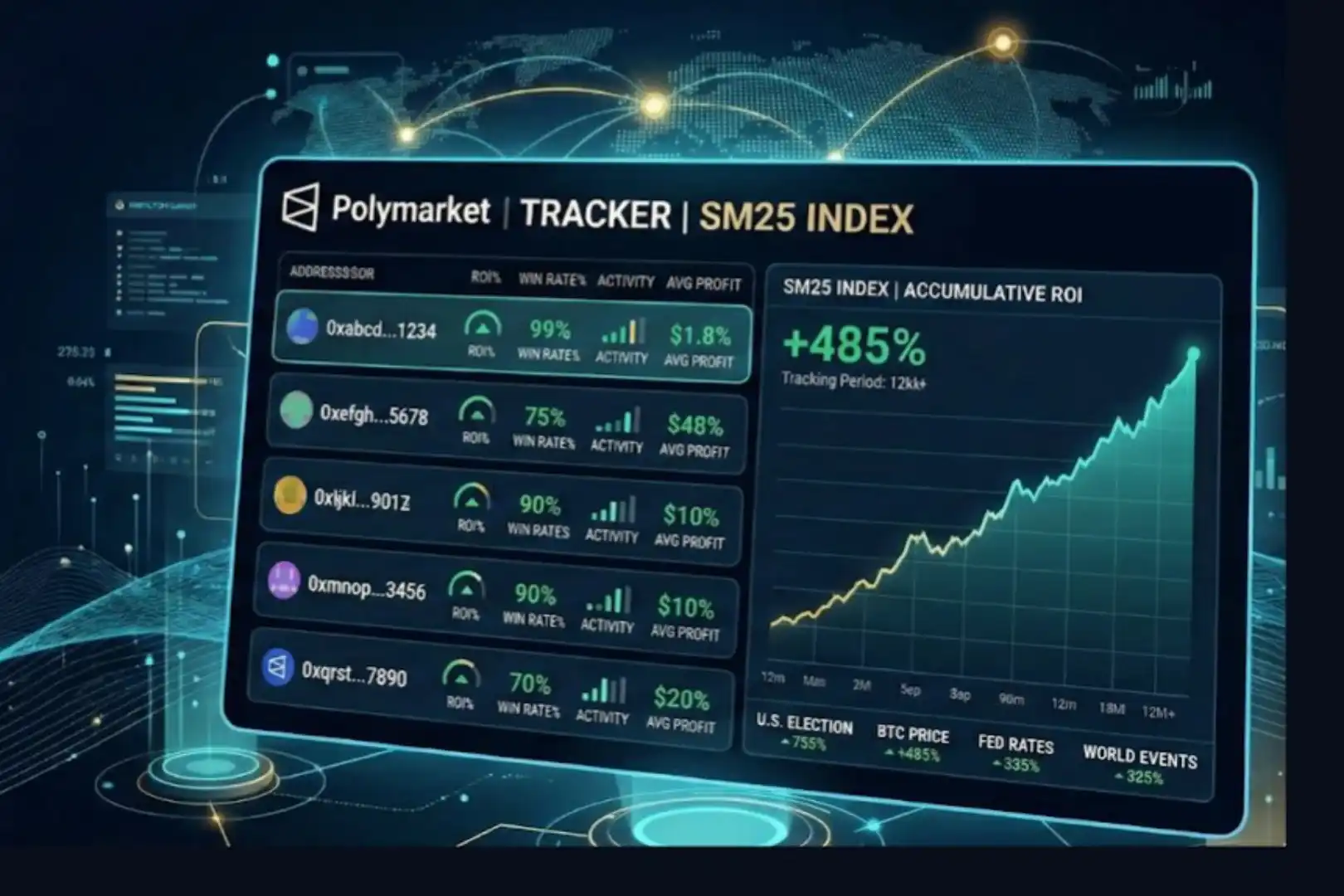
Polymarket Smart Money Panorama: 26 Long-Term Trackable Addresses (Categorized by Sector)

This article profiles 26 high-performing "smart money" addresses on Polymarket, categorized by their expertise in five distinct prediction market sectors. The selection criteria focused on proven Profit and Loss (PNL), a diversified winning structure (not reliant on a single bet), and high transaction volume to distinguish informed speculation from arbitrage. The addresses are broken down as follows: * **Politics & Geopolitics (5 addresses):** Experts in long-cycle macro events like Fed rates, US elections, and Middle Eastern geopolitics. They often bet against consensus (NO) in low-probability markets, achieving high ROI. * **Weather (6 addresses):** Specialists in temperature prediction markets for specific cities. Strategies range from high-frequency, small bets across thousands of markets to focused, high-conviction wagers. * **Tech (5 addresses):** Focused on Big Tech and AI product timelines (e.g., Google, OpenAI). They typically target high-probability outcomes or use a high-volume, low-cost approach on undervalued options. * **Culture (5 addresses):** Experts in movie box office results and Twitter-related markets. Strategies include betting on high-probability outcomes or taking contrarian, high-odds positions in low-probability markets. * **Sports (5 addresses):** Specialists in specific leagues like UFC, Soccer, and Tennis. They excel at identifying mispriced odds, often in medium-probability markets, and hold positions until settlement. A key warning is emphasized: a trader's success is often not transferable across sectors. An expert in sports may perform poorly in politics. The article advises followers to only mirror trades within a trader's proven area of expertise to avoid losses from their cross-sector ventures. All addresses are for reference only and not financial advice, as prediction markets carry significant risk of capital loss.

marsbitHá 1h

Polymarket Smart Money Panorama: 26 Long-Term Trackable Addresses (Categorized by Sector)

marsbitHá 1h

Trading

Spot
Futuros
活动图片