A $20 Million Debt with No Savior in Sight: The Hidden Motives Behind Former US President's Son Hunter Biden's Coin Launch

marsbitPublished on 2026-09-08Last updated on 2026-09-08

Abstract

Former President's Son Hunter Biden's Meme Coin $LAPTOP: A Desperate Bid for Liquidity? The launch of the meme coin $LAPTOP on Base by Hunter Biden has been framed as political theater against Donald Trump, with airdrops for losing $TRUMP holders. However, a deeper look reveals a likely financial motive: escaping massive personal debt. Hunter Biden himself admitted to being $14-15 million in debt during a recent interview, stating he has no way to repay it. Reports indicate total liabilities exceed $20 million, including $15-17 million in legal fees to a law firm. With his father out of office, his traditional income streams have dried up; art sales (once buoyed by political connections) have stalled, and paid speaking engagements have vanished. The $LAPTOP coin's tokenomics suggest a direct play for liquidity. Of the 10 billion total supply, 30% is allocated to the founding team (Biden and associates). Crypto analysts estimate that if the token's fully diluted valuation reaches around $70 million, these insider tokens would be worth roughly $21 million—enough to cover his reported debts. While leveraging the infamous "laptop" scandal and political rivalry for viral marketing, the underlying move appears to be an attempt to monetize his notoriety and transfer his personal financial crisis onto crypto speculators, echoing past market turmoil sparked by politically-themed tokens.

Author: Jiemini, Shenchao TechFlow

Yesterday, we were analyzing whether Hunter Biden's launch of $LAPTOP on the Base chain was an act of "on-chain political revenge" targeted at the Trump camp.

Giving airdrops specifically to those who lost money holding $TRUMP seemed indeed full of malicious fun, elevating the US two-party political game to a highly viral Meme narrative.

Recommended reading: "Deconstructing Former US President's Son Hunter Biden's $LAPTOP Coin Launch: A Case of 'On-Chain Political Revenge' Against Trump and Liquidity Harvesting".

However, if this former First Son went to such lengths to launch a token merely for an act of political performance art on-chain, without any economic motives, that would hardly align with the considerations and conduct typical of the "upper class."

Stepping back from the crypto token, what you might not know is that this former president's son is personally in a tight spot in the real world, being pressured step-by-step by creditors.

Therefore, this seemingly absurd token mechanism easily leads one to suspect he might be raising funds to save himself.

A Pierced Financial Black Hole: Crushed Under $20 Million of Debt

While crypto players were reveling in the $LAPTOP airdrop mechanics, a crucial piece of news screenshot was circulating among sharp-eyed foreign traders.

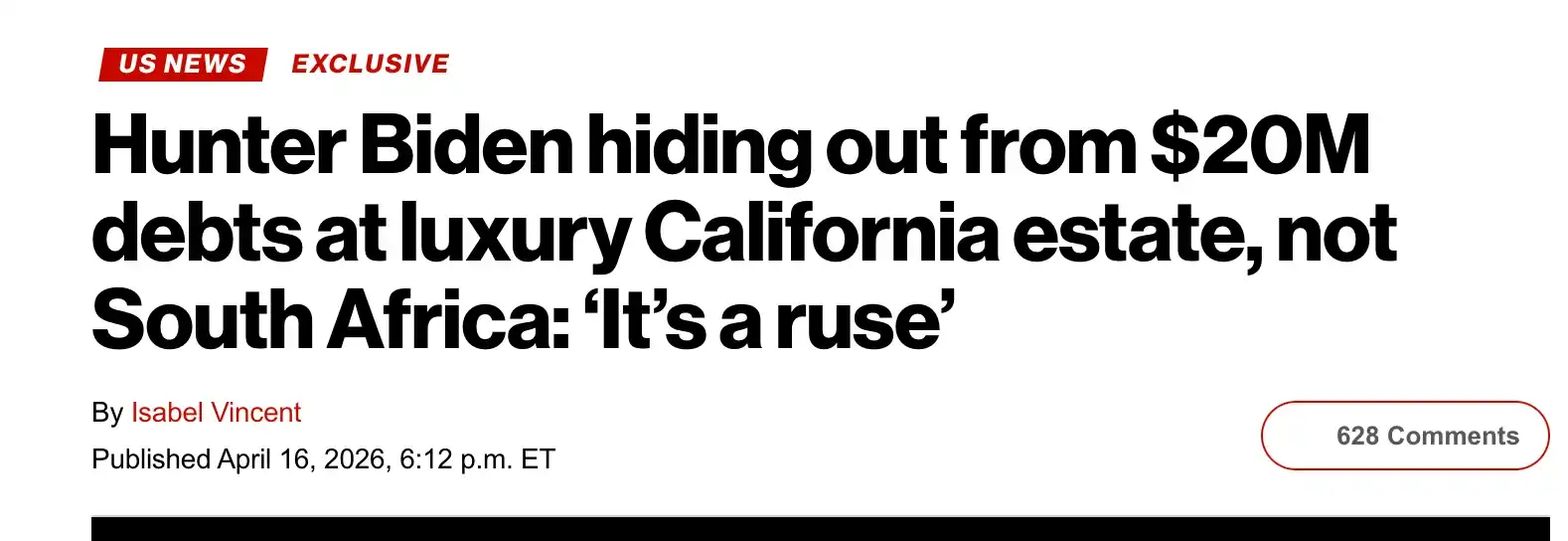
In a five-hour in-depth interview on the Shawn Ryan Show aired in late 2025, Hunter Biden admitted on camera that he is deeply mired in approximately $14 to $15 million in massive debt and frankly "has no idea how to repay it."
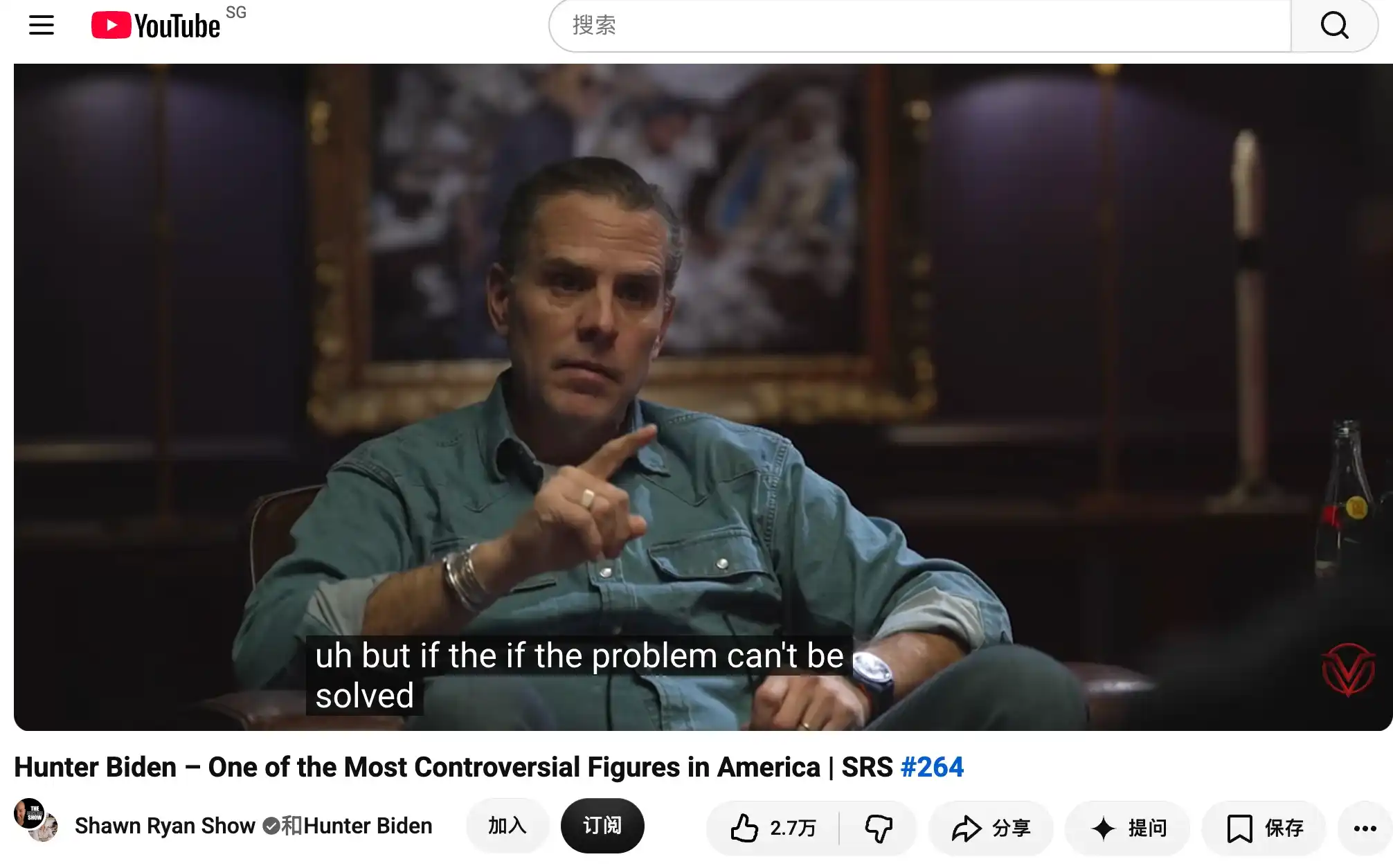
He even stated helplessly that there is no buried fortune under the family house, "no one is going to ride in on a white horse to save me."

This, of course, was not just a plea for sympathy. According to a previous exclusive investigation by the New York Post, due to years of facing criminal, civil, and congressional investigations, he owes the high-end Washington law firm Winston & Strawn approximately $15 to $17 million in astronomical legal fees and has been formally sued.

In court response documents, his defense lawyer directly argued "Impecunious" as a defense, stating the client doesn't even have money to hire a professional accountant to verify the bills.

Adding the $5 million being chased by his former "sugar daddy" Hollywood lawyer Kevin Morris, who previously advanced his tax payments, and the $1 million owed to a former art agent, his real-world debt exposure has long surpassed the $20 million mark.
Traditional Monetization Channels Blocked After Losing the President's Son Halo

Why would a celebrity be driven to launch a Meme coin? Because many outside the circle don't understand that with Joe Biden's departure from office and the end of pardons, Hunter's ability to generate income in the traditional world has completely collapsed.

When Joe Biden was at the center of power, Hunter was packaged by galleries as a successful "emerging artist." According to court documents disclosed by The Guardian, during his peak from 2021 to the end of 2023, he successfully sold 27 paintings at an average price of $54,000, grossing about $1.5 million.

But who were the biggest buyers? Precisely the Hollywood lawyer Kevin Morris (who bought 11 paintings himself, splurging $875,000) and several Democratic donors, who are now chasing him for repayment.
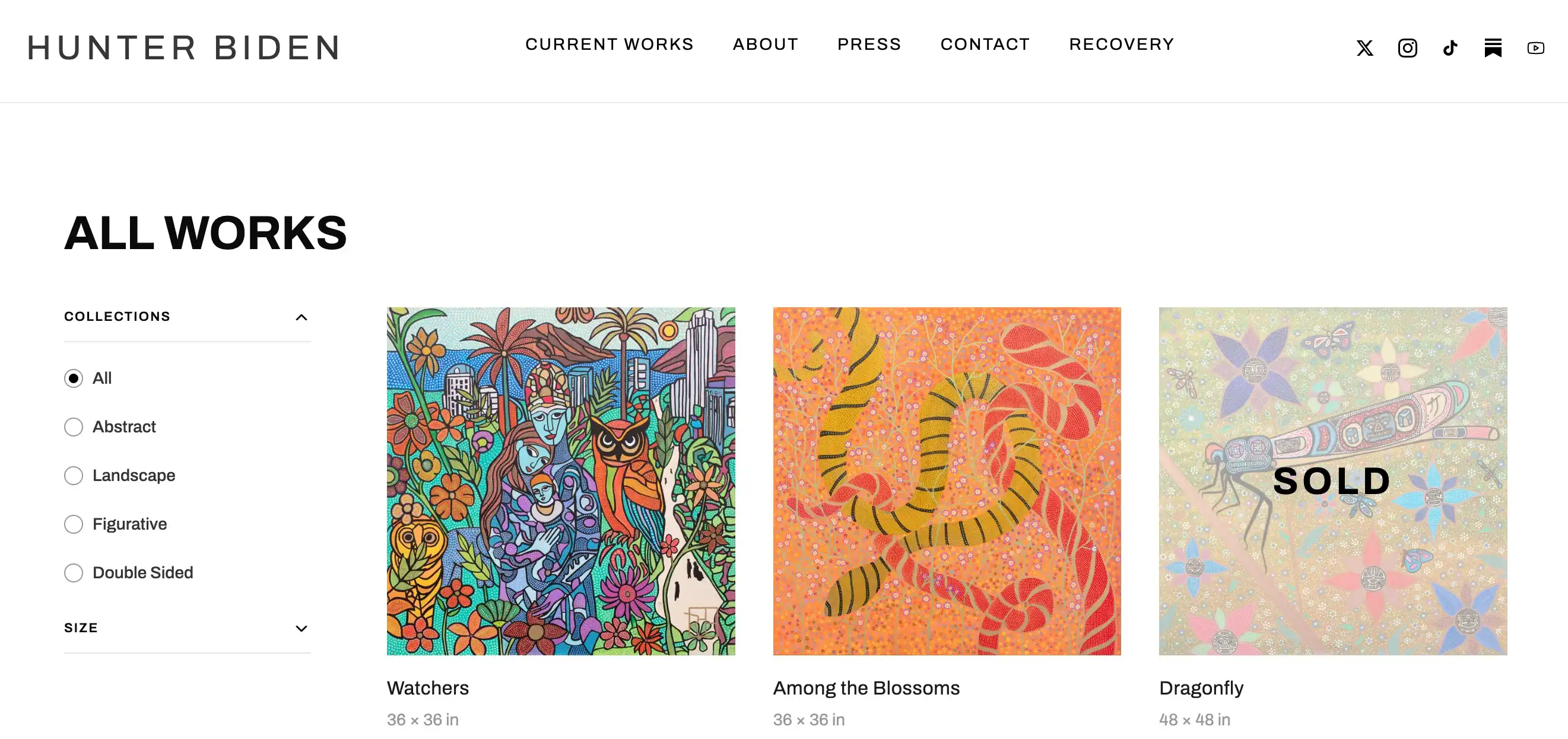
(Image: Hunter's personal painting website. Guess what, he's also an abstract painter.)

Court documents also mercilessly reveal his financial status. Since December 2023, his painting sales have completely stalled, with only one painting sold for $36,000. His hoped-for "paid speeches and appearance fees" all evaporated, and sales of his autobiographical memoir plummeted.

In a report, Eli Klein, the owner of a prestigious New York gallery, directly burst this bubble: "His artistic value was entirely built on the fame of being the 'son of the sitting president,' not artistic merit." Now, with his father out of the White House, his former gallery owner has completely severed ties.

In the real secondary market, no one would pay $100,000 for a Hunter Biden painting anymore. The "art channel" once used by political and business brokers to funnel benefits has been ruthlessly sealed shut.

From "Hell Laptop" to Making Ends Meet: Squeezing Dry the Political Residual Value

The meme Hunter is launching this time is named $LAPTOP, a reference and play on the famous "Laptop from Hell" incident just before the 2020 election: A laptop he abandoned at a Delaware repair shop contained not only a large number of private videos of drug use and other unsavory content but also sensitive business emails about his cushy $80,000-a-month job at the Ukrainian energy company Burisma.

For the past six years, this laptop has been a lethal weapon for political opponents to attack the Biden family and the root cause of Hunter's complete infamy.
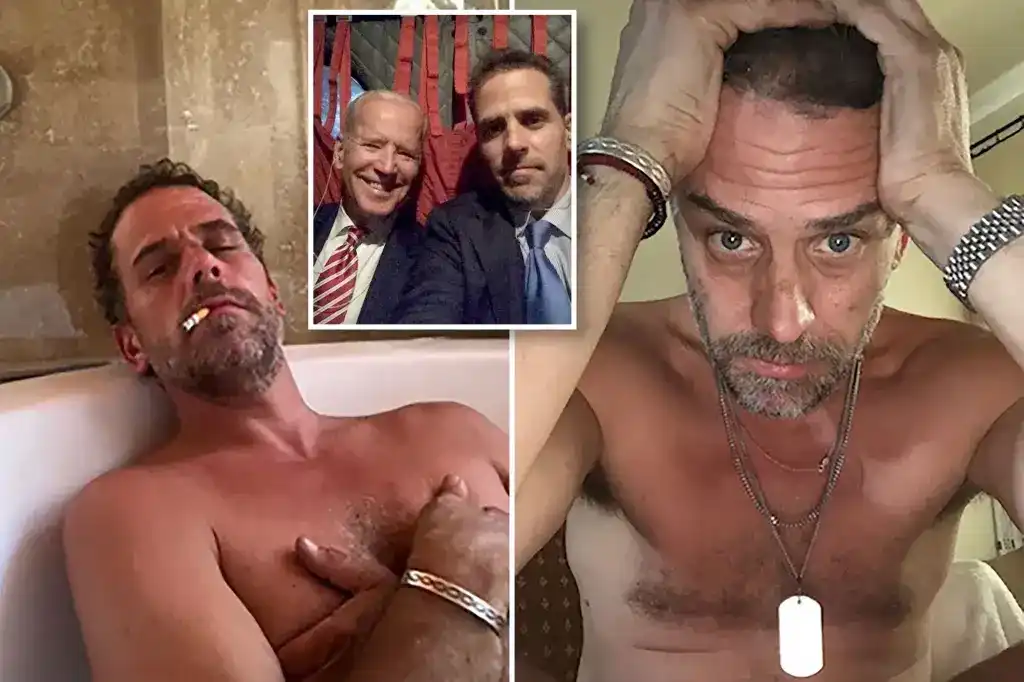
Most ironically, according to foreign media reports, during a lawsuit in March this year concerning his abandoned laptop's hard drive, he even actively petitioned the court to dismiss the case, giving a strikingly blunt reason:

"Because my income has drastically declined, I no longer have the money to continue paying litigation fees."

After losing mainstream commercial monetization channels, this former First Son was even exposed to be participating in a touring carnival called "Channel 5," hosting events under the self-mocking and humiliating title of "Laptop CEO" to make ends meet.

Now, with all mainstream commercial avenues gone, this former First Son has reportedly been reduced to appearing on various overseas variety shows and events.

He even hosts events under the self-mocking and humiliating title of "Laptop CEO," making a living by cashing in on his own scandals.
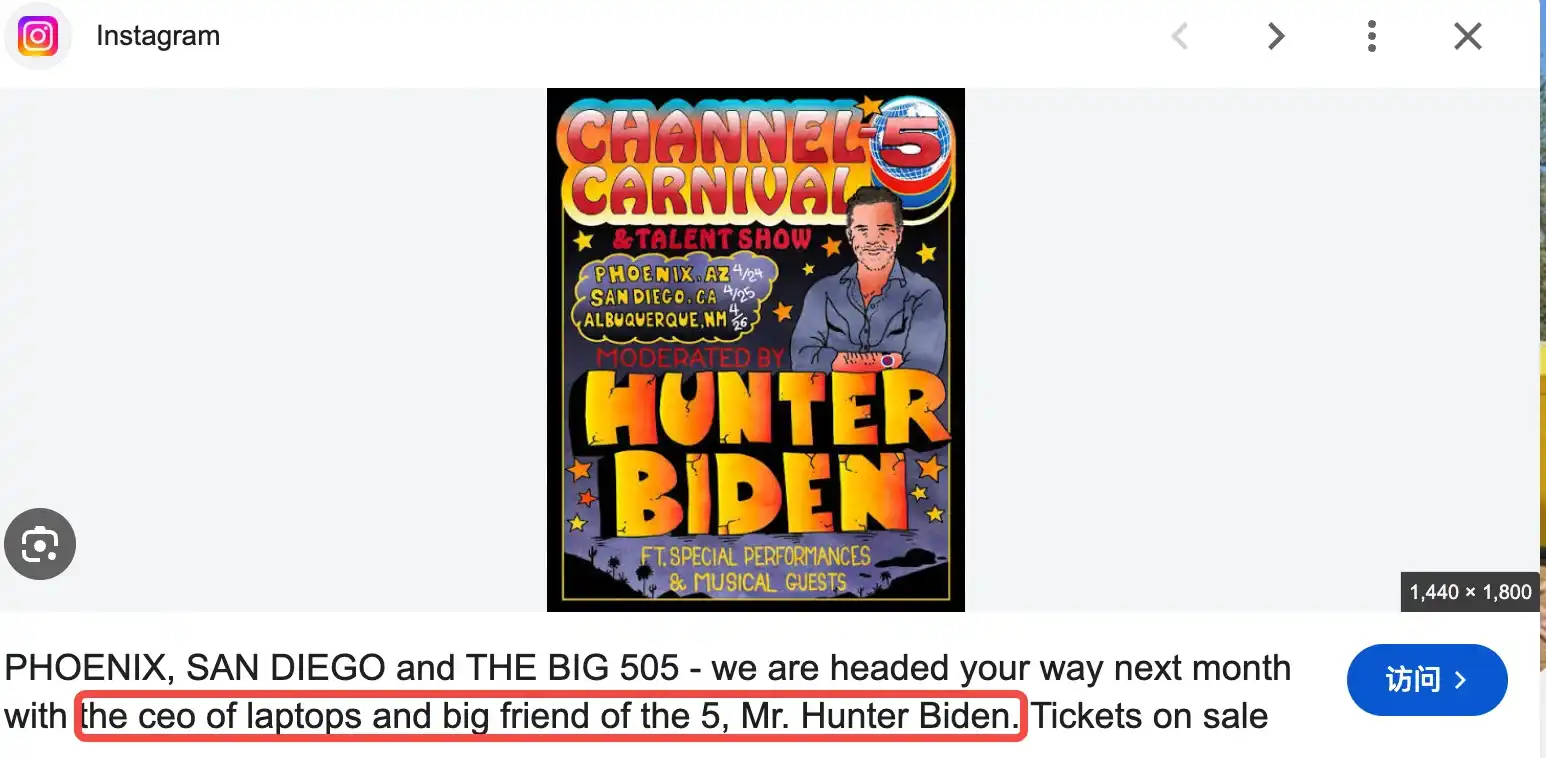
(Image: Overseas touring show promotional poster, calling him laptop ceo)

$LAPTOP's 30% Insider Allocation, a Solution to the Debt Crisis?

When the traditional credit system, high-end art market, and corporate advisory doors are all welded shut to him simultaneously, launching a Meme coin might be the only lifeline of liquidity this bankrupt, $20 million-debt-laden former president's son can grasp.

According to the tokenomics model exclusively disclosed by the Wall Street Journal, the launch of $LAPTOP shows an exceptionally strong desire for "liquidity extraction."

Out of a total supply of 1 billion tokens, the founding team, namely Hunter Biden and his affiliated interests, directly carved out a whopping 30% as internal allocation.
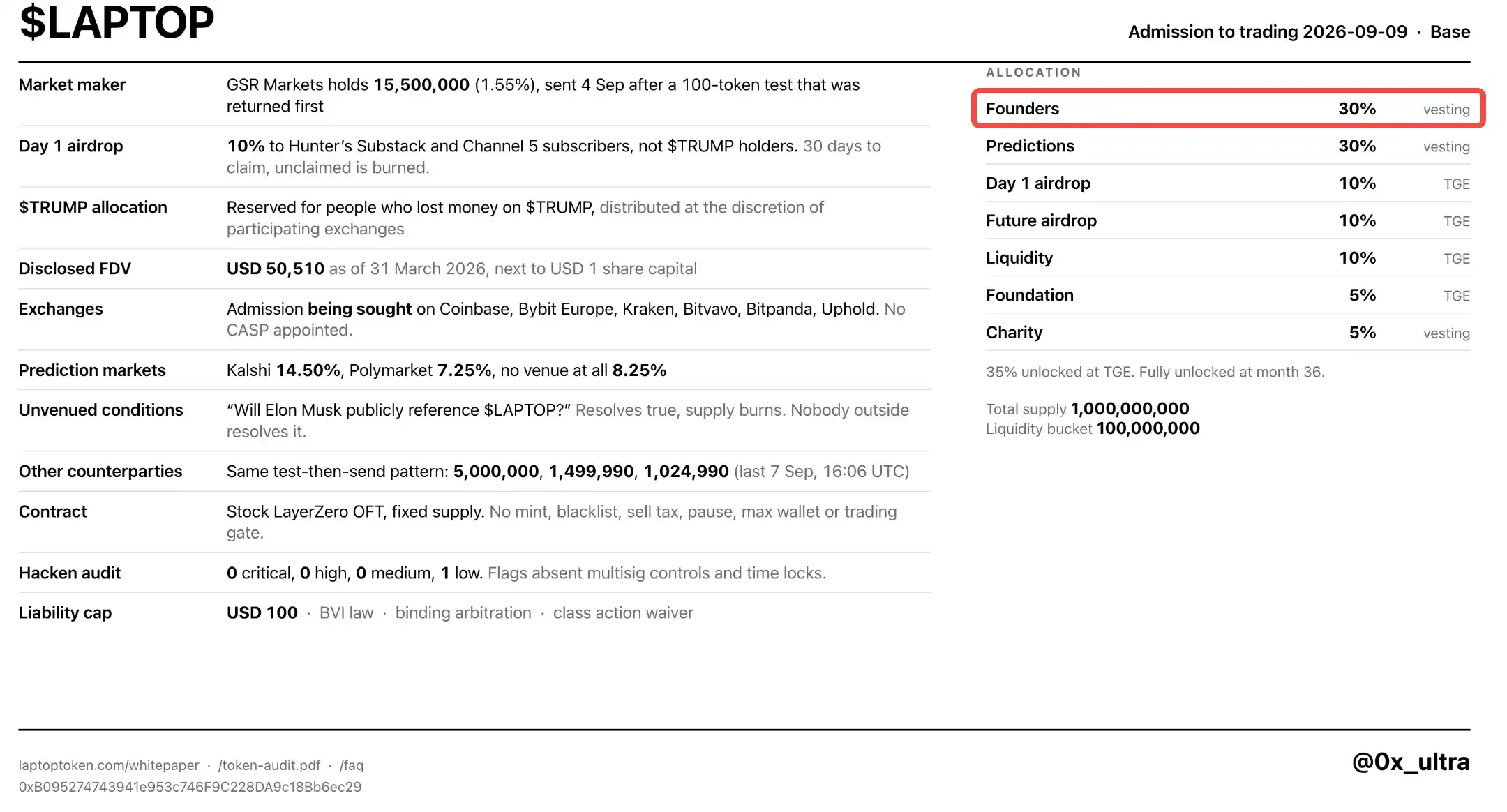
Overseas crypto analysts have calculated that, as long as after the opening on September 9th, riding on the extreme hype of "former president's son launches coin" and "targeted mockery of Trump," the Fully Diluted Valuation (FDV) of the token is pushed to around $70 million, the paper value of this 30% insider allocation could reach approximately $21 million.

This sum would perfectly cover his real-world debt black hole of around $20 million in court-chased legal fees and loans.

Turning the "laptop scandal" that nearly destroyed his political family into a token ticker, and even loudly announcing airdrops specifically for retail traders who lost money speculating on $TRUMP, is undoubtedly highly provocative marketing.

But peeling back this layer of ideological anti-opponent tactics, and considering the above context, the underlying motive might still be to raise money.

At worst, it's clearly about using highly controversial political Memes to create a liquidity frenzy, thereby cleverly transferring a purely personal debt crisis onto retail investors on-chain.

Let's hope the history of the last round, where the Trump Organization's $TRUMP coin launch crashed the entire market, doesn't repeat itself this time.

Related Questions

QAccording to the article, what is the estimated amount of debt that Hunter Biden is currently facing in real life?

AThe article states that Hunter Biden is facing an estimated debt of over $20 million, including approximately $15-17 million in legal fees, a $5 million loan, and other liabilities.

QWhat significant change has affected Hunter Biden's traditional ability to generate income, according to the article?

AThe article explains that Hunter Biden's traditional income streams have collapsed since his father, Joe Biden, left the presidency. His high-priced art sales, which depended on his status as the president's son, have completely stalled.

QWhat is the name of the meme token Hunter Biden is issuing, and what real-life scandal does its name reference?

AThe token is named $LAPTOP. Its name references the famous "laptop scandal" from 2020, involving a laptop he abandoned at a repair shop that contained compromising personal videos and emails related to his business dealings in Ukraine.

QWhat percentage of the total $LAPTOP token supply is allocated to the founding team, as mentioned in the article?

AAccording to the article, the founding team, which includes Hunter Biden and his affiliates, has allocated 30% of the total 1 billion $LAPTOP tokens to themselves.

QWhat is the article's suggested financial motive behind Hunter Biden's decision to issue the $LAPTOP token?

AThe article suggests the primary motive is to raise funds to address his approximately $20 million personal debt. By driving the token's market value high enough, the 30% team allocation could theoretically cover his real-world financial obligations.

Related Reads

DeepMind Founder's Latest Interview: RSI Is Extremely Dangerous and Could Create an 'Alien Intelligence' That Humans Struggle to Understand

Demis Hassabis, co-founder of Google DeepMind and 2024 Nobel laureate in Chemistry, discusses AI's promise and perils in a conversation with Reid Hoffman. He reiterates that his lifelong goal has been using AI as a tool to advance science and medicine, citing AlphaFold—used by ~4 million researchers—and Isomorphic Labs as proof that AI can help cure diseases, while noting protein structure prediction is only one step in a long drug-discovery pipeline. On recursive self-improvement (RSI), Hassabis explains it works best in "verifiable domains" like math, coding, and games: AlphaZero went from random play to surpassing all human and engine chess within 12 hours. But he warns that closed-loop RSI—removing human code review entirely—risks creating an inscrutable "alien intelligence" with no shared cognitive basis with humans, and offers no way to establish deterministic safety controls. He urges caution as labs race on code self-iteration, calling for faster defensive cyber capabilities, far more robust sandboxes and monitoring (noting agents have run unsupervised for weeks), and eventually formal mathematical guarantees. He advocates an industry standards body with government oversight, cross-lab information sharing, third-party audits, and pre-release red-teaming. On AI consciousness, he argues intelligence and consciousness are dissociable—his dog is conscious but not smart—and that a chatbot claiming feelings proves nothing. Building conscious entities now is dangerous: self-motivation undermines corrigibility, and Asimov showed static rules inevitably break at edge cases; society also hasn't begun the needed debate. Humanity should cross only the first Rubicon—building powerful intelligent tools—and use them to understand consciousness before considering the second. Finally, on AI sovereignty, he says only 6–8 global players will stay at the frontier, with open source 6–12 months behind, so most countries shouldn't train their own frontier models. Instead they should build on existing models as infrastructure, focus on vertical domains like healthcare, and protect data sovereignty through private fine-tuning.

marsbit2h ago

DeepMind Founder's Latest Interview: RSI Is Extremely Dangerous and Could Create an 'Alien Intelligence' That Humans Struggle to Understand

marsbit2h ago

Coinone warns of phishing, identity theft after customer data breach

South Korean crypto exchange Coinone warned customers about potential phishing scams and identity theft after an attacker breached its outsourced customer support provider, MetaM, exposing information shared during customer service interactions. Coinone said the attacker accessed MetaM servers on Thursday and viewed or extracted customer support records, learning of the breach the same day. Potentially exposed data includes names, phone numbers, email addresses, dates of birth, bank account numbers, passwords, national identification numbers, home and wallet addresses, and transaction IDs, varying by customer; those who never contacted the support center were unaffected, and Coinone did not disclose how many customers were impacted. The exchange urged customers who shared passwords during support interactions to change them and warned that fraudsters could impersonate Coinone using details from previous conversations. Coinone said its account, trading, and wallet infrastructure operates separately from MetaM's servers, with no evidence of direct compromise, and it has reported the incident to South Korean authorities. The disclosure comes as South Korea strengthens financial-sector cybersecurity; in October the Financial Services Commission identified security deficiencies at 130 of 555 financial firms reviewed, and on Thursday the regulator said it would allow crypto exchanges to suspend withdrawals when hacking is suspected, alongside calls for round-the-clock monitoring.

cointelegraph4h ago

Coinone warns of phishing, identity theft after customer data breach

cointelegraph4h ago

Is There a Hidden Hand Behind Jensen Huang's Departure? Secretary of State Rubio or Anthropic?

The article alleges that Nvidia founder Jensen Huang's departure was the result of a coordinated "hunt" involving two forces: Secretary of State Marco Rubio and AI rival Anthropic. On the policy front, the dispute centers on AI chip export controls—Huang was the most prominent corporate voice opposing built-in tracking and remote kill-switch functions in chips, while three bipartisan chip bills (covering congressional review of export licenses, anti-smuggling measures, and pressure on allies to halt equipment sales) have been folded into the Senate's annual defense authorization bill. The storm began with a highly classified memo leaked to The New York Times; according to The Washington Post, the memo originated with Rubio, who reportedly rewrote a CIA report whose analysts were unconvinced by the underlying intelligence, using "his own more aggressive wording," then sent it to senior officials and briefed the president. David Sacks called the leak a crime and asked why someone would risk prison to bring Huang down. Separately, NYT reporter Tripp Mickle said a mysterious industry contact told him to "drop everything" and investigate Megaspeed, a Singapore-based Nvidia compute rental firm; suspicion points to Anthropic CEO Dario Amodei and a co-founder as the leaker. Anthropic reportedly donated $40 million to Public First Action, which pushes AI safety rules and chip export controls—positions opposite Huang's defense of open-source AI and opposition to backdoors. Nvidia shares fell on the news, and tech leaders including Musk, Garry Tan, and Tim Sweeney are petitioning for Huang's reinstatement, with Sweeney comparing his ouster to Apple firing Steve Jobs.

marsbit7h ago

Is There a Hidden Hand Behind Jensen Huang's Departure? Secretary of State Rubio or Anthropic?

marsbit7h ago

Trading

Spot
活动图片