Author: Jamie, Deep Tide TechFlow
A few days ago, the whole internet was discussing how Robinhood Chain's 24-hour DEX trading volume had fallen back from $3 billion due to liquidity fragmentation. Today, it seems the brief on-chain bear market has already ended.
Some leading tokens on RH Chain like Pons and Cashcat have experienced a rebound to some extent. Meanwhile, the speculative capital on-chain hasn't really left; it's just searching for the next narrative driver.
If the past two weeks saw platforms like Pons and Long push the "token-stock pairing" model—"pricing Meme tokens with Nvidia and Tesla tokens"—to its peak;
then today, capital on RH Chain has already grown weary of the homogeneous stock-based memecoins. Replacing them is a newly launched platform, Commodity Market Exchange; its token $CME has soared past a market cap of $15 million, with daily trading volume approaching the $10 million mark.
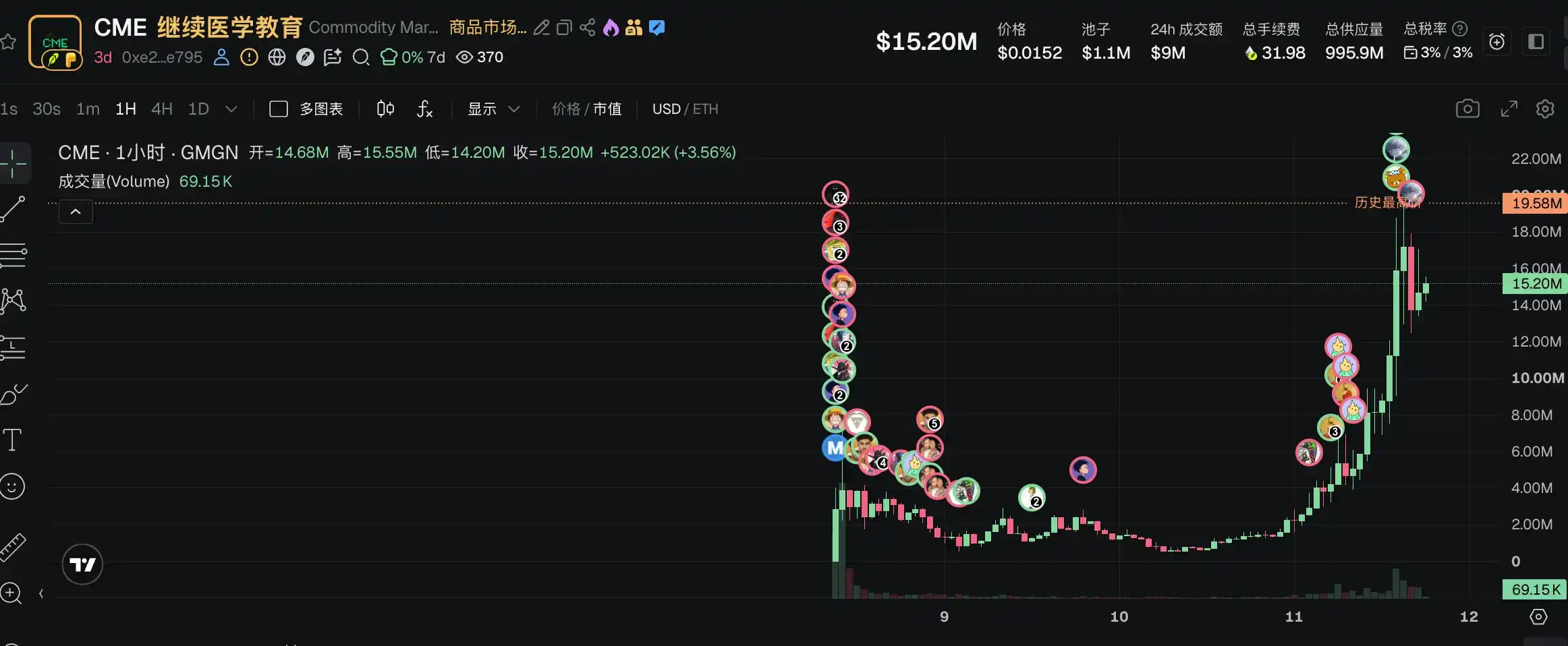
So, what exactly are people FOMO-ing into? The answer is that it has pioneered an incredibly abstract yet entirely new token launch playbook distinct from token-stock pairing:
Token-Commodity pairing, or "Everything can be paired".
If you thought the previous wave's "token-stock pairing," which used Nvidia and Tesla to price Memes, was novel enough, then CME pushes this playbook to another dimension entirely.
Can All Commodities Be MEME-Priced Assets?
When it comes to creating dramatic effects, crypto never disappoints.
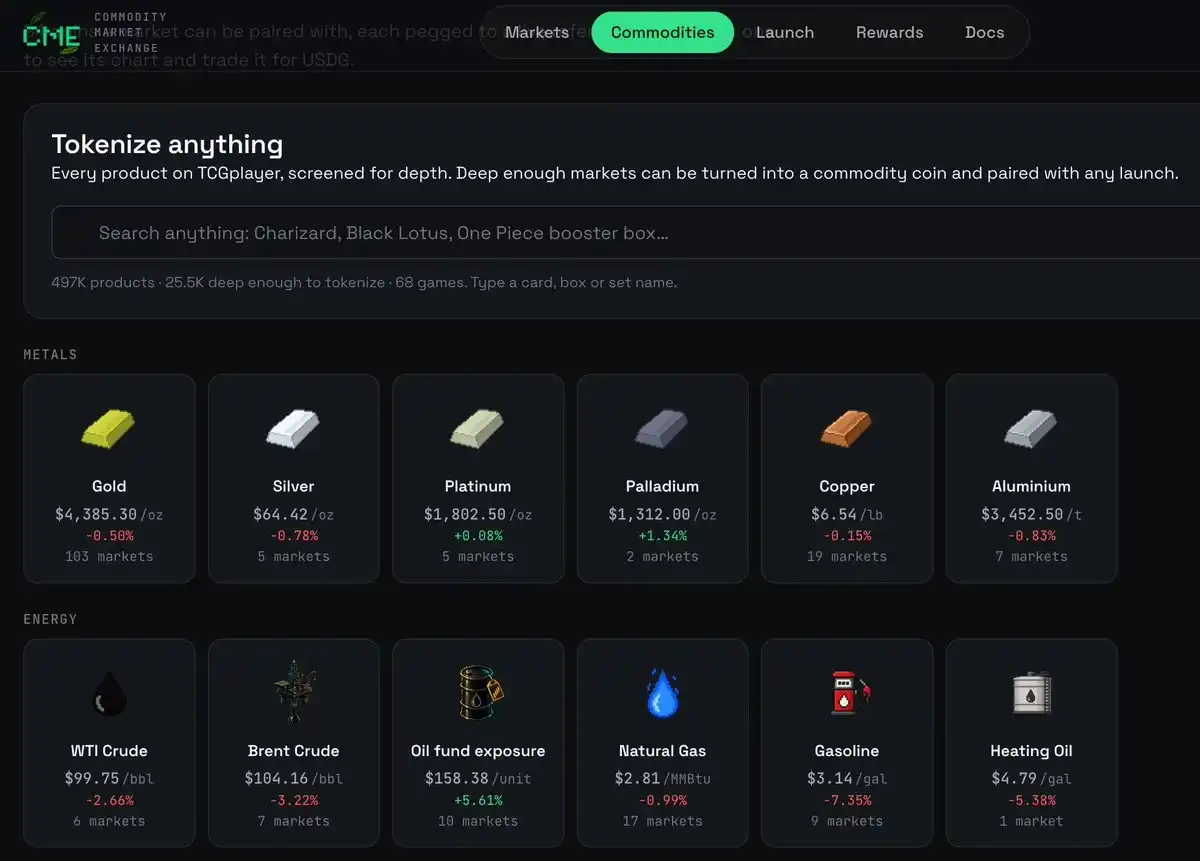
In traditional DEXs, Meme asset trading pairs are usually stablecoins, ETH, or the current on-chain stocks from the token-stock model. Now, this platform's liquidity pool assets have expanded to 94 real-world commodities and non-standard assets.
For example, parodying real-world goods: $FART, a fart-themed token paired with a natural gas token; $MILKERS paired with on-chain milk prices; agricultural product tokens paired with crude oil and corn.
Furthermore, you can even pair meme tokens with non-standard consumer goods, such as pairing a meme with a McDonald's Big Mac, a Dragon Lore skin from CS2, or a first-generation Charizard Pokémon card, and so on.
And this freewheeling playstyle has allowed meme traders to get creative. Buying $WEN, which pairs with a "Lamborghini" pool, roughly plays on the self-deprecating joke of "wen (when) will I be able to buy a Lamborghini?"
No Real Assets, Just Unilateral Pools and Oracles
The biggest misconception for many first-time users is: "By buying a gold-paired Meme, am I indirectly holding real gold?"
The answer is obviously no. Unlike the tokenized US stocks (Stock Tokens) or precious metal ETFs within Robinhood's official compliant brokerage system, the commodities on the CME platform do not involve actual physical delivery or warehouse receipt custody off-chain.
To enable Memes to be paired with virtually everything in the real world, the platform has built its own lightweight synthetic asset system:
Issuing 94 ERC-20 Commodity Tokens: The platform itself mints tokens like Gold Coin, Crude Oil Coin, Milk Coin, etc., each representing the price of a corresponding unit of the commodity (e.g., 1 bushel of corn or 1 ounce of gold).
The protocol then scrapes real-time reference prices from sources like near-month commodity futures prices, fast-food menu prices, and TCGplayer card listings, with an update cycle of about 60 seconds.
It establishes unilateral Uniswap pools between the commodity tokens and the stablecoin USDG. The protocol's sell orders are placed one tick above the reference price, and buy orders are placed one tick below. When real-world prices change or one side of liquidity is depleted, off-chain Keeper bots quickly cancel orders and migrate the pool to the latest price.
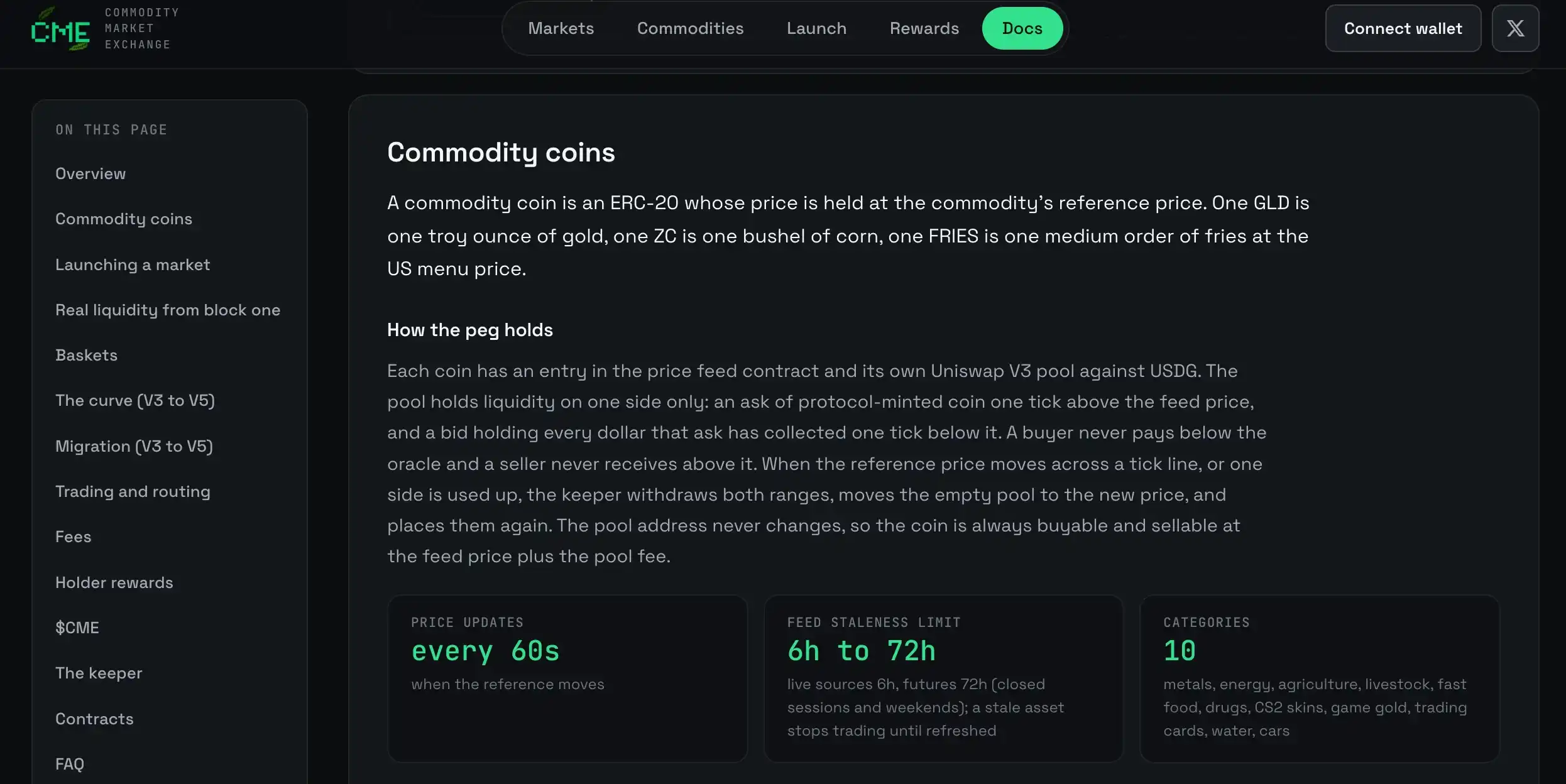
So, in essence, what players are actually interacting with is not physical assets, but a set of "commodity synthetic stablecoins" whose price exposure is maintained by algorithms and oracles. This synthetic asset playbook isn't new in nature, but riding the narrative wave of token-stock pairing and "everything can be paired," it has also piqued the interest of on-chain degens this time around.
Aggressive Distribution Model Attracts Capital
Without wealth creation expectations and a distribution model favoring participants, any on-chain micro-innovation would struggle to siphon liquidity on day one. The reason $CME, the platform token, managed to drive its market cap into the $15 million range in a short time lies in the aggressive adjustments to its business model and tokenomics:
40% Commodity Fee Auto-Dividends: 40% of the platform's transaction fees are automatically distributed to token holders in "the corresponding commodity tokens" based on their holdings, settled every 15 minutes without requiring manual claiming. Buying a milk-themed Meme will result in "milk" deposits every quarter-hour. This immediate, tangible reward greatly amplifies the viral effect of holding the token.
30% Permanent Buyback and Burn: 30% of the fees are converted to ETH, used to continuously buy back and permanently burn the platform token $CME on the secondary market, giving the platform token a strong deflationary expectation.
0% Creator Share (Anti-Grind Mechanism): Unlike most launchpads that reserve high fee percentages for developers, CME's subsequent market completely eliminates dev profit sharing, forcing token launchers and ordinary players to compete on a level playing field within the same pool.
V6 Architecture Enables Genesis as Real v4 Pools: Abandoning the traditional "internal/external market" model of waiting for a bonding curve to fill before migration, assets are deployed directly into Uniswap v4 pools from the genesis block itself. Various DEX aggregators and trading terminals can route trades directly from the very first transaction.
The lifespan of a single Meme might only be a few days, but as long as new projects continuously choose to launch tokens with pools backed by gold, corn, crude oil, or even unimaginable assets, the transaction fees and capital deposited by retail traders will accumulate deeper and deeper within this shared commodity exchange pool.
And this perhaps constitutes a surreal yet genuine metaphor for the Web3 industry.
Large institutions aiming to do RWA are bogged down by licensing, custody, and lengthy compliance audits; meanwhile, on-chain degens, driven purely by speculative desire and absurd Meme culture, have inadvertently and bottom-up cultivated a synthetic commodity liquidity network with deep price discovery capabilities for the entire public chain.
Of course, the unilateral pool and oracle-reliant Keeper system still carry the physical risk of depegging when facing extreme one-sided market movements or network delays.
But undoubtedly, on the liquidity map of Robinhood Chain, this asset issuance experiment of "everything can be pooled" has only just begun.