Author: hosseeb, Partner at Dragonfly
Compiled by: AididiaoJP, Foresight News
Two days ago, OpenAI released 722 mathematical manuscripts in one go, claiming it to be "the most important moment in mathematical history." Foundational problems that had puzzled mathematicians for over a century were solved one after another, with each problem consuming only 3 hours of computing power. Mathematicians were stunned—they could no longer predict what would happen next.
It now appears that cryptography might be the next target.
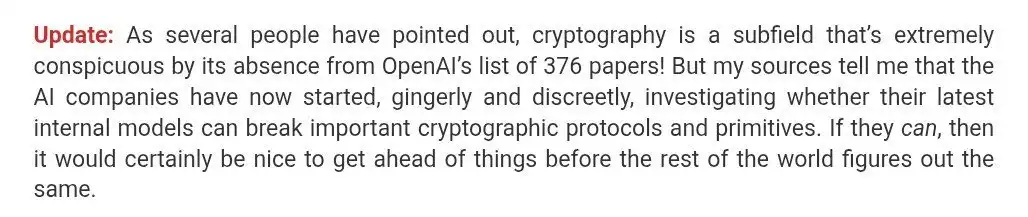
Scott Aaronson stated that OpenAI has already set its sights on breaking cryptography.
The encryption industry is now facing the "mathematical doomsday" seriously—what happens when super-intelligent AI clusters target foundational cryptography?
Matthew Green responded to @kmad and @matthew_pines on October 8, saying: "I think we might lose public-key cryptography."
Let's be clear: we're not talking about AI accelerating the quantum computing process. That is certainly possible, but quantum computing requires significant physical engineering, which AI can't accomplish overnight. This process takes time and is publicly observable. Preparing for the quantum era is crucial, but the path is relatively clear.
We're talking about some unexpected mathematical breakthrough—something that overturns the foundational assumptions of classical cryptography, allowing ordinary computers to compute discrete logarithms and thus break modern public-key cryptography.
This would be an existential-level disaster.
Justin Drake said on October 7: "Today, I call on the blockchain industry to calmly begin planning a 'bunker mode.' My personal suggestion is to initiate a controlled mass migration of assets to new addresses, specifically addresses where public keys remain hidden behind hashes."
In his now-viral "bunker mode" post, Justin essentially advocated: save yourself, protect your own token assets. The disaster might strike others, but at least you know you're safe.
This is cryptography doomsdayism. It's equivalent to saying, since you know the world is ending, start hoarding supplies.
The problem with doomsdayism isn't its core judgment. Of course, there exists a tail risk of catastrophic failure. You can't simply say the risk is zero.
The problem with doomsdayism lies in its response: if this is true, what should we do?
We cannot know the probability that public-key cryptography has some fundamental weakness. It might be low, but it's not zero. For the sake of discussion, let's assume this possibility is 5%. This means there's a 95% chance everything is fine. We'll blog about it, hesitate, and ultimately nothing bad will happen.
In fact, in that 95% scenario, AI will most likely simply confirm our existing belief: public-key cryptography is secure.
But if I told you now that I have a cryptographic scheme with a 95% chance of protecting your funds, you certainly wouldn't place complete trust in it. Cryptographers measure security risks by failure probabilities as low as 2^-128, meaning "almost impossible to fail," not "probably won't fail."
Some might say: true, but if ECDSA is broken, society faces far bigger problems than blockchain! Think banks, TLS, certificate authorities—blockchain is the least of your worries.
But you shouldn't take that as comfort. Banks can recover, TLS can recover, certificate authorities can recover. They can redo KYC, switch to new cryptographic standards.
The encryption industry cannot. If public-key cryptography fails, blockchain cannot recover. In the worst case, anyone could compute anyone else's keys, meaning anyone could take anyone else's money. We wouldn't know who owns what, and there would be no way to prove anything. It would no longer be cryptocurrency but a graffiti wall, forcing us to start over.
Therefore, we must insure against this failure. We cannot guarantee cryptography won't collapse, but we can guarantee it won't destroy blockchain. This "optimization" must happen both at the protocol level and the societal level, requiring immediate action and coordination.
The common saying is "this is not a drill." But in reality, this is an absolutely necessary drill.
We are like countries that must conscript everyone and teach them to shoot. War might come, and you probably won't be sent to the front lines. But if you are, we need you to become a real soldier immediately.
The opposite of doomsdayism is decisive action. Don't retreat; prepare to withstand potential disaster, which means we must start making changes now.
Why Governance Must Change
Historically, our confidence in cryptography was built on a social process.
Cryptographers would spend years trying to attack a structure. If it wasn't broken, we'd say it's probably fine. Surviving a decade, we'd say it's almost certainly fine and place absolute trust in it for production use. But almost all cryptographic schemes are eventually broken—attack methods improve, security margins shrink, and eventually, we must switch to something better.
This pace has never been fast for blockchain: migrations could take years, and social consensus kept up with cryptographic changes.
But this premise is faltering. We are about to face cryptanalysts stronger than any human, scrutinizing these schemes with a rigor never seen before. There are perhaps only a few thousand truly qualified cryptanalysts in the world, and that number is about to increase by several orders of magnitude.
All the cryptanalytic results accumulated by humanity over the past 40 years might pale in comparison to what AI will do next. Work that used to take a decade might be done in months. Or even overnight.
The pace that blockchain governance has grown accustomed to simply won't work in that environment.
We are now in cryptowar times; peacetime norms no longer apply. We must be able to act extremely fast because things can change extremely fast. If social consensus can no longer keep pace with the speed of technological and cryptographic change, then social consensus must adjust immediately.
But Won't This Cause Panic?
Vitalik said on October 8: "I don't recommend anyone rush to move funds to new wallets today. But we should take seriously the risk that AI-accelerated math poses to cryptography, and minimize our exposure not just to quantum-vulnerable cryptography, but potentially AI-vulnerable cryptography as well."
Panic is not the answer either. I agree with Vitalik: if we encourage panic, people are more likely to cause losses during hasty migrations, which is worse than the actual risk of ECDSA keys being compromised.
So-called "bunker mode" is not a real way out either. You alone moving your keys to a new address might make you safe. But then what? The crux of bunker mode is: your coins can't move. As long as you don't move them, they're protected. But if the entire chain collapses, what use is your individual safety? If everyone's coins are being stolen and dumped, your coins are worthless. Even if your address remains untouched, what's the point?
No, the solution must be systemic. Encouraging people to fend for themselves doesn't solve the problem.
At the same time, the argument that "the most important thing is for everyone not to panic" is becoming less tenable. We should be honest and direct about the risks, get people to take them seriously, and push them to take action.
This keeps reminding me of the Cold War. During the Cold War, Western societies were repeatedly told: nuclear war could happen. For most people, civil defense drills seemed pointless—hiding under a desk wouldn't stop a nuclear bomb. But precisely because everyone participated in the drills, the entire society truly understood the severity of the risk. Political winds shifted toward avoiding war at all costs while building bomb shelters just in case. And indeed, we came close to nuclear war several times. We were truly lucky. The stories of the Cuban Missile Crisis and Stanislav Petrov show: the probability was not zero.
In the matter of cryptography, we might be lucky. Most likely, we will be, but we should be prepared in case luck is not on our side.
So, how must governance change?
1) In a crisis, speed is more important than decentralization. Chains that can coordinate quickly will have an advantage. Decentralized social consensus is inherently mismatched with the pace of ultra-fast technological change. Governance mechanisms must adjust as soon as possible. Even if this means loosening decision-making rules, even if this means giving more power to validators, it must be done. Potential crises require swift and decisive responses.
2) The entire ecosystem must be mobilized. It's not just protocol developers; wallets, exchanges, RPC providers, applications, asset issuers, and end-users all need to act in unison; the entire ecosystem must respond together.
3) Plans must be made in advance. If things fall apart and there's no plan, it will be too late.
The market will watch which chains take this seriously. I've already received inquiries from large investors who understand why this is concerning and want to know if our entire industry has an answer.
So, let's provide an answer.
Cryptographic Recovery Mode
I propose that every major blockchain implement a mechanism as soon as possible, which I call "Cryptographic Recovery Mode." This is a nuclear-level contingency plan to be used only in the worst-case scenario.
The general idea is as follows:
In the next protocol upgrade, add a brand-new, extremely simple hash-based public-key system. (Hash-based signatures typically rely on the fewest cryptographic assumptions.) This is akin to Cold War-level minimalist cryptography. This scheme is slow, expensive, and extremely cumbersome to use. We don't want to touch it at all—almost anything else is better if we have a choice. If we actually have to use it, the chain will be as slow as a snail, and DeFi will be largely paralyzed.
But it works. Technically functional is better than nothing.
Everyone creates a backup key using this terrible signature scheme. All users will be guided to establish a link between their regular address and this hash-based backup key. Initially optional, it becomes mandatory after a few months. Once enforced, you cannot sign new transactions with your ECDSA key until you set up your hash-based backup key. Without a backup key, transactions will simply fail.
Every exchange will also start generating backup keys for their addresses. Coinbase, Metamask, Ledger—if they detect you lack a backup key, they will prompt you to create one before you sign. This way, everyone has a backup plan. Of course, we continue using ECDSA normally.
We pre-set an emergency switch. If disaster strikes and AI discovers a vulnerability in ECDSA, validators can agree to activate the emergency protocol, entering crisis mode. No protocol upgrade is needed; merely by validators signaling, they can vote to flip the switch.
Once the switch is flipped, all addresses enter Cryptographic Recovery Mode. At this point, ECDSA is invalid. Completely dead.
Then What?
At that point, the chain will be a mess. Nothing will run well; it will be almost unusable—but technically, it will still run. Developers will have to figure things out: how much damage is done, which cryptography is still intact, how to transition to a new chain to bring performance back to acceptable levels. At least for now, everyone's balances remain secure, and there is a path to recovery.
What about those who haven't migrated in time? Almost certainly, a significant number of addresses will be left behind.
Those still holding their seed phrase can, at any time, generate a hash-based zero-knowledge proof of their seed phrase (similar to @VitalikButerin's 2024 proposal) and assign themselves a new hash-based address. If their address has never signed any transaction (the so-called "bunker mode"), recovery with a ZK proof is straightforward.
But many simply won't be able to. For them, a countdown begins. To recover, they must take this path: they need to both generate an ECDSA signature and solve a Proof-of-Work hash puzzle to unlock their address and move assets out. The difficulty of this puzzle scales based on the amount of native tokens held by the address. That is, if you hold 100 ETH, the difficulty is 100N.
But this N grows exponentially. 1 day later, it's 100N, 2 days later 200N, then 400N, then 800N. Validators can vote to cap N or limit the growth rate based on the nature of the vulnerability and their risk modeling. Maybe we'll have months; maybe only hours.
To be clear: in a real attack scenario, this becomes a race. If someone actually finds an efficient method to break ECDSA keys, the real owner's only advantage is: the attacker must first crack the key, then do the PoW; the real owner only needs to do the PoW, which should be faster. This makes large-scale theft difficult to execute. If massive theft is detected, validators can drastically accelerate the difficulty growth, preventing more funds from flowing out (or, if things go completely out of control, raise the difficulty to infinity, permanently freezing all vulnerable coins).
I'm certainly missing many crucial details. This is just a proposal; I am neither a cryptographer nor a protocol designer. But the general idea is: a mechanism like this should be implemented on every blockchain as soon as possible.
The market will soon demand this. Given the changes happening in mathematics, every blockchain needs a backup recovery plan, and consensus must be reached in advance—so that when that moment truly arrives, no one is still debating how the transition should happen.
In a crisis, speed is everything.
In such a situation, don't let the perfect be the enemy of the good. If OpenAI is already working on this now, we don't know how soon an unexpected cryptographic breakthrough might occur. The first version of Cryptographic Recovery Mode can be rough (and probably should be rough), but once a preliminary scheme is in place, it can be refined. (Note: if a sudden quantum breakthrough occurs, this mechanism also applies. But its primary need is to address the fundamental breaking of underlying cryptography.)
The key is that we must not just debate and argue on Twitter; we must actually get to work.
Nothing Is Permanent
A few weeks ago, I argued that Zcash should complete its post-quantum migration and then remain unchanged.
I retract that statement now. When the mathematical foundations beneath our feet are as shaky as they are now, nothing is permanent.
Perhaps years from now, we will have more confidence in the foundations of cryptography. But for now, everything is still in flux.
This requires us to react faster, trust protocol teams' judgments more, and face the trade-offs before us more honestly. Ultimately, it's about safeguarding the security foundations of the entire crypto industry amidst rapid technological change.
The "mathematical doomsday" of cryptography is approaching, and we must prepare.
I want to be clear: most likely, nothing will happen, and everything will be fine. AI will invest vast computing power and ultimately conclude—cryptography is all secure enough.
But we must ensure one thing: even in the worst-case scenario, blockchain remains secure.