Ahead of the 2026 midterm elections, crypto voters are closely watching lawmakers' positions on digital assets as the CLARITY Act emerges as a key legislative issue for the industry.
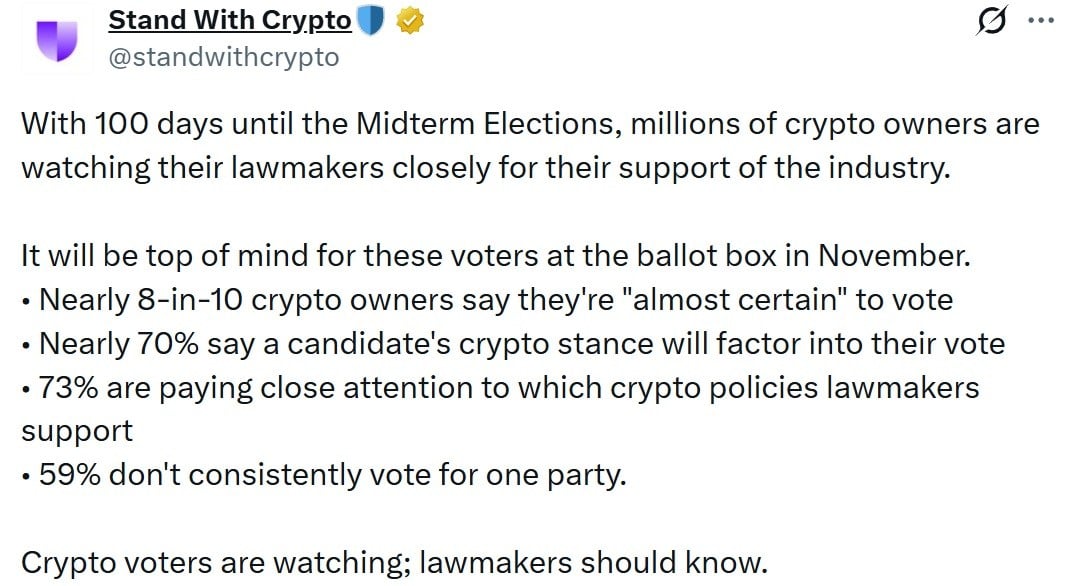
The cryptocurrency advocacy group Stand With Crypto stated in an X post on July 26th that digital asset policy is becoming a priority for many crypto holders leading up to the elections. According to the group, nearly 70% of crypto owners believe a candidate's position on crypto will influence their voting choice, and nearly 8 in 10 said they are almost certain to vote.
Stand With Crypto also reported that 73% of crypto owners are paying close attention to which crypto policies lawmakers support, while 59% do not consistently vote for one political party. The group's poll suggests that crypto policy could sway voters regardless of party affiliation.
CLARITY Act Faces Pressure Amid Heightened Pre-Midterm Political Jockeying
At the center of attention is the CLARITY Act, formally known as the Digital Asset Market Clarity Act of 2025. This bill aims to establish clearer rules for digital assets by defining regulatory authority between the U.S. Securities and Exchange Commission (SEC) and the Commodity Futures Trading Commission (CFTC). This regulatory framework could help determine whether certain digital assets are treated as securities or as commodities under federal oversight.
For crypto investors, companies, and consumers, the bill could define how digital assets are classified, which federal agency will oversee market activity, and what requirements exchanges must meet.
Timing adds urgency to the matter. Supporters of the bill argue that lawmakers have limited time to advance it before the political climate in an election year makes major policy changes more difficult.
The approaching midterm elections could create hurdles for the bill's passage, as lawmakers will devote more time to campaigning and Congressional leaders will reassess legislative priorities. If consideration of the CLARITY Act extends into the elections, its backers will face a more complicated path, as a new Congress could have different priorities and negotiating terms.
Crypto Industry Ramps Up Pressure Amid Senate Time Crunch
The push for the CLARITY Act has extended beyond traditional lobbying, with crypto advocates urging users to contact legislators directly.
Crypto proponents say they have contacted Congress more than 1 million times in an effort to gain support for the bill. These efforts underscore the growing political focus on digital asset regulatory issues.
Advocates argue the bill could provide regulatory clarity for the industry after years of uncertainty over whether certain cryptocurrencies should be considered securities or commodities. They believe clearer rules could encourage companies to grow their business in the U.S. and give consumers more predictable protection.
Critics argue that any new regulatory framework must include strong safeguards against fraud, market manipulation, and investor losses. This debate reflects the complexity of balancing financial innovation with consumer protection.
CLARITY Act Becomes a Test for Washington's Crypto Strategy
The debate over the CLARITY Act has become part of a broader pre-election struggle over how Washington should approach cryptocurrency: supporters frame the bill as a path to regulatory certainty, while opponents highlight oversight and consumer protection concerns.
The next 100 days could prove decisive in determining whether the CLARITY Act moves forward before the midterm elections or becomes stuck in the general election cycle calendar.
For lawmakers, the bill presents a choice: how decisively the United States should define the future of digital asset markets. Supporters see the bill as a path to clearer oversight, while opponents continue to debate whether the regulatory framework provides sufficient consumer protection.
For voters, the outcome of this issue could influence concerns extending beyond crypto markets, including access to exchanges, investment products, taxation, and the future role of federal regulators in digital finance.
As the election campaign intensifies, lawmakers' stances on the CLARITY Act could become a factor for some voters assessing the future of crypto regulation in the U.S.