Forget Ctrl+F, a New AI Paper Tool Helps You Search for Needles in the Haystack of Full-Text Literature

marsbitPublished on 2026-10-10Last updated on 2026-10-10

Abstract

This article introduces a new AI-powered academic paper writing tool called "Open Academic Paper Gen." Unlike typical AI writing assistants that generate content and citations, this tool features a unique multi-step workflow designed to ensure the validity of references. After generating an initial draft based on a user-provided research topic, the system performs a crucial verification step: it locates and analyzes the full text of cited papers to check if the referenced claims are genuinely supported by the source material. It can even pinpoint relevant paragraphs and PDF page numbers. The tool's workflow involves nine stages: defining the research scope, literature retrieval, filtering, trend analysis, identifying research gaps, outlining, writing, citation verification, and final export. It searches databases like OpenAlex and arXiv, builds an evidence table from gathered papers, and includes an "innovation diagnosis" to assess a proposed angle against existing work. A key focus is its three-layer citation verification process: 1) ensuring citations exist in the collected literature pool, 2) cross-referencing metadata like DOI and author details with official records, and 3) using AI to analyze the source's full text (or abstract if unavailable) to confirm it supports the claim made in the draft. Unverifiable citations are flagged rather than assumed correct. The tool offers both manual review checkpoints and a fully automatic mode, requiring OpenAI or GLM API keys. The...

I'm begging you, we already have more papers than we can read, why are tools for automatically writing papers still popping up everywhere!

Recently, GitHub has once again launched a new AI paper generation tool—

Open Academic Paper Gen.

Don't swipe away just yet!

Besides being able to automatically generate a first draft with references, Open Academic Paper Gen has another feature you must pay attention to—

When it can obtain the full text of a paper, it will search the full text(underline this) for evidence to verify the cited viewpoints within the paper.

To be honest, this is super useful.

Because writing a paper often starts with a research topic, followed by continuously organizing arguments, searching for evidence, and then adjusting one's own judgments based on the literature.

With AI, it can help you brainstorm arguments and also help you search for sources of evidence.

But the problem is, sometimes the arguments or papers are real, but once you put the (AI-given) "argument" back into the full text and read it in context, you might find that the author probably didn't mean that at all.

So, to solve this problem, after obtaining the full text of a paper, Open Academic Paper Gen further locates relevant paragraphs to judge whether that paper can actually support the corresponding argument.

If there's page number information, it will also mark the corresponding PDF page number in the notes, making it easier for people to look it up later.

In other words, it not only checks "if this paper exists," but also checks "if this paper actually said that."

A Multi-Agent Workflow for Generating First Drafts of Papers

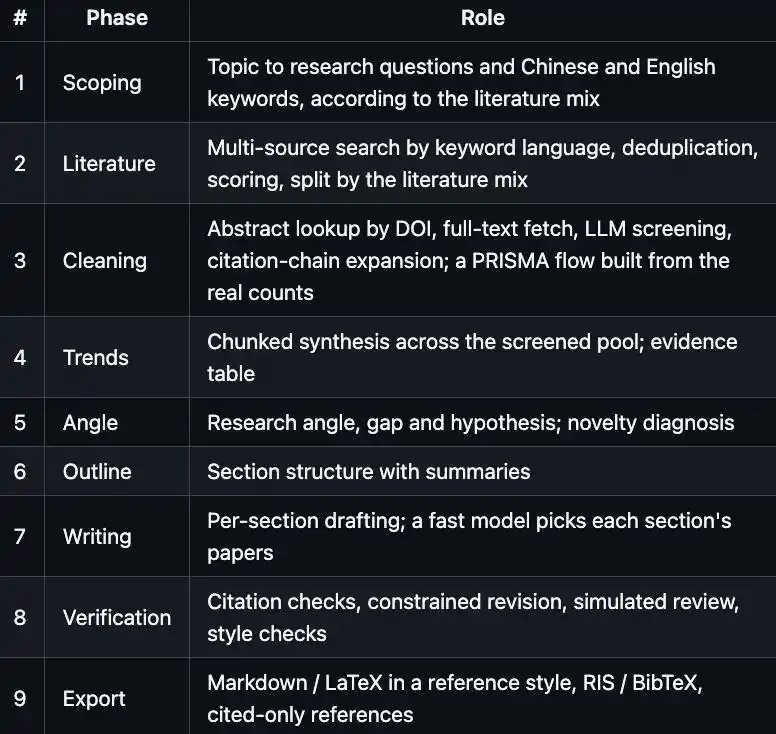
Overall, Open Academic Paper Gen is a multi-agent workflow for generating first drafts of papers, breaking down the process from topic selection to export into nine stages:

Define research scope, search for literature, clean and filter, analyze trends, find entry points, outline, write, verify, and finally export.
Similar to other AI paper writing tools, you give it a research topic, like "RSI in the Physical World."

It then breaks down this topic into specific research questions, generates corresponding Chinese and English keywords, and searches for papers in OpenAlex, Crossref, Semantic Scholar, and arXiv.

The retrieved literature is further deduplicated and scored, then filtered for relevance by the model. When encountering highly relevant papers, it continues searching by following their references and later studies that cite them.

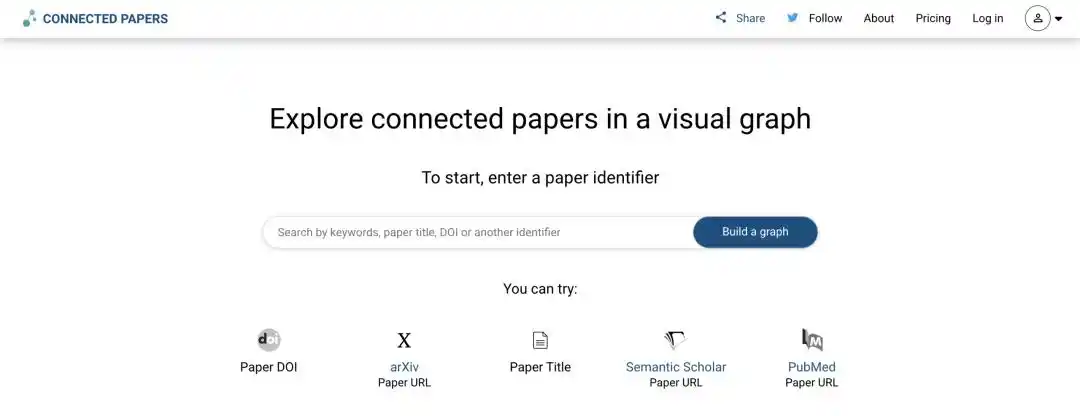
It's like grabbing one paper and then following the trail to supplement a batch. The idea is actually a bit like the old CONNECTED PAPERS.

(If you know, you know).
Next, the collected literature is organized into an evidence table, summarizing each paper's research question, method, data, conclusions, and limitations.

With these materials, the system analyzes research trends and proposes possible research angles, gaps, and hypotheses.

There's also a quite interesting step here called Innovativeness Diagnosis.

Open Academic Paper Gen evaluates the entry point from dimensions like problem, method, data, and perspective, points out the most similar existing work in the literature pool, and gives possible critiques reviewers might raise.

(This is like, when you think you've created ResNet, the AI first helps you check if someone else has already done it.)

Specifically, these judgments are based on the literature retrieved this time, but not finding it in the pool doesn't mean no one in the world has done it~

Finally, once the research angle is determined, the system continues to generate an outline and draft sections.

After the first draft is written, it enters the citation verification and simulated peer review stages, and can finally export to Markdown or LaTeX, as well as reference formats like RIS and BibTeX.

Regarding the specific operation mode, in the default mode, Open Academic Paper Gen will pause at major stages, waiting for you to review, edit, and confirm before proceeding.

If you want to test the AI's research capabilities, you can also let it run automatically by choosing the fully automatic mode.

Lastly, friends ready to give it a try should also pay attention to the model configuration:

The project currently supports OpenAI and Zhipu GLM, but for the steps of argument verification, citationless statement checking, and simulated peer review, an OpenAI API Key is still required.

How Does the Citation Check Get into the Sentence?

Honestly, automatically searching for literature, writing a first draft, and then having AI review it is already a common combination in many paper writing projects.

Some of them also incorporate citation verification and manual confirmation to minimize model hallucinations.

Within this workflow, Open Academic Paper Gen further refines the checking and modification of citations.

After all, attaching references to a first draft is one thing; proving that these references can actually support the main text is another.

Specifically, it breaks verification down into three checks.

First, check if the cited paper can be found in the literature pool.

During writing, each citation marker must correspond to a paper already collected.

If the model fabricates a non-existent citation identifier, the system will mark it for easy location and correction.

Second, verify the identity of the cited paper.

Papers with a DOI are first cross-checked with Crossref records; if not found, confirmation is sought at doi.org.

Mismatches in title, author, year, etc., will trigger corresponding warnings.

Third, check if the source text actually supports the statement.

Here, the check truly moves from "paper metadata" into "paper content."

After obtaining the full text, the system finds the paragraph(s) most relevant to the cited argument and feeds them, along with the paper's abstract, to the model to judge whether the source text can support the statement in the main text.

If the full text is unavailable, the abstract or excerpts are used. When page number data exists, warnings can also indicate the corresponding PDF page number, making it easier for people to look it up.

Of course, the model not finding sufficient evidence does not mean it has proven the statement is wrong.

According to Open Academic Paper Gen's handling, when evidence is insufficient, it can be marked as "Unable to judge."

Literature with too little text to verify at all is marked as "Not verified," rather than directly counted as passed.

So, looking at it overall, compared to "writing the paper with one click," the idea of linking literature organization, evidence location, and citation self-check is indeed clever.

Especially when facing arguments and evidence generated by AI, and feeling "it seems plausible, but I don't dare to just trust it," being able to find the corresponding original text at least provides another handle for verification.

By the way, this project is from an individual developer Cat Uncle. Besides Open Academic Paper Gen, he has previously released several projects including an AI scriptwriter and an AI researcher.
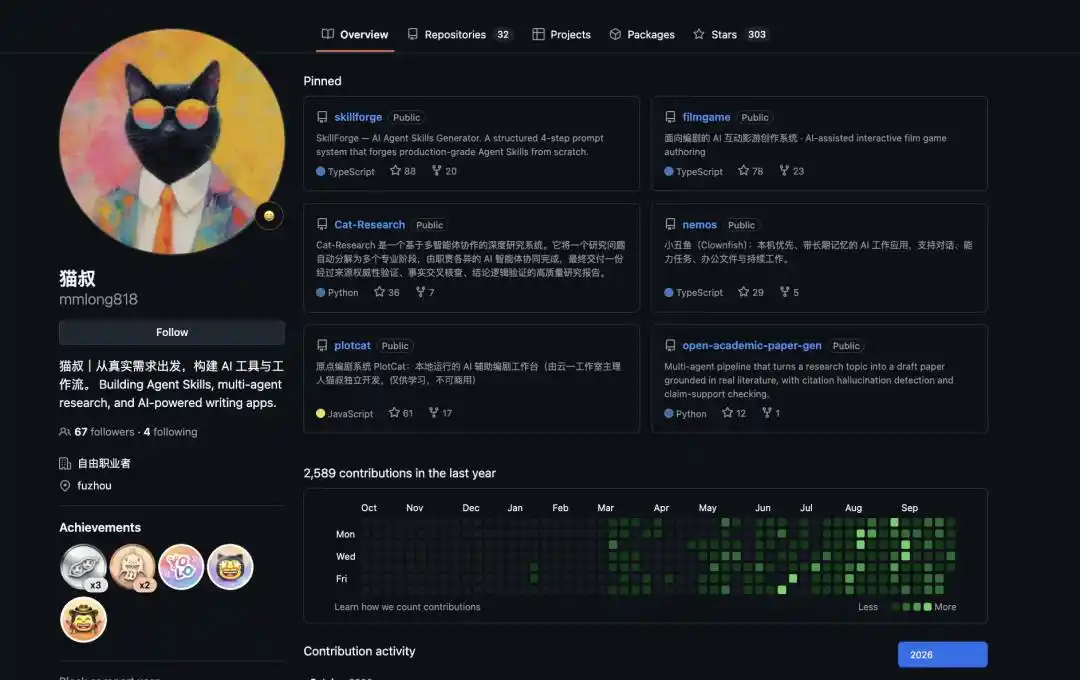
Reference Links

[1]https://github.com/mmlong818/open-academic-paper-gen

This article is from the WeChat public account "QbitAI", author: henry

Related Questions

QWhat is the name of the new AI paper writing tool introduced in the article?

AThe new AI paper writing tool is called Open Academic Paper Gen.

QWhat is the unique feature of Open Academic Paper Gen regarding literature verification?

AIn addition to generating a draft with references, Open Academic Paper Gen can verify citations by locating relevant paragraphs within the full text of a paper to check if the cited content genuinely supports the argument being made.

QHow many stages does the Open Academic Paper Gen workflow consist of?

AThe Open Academic Paper Gen workflow consists of nine stages: scoping the research, searching for literature, cleaning and filtering, analyzing trends, finding research angles, outlining, writing, verifying citations, and exporting.

QWhat databases does the tool use to search for academic papers?

AThe tool uses OpenAlex, Crossref, Semantic Scholar, and arXiv to search for academic papers based on generated keywords.

QWhat does the tool do when it cannot verify a citation due to insufficient evidence in the source?

AIf the tool finds insufficient evidence in the source material to verify a citation, it will mark the citation as 'unverifiable' or 'cannot be judged' rather than assuming it is correct.

Related Reads

Strategy stock sheds 5% amid MSCI index removal, Bitcoin sell-off

Strategy (Michael Saylor's Bitcoin treasury company) fell 6.49% on Thursday to close at $114.41, after MSCI confirmed the company's removal from its global equity indexes, compounded by a broader crypto market sell-off. The removal takes effect after the Nov. 30 market close and could trigger selling by index-tracking funds; JPMorgan previously estimated roughly $2.8 billion in potential selling pressure. Ryan Kirkley, CEO of Global Settlement Network, said the decision could distinguish Bitcoin treasury companies from traditional operating businesses and limit indirect crypto exposure for passive investors, noting that index inclusion had given ordinary passive investors leveraged Bitcoin exposure they never chose. He added it raises questions about whether such companies should be classified alongside traditional operating businesses, arguing that buying and holding an asset isn't an operating business but rather a fund that doesn't follow fund rules. In its Aug. 31 response to MSCI's proposed rules, Strategy called the changes a pretext for targeting digital asset treasury companies and downplayed the impact, saying MSCI-linked funds held about 13 million of its shares, just 3.1% of basic shares outstanding. The decline coincided with a broader crypto sell-off, with Bitcoin near $71,340, down 4.3% in 24 hours, and total crypto market capitalization down 3% to about $2.49 trillion.

cointelegraph48m ago

Strategy stock sheds 5% amid MSCI index removal, Bitcoin sell-off

cointelegraph48m ago

US Justice Department, business groups and DeFi firms challenge Illinois crypto tax

The US Department of Justice, business and financial industry groups, and a coalition of DeFi firms have backed a legal challenge to Illinois' 0.2% digital asset tax, arguing it unfairly targets crypto transactions and could impose taxes even without profit. The Justice Department filed a statement of interest, while the US Chamber of Commerce and SIFMA submitted an amicus filing. A coalition including Andreessen Horowitz, Paradigm, Uniswap and Aave Labs also filed a brief. The law, enacted in June, taxes the value of digital assets exchanged, transferred or stored regardless of profit. The Digital Chamber sued Illinois officials in July, followed by a separate challenge from the Blockchain Association and Crypto Council for Innovation in August. Originally set for Jan. 1, 2027, the tax was delayed to July 1, 2027. Illinois projected $60 million in fiscal year 2027 revenue. SIFMA and the Chamber warned the tax would affect banks, broker-dealers, custodians and asset managers nationwide, exposing them to compliance costs and burdening customers—someone who loses money owes the same tax as someone who profits, and moving assets between accounts could trigger tax without a sale or gain. They argued it discriminates against digital assets and may violate federal internet tax protections and constitutional interstate commerce requirements. The DOJ said the tax undermines federal efforts to promote crypto innovation, citing the Strategic Bitcoin Reserve and GENIUS Act. The DeFi coalition warned the rules could impose obligations on software developers and blockchain participants lacking customer information or control over funds.

cointelegraph1h ago

US Justice Department, business groups and DeFi firms challenge Illinois crypto tax

cointelegraph1h ago

DTCC Plans Solana Expansion as Wallet Rules Limit Access

DTCC plans to connect its tokenization service to Solana in the second half of 2027, allowing certain securities held by its DTC subsidiary to be converted into digital tokens on the network. Analysts say the move could attract more traditional financial institutions to Solana, which is known for fast transactions and low fees and had about $4.94 billion in total value locked as of Nov. 12. However, the impact may be limited by US regulatory rules. Alex Lin of Reforge noted that Solana's experience handling memecoin trading served as a public stress test, giving the network credibility to handle retail-scale volume reliably. Still, under a December 2025 SEC no-action letter, DTC participants must register wallets to hold tokenized securities, and tokens can only be transferred between registered wallets. Lin said the near-term impact is overstated because the tokens remain in a walled garden, inaccessible to permissionless retail and DeFi liquidity until regulators allow these assets to function as true onchain collateral. DTCC launched its tokenization service on the Canton Network and its private Besu network on Oct. 28, with 20 DTC participants signed on, though it has not said whether any plan to use Solana. Kha Nguyen of Birdeye said Solana has already seen growing demand for tokenized stocks, with trading volume reaching around $4.9 billion in H1 2026 and over 1 million accounts holding tokenized stocks by late September. However, broader Solana activity has slowed, with transactions down nearly 40%, DEX volume down 34.4%, and fees down 39%, while tokenized RWA value rose almost 7% to $4.76 billion. Nguyen said DTCC's integration would need banks, brokers, and issuers to actively issue, trade, and settle on Solana, with enough liquidity for large trades. He stressed that assets must be active rather than idle—traded around the clock, used as collateral, and earning yield. Lin agreed that long-term impact depends on where assets are used for secondary trading and collateral activity, not where they are issued.

cointelegraph2h ago

DTCC Plans Solana Expansion as Wallet Rules Limit Access

cointelegraph2h ago

Trading

Spot
活动图片