Goldman Sachs Research Report Analysis: Cryptocurrency Trading Declines for Ten Consecutive Months, Turning Point May Be Approaching

marsbitPublicado em 2026-08-25Última atualização em 2026-08-25

Resumo

Gold Sachs Research Note: Crypto Trading Declines for Ten Months, Inflection Point May Be Near Crypto trading volumes fell 30% in July and 21% in August, marking ten consecutive months of decline—a duration now exceeding the median of past five cycles. However, in a report dated August 24, Goldman Sachs expresses "cautious optimism" for the second half, suggesting a market recovery could provide significant upside potential. The current crypto trading volume downturn has seen a 75% drop from its peak over ten months. While a brief rebound in April-May failed to sustain, a recent 21% market cap increase, if maintained, could signal a volume inflection point. Goldman notes sector valuations are near the 30th percentile of the past five years, presenting a favorable risk-reward profile. Key catalysts include regulatory progress, such as the SEC's innovation exemption proposal and over 15 crypto firms receiving federal banking charters by 2026, which could bolster institutional adoption. Furthermore, crypto companies have cut costs by ~5% on average in 2026, improving operating margins and preserving cash flow. The report highlights four Buy-rated stocks: HOOD ($124 target), IBKR ($114 target, on Conviction List), FIGR ($43 target), and COIN ($196 target), each benefiting from distinct growth drivers like structural account growth, international expansion, or regulatory tailwinds. Overall, Goldman argues the sector has priced in significant pessimism, with a potential revers...

Author: Rita

Cryptocurrency trading volume fell 30% in July and another 21% in August, marking a continuous decline for ten months, exceeding the median duration of the previous five cycles. However, in its Americas Brokers & Cryptocurrency Industry Report published on August 24, Goldman Sachs expressed a "cautiously optimistic" outlook for the second half of the year. A recovery in the crypto market would provide additional upside optionality.

Traditional brokers base their logic on a seasonal rebound in September, prediction markets tout a 1160% structural growth story over two years, while the crypto sector's appeal lies in the possibility of a reversal as the downturn approaches historical limits. Goldman Sachs believes the current valuation for the entire sector is only at the 30th percentile of its historical range over the past five years, suggesting a favorable risk-reward ratio is already in place.

Crypto Downturn Nearing Historical Limits
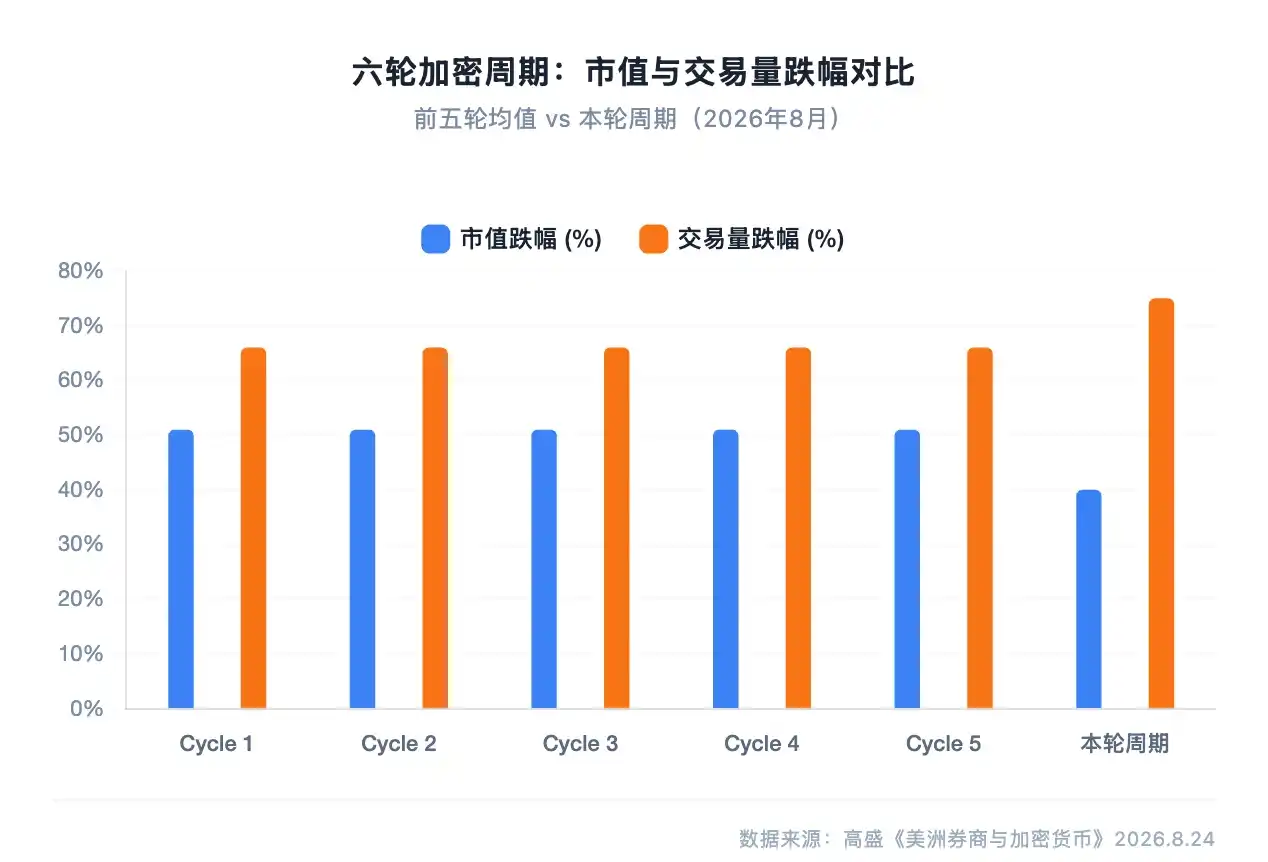
The current decline in crypto trading volume from its peak has reached 75%, lasting ten months, surpassing the median duration of four months in the previous five cycles. Crypto market cap rebounded 21% over the past week. Although a similar rebound from April to May failed to sustain, Goldman Sachs believes if the market cap can stabilize at current levels, a turning point in trading volume could emerge.

Data from Goldman Sachs' Prime Brokerage Survey shows that 35% of institutional investors view regulatory uncertainty as the biggest obstacle to entering the crypto market, while 32% believe regulatory clarity is the top catalyst for institutional adoption.

Regulatory Reform Provides Institutional Support

Although the likelihood of the "CLARITY Act" passing before the midterm elections continues to decrease, U.S. regulators are still pushing for substantive reforms. Recent SEC proposals for innovation exemptions, along with over 10 new digital asset companies obtaining OCC bank charters in 2026, bring the total number of crypto firms incorporated into the federal banking system to more than 15.

Goldman Sachs believes the catalytic effect of regulatory reform on crypto infrastructure businesses (custody, staking, stablecoins) cannot be ignored, though a true surge in institutional adoption likely awaits legislative finalization.

Cost Cuts Already Buffering Profits

Crypto companies have proactively reduced costs in response to the market downturn. Goldman Sachs estimates that covered companies have cut expenses by an average of about 5% in 2026. Multiple firms have reduced spending through layoffs, scaling back marketing budgets, and optimizing technology infrastructure expenditures.

The effects of cost-cutting are directly reflected in profits. Expense reductions have driven operating margins up by approximately 5.8 percentage points, partially offsetting the impact of revenue declines on profits. This has enabled crypto companies to maintain positive operating cash flow even before revenue recovery, preserving tactical space for the next cycle.

Four Key Picks with Distinct Positioning

From its coverage universe, Goldman Sachs has selected four stocks with a Buy rating.

HOOD (Target Price $124): Structural account assets growing at an annualized rate above 20%. The Rothera prediction market exchange, launched less than two months ago, has already entered the industry's top three, contributing approximately $150 million in annualized revenue.

IBKR (Target Price $114, U.S. Conviction List): Account growth is expected to exceed 30% in 2026, with over 85% of new accounts coming from outside the U.S., and a pre-tax margin above 75% driving robust capital generation.

FIGR (Target Price $43): The HELOC loan platform saw transaction volume grow over 100% year-over-year in July. The number of partners increased from 178 in 2025 to 1,002 in Q2 2026 and is still accelerating.

COIN (Target Price $196): Crypto derivatives market share has increased by approximately 8 percentage points since Q1 2024. Subscription and services revenue now accounts for about 40% of total revenue. If the SEC innovation exemption materializes, its institutional token service capabilities would directly benefit. Its forward P/E ratio is around 28x, at only the 5th percentile of its historical range since its IPO.

The three asset classes have different logics: traditional brokers rely on a September seasonal reversal, prediction markets on election cycles, and crypto plays on the triple catalysts of market cap recovery, cost cuts, and regulatory reform. Goldman Sachs believes valuations for the entire sector already reflect ample pessimism.

Disclaimer

This article is Tide Research's compilation and interpretation of a third-party brokerage research report (Goldman Sachs, August 24, 2026), combined with public market information. The ratings, target prices, earnings forecasts, and related judgments cited in this article represent the views of the analyst from that brokerage firm, reflecting the stance of their institution. They do not represent the views of Tide Research and do not constitute any investment advice.

The market carries risks, and decisions should be made independently. This article should not serve as the basis for trading any securities.


Perguntas relacionadas

QAccording to Goldman Sachs' report, what is the key factor that could signal a turning point for cryptocurrency trading volume?

AGoldman Sachs suggests that if the cryptocurrency market capitalization can be maintained at its current level (after a recent 21% rebound), it could signal a potential turning point for trading volume.

QWhat are the two most cited barriers and catalysts for institutional adoption of cryptocurrencies according to Goldman Sachs' prime broker survey?

AAccording to the survey, 35% of institutional investors cite regulatory uncertainty as the biggest barrier, while 32% believe regulatory clarity is the primary catalyst for adoption.

QHow have cryptocurrency companies' cost-cutting measures impacted their financials, according to Goldman Sachs' analysis?

AThe average 5% reduction in expenses has boosted operating profit margins by approximately 5.8 percentage points, helping to offset revenue declines and maintain positive operating cash flow.

QWhich of the highlighted stocks (FIGR) is noted for its growth in the HELOC loan platform, and what is its reported performance?

AFIGR is the highlighted stock. Its HELOC loan platform saw transaction volume grow over 100% year-over-year in July, and its number of partners increased from 178 in 2025 to 102 by Q2 2026 and continues to accelerate.

QWhat are the three different catalysts identified by Goldman Sachs for the three asset classes mentioned: traditional brokers, prediction markets, and crypto stocks?

AFor traditional brokers, the catalyst is a seasonal September rebound. For prediction markets, it's the election cycle. For crypto stocks, it's a triple catalyst of market cap rebound, cost-cutting benefits, and regulatory reforms.

Leituras Relacionadas

The End of Old Cryptography: How Ethereum is Preparing for the Era of Quantum Computing

Ethereum developers have proposed a new system for handling staking deposits, aiming to future-proof the network against the potential threat of quantum computers. Currently, Ethereum's security relies on elliptic curve cryptography, which could be broken by sufficiently powerful quantum machines capable of deriving private keys from public ones. While estimates of the timeline for this threat vary, with Google research in March 2026 suggesting it could be closer than previously thought, major blockchains are proactively preparing. The new proposal introduces a more flexible deposit contract capable of accepting keys of various types and lengths, identified by a scheme label. It also changes how deposit data is communicated within the network's layers. Crucially, the transition plan involves a three-phase process to ensure a controlled and predictable shift, initially disabling new deposits, then re-enabling the current format, and finally permanently switching to new post-quantum cryptography in a future update. The proposal is currently a draft with no set implementation date. It represents a strategic move to build infrastructure in advance, rather than a direct solution for existing accounts. Analysis notes that Ethereum is structurally vulnerable to a "store now, decrypt later" attack, as public keys revealed in past transactions remain permanently on-chain. This proposal prepares for a signature algorithm change but does not address the risk to keys already exposed.

cryptonews.ruHá 3m

The End of Old Cryptography: How Ethereum is Preparing for the Era of Quantum Computing

cryptonews.ruHá 3m

Meta Faces a $1.4 Trillion Penalty: Algorithmic Recommendation in the Dock. Will the Rules Change in the Second Half of the Internet Era?

A landmark federal trial in Oakland, California, has begun against Meta, with 29 states accusing the company of harming children and teens through its social media platform designs. The states seek a potential maximum penalty of $1.4 trillion, calculated from alleged repeated violations of consumer protection laws and the Children's Online Privacy Protection Act (COPPA) involving millions of underage users. The core legal strategy bypasses the traditional shield of Section 230 by targeting Meta's own platform features—like its recommendation algorithms, infinite scroll, and "like" buttons—rather than user-generated content. The plaintiffs argue these designs are addictive and deceptive. Meta denies the claims, calling the penalty "unprecedented" and disputing the methodology. While the astronomical $1.4 trillion figure is seen as a starting point for negotiations, even a significantly reduced penalty in the hundreds of billions could establish a critical precedent. The case focuses on holding platforms legally responsible for their algorithmic designs. A ruling against Meta could force product changes, such as removing "likes" or imposing usage limits, and provide a legal template for similar suits against other tech giants like TikTok and YouTube. The trial's outcome may redefine accountability for algorithm-driven business models across the internet.

marsbitHá 12m

Meta Faces a $1.4 Trillion Penalty: Algorithmic Recommendation in the Dock. Will the Rules Change in the Second Half of the Internet Era?

marsbitHá 12m

A Precedent for the Prediction Markets: CFTC Aims to Prove Authority Over Polymarket via Criminal Case

A U.S. Army soldier, Gannon Ken Van Dyke, who earned $400,000 using non-public information on the crypto event-prediction platform Polymarket, is contesting the U.S. Commodity Futures Trading Commission's (CFTC) attempt to intervene in his criminal case. The CFTC, which initiated a separate civil suit against Van Dyke but has not pursued it to trial, seeks to submit arguments in the ongoing criminal proceeding. Van Dyke's lawyers filed a motion opposing this, arguing the CFTC is improperly trying to influence the criminal case as an outside expert rather than through its own lawsuit. They contend that event contracts traded on platforms like Polymarket are not swaps and thus fall outside the CFTC's jurisdiction, calling the regulator's tactics a procedural maneuver. Van Dyke faces criminal fraud charges for allegedly trading based on confidential information about potential regime change in Venezuela. His civil case with the CFTC is stayed pending the criminal trial, expected in late 2026 or early 2027. The court's decision on whether to allow the CFTC's intervention could set a precedent for how such event contracts are regulated. An AI analysis notes inconsistency in the CFTC's approach compared to a similar case involving a Google employee, raising questions about the legal strategy for the prediction market industry, which includes platforms like Kalshi. The outcome may define future regulatory standards for the entire market.

cryptonews.ruHá 17m

A Precedent for the Prediction Markets: CFTC Aims to Prove Authority Over Polymarket via Criminal Case

cryptonews.ruHá 17m

Trading

Spot
活动图片