Crypto xAI Weekly Roundup: TAO Surges 40% in a Week, Decentralized Computing Trains First Competitive-Grade Large Model

marsbitPublicado a 2026-03-18Actualizado a 2026-03-18

Resumen

This week in crypto xAI was dominated by Bittensor subnet Templar's historic achievement: the decentralized pre-training of Covenant-72B, a 720-billion-parameter LLM, reportedly rivaling LLaMA-2-70B. Trained on 1.1 trillion tokens using consumer-grade hardware within Bittensor’s permissionless network, this milestone shifts the narrative from proving subnet viability to delivering outputs competitive with centralized alternatives. TAO surged 40% in response. The broader DeAI market cap rose 12% to $16.2B, with FET (+61%) and RENDER (+31%) also posting significant gains. The robotics sector grew 6% to $811M, led by PEAQ’s 48% rise. Nansen DEX flow data showed net inflows into sUSDAI, WTAO, and VIRTUAL, indicating smart money accumulation. x402 transaction analysis revealed a key trend: while transaction counts fell, the total transaction value spiked, signaling a shift toward higher-value, legitimate commercial use cases over low-value spam. AWS further validated the space by releasing a full technical reference architecture for x402, marking its transition from concept to infrastructure.

Author: 0xSammy

Compiled by: Deep Tide TechFlow

Deep Tide Guide: Bittensor subnet Templar has completed the largest decentralized LLM pre-training in history—Covenant-72B with 72 billion parameters. Its performance is reportedly comparable to LLaMA-2-70B, and the entire training process was based on consumer-grade internet hardware.

This is not a proof of concept but a delivered product. It elevates Bittensor's narrative from "subnets can exist" to "subnets can produce outputs that compete with centralized alternatives."

At the same time, AWS released the complete x402 technical reference architecture. These two events combined drove the DeAI sector up 12% in a single week.

Full Text Below:

Headline of the Week: TAO and Covenant-72B

On March 10, Templar (Bittensor Subnet 3) completed the largest decentralized LLM pre-training in history: Covenant-72B. 72 billion parameters. Approximately 1.1 trillion tokens. Fully trained on consumer-grade internet hardware within Bittensor's permissionless network. Anyone with a GPU can freely join or leave. Performance is reportedly comparable to LLaMA-2-70B.

This upgrades Bittensor's core thesis from "subnets can exist" to "subnets can produce outputs that compete with centralized alternatives."

A permissionless network of consumer-grade GPUs, achieving synergy on a scale previously associated only with hyperscale cloud providers. Before Covenant-72B, decentralized training was just a promise on the roadmap; now, it is a delivered product.

Within 24 hours of the announcement, TAO rose 19%, with a weekly gain of +39.8%. Templar's post on X received 1.7 million views:

Three ecosystem subnets (SN3 Templar, SN4 Targon, SN39 Basilica) ranked among the top eight gainers on CoinGecko that day. The structural dynamics between TAO and subnets amplify buying pressure: investors need TAO to acquire subnet tokens, so concentrated demand for any single subnet cascades into accumulation of the underlying asset.

The price action is now anchored to a verifiable technical milestone. Covenant-72B is a fully trained model. Grayscale's Bittensor Trust SEC filing (December 2025) is still pending approval; xTAO continues to accumulate as the largest corporate holder. Institutional access is being built in parallel.

A) DeAI Total Market Cap Analysis

This week, the total DeAI market cap increased by $1.9 billion (+12%), reaching $16.2 billion:
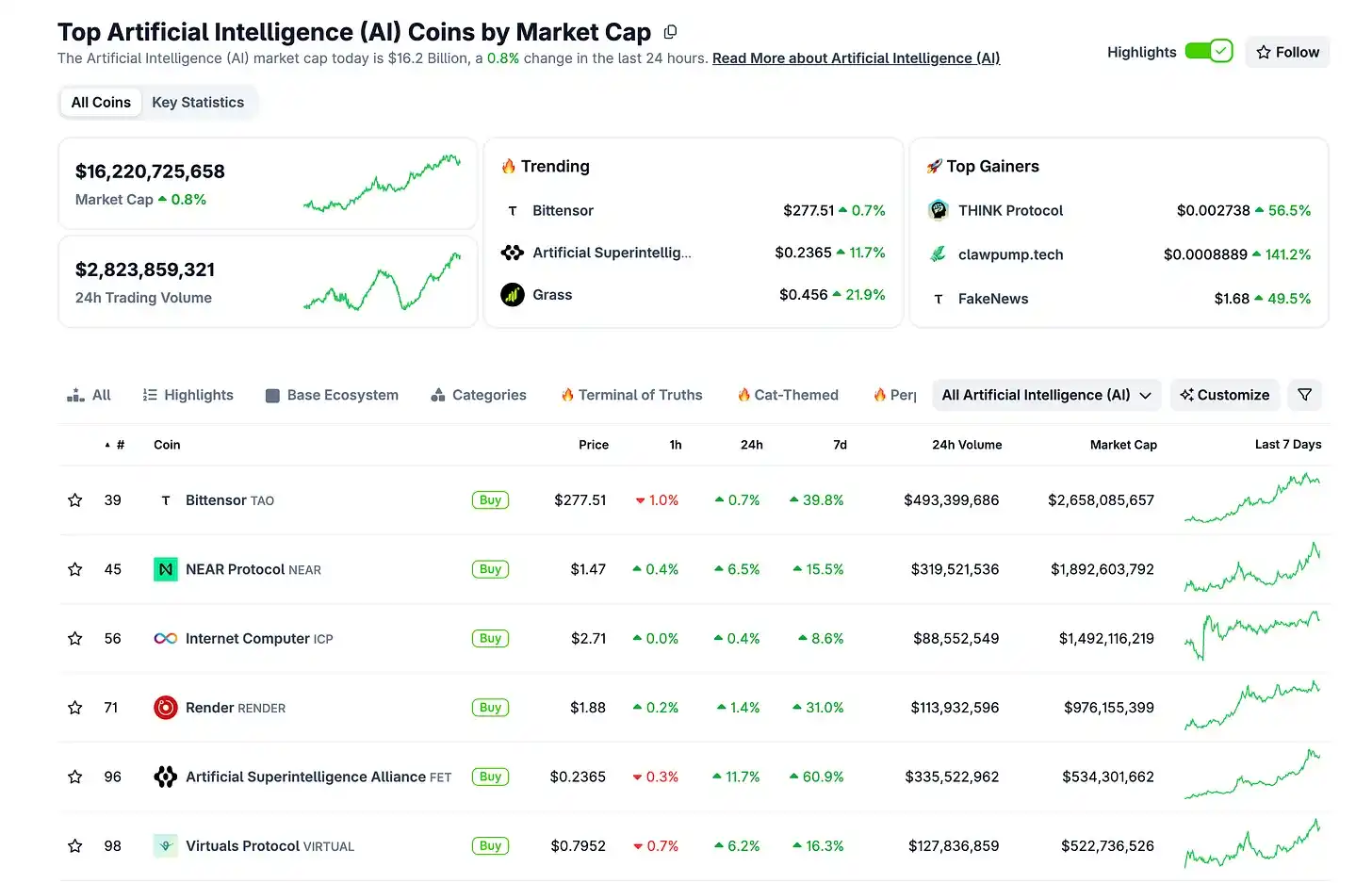
The core news this week was Templar's Covenant-72B (details above). The overall AI sector benefited from Bittensor's catalyst effect and continued institutional narrative momentum around Agent infrastructure.

TAO (7-day +40%): $277.51, market cap $2.66 billion. Catalyst: Covenant-72B; structural dynamics from subnets to TAO amplified gains.

FET (7-day +61%): $0.2365, market cap $534 million. The strongest weekly gainer among top DeAI assets. The Artificial Superintelligence Alliance benefited from sector rotation catalyzed by TAO, with capital broadly flowing into AI tokens.

RENDER (7-day +31%): $1.88, market cap $976 million. Covenant-72B proves distributed GPU networks can train competitive models, providing a tailwind for the decentralized computing narrative.

NEAR (7-day +16%): $1.47, market cap $1.89 billion. IronClaw (a security-hardened rewrite of OpenClaw in Rust, deployed on TEE) and NEARCON 2026 catalysts continue to have an effect. NEAR's positioning as enterprise-grade OpenClaw infrastructure keeps it in AI buying interest.

ICP (7-day +9%): $2.71, market cap $1.49 billion. Caffeine AI, a self-writing application platform on DFINITY's ICP platform, continues to attract developers (reportedly hundreds of thousands of monthly unique visitors according to Dominic Williams). Version V3 is upcoming, featuring Claude Code integration. The "Mission 70" tokenomics proposal aims to reduce annual inflation by 70% by the end of 2026, with Caffeine-driven compute burning as a key mechanism. Over the past 30 days, ICP ranked first in code development activity among AI/Big Data crypto projects.

VIRTUAL (7-day -16%): $0.7952, market cap $523 million. Pullback following AGDP-driven rally. But the more interesting story for VIRTUAL this week is in the x402 facilitator data: Virtuals have already ranked among the top three facilitators by transaction volume on x402 via ACP.

B) Robotics Total Market Cap Analysis

This week, the total Robotics sector market cap increased by $44 million (+6%), reaching $811 million:
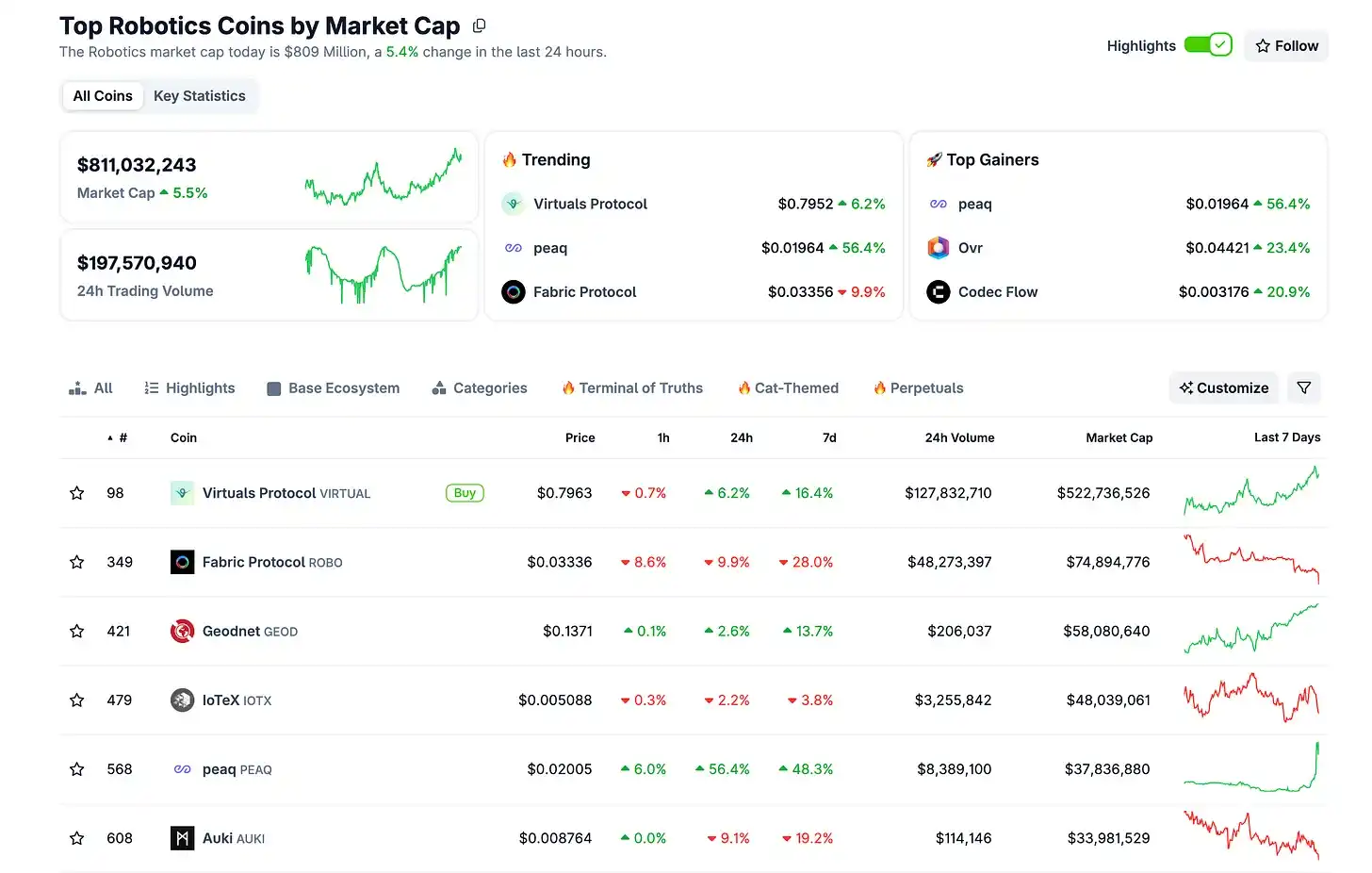
PEAQ (7-day +48%): $0.02005, market cap $37.8 million. The standout performer. peaq released a new video explaining the robotics narrative and its Robotics SDK (compatible with ROS 2, enabling any robot to obtain a peaq ID, perform on-chain payments/receipts, and data verification). Hashkey Capital's "Machine Economy" research report listed peaq as the foundational L1 for machine identity, payments, and governance. Over 60 DePIN projects across 22 industries are operational on the network; the Dubai VARA regulatory sandbox is open for on-chain robotics businesses.

ROBO (7-day -28%): $0.03336, market cap $74.9 million. Fabric Protocol (OpenMind/Fabric Foundation) is finding price equilibrium after initial listing enthusiasm. Still a relatively new player in the robotics category.

GEOD (7-day -14%): $0.1371, market cap $58.1 million. 24-hour trading volume only $206k, despite GEO-SWARM being live on Kickstarter and GEOD coverage added by Solana/Blockworks' Lightspeed institutional platform, which is expected to improve institutional visibility over time.

Crypto AI Agent Sector

a) Nansen DEX Fund Flows (All Traders, 7-Day)
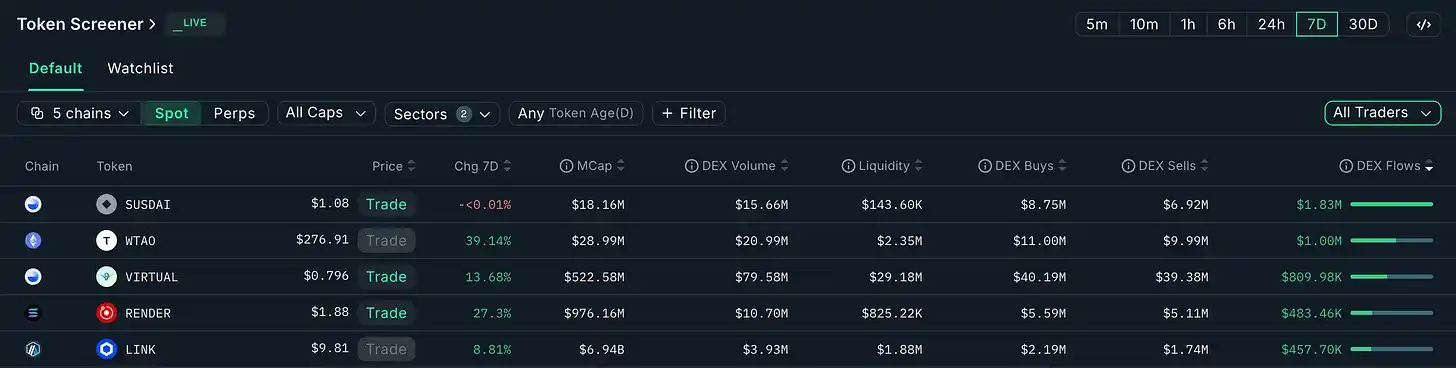
sUSDAI (+$1.83M net inflow): Largest net inflow in the AI sector. The yield layer for USDai, a GPU-collateralized stablecoin protocol (Permian Labs; backed by Dragonfly, Coinbase Ventures, YZi Labs). Lends against physical GPU infrastructure, returning yield via sUSDAI. PayPal/PYUSD integration; peak TVL $658M. CHIP governance token launched via CoinList in late February; capital is rotating into the yield layer. DeFi capital meets physical AI infrastructure financing.

WTAO (+$1.00M net inflow): $11.0M bought vs $10.0M sold. Confirms Covenant-72B drove real DEX accumulation behavior.

VIRTUAL (+$810k net inflow): Net inflow remained positive despite a 16.3% weekly price drop. $40.19M bought vs $39.38M sold. Smart money buying the dip. This group has the deepest liquidity at $29.18M.

RENDER (+$483k net inflow): Slight positive. Sector tailwinds, no specific catalyst. Render Con 2026 is upcoming.

LINK (+$458k net inflow): Noteworthy that Chainlink appears in the AI sector filter. Chainlink Runtime Engine is the connective tissue for Agent infrastructure; explicitly referenced in an AWS blog post this week regarding CRE integration.

b) Nansen Public Figure Fund Flows (7-Day)

DRV (+$264k net inflow, 7 traders): Derive, a decentralized derivatives protocol based on OP Stack. +48.84% in 7 days, market cap $111M. Institutional staking goes live on March 23; 25% of fees used for DRV buybacks.

FAI (+$187k net inflow, 4 traders): Freysa AI, a sovereign Agent stack on Base. Market cap $62M. Uses TEE and zkTLS, enabling Agents to hold their own keys. Similar to OpenClaw but approaches from a cryptographic sovereignty angle.

WTAO (+$105k net inflow, 3 traders): Corroborates the signal around Covenant-72B seen among all traders.

c) x402 Analysis

i) Transaction Count Down, Transaction Value Up
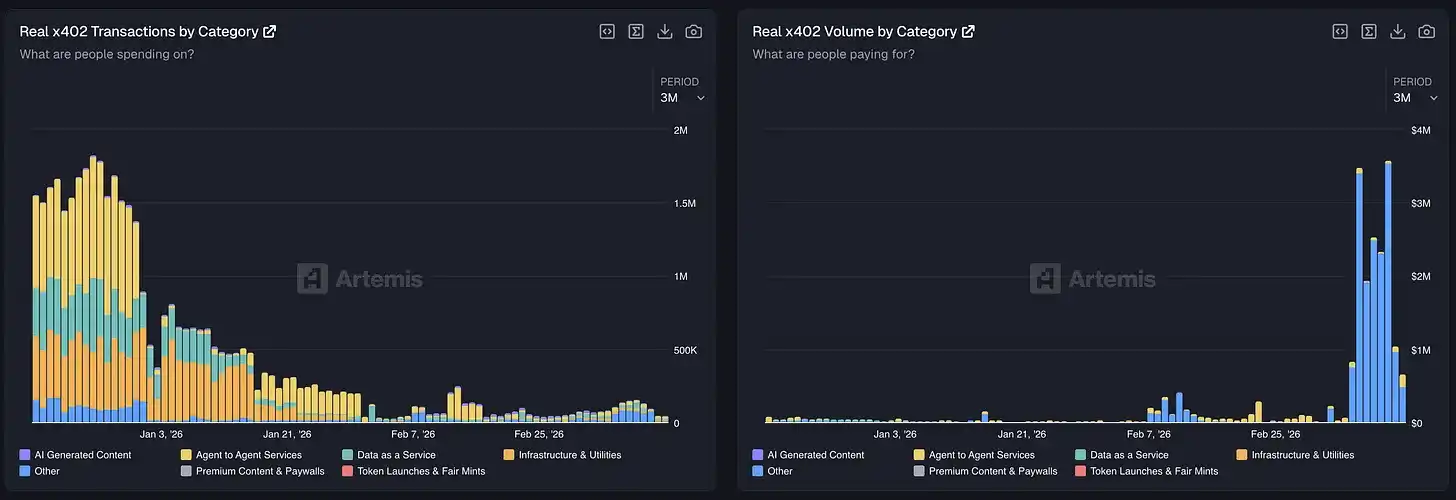
Artemis data tells two stories:

Transaction Count (Left Chart): Significant decline from Dec/Jan peaks. Daily average transactions dropped from over 1.5-2 million to the hundreds of thousands.

Transaction Value (Right Chart): Sharp uptick after a plateau in Jan/Feb, pushing daily average transaction value to $3-4 million. Concentrated in Infrastructure & Utilities and Data-as-a-Service categories, with Agent-to-Agent Services contributing secondarily.

This divergence is the most important signal for x402 currently. Decreasing transaction count with increasing transaction value means the average transaction size is growing. Fake transactions are being washed out; what remains are fewer, higher-value real commercial transactions.

Based on the current merchant landscape, the dominant categories likely represent: Agents paying for compute (cloud GPU, inference nodes, Chutes); API data source access (Firecrawl, StableEnrich, market intelligence data); browser sessions (Browserbase); and content generation (Freepik).

Agent-to-Agent Services is structurally the most interesting: autonomous Agents paying other Agents to complete subtasks.

AI-generated content and token issuance, which dominated early transaction counts, have largely been washed out.

ii) a16z and the Data Measurement Gap

a16z partner Noah Levine pointed out that "real" transaction volume is significantly lower than the inflated numbers caused by fake activity earlier this year. Bloomberg reported x402's 30-day payment volume at $24 million (data from x402.org); Allium Labs' data was around $3 million; Artemis, filtering out wash trading, estimated real volume at about $1.6 million.
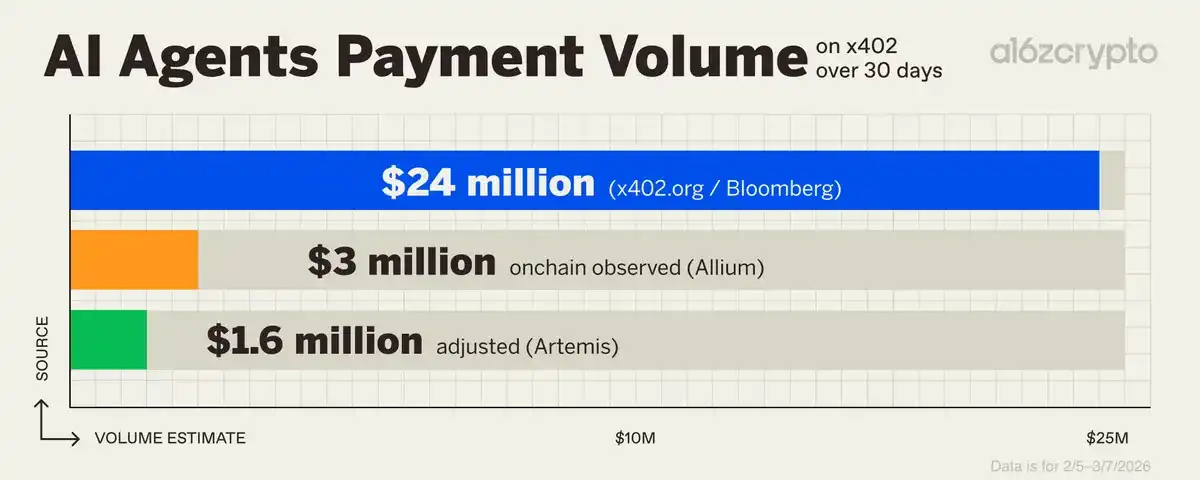
But this gap reveals how early the measurement infrastructure is—especially as more mature institutions begin adopting this open protocol: Stripe, Cloudflare, Vercel, and Google have all integrated x402.

These institutions are betting not on the current $1.6 million per month, but on what that number becomes when Agents become the default buyers.

iii) Top Facilitators Ranking (Past 7 Days)
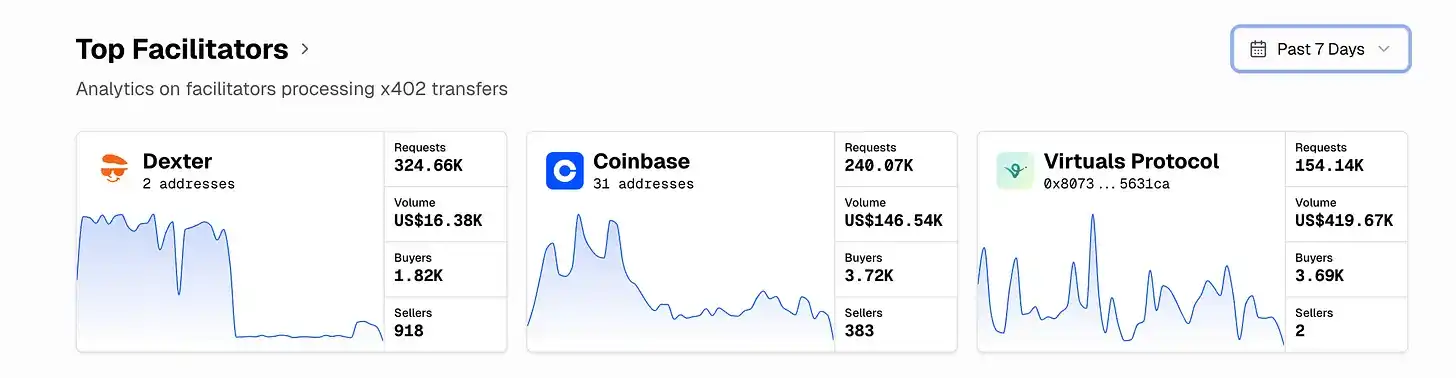
The facilitator ranking is diversifying: high-frequency micro-payments (Dexter), institutional API access (Coinbase), structured Agent commerce (Virtuals/ACP).

Virtuals Protocol (144.14k requests, $419.67k volume): Ranked third by request count, but highest by transaction value. Average price per request ~$2.72 (5x Coinbase's, 54x Dexter's). 3,690 buyers对应仅 2 sellers.

This is ACP settling structured Agent-to-Agent commercial transactions: a few service Agents completing high-value tasks for thousands of buyers.

On March 10, Virtuals and the Ethereum Foundation dAI team jointly submitted ERC-8183, formalizing the trusted Agent commercial transaction lifecycle alongside x402 (payments) and ERC-8004 (identity/reputation).

iv) AWS Releases Full x402 Reference Architecture

On March 15, AWS published "x402 and Agent Commerce: Redefining Autonomous Payments in Financial Services" on its industry blog, including a complete technical reference architecture.

When AWS releases a production-grade reference architecture with open-source code for a native crypto payment standard, the protocol moves from the conceptual stage to the infrastructure stage.

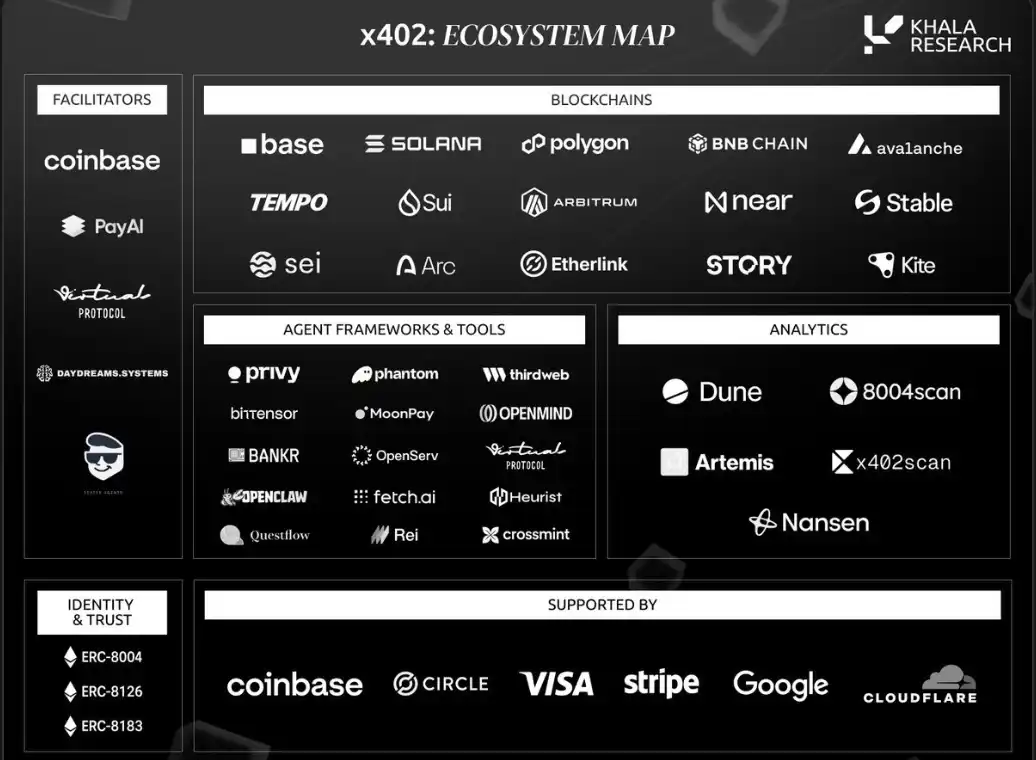
To learn more about x402's trajectory, follow Khala Research, as we will release a full report later this week. Below is the current ecosystem map:
Disclaimer: The content covered in this communication should not be considered investment or financial advice. It is for informational and educational purposes only.

Disclosure: I hold some of these assets and have cooperative relationships with certain projects mentioned in this communication.


Preguntas relacionadas

QWhat is the significance of the Covenant-72B model trained by Templar on the Bittensor network?

AThe Covenant-72B model is a 72-billion parameter LLM pre-trained on 1.1 trillion tokens, entirely on consumer-grade internet hardware within the Bittensor network. Its significance lies in being the largest decentralized LLM pre-training to date, with performance reportedly comparable to centralized models like LLaMA-2-70B. This upgrades Bittensor's narrative from proving subnets can exist to demonstrating they can produce outputs competitive with centralized alternatives.

QWhat was the price performance of TAO following the announcement of Covenant-72B, and what drove this performance?

AFollowing the announcement of Covenant-72B, the price of TAO increased by 19% within 24 hours and saw a weekly gain of +39.8%. This performance was driven by the technical milestone of the successful training, which validated the decentralized AI narrative. The structural dynamic between TAO and its subnets also amplified buying pressure, as investors need TAO to acquire subnet tokens.

QAccording to the article, what is the x402 protocol data showing about the nature of transactions?

AThe x402 protocol data shows a divergence: the number of transactions has decreased significantly from its peak, but the total transaction volume (in USD) has sharply increased. This indicates that the average transaction size is growing, suggesting that low-value, fake 'wash trading' is being cleaned out and replaced by fewer, but higher-value, genuine commercial transactions.

QWhich company released a full technical reference architecture for the x402 protocol, and why is this important?

AAWS released a full technical reference architecture for the x402 protocol. This is important because when a major cloud provider like AWS publishes a production-ready reference architecture with open-source code for a native crypto payment standard, it signifies the protocol's transition from a conceptual stage to an infrastructure stage, boosting its legitimacy and potential for institutional adoption.

QWhat role did the Virtuals Protocol play in the x402 ecosystem according to the merchant rankings?

AAccording to the 7-day merchant rankings, the Virtuals Protocol ranked third by number of requests but first by total transaction volume. Its high average transaction value (~$2.72 per request) and the structure of its business (3,690 buyers to just 2 sellers) indicate it is settling high-value, structured agent-to-agent commerce transactions through its ACP (Agent Commerce Protocol).

Lecturas Relacionadas

The $290 Million Deficit: A Three-Way Game Between Aave, L0, and Kelp—Who Should Foot the Bill?

An incident involving the theft of 116,500 rsETH (worth approximately $290 million) from Kelp DAO’s cross-chain bridge contract has triggered a complex dispute over responsibility and compensation among Kelp DAO, LayerZero, and Aave. The attack occurred due to a compromised RPC provider used by LayerZero’s Decentralized Verifier Network (DVN). Since Kelp DAO’s bridge used a 1/1 DVN configuration—a single point of failure—the attacker successfully forged a cross-chain message, leading to the unauthorized release of rsETH tokens from the mainnet. These genuine tokens were then deposited into Aave and other lending platforms to borrow WETH, enabling the attacker to exit with the funds. Responsibility is attributed primarily to Kelp DAO for its risky 1/1 DVN setup. LayerZero bears secondary responsibility for permitting such a vulnerable configuration in its protocol layer. Aave also shares indirect blame for over-collateralizing rsETH and other Liquid Restaking Token (LRT) assets without adequate ongoing risk oversight. Kelp DAO lacks sufficient funds to cover the loss, shifting focus to the deeper-pocketed players: LayerZero, whose cross-chain ecosystem and reputation are at risk, and Aave, which faces massive bad loans and declining Total Value Locked (TVL). Aave has asserted that mainnet rsETH remains fully backed, implying it expects Kelp DAO to allow redemption of underlying ETH. This approach would preserve Aave’s mainnet positions but invalidate Layer2 rsETH, damaging LayerZero’s cross-chain credibility. Potential solutions include: - A universal 18.5% haircut on all rsETH holders, causing significant Aave bad debt. - Writing off Layer2 rsETH entirely, protecting Aave mainnet but harming LayerZero and Kelp DAO. - Negotiating a bounty with the hacker for partial fund return. - A joint bailout, possibly led by LayerZero’s ecosystem fund, given its long-term stake in the cross-chain ecosystem. The situation remains unresolved as the parties negotiate, but prolonged delay risks broader DeFi instability, including potential liquidity crises and loss of confidence in LRT and cross-chain infrastructures.

Odaily星球日报Hace 12 min(s)

The $290 Million Deficit: A Three-Way Game Between Aave, L0, and Kelp—Who Should Foot the Bill?

Odaily星球日报Hace 12 min(s)

Bitcoin's Bull-Bear Range Battle Continues, HYPE Faces Critical Test of Wave V Support | Exclusive Analysis

This market analysis covers Bitcoin (BTC) and HYPE, highlighting key levels and trading strategies for the week. HYPE is currently testing a critical support level at $40.17. A hold above this level could lead to consolidation between $40.17–$45.76, while a break below it may signal the end of its current V-wave uptrend from the April 2 low. The short-term strategy is to look for long entries near $40.17 if support holds, using 30% leverage and strict stop-loss discipline. Bitcoin is interpreted to be in a larger D-wave rebound from the February 6 low of $60,000, currently trading within a $73,500–$79,000 range. Key resistance lies at $79,000–$80,600 and $83,500–$84,500, with supports at $73,500, $69,500, and $65,000–$66,000. The medium-term strategy maintains a 60% short position from $89,000. Short-term tactics include selling into rallies near $76,500–$79,000 (Scenario A) or breaking below $73,500 (Scenario B), using 30% leverage. Last week, a 1x leveraged long trade in HYPE yielded a 6.80% gain, and the BTC short from $89,000 is currently up approximately 17.08%. Risk management is emphasized: set stop-losses at entry, move to breakeven at +1% profit, and trail stops to lock in gains thereafter. All views are based on technical analysis and are not investment advice. Traders are urged to exercise caution and adapt to market changes.

marsbitHace 43 min(s)

Bitcoin's Bull-Bear Range Battle Continues, HYPE Faces Critical Test of Wave V Support | Exclusive Analysis

marsbitHace 43 min(s)

Bitcoin's Bull-Bear Range Battle Continues, HYPE Faces Critical Test of Wave V Support | Invited Analysis

The market is experiencing directional uncertainty with both opportunities and risks. HYPE's daily V-wave structure is at a critical juncture, with the $40.17 support level being pivotal for its future trajectory. A break below this level, followed by an inability to surpass the recent high of $45.76, could signal the end of the current upward structure. The short-term strategy for HYPE is to "follow the trend and buy on dips," using a 30% position size and a 30/60-minute trading cycle, entering long upon confirmed support holds with model signals. Bitcoin's market structure is reinterpreted, with the rally from the $60,000 low now considered a larger D-wave rebound within a medium-term correction, facing a key test between $73,500 and $79,000. A break above the upper bound may lead to limited upside, while a drop below could see a decline toward $69,500. Core resistance lies at $79,000–$80,600 and $83,500–$84,500, with support at $73,500, $69,500, and $65,000–$66,000. The medium-term strategy maintains a 60% short position from $89,000, to be exited if price stabilizes above the multi-empty band. Short-term tactics involve 30% positions for "spread" opportunities, with two scenarios: selling on rallies near $76,500–$79,000 (Scheme A) or shorting on a breakdown below $73,500 (Scheme B), both with strict stop-losses. A复盘 of HYPE's recent short trade showed a 6.80% gain from a long entry at $41.59 (based on model buy signals) and exit at $44.42 (triggered by top signals). Key reminders include setting initial stops at entry, moving to breakeven at +1% profit, and trailing stops thereafter. All views are for reference only; market conditions change rapidly, and caution is advised.

Odaily星球日报Hace 50 min(s)

Bitcoin's Bull-Bear Range Battle Continues, HYPE Faces Critical Test of Wave V Support | Invited Analysis

Odaily星球日报Hace 50 min(s)

On the Same Day Aave Introduced rsETH, Why Did Spark Choose to Exit?

On April 18, Kelp DAO's cross-chain bridge was exploited, resulting in the malicious minting of 116,500 unbacked rsETH. The attacker deposited these into Aave and borrowed WETH, creating a potential bad debt of approximately $195 million. Aave’s Guardian quickly froze the market, but the protocol’s insurance could only cover about 25% of the loss. In contrast, SparkLend, a lending protocol in the MakerDAO ecosystem, suffered no direct losses. This was not due to superior foresight but rather a preemptive governance decision. On January 29, Spark executed a governance action to discontinue new rsETH supply, citing low usage and high concentration from a single wallet. The same day, Aave expanded its rsETH market by enabling E-Mode with a 93% LTV to attract more deposits. Spark’s risk management framework is designed to remove assets with low usage or poor risk-adjusted returns, regardless of external security concerns. Aave’s decision was growth-oriented, aiming to boost WETH utilization and attract capital. Spark also employs additional safeguards: rate-limited supply and borrow caps that would have limited the scale of such an attack, and a robust oracle system using the median of three price feeds. These mechanisms systemically contain the maximum exposure to any single risk event, demonstrating a fundamentally different approach to risk than Aave’s growth-first model.

marsbitHace 50 min(s)

On the Same Day Aave Introduced rsETH, Why Did Spark Choose to Exit?

marsbitHace 50 min(s)

Strategy's 'Money Printer': Is STRC Bitcoin's Savior or Destroyer?

Bitcoin's recent price movement is being heavily influenced by Michael Saylor and his company, MicroStrategy, through a new financial instrument: STRC (Variable Rate Series A Perpetual Stretch Preferred Stock). This Nasdaq-listed perpetual preferred stock offers an 11.5% annual dividend, attracting significant capital. Crucially, funds raised from STRC are used to purchase Bitcoin, with a 3x leverage effect—for every $1 from STRC, MicroStrategy adds $2 from MSTR equity to buy $3 worth of BTC. This creates a powerful "flywheel": more STRC sales fuel massive BTC buying, supporting its price and improving MicroStrategy's credit, which in turn makes STRC more attractive to investors. However, this mechanism introduces risks. A significant "ex-dividend arbitrage" pattern has emerged, where traders buy STRC before its monthly dividend, collect the payout, and quickly sell, causing price volatility and potentially driving up Bitcoin's cost basis for MicroStrategy. In response, Saylor has proposed shifting STRC to a semi-monthly dividend to smooth out these effects. Furthermore, STRC's high yield is being integrated into DeFi protocols like Apyx Protocol and Saturn Credit, offering new on-chain yield opportunities. The central concern remains: as MicroStrategy aggressively accumulates over 3.5% of all BTC, it challenges Bitcoin's foundational principle of decentralization, creating a system where a single public company significantly influences the market.

marsbitHace 58 min(s)

Strategy's 'Money Printer': Is STRC Bitcoin's Savior or Destroyer?

marsbitHace 58 min(s)

Trading

Spot
Futuros
活动图片