Goldman Sachs Research Report: Cryptocurrency Market Cap Rises 34% in Q3, Profit Forecasts and Price Targets for Brokers and Crypto Stocks Revised Upward

marsbitPublished on 2026-09-10Last updated on 2026-09-10

Abstract

Goldman Sachs Research Report Update: Crypto Market Cap Surges 34% in Q3, Boosting Revenue Forecasts for Brokers & Crypto Stocks Goldman Sachs has raised revenue and price targets for covered brokers and crypto-related companies, citing a 34% increase in the total crypto market capitalization quarter-to-date (QTD) in Q3. The firm's updated analysis, published on September 8, led to a 10% average upward revision in Q3 revenue expectations for the coverage group. While overall trading volumes remain below Q2 levels (down 8% QTD), an August rebound of 16% showed marginal improvement. The market cap appreciation drives revenue through multiple channels beyond direct trading: higher custody and staking fees linked to asset values, and increased stablecoin revenue tied to stablecoin market capitalization. Consequently, Goldman raised its median 2026 EPS estimate by 1% and increased the median target price-to-earnings (P/E) multiple by 3.0x to 32.5x, resulting in a median total return expectation of +3% for the group. Key individual adjustments include raising Coinbase's (COIN) price target to $219 (Buy) from $196, reflecting a 7% increase in assumed platform assets and a 9% rise in expected Q3 trading volume. Similar target price increases of 12-14% were applied to other covered stocks like ETORO, Galaxy Digital (GLXY), BitGo (BTGO), and Circle (CRCL), with ratings largely maintained at Neutral. The report highlights that companies with diversified revenue streams from custody,...

Author: Rita

The cryptocurrency market capitalization has increased by 34% so far in the third quarter, leading Goldman Sachs to revise upward its profit forecasts and price targets for brokers and crypto-related companies. On September 8, Goldman Sachs released its Americas Brokers and Crypto report. Based on updated quarter-to-date data, the firm raised the average expected Q3 revenue for its coverage group by 10%, the median 2026 EPS estimate by 1%, and the median target P/E multiple by 3.0x. The median total return expectation for this group is now +3%. Trading volume remains below last quarter's level, but growth in custody, staking, and stablecoin revenues driven by market cap revaluation has been the primary driver behind the forecast revisions.

The impact of rising crypto market cap on revenue for brokers and crypto companies is multi-dimensional. Beyond direct digital asset gains/losses, custody and staking revenues are linked to market cap, and stablecoin revenues are linked to stablecoin market cap. Even if trading volume has not fully recovered, the market cap increase itself can drive upward revisions to revenue forecasts.

34% Crypto Market Cap Gain Drives Higher Revenue Forecasts

Goldman Sachs updated its crypto data for Q3-to-date in the report. The crypto market cap rose 34%, with end-of-period USDC balance up 1% sequentially, but the average balance down 5%. August trading volume rebounded 16% month-over-month, though the industry average volume for Q3-to-date is still down 8% sequentially. Based on this, Goldman Sachs adjusted revenue forecasts for several companies, raising the average expected Q3 revenue for the coverage group by 10%.

Specific adjustments include: Raising staking and custody revenue to reflect higher crypto market cap. Raising stablecoin revenue to reflect higher stablecoin market cap. Raising digital asset gain/loss to reflect profits from market cap increases. Slightly raising trading volume forecasts, as industry and company-specific volumes were marginally stronger than previously expected.

Looking at individual stocks: COIN's Q3 platform assets were raised from $269B to $288B, an increase of 7%. Trading volume was raised from $127B to $138.5B, an increase of 9%.

BTGO's platform assets were raised from $6.2B to $6.6B, an increase of 5%. Trading volume was raised from $4.1B to $4.5B, an increase of 10%.

CRCL's platform assets were raised from $27.3B to $27.6B, an increase of 1%. Trading volume was lowered from $0.9B to $0.8B, a decrease of 9%.

ETOR's platform assets remained unchanged at $19.1B. Trading volume was raised from $2.7B to $3.7B, an increase of 39%.

GEMI's platform assets were lowered from $100M to $90M, a decrease of 7%. Trading volume was raised from $270M to $370M, an increase of 37%.

GLXY's platform assets were raised from $9.1B to $9.5B, an increase of 7%. Trading volume was raised from $790M to $800M, an increase of 2%.

Goldman Sachs stated that these adjustments reflect the rise in crypto market cap and stablecoin market cap, as well as marginal improvements in trading volume.

Trading Volume Remains Soft but Rebounded in August

Despite the significant market cap increase, trading volume remains low. The industry average volume for Q3-to-date is down 8% sequentially, indicating market activity has not fully recovered. August volume rebounded 16% month-over-month, showing signs of marginal improvement.

The softness in trading volume contrasts with the rise in market cap. The market cap increase is mainly driven by the macro environment and recovery in crypto asset prices. Trading volume is constrained by retail participation and market sentiment. Goldman Sachs slightly raised its trading volume forecasts as industry and company-specific volumes were marginally better than expected, but remains cautious overall.

From a revenue structure perspective, trading volume is crucial for brokers and crypto companies. For platforms where trading fees are the primary revenue source, declining volume directly drags on revenue. For companies with custody, staking, and stablecoin businesses, market cap gains can partially offset the impact of lower volume. Goldman Sachs's forecast revisions are based on this logic.

Price Targets and Valuation Revisions

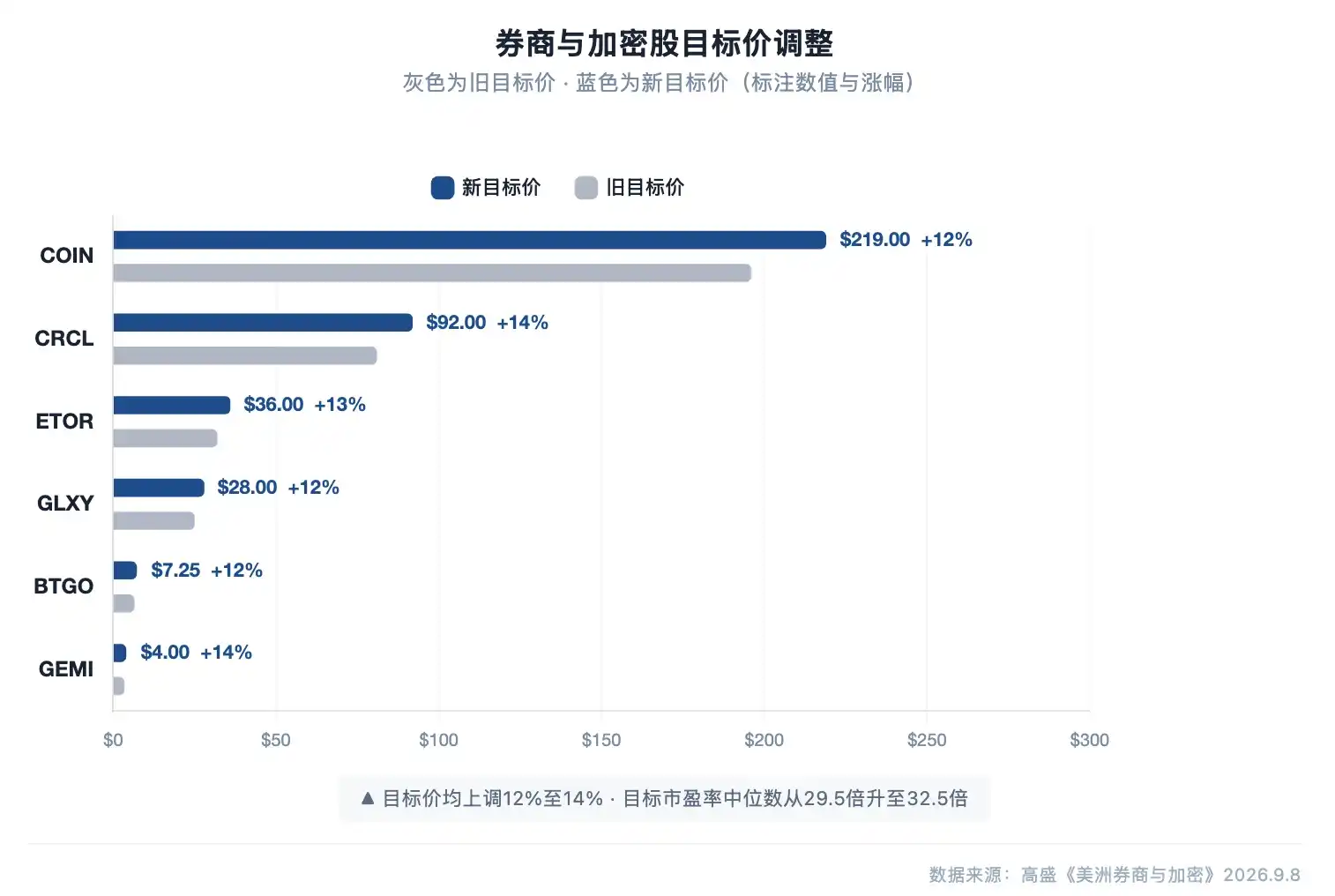
Goldman Sachs raised the median target P/E multiple for the coverage group from 29.5x to 32.5x, an increase of 3.0x, to reflect higher market multiples. The median 2026 EPS estimate was raised by 1%, and the median total return expectation is +3%.

Individual stock price target adjustments are as follows:

COIN target price raised from $196 to $219, up 12%, Buy rating maintained.

ETOR raised from $32 to $36, up 13%, Neutral maintained.

GLXY raised from $25 to $28, up 12%, Neutral maintained.

BTGO raised from $6.50 to $7.25, up 12%, Neutral maintained.

CRCL raised from $81 to $92, up 14%, Neutral maintained.

GEMI raised from $3.50 to $4.00, up 14%, Sell maintained.

GLXY's target price is based on a sum-of-the-parts valuation. The Digital Asset segment uses 24.0x Q5-Q8 adjusted EPS, raised from 23.0x. The Data Center segment uses 15.5x Q5-Q8 adjusted EBITDA, raised from 14.5x. The Corporate segment uses 1.0x Q5 P/B, unchanged. All three adjustments reflect higher market multiples.
Median Total Return Expectation +3%

Goldman Sachs currently expects a median total return of +3% for broker and crypto stocks. This expectation is based on updated profit forecasts and target P/E multiples. Goldman Sachs believes that rising crypto market cap and marginal improvement in trading volume will drive modest stock price appreciation. Trading volume remains below last quarter's level, and regulatory risks persist, limiting upside potential.

Goldman Sachs suggests investors focus on companies with diversified revenue streams, such as platforms with higher exposure to custody, staking, and stablecoin businesses. These companies are more resilient to trading volume fluctuations and benefit from market cap increases. For companies primarily reliant on trading fees, volume recovery remains a key variable.
Disclaimer

This article is a summary and interpretation by Tide Research of a third-party brokerage research report (Goldman Sachs, September 8, 2026), combined with publicly available market information. The ratings, target prices, profit forecasts, and related judgments cited herein are the views of the analyst(s) from that brokerage firm, representing only the stance of their institution. They do not represent the views of Tide Research and do not constitute any investment advice.

The market carries risks, and investment decisions should be made independently. This article should not be used as a basis for trading any securities.

Related Questions

QWhat is the main reason Goldman Sachs raised its revenue forecast and price targets for brokerage and crypto-related stocks?

AThe primary reason is the 34% increase in cryptocurrency market capitalization during the third quarter. This drove upward revisions for custody, staking, stablecoin revenue, and digital asset gains, which more than offset weaker trading volumes.

QAccording to the report, what is Goldman Sachs' median total return expectation for the covered group of brokerage and crypto stocks?

AGoldman Sachs currently expects a median total return of +3% for the covered brokerage and crypto stock group.

QHow did Goldman Sachs adjust its trading volume predictions, and what was the overall trend in Q3?

AGoldman Sachs modestly raised trading volume predictions as industry and company-specific volumes were slightly stronger than previously expected. However, the industry's average trading volume in Q3-to-date still declined 8% quarter-over-quarter, indicating continued softness despite a 16% month-over-month rebound in August.

QWhich company had the largest percentage increase in its price target from Goldman Sachs, and what was the change?

ACRCL and GEMI both had the largest percentage increase in their price targets at 14%. CRCL's target was raised from $81 to $92, while GEMI's was raised from $3.50 to $4.00.

QWhat type of companies does Goldman Sachs recommend investors focus on, and why?

AGoldman Sachs recommends investors focus on companies with diversified revenue streams, particularly those with higher exposure to custody, staking, and stablecoin businesses. These companies are better positioned to withstand trading volume volatility and benefit more directly from increases in overall market capitalization.

Related Reads

UnitStake and Brickken announce strategic partnership to improve the visibility of tokenized real estate

UnitStake, an independent RWA aggregation platform for tokenized real estate, and Brickken, a tokenization infrastructure provider for real-world assets and agentic capital markets, have announced a strategic partnership focused on distributing information about tokenized real estate projects. The collaboration will list tokenized real estate projects from Brickken's ecosystem on UnitStake's aggregator, expanding their visibility. Brickken's technology solutions will be integrated into the UnitStake ecosystem, giving asset owners access to tools for tokenization, digital asset management, and project administration under the UnitStake brand. The partnership connects both sides of the tokenization lifecycle: Brickken covers asset structuring and issuance, including investor onboarding, permissions, records, reporting and lifecycle management, while UnitStake covers discovery and market exposure, bringing projects together so opportunities are easier to discover, compare and evaluate through transparent, structured information. Each party operates within its respective functions in compliance with applicable legal and regulatory requirements. UnitStake operates its aggregator independently and does not sell tokens, provide investment advice, or endorse projects. The collaboration starts with tokenized real estate, including projects such as Residencia Tejina, a building conversion in south-west Tenerife presented in UnitStake's standard information format covering the underlying asset, issuer, legal structure and available documentation. Aldiyar Bogenbayev, Head of Partnerships at Brickken, said UnitStake is building an essential layer of the tokenization ecosystem by making tokenized real estate opportunities easier to discover, understand and compare. Yuliia Kutasevych, Head of Business Development at UnitStake, called the partnership an important milestone and said combining Brickken's technology with UnitStake's international ecosystem will contribute to a more transparent and interconnected global RWA market. Brickken's infrastructure has supported over $660M in tokenized assets and served more than 150 institutional clients across 40+ countries.

cointelegraph1m ago

UnitStake and Brickken announce strategic partnership to improve the visibility of tokenized real estate

cointelegraph1m ago

230k-follower “Crypto God” exposed: 30 sock puppet accounts caught harvesting fans

Cupsey, a Solana meme coin trader with over 230,000 X followers, has been exposed by on-chain analytics firm Bubblemaps for allegedly running roughly 30 secret wallets to profit off his own followers. Since May 7, these linked addresses traded over 27,000 tokens and cashed out about $1.74 million on roughly 3,000 tokens using a repeated three-step scheme: four core wallets quietly accumulate a new token and spread holdings across 12 associated wallets; Cupsey's public wallet then buys the same token and he promotes it to followers; finally, the hidden wallets sell into the incoming buy orders. In some cases the secret wallets dumped tokens while Cupsey was still drafting his recommendation posts. Because new meme coins have thin liquidity, followers' buys push prices up briefly, letting the insider wallets exit while late buyers absorb the losses. The report also links Cupsey-associated wallets to a token-issuing address starting with "3z4vj," which launched over 400 tokens and earned an estimated $1.3 million. Beyond trading spreads, Cupsey reportedly received about $331,000 in Pump.fun promotion rewards. Bubblemaps has similarly exposed other top traders such as Anglio, 0xEthan, and Solstice for front-running their own recommendations, in some cases buying about 20 seconds before posting. The firm criticizes platforms for rewarding trading volume with millions in incentives while doing little to detect bundled holdings, insider wallets, or repeat offenders, turning followers into exit liquidity. Cupsey has not yet responded to the allegations.

marsbit1h ago

230k-follower “Crypto God” exposed: 30 sock puppet accounts caught harvesting fans

marsbit1h ago

Ex-employee sues Ethereum Foundation and Vitalik Buterin over firing

A former Ethereum Foundation employee, Kayleen Fulton (known as “Nixo”), has sued the organization, co-founder Vitalik Buterin, and four others, alleging she was fired after disclosing a cancer diagnosis and organizing a staff letter challenging a directive tied to the foundation’s new mandate. Fulton, who led the protocol support team, filed the complaint on Nov. 4 in the U.S. District Court for the District of Colorado. She claims Bastian Aue, then a co-executive director, fired her on April 6, 13 days after her diagnosis disclosure, and that Buterin helped adopt and enforce the directive as a board member. Fulton and colleague Trent Van Epps organized a letter with 53 signers supporting the mandate’s goals but objecting to a requirement that employees affirm it to keep their jobs; she alleges she and Van Epps were fired 30 minutes apart days later. She alleges disability discrimination, retaliation, and interference with medical leave rights, seeking lost pay and damages. The complaint also notes some employees objected to a reference to ritual suicide in the mandate, quoting Aue saying the language was figurative. A lawyer for the foundation’s Singapore affiliate denied unlawful conduct or retaliation and said her separation agreement was binding. The foundation published its mandate in March, highlighting censorship resistance, open-source code, privacy and security, and a focus on protocol upgrades, research, and developer tools.

cointelegraph2h ago

Ex-employee sues Ethereum Foundation and Vitalik Buterin over firing

cointelegraph2h ago

Major Analog Chip Acquisition: The Account Behind Over 500 Part Numbers

On November 9, Awinic Electronics announced a trading halt to plan the acquisition of Yutai Semiconductor shares via share issuance and cash, plus supporting financing—a landmark integration in China's analog chip design sector. Both companies compete in analog chips but follow different product paths. Awinic's power management revenue reached 1.047 billion yuan in 2025 (about 37% of total), slightly down 0.03% year-on-year, deeply tied to consumer electronics like phones, AIoT, and wearables. Its real strength lies in high-performance mixed-signal chips (1.505 billion yuan, 53% of revenue), with audio power amplifiers as the core, now extending into edge AI audio for AI glasses, supplying Meta, Rokid, and RayNeo. However, consumer cyclicality and fierce 2026 price competition expose Awinic's limited coverage in industrial-grade medium/high-voltage power, telecom power, and smart meters. Yutai, founded by former Maxim designers with R&D centers in Shanghai, Silicon Valley, and Hanoi, offers over 500 product models covering DC-DC, AC-DC, LDO, battery management, and PMU. Its AC-DC line spans 5 categories and 130+ models, including PWM controllers, integrated GaN converters, synchronous rectification, and fast-charging protocols—targeting high-voltage, high-frequency, high-power-density applications like fast chargers, industrial power, and telecom equipment. Its DC-DC products, such as the ETA9121/9122 dual-phase buck converters and ETA5220 ultra-low-noise LDO (0.96μV RMS), are not commodity consumer parts. Yutai also partners with MediaTek, Intel, Spreadtrum, Rockchip, Ambarella, and NXP, covering smart meters, security, set-top boxes, and routers. The complementarity is clear: Awinic excels in low-voltage, consumer-grade, highly integrated power for phones and wearables; Yutai in medium/high-voltage, industrial-grade, full-category solutions. A merger could theoretically cover consumer to industrial communications, low to medium/high voltage, and single chips to system-level solutions. Yet product logic alone doesn't guarantee success: Saint-Gong holds 25.95% of Yutai as second-largest shareholder, potentially constraining R&D integration, customer sharing, and product roadmaps post-closing. The deal reflects China's analog chip industry moving from niche land-grabbing to platform-based consolidation. Awinic needs Yutai's industrial power lines and customer ecosystem to break consumer growth ceilings; Yutai needs Awinic's listing platform and consumer channels to offset capital and market shortcomings. But success won't be decided by synergy visions in announcements—it depends on whether the two R&D teams can work under one product definition framework after the halt ends, and how many of Yutai's 700+ part numbers truly enter Awinic's customer system and generate design wins. Products can be acquired; scenario capabilities must be digested.

marsbit2h ago

Major Analog Chip Acquisition: The Account Behind Over 500 Part Numbers

marsbit2h ago

Trading

Spot
活动图片