Broadcom vs AMD: Which is the Most Promising AI Chip Stock to Bet on After Nvidia?

marsbitPublished on 2026-06-09Last updated on 2026-06-09

Abstract

Amidst Nvidia's dominance in the AI chip market, Broadcom and AMD are key contenders for the second-place spot. AMD competes directly in general-purpose GPUs, gaining some traction with clients like Meta but facing significant challenges overcoming Nvidia's entrenched CUDA software ecosystem. In contrast, Broadcom pursues a differentiated strategy by designing custom XPU chips tailored to specific AI workloads for major clients like Anthropic, Google, Meta, and OpenAI. This approach offers efficiency advantages and greater customer stickiness, particularly as AI compute shifts from training to inference. Despite a recent stock sell-off following a Q2 revenue guidance miss, Broadcom's CEO reaffirmed the long-term target of $100 billion in annual AI chip revenue by fiscal 2027. With Q2 AI revenue at $10.8 billion, significant growth potential remains as its custom chip projects ramp up. While Broadcom trades at a higher valuation multiple than AMD, analysts argue this premium is justified given its superior competitive positioning and expected faster growth trajectory, making it the more compelling investment choice following its recent pullback.

Author: Justin Pope

Compiled by: Tide Research

Introduction: Beyond Nvidia, the battle for the runner-up position in AI chips is heating up. AMD has chosen to directly challenge Nvidia's general-purpose GPU path, while Broadcom takes a differentiated approach with custom chips (XPU), securing top clients like Anthropic, Google, Meta, and OpenAI.

Following the latest earnings report, Broadcom's stock price fell sharply, but the CEO still maintains the target of reaching $100 billion in annual AI chip revenue by fiscal year 2027. Motley Fool analyst Justin Pope believes that even though Broadcom is more expensive, this premium is worth paying.

Caption: Source Getty Images

Nvidia still firmly holds the top spot in the AI data center chip market. But the AI pie is simply too large, making the runner-up position equally valuable. According to Statista estimates, the AI chip market will grow to $333 billion by 2030.

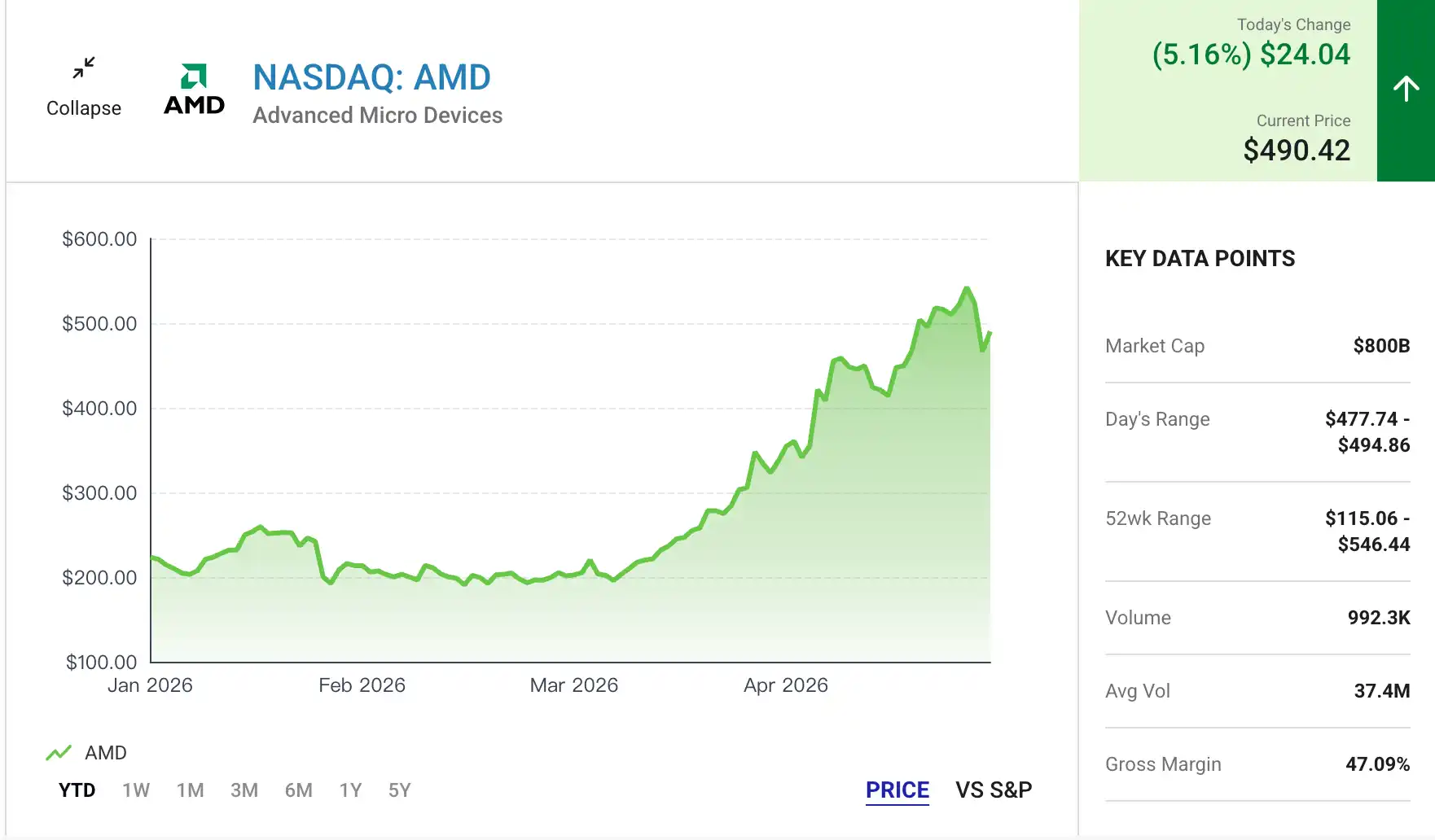
This means other companies also have the opportunity to make investors a lot of money. Broadcom (AVGO, down 7.49% on the day) and AMD (down 11.01% on the day) are the two most competitive candidates. Both companies have made progress in the AI chip field, but overall, one is clearly more worthy of holding than the other.

AMD Chose a More Difficult Path

The core question is: How can a smaller company compete for market share with an industry giant?

AMD's strategy is to compete head-on with Nvidia in the field of general-purpose AI chips. To be fair, it has indeed achieved some results. Q1 2026 data center revenue grew 57% year-over-year to $5.8 billion.

AMD benefits from AI hyperscalers' natural desire not to put all their eggs in Nvidia's basket. AMD recently announced it will supply Meta with 6 GW of Instinct GPUs, with the first GW being a custom version.

But AMD is unlikely to truly threaten Nvidia's dominance. Meta and other Nvidia customers are deeply entrenched in Nvidia's CUDA software ecosystem. The moat of CUDA cannot be crossed by hardware specifications alone.
Broadcom's Custom Chip Path is the Winner

To breach Nvidia's moat, one must take a different path. Broadcom has achieved this with its XPU chips.

Unlike AMD, which emphasizes general-purpose AI chips, Broadcom tailors chips to each customer's specific AI workloads. This approach brings efficiency advantages and makes customer relationships stickier. Currently, Broadcom is designing custom chips for companies like Anthropic, Alphabet (Google's parent company), Meta, and OpenAI.

As computing demand shifts from training to inference, efficiency becomes even more critical, further amplifying the advantages of custom chips.

Following the latest Q2 earnings report, Wall Street heavily sold off Broadcom, mainly due to Q3 AI revenue guidance falling short of expectations. But CEO Hock Tan reiterated on the earnings call that the company's long-term expectation of reaching $100 billion in annual AI chip sales by fiscal 2027 remains unchanged. Q2 AI revenue was $10.8 billion, and there is still significant growth potential as custom chip projects ramp up.

You Get What You Pay For

With a roster of top-tier AI clients and steady progress toward the $100 billion annual revenue target, Broadcom indeed has a stronger competitive position than AMD. Investors may note that Broadcom's stock is more expensive than AMD's, but this premium is justified.
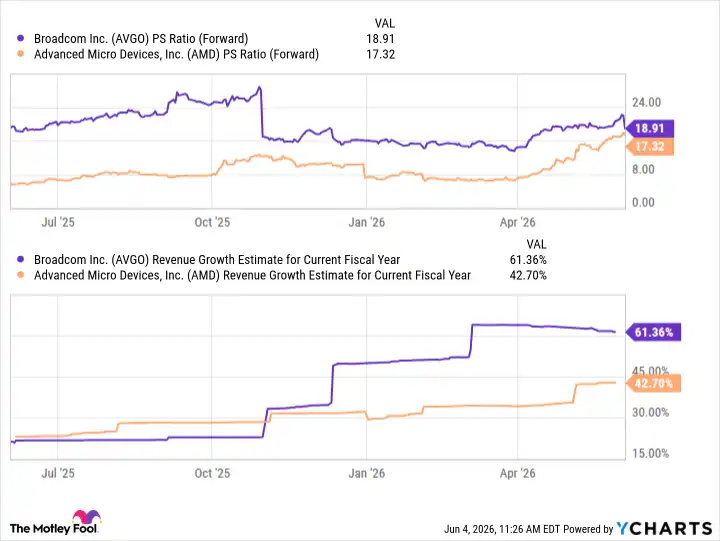
Caption: AVGO vs AMD Forward Price-to-Sales Ratio Comparison, Source YCharts

Analysts expect Broadcom's growth to be significantly faster than AMD's, and the valuation gap between the two is not that large. Especially after the pullback following the earnings report, Broadcom is more worthy of a buy.

Related Questions

QAccording to the article, what are the main differences between AMD's and Broadcom's strategies in the AI chip market?

AAMD is taking a generalist approach, competing directly with Nvidia in the market for general-purpose AI GPUs. In contrast, Broadcom follows a differentiated, custom chip (XPU) strategy, designing chips tailored to the specific AI workloads of individual clients like Anthropic, Google, Meta, and OpenAI.

QWhat reason does the analyst give for Broadcom's stock being more expensive (having a valuation premium) compared to AMD's?

AThe analyst argues that Broadcom's premium valuation is justified because it holds a superior competitive position with a roster of top-tier AI clients and is projected to grow significantly faster than AMD, as it progresses toward its long-term AI revenue target of $100 billion annually by fiscal 2027.

QWhat was the market reaction and the CEO's response following Broadcom's latest quarterly earnings report?

AFollowing its Q2 earnings report, Broadcom's stock fell sharply due to a Q3 AI revenue forecast that fell short of expectations. However, CEO Hock Tan reaffirmed the company's long-term target of achieving $100 billion in annual AI chip sales by fiscal 2027.

QWhat is identified as a key competitive barrier that makes it difficult for AMD to challenge Nvidia's dominance?

AThe article identifies Nvidia's CUDA software ecosystem as a key competitive barrier or 'moat.' Major clients like Meta are deeply entrenched in this ecosystem, making it very difficult for competitors like AMD to overcome through hardware specifications alone.

QWhy might Broadcom's custom chip (XPU) strategy become even more advantageous in the future, according to the article?

AThe article suggests that as the focus of computing demand shifts from AI training to inference, efficiency becomes more critical. Broadcom's custom chips, which are optimized for specific client workloads, offer efficiency advantages that will likely become even more valuable in this evolving market landscape.

Related Reads

Dialogue with a Macro Analyst: AI Drains All Liquidity from U.S. Stocks, $40K Bitcoin is the True Bottom

In a recent discussion, macro strategist Luke Groman, founder of FFT LC, presented a sobering analysis of current markets. He argues that while the S&P 500 hits new highs, this is largely driven by just seven AI stocks, which are "sucking all the oxygen and liquidity out of the room." Bitcoin, which he calls the "last working smoke alarm for liquidity," is signaling trouble, having entered a difficult period. Groman explains that the AI boom is fueled by accounting practices that front-load revenue, creating an illusion of high profits while cash is being depleted. He warns this cycle could reverse sharply when construction slows. His base case is that stocks will rise in dollar terms but fall significantly when measured in gold or Bitcoin, highlighting that long-term US Treasury futures have already lost 90% of their value against gold over the past decade. He points to major structural risks, including China's dominance in rare earths—a small commodity market underpinning trillions in tech stock value—and the prolonged closure of the Strait of Hormuz, which he calls a "Suez Moment" for the US. This, combined with a shift towards a "no ticky, no washy" proof-of-work system for settling trade (using gold, not trust), signals deeper systemic distrust. Regarding US debt, Groman notes that historically, all 58 countries that reached a 130% debt-to-GDP ratio defaulted, primarily through inflation. The US crossed this threshold in 2020. He also highlights a contradiction in the AI narrative: if it's as transformative as claimed, it must destroy white-collar jobs, threatening half of US tax revenue—a reality at odds with the "no job loss" messaging from tech leaders. On Bitcoin, Groman sold most of his position near the top and hasn't fully re-entered. Citing technical analysis from Northstar Bad Charts, he suggests a potential bottom around $40,000 could materialize in Q3 or Q4. He concludes that while he may be labeled a doomsayer, his view is simply realistic, grounded in historical precedents and current macro pressures.

marsbit2h ago

Dialogue with a Macro Analyst: AI Drains All Liquidity from U.S. Stocks, $40K Bitcoin is the True Bottom

marsbit2h ago

Apple's Desired On-Device AI Sees a Dark Horse Emerge: The First Cognitive Model is Born, 4B Matches GPT-5.4

A Chinese company, Tomorrow's Journey (Nextie), has introduced what it is calling the industry's first "cognitive model" for edge devices. Named New Journey Alpha, this 4-billion-parameter model reportedly matches the performance of trillion-parameter giants like GPT-5.4 in group intelligence tasks such as debate and collective decision-making. The development follows Andrej Karpathy's vision of stripping vast factual knowledge from large language models to retain only a smaller "cognitive core" capable of reasoning, planning, and knowing its own limits. This approach directly addresses the soaring computational costs and token expenses hindering AI's widespread deployment, as highlighted by incidents like Amazon shutting down an internal AI tool due to prohibitive costs. Trained via reinforcement learning on a corpus of academic papers from 1800-2020 to enhance generalization, the model enables three key advancements: 1) Improved decision quality in multi-agent systems, 2) Drastically reduced compute costs, allowing for cost-effective cloud or on-device (e.g., MacBook) deployment, and 3) The feasibility of "proactive" AI agents that act autonomously without user prompts, unlocking new commercial possibilities beyond today's reactive models. Built by the former Microsoft Xiaoice team—known for creating a 3.6B model that outperformed a 65B Llama model—the company is now focusing on the multi-agent systems sector, a field gaining significant investor interest. The model's economic impact is profound; by achieving high-level performance with minimal parameters, it fundamentally alters the cost structure of AI services, challenging the prevailing model of ever-larger parameter counts.

marsbit5h ago

Apple's Desired On-Device AI Sees a Dark Horse Emerge: The First Cognitive Model is Born, 4B Matches GPT-5.4

marsbit5h ago

Trading

Spot
Futures

Hot Articles

How to Buy CHIP

Welcome to HTX.com! We've made purchasing USD.AI (CHIP) simple and convenient. Follow our step-by-step guide to embark on your crypto journey.Step 1: Create Your HTX AccountUse your email or phone number to sign up for a free account on HTX. Experience a hassle-free registration journey and unlock all features.Get My AccountStep 2: Go to Buy Crypto and Choose Your Payment MethodCredit/Debit Card: Use your Visa or Mastercard to buy USD.AI (CHIP) instantly.Balance: Use funds from your HTX account balance to trade seamlessly.Third Parties: We've added popular payment methods such as Google Pay and Apple Pay to enhance convenience.P2P: Trade directly with other users on HTX.Over-the-Counter (OTC): We offer tailor-made services and competitive exchange rates for traders.Step 3: Store Your USD.AI (CHIP)After purchasing your USD.AI (CHIP), store it in your HTX account. Alternatively, you can send it elsewhere via blockchain transfer or use it to trade other cryptocurrencies.Step 4: Trade USD.AI (CHIP)Easily trade USD.AI (CHIP) on HTX's spot market. Simply access your account, select your trading pair, execute your trades, and monitor in real-time. We offer a user-friendly experience for both beginners and seasoned traders.

1.5k Total ViewsPublished 2026.04.21Updated 2026.06.02

How to Buy CHIP

Discussions

Welcome to the HTX Community. Here, you can stay informed about the latest platform developments and gain access to professional market insights. Users' opinions on the price of CHIP (CHIP) are presented below.

活动图片