Every Monday to Friday morning, focusing on macro, U.S. stocks, AI, precious metals, crude oil, and other directions. Using data to review the market and trends to seize opportunities. Produced by PANews.
Dual Geopolitical Fronts Tug at Pricing Power, Could Gold Test $4000 Support Again in Short Term?
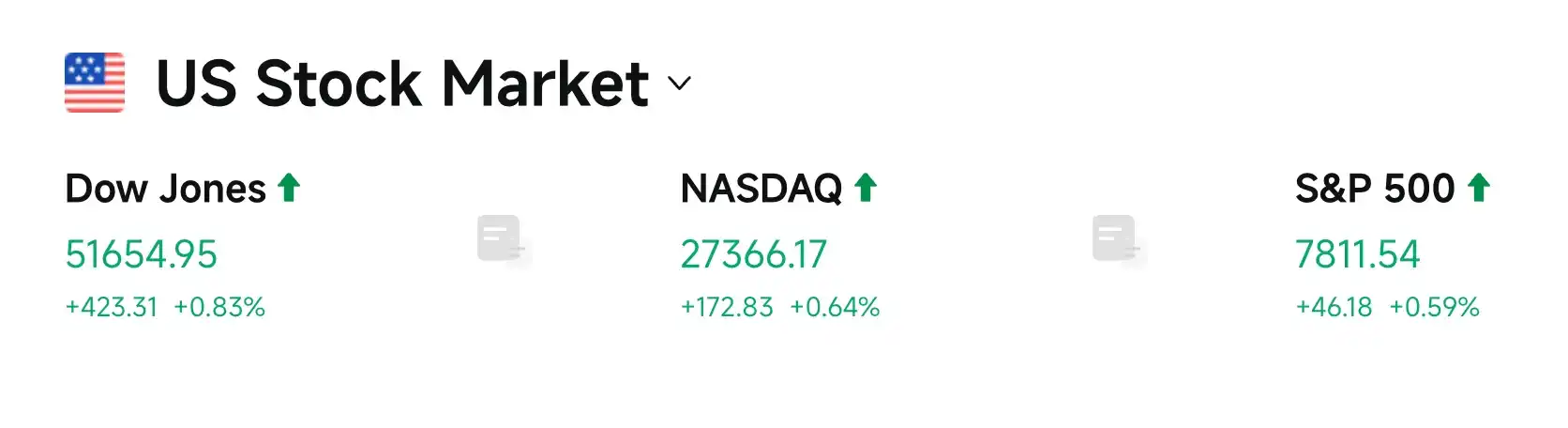
Last Friday, the three major U.S. stock indices collectively closed higher. The Dow Jones Industrial Average rose 0.83%, the S&P 500 rose 0.59%, and the Nasdaq rose 0.64%. All three indices posted weekly gains.
Over the weekend, Trump suddenly announced that Russia and Ukraine agreed to immediately implement an "energy ceasefire." Zelenskyy responded in support of halting attacks on energy facilities but is still awaiting specific arrangements from the U.S., noting that Russia attacked a Kharkiv cogeneration plant after the announcement. The market instantly captured signals of potential improvement in refined product supply, pressuring diesel and oil risk premiums, but doubts about implementation kept traders from placing one-sided bets. Simultaneously, Riyadh International Airport in Saudi Arabia was attacked again, causing a fire and injuries; the Houthis also claimed strikes on Dammam Airport and Aramco facilities. Trump stated U.S. forces might participate in action against the Houthis. Talks on reopening the Strait of Hormuz are also deadlocked, with Iran calling the U.S. response to seven conditions "insufficient." With Middle East escalation and the Russia-Ukraine "ceasefire" narrative coexisting, crude oil dipped slightly.
Gold and silver rebounded driven by bargain hunting, with New York gold futures climbing back near $4200 and silver reclaiming levels above $60. Copper prices also strengthened, boosting sentiment for mining companies. UBS stated gold could retest the $4000 support level in the short term, with bargain hunting potentially building a bottom, forecasting $4600 for December, $5000 for March 2027, $5200 for June, and $5400 for September.
U.S. Treasury yields remain high, with the 10-year yield around 5.24%, at a 52-week high percentile. Although last Friday's 30-year auction stopped at 5.618%, the highest since August 2000, the 30-year yield remains near the high of 5.6%. Pimco CIO Ivascyn warned that high oil prices and public debt concerns could push the 10-year yield towards 6%.
U.S. Treasury traders are watching this week's September CPI and Fed Chair Wash's speech at the IMF annual meeting on Friday to gauge the subsequent pace. Besant, meanwhile, revealed federal debt has risen to about $41 trillion, planning to announce a consolidation plan after the midterm elections, and expects economic growth this quarter to exceed 3%.
Tech Stock Rebound Nears Short-Term High, Institutional Optimism Towards Bank Stocks Clearly Cools
On Friday, tech stocks led the U.S. market rebound as investors bought back into AI heavyweights after the OpenAI revenue shock, but market scrutiny of AI revenue metrics and capital returns has noticeably intensified. However, Deutsche Bank warns that this rebound in tech stocks since July is nearing a short-term peak, with only about 4% upside remaining and historical downside risks reaching 16%, making the risk-reward less favorable than before, thus downgrading U.S. tech and large-cap growth stocks from "overweight" to "neutral."
The AI computing power market also shows an important signal: short-term computing power is too expensive. Goldman Sachs data shows short-term U.S. AI compute rentals can cost $40-50 billion per gigawatt per year, with long-term contracts around $20-30 billion, while the return threshold for major cloud providers building their own capacity is about $12 billion. This means current short-term rental prices are four times the cost threshold for self-building. Goldman believes companies like Google are willing to rent at high prices because self-building can't keep up with demand. Once supply catches up, spot prices may fall. This presents both opportunity and risk for compute rental companies like CoreWeave, Nebius, and IREN.
Nvidia is also being re-evaluated by the market. SemiAnalysis points out Nvidia's off-balance-sheet guarantee commitments have risen to $530 billion, involving supply commitments, data center backup agreements, and AI cloud services. As long as AI investment remains hot, these commitments aren't a problem; but if AI infrastructure slows, the market will start worrying about financial pressure.
Additionally, bank earnings season opens this week, but institutional optimism towards bank stocks has clearly cooled. A Truist Securities survey shows only 35% of institutions expect bank stocks to outperform, far below 68% in July. Goldman CEO Solomon said fixed income and commodity trading were slightly weaker than the same period last year, while a Morgan Stanley co-president said Q3 is unlikely to replicate Q2 performance. The financial sector has fallen about 4% over the past month, with the top five banks' market caps shrinking a combined $270 billion.
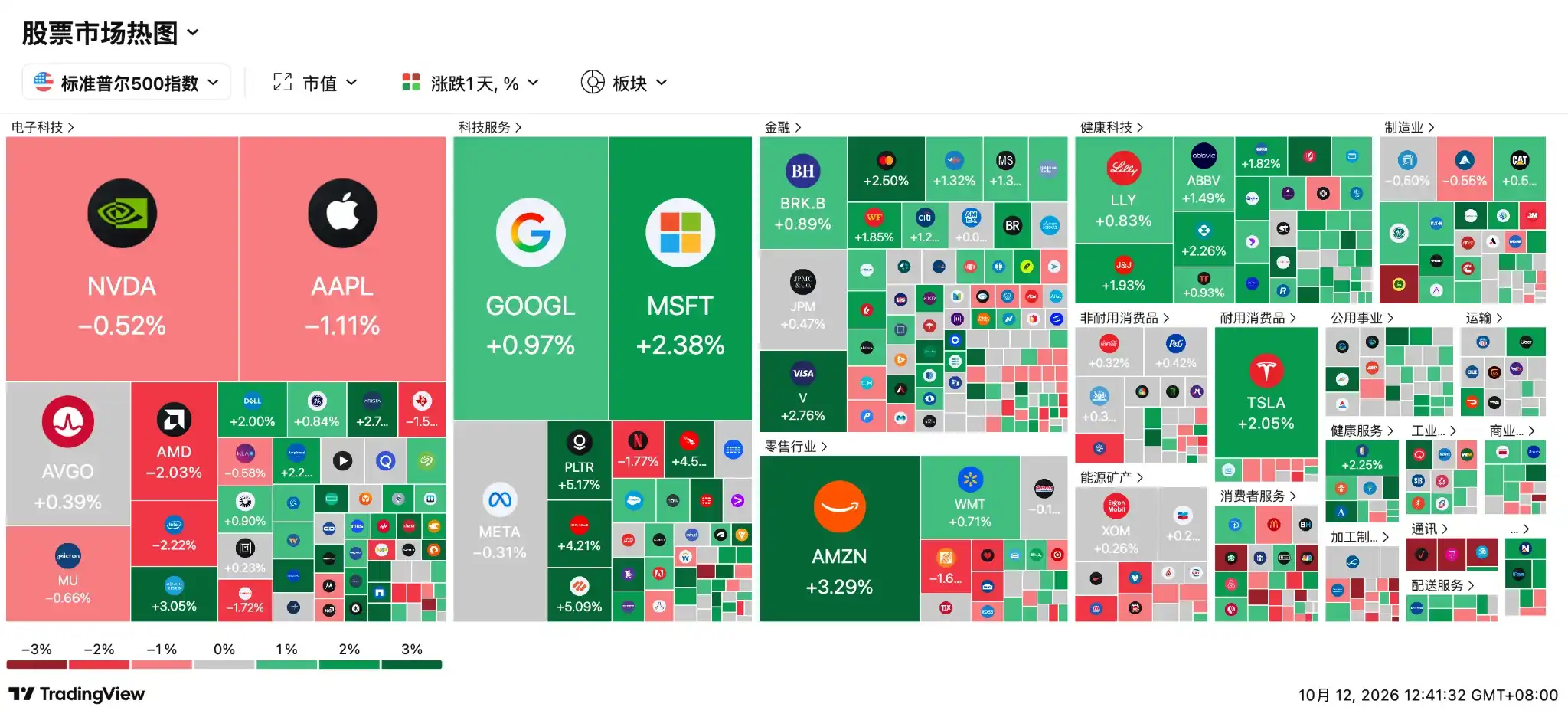
Specific Project Actions and Stock Price Movements:
-
Moderna up 14.21%, Humana up 11.6%: Moderna hits a new high since December 2022, officially joins the Nasdaq 100 Index, and is boosted by NIH advancing cancer vaccine R&D news; U.S. government data shows 95% of Humana's 2027 Medicare Advantage plan enrollees receive four stars or higher, while Oppenheimer raises its target price to $475. Biotech sector broadly higher: Novavax up 15.8%, Merck and Gilead Sciences up over 2%, Biotech Index ETF up 3%.
-
Palantir up 5.17%, stock hits record high: Goldman Sachs upgrades from Neutral to Buy, target price $230, implying ~18% upside; Barclays rates Overweight, target $265, citing deep competitive moats. AI application software stocks surge: Snowflake, Datadog up 7%, AI Application Software Stock Index up 2.90%.
-
Lumentum up 5.22%: CEO says ~70% demand for some products cannot be met before next year, some products still have 30% shortfall until 2028, "completely sold out, no end in sight."
-
Micron Technology closes down ~1%: Board approves increase in discretionary repurchase amount starting December 9 to $35.16 billion, with about $2.2 billion unused from the previous $10 billion plan; stock up ~260% year-to-date. Semiconductor sector declines: Philadelphia Semiconductor Index down 0.41%, down 4.3% for the week; ARM down 3.27%, Intel and AMD down over 2%, TSMC down over 1%.
-
Apple down 1.11%: Sharp rise in memory chip costs forces price hikes and suppresses demand; company asks some suppliers to cut component production for iPhone 18 Pro and Pro Max, with October orders at least 15% lower than initial requests. Consumer electronics sector under pressure, but Apple will still hold a "Welcome Home" smart home event on Oct. 13, expected to launch HomeView, new HomePod mini, and Apple TV 4K.
-
T-Mobile down over 13%, AT&T down nearly 10%, Verizon down 8.7%: SpaceX reaches agreement to acquire nationwide low-frequency wireless spectrum assets, directly challenging traditional wireless carriers. Related telecom sector closes down 0.4%, one of the few declining sectors in the S&P 500.
-
Gold, silver, copper concept stocks stronger: Southern Copper up over 5%, BHP, Pan American Silver up over 2%, driven by rebounding metal prices and some miner operating data.
-
Mag 7 moves: Amazon up 3.29% (UOB and AWS sign MoU to explore AI-driven banking innovation in ASEAN); Microsoft up 2.38% (CEO Nadella launches new-generation rapid decision-making AI model Decision-1); Tesla up 2.05% (FSD renamed in Europe, Roadster event moved to Oct. 15); Google up 0.87%, Meta down 0.31%, Nvidia down 0.52%, Apple down 1.11%.
- IREN after-hours up over 8%: Anthropic has signed a yet-unannounced multi-year cloud service agreement with IREN to expand its ~$530 billion data center leasing partner network. Analysts estimate a 245-megawatt campus coming online one month early could add over $1.3 billion in revenue for Anthropic.
Upcoming Events to Watch:
October 12 (Monday)
-
IMF and World Bank Annual Meetings in Bangkok, lasting until Oct. 18: Global finance ministers, central bankers, and international financial institution heads will discuss growth, inflation, interest rates, energy shocks, and public debt. If the IMF emphasizes high debt and high interest rate risks, long-end Treasury yields, the dollar, and gold could be affected.
-
14:00 EU Foreign Ministers meeting in Luxembourg: The meeting will discuss the Russia-Ukraine conflict, the Middle East situation, and security implications of further EU enlargement. If statements on Russian sanctions or Middle East security are tougher, oil, gold, and European defense stocks could be supported.
-
U.S. stock market open as usual, U.S. Treasury cash market closed all day: CME U.S. Treasury futures trade normally, but the cash market closure will reduce liquidity in rates markets. If oil prices or geopolitical news break, Treasury futures and dollar volatility could be amplified.
-
17:45 2026 Nobel Prize in Economic Sciences announced: Limited short-term trading impact, but if the award theme involves growth, debt, AI, or institutional economics, it may spark related policy and long-term investment discussions.
-
OCP Global Summit in San Jose, lasting until Oct. 15: Market focus on AI servers, open compute, data center architecture, power supply, liquid cooling, and networking equipment. If cloud vendors signal new procurement directions, the AI infrastructure chain may benefit.
October 13 (Tuesday)
-
10:00 IMF releases World Economic Outlook report: If the IMF downgrades global growth, upgrades inflation or debt risk assessments, markets may turn risk-off, benefiting the dollar and gold, pressuring cyclical stocks.
-
15:45 Fed Governor Waller speaks at Bloomberg New Economy Forum: A key Fed signal before U.S. CPI release. If Waller emphasizes sticky inflation, Treasury yields and the dollar may strengthen, pressuring tech stocks; if he emphasizes waiting for more data, growth stock sentiment could ease.
-
21:02 Apple holds "Welcome Home" smart home product launch event: Expected to launch new Apple TV 4K, HomePod mini, and home hub device HomeView. Market watches whether Apple's AI can expand from phones to the home entry point, affecting Apple, consumer electronics, smart home, and edge AI sectors.
-
UK Parliament AI Safety Hearing: Meta, Google, OpenAI, Anthropic invited to attend, with UK AI Safety Institute representatives also participating. If regulatory tone tightens, AI model companies and large-cap tech stocks may face sentiment headwinds.
-
Semiconductor industry flagship event SEMICON West in San Francisco, lasting until Oct. 15, including an Advanced Packaging Summit: Market focus on semiconductor equipment, advanced packaging, wafer manufacturing, and supply chain expansion signals. Relevant for ASML, Applied Materials, Lam Research, and TSMC supply chain.
-
Qwen AI glasses available for purchase: Market watches whether AI glasses can become a new edge AI entry point. If sales feedback is positive, it could boost consumer electronics, smart glasses, edge chips, and AI Agent concepts.
-
Earnings: JPMorgan Chase, Goldman Sachs, Citigroup, Wells Fargo, UnitedHealth, Johnson & Johnson, Domino's Pizza report: Bank earnings will test net interest margins, trading revenue, and credit risk in a high-rate environment; UnitedHealth and J&J will verify healthcare sector strength. If bank credit losses rise, markets may start trading an economic slowdown.
October 14 (Wednesday)
-
U.S. additional port fees on Chinese-owned, -operated, or -built ships take effect: This will affect shipping costs and U.S.-China trade chains. Market focus on impact for Chinese exporters, shipping companies, and car carriers.
-
09:30 China September CPI, PPI release: If CPI and PPI improve, indicating domestic demand and industrial price recovery, positive for A-shares, Hong Kong stocks, and pro-cyclical assets; if still weak, markets will expect more easing policies.
-
China September import/export data released, time TBD: Data lands on the day U.S. additional port fees take effect, a key window to observe front-loading, transshipment trade, and external demand resilience. If exports beat expectations, positive for ports, shipping, manufacturing, and China-concept sentiment; if weaker, the RMB and Chinese assets may face pressure.
-
20:30 U.S. September CPI and Core CPI release: The most important macro data this week. If core CPI MoM reaches 0.3% or higher, October rate hike discussion may reignite, boosting Treasury yields and the dollar, pressuring gold and high-valuation tech stocks; if lower than expected, AI and growth stocks may continue rebounding.
-
17:40 Fed Governor Bowman speaks: Bowman typically focuses on inflation risks; if her remarks are hawkish, they may reinforce December rate hike expectations.
-
Anthropic holds Pre-IPO Investor Day: Market focus on its revenue, cloud partnership costs, compute rental contracts, and IPO timeline. If revenue growth is strong, AI sentiment gets a boost; if cost pressures are too high, markets will continue questioning AI commercial returns.
-
Nvidia China Developer Day in Suzhou, lasting until Oct. 16: Market watches Nvidia's stance on its China ecosystem, developer tools, AI applications, and compute solutions. New partnerships or product updates may affect AI application and domestic compute substitution discussions.
-
Earnings: Bank of America, Morgan Stanley, BlackRock, ASML report: Bank of America and Morgan Stanley complete the big bank earnings picture; BlackRock reflects global asset management fund flows; ASML is a core semiconductor equipment chain event; orders and guidance will affect AI chip sector sentiment.
October 15 (Thursday)
-
02:00 Fed releases Beige Book on economic conditions: The Beige Book reflects consumption, employment, wages, and prices across U.S. regions. If it shows a strong economy with sticky inflation, rate hike expectations rise; if it shows cooling demand, rate pressure may ease.
-
G20 Finance Ministers and Central Bank Governors meeting: Market focus on global debt, inflation, currency, and financial stability discussions. If the meeting emphasizes fiscal risks and high-rate pressures, it may continue affecting long-end bond yields.
-
20:30 U.S. Initial Jobless Claims for week ending Oct. 10: If claims remain low, indicating a still-tight labor market, the Fed cannot pivot quickly; if they rise significantly, economic slowdown trades may gain traction.
-
China's refined oil products enter new pricing adjustment window: If oil prices are raised, it affects transportation, logistics, and chemical costs; if lowered, it helps ease inflationary pressures.
-
Tesla holds next-gen Roadster event: Market watches for new car performance, production timeline, and whether it incorporates SpaceX-related tech. If the launch exceeds expectations, Tesla and the high-end EV chain may get sentiment catalysts; if further delayed, markets may be disappointed.
-
Earnings: TSMC reports Q3 earnings; Alcoa reports after-hours: TSMC is the most critical event for the AI hardware chain. Market focuses on AI chip demand, advanced node capacity utilization, advanced packaging revenue, and capex plans. If guidance is strong, Nvidia, semiconductor equipment, AI servers, and optical module chains benefit; if demand or capex slows, AI hardware stocks may face pressure.
October 16 (Friday)
-
Fed Chair Wash attends IMF annual meeting, holds fireside chat with IMF Managing Director Georgieva: The key event capping the week. Wash will speak after U.S. CPI, PPI, and retail sales. Market listens closely to whether he supports a December rate hike. If hawkish, the dollar and Treasury yields may rise, pressuring U.S. stocks; if he emphasizes bond market tightening of financial conditions, growth stocks may rebound.
-
iPhone Duo pre-orders begin: Market watches demand for Apple's new products and pricing acceptance. If pre-orders are strong, positive for Apple's supply chain, consumer electronics, memory, and optics; if below expectations, concerns about Apple's demand intensify.