Bitcoin Closer to Bottoming Phase Than Early Bear Stage, Report Says

bitcoinistPublished on 2026-02-27Last updated on 2026-02-27

Abstract

A new Glassnode report suggests Bitcoin may be closer to a bottoming phase than the early stage of a bear market. The analysis focuses on the "Total Supply in Loss" metric, which measures the amount of Bitcoin held at an unrealized loss. This indicator has surged to 9.2 million BTC, its highest level since the last bear market, meaning nearly half of all circulating supply is in loss. This pattern aligns with historical bear markets where such high loss concentrations often signaled exhaustion of selling pressure and preceded market bottoms. While the current level hasn't surpassed previous cyclical bottoms, the market structure resembles the latter stages of past bear markets rather than their beginning. Despite ongoing volatility, this indicates a potential bottoming range. Bitcoin's price recently touched $69,000 but has since back to around $67,300.

A new report from Glassnode says Bitcoin could potentially be closer to a bottoming range than the early phase of the bear market.

Bitcoin Supply In Loss Trend Doesn’t Look Similar To An Early Bear Market

In its latest weekly report, on-chain analytics firm Glassnode has discussed how the current bear market structure is looking from the perspective of the Total Supply in Loss. This indicator measures the amount of Bitcoin that’s currently being held at some net unrealized loss on the blockchain.

Here is the chart shared by Glassnode that shows the trend in the 7-day moving average (MA) value of the metric over the last several years:
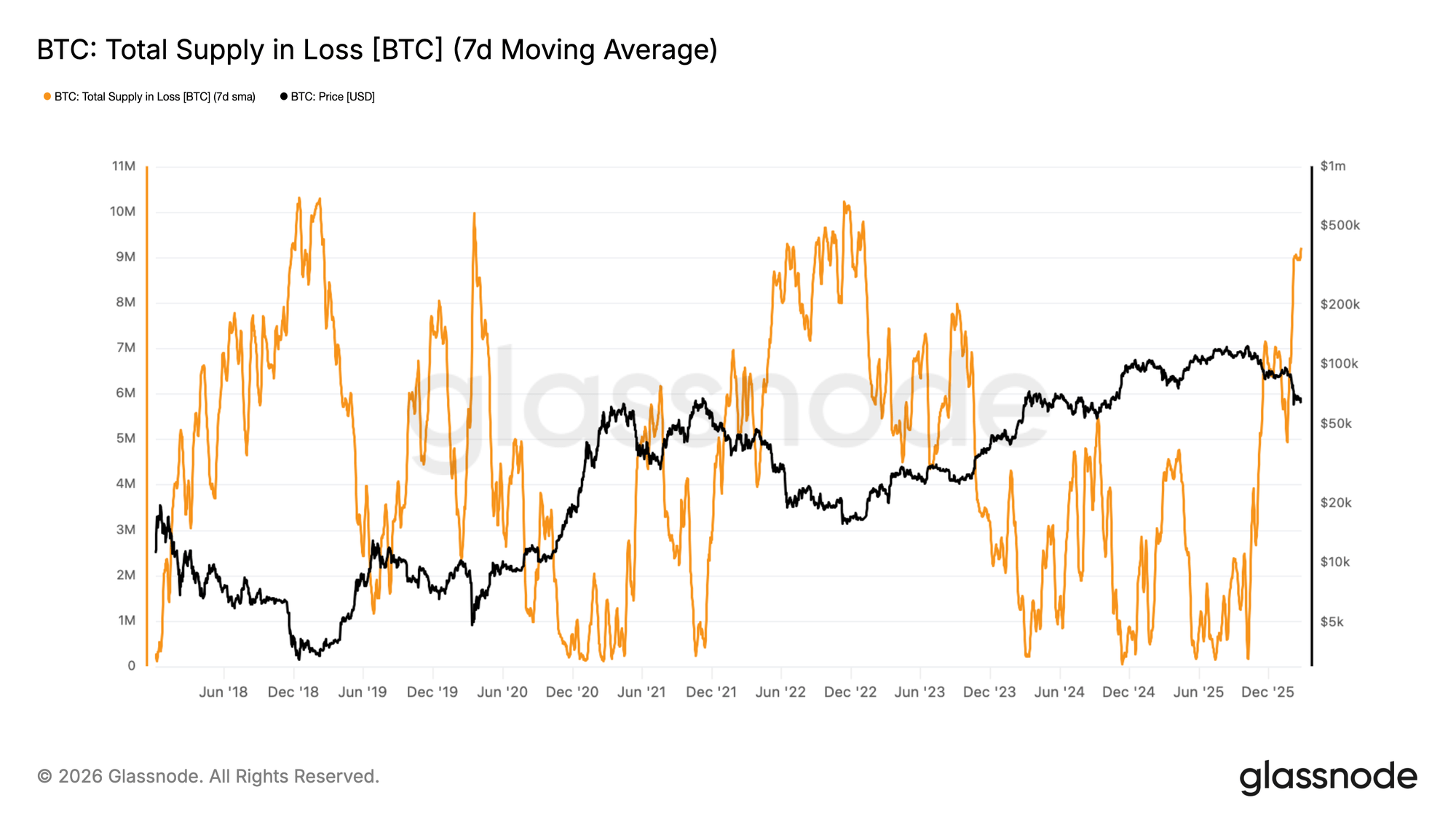
The 7-day MA value of the metric seems to have shot up in recent months | Source: Glassnode's The Week Onchain - Week 8, 2026

As displayed in the above graph, the Bitcoin Total Supply in Loss approached a value of zero as the cryptocurrency’s price hit a new all-time high (ATH) in October. The market downturn that has followed since then, however, has put a large chunk of the supply into loss, causing a sharp surge in the indicator.

Today, the 7-day average value of the metric is sitting at 9.2 million BTC, which is the highest level since the end of the last bear market. Currently, there are just under 20 million tokens in circulation, so the latest value of the Total Supply in Loss corresponds to nearly half the asset’s supply. “This aligns with prior bear market environments where drawdowns approached the 50% threshold and broad investor cohorts were under pressure,” explained the analytics firm.

From the chart, it’s visible that not only is the current level of the metric similar to past bear markets, its structure in fact resembles that of their latter stages, rather than early phases.

Historically, the higher the Total Supply in Loss has gone, the more probable a market bottom has become. The reason behind the pattern is that as loss concentration increases on the Bitcoin network, selling pressure with the motive of profit-taking starts becoming exhausted. Both the 2018 and 2022 bear markets reached their bottoms alongside tops in the metric.

So far, the 7-day MA Total Supply in Loss hasn’t reached the same highs as during previous cyclical bottoms, but it has certainly come close following the most recent jump in the metric. “In structural terms, the market appears closer to a potential bottoming range than to the initial onset of contraction, even as volatility and fragility persist,” noted Glassnode.

BTC Price

Bitcoin recovered above $69,000 on Wednesday, but its price has seen a small pullback since then as it’s now trading around $67,300.

Looks like the price of the coin has overall moved sideways over the past few days | Source: BTCUSDT on TradingView


Related Questions

QAccording to Glassnode's report, is Bitcoin closer to a bottoming phase or the early stage of a bear market?

AAccording to the report, Bitcoin appears closer to a potential bottoming range than to the initial onset of a bear market contraction.

QWhat does the 'Total Supply in Loss' indicator measure?

AThe 'Total Supply in Loss' indicator measures the amount of Bitcoin that is currently being held at some net unrealized loss on the blockchain.

QWhat was the 7-day moving average value of the Total Supply in Loss at the time of the report, and what does it represent?

AThe 7-day moving average value of the Total Supply in Loss was 9.2 million BTC, which represents nearly half of the asset's circulating supply and is the highest level since the end of the last bear market.

QWhy does a high level of the Total Supply in Loss historically suggest a market bottom is more probable?

AA high level of the Total Supply in Loss suggests a market bottom is more probable because as loss concentration increases, selling pressure from investors looking to take profits becomes exhausted.

QWhat was the price of Bitcoin at the time the article was written?

AAt the time the article was written, Bitcoin was trading around $67,300 after a small pullback from recovering above $69,000.

Related Reads

Firecrawl Launches Web Scraping Tool for Agents, NVIDIA Releases Nemotron 3 Super: What's the English Community Discussing Today?

Over the past 24 hours, key discussions in the English-speaking crypto and AI communities centered on several major developments. Firecrawl launched a CLI toolchain specifically for AI agents, enabling efficient web scraping and data extraction, though its pricing drew some criticism. Nvidia released Nemotron 3 Super, a 120B-parameter open-weight model with a 1M-token context window, raising both excitement and concerns over latency and safety. Google introduced Nano Banana 2, a high-speed image generation model, though its naming was met with mixed reactions. In AI agent infrastructure, Base44’s Superagent entered the cloud-based agent automation space, intensifying competition with local solutions like OpenClaw and raising debates over security and centralization. Ramp’s AI Index suggested Anthropic is gaining traction as the preferred enterprise AI vendor over OpenAI. In crypto, Solana continued to strengthen its infrastructure with DoubleZero Edge’s real-time market data via multicast technology and led in stablecoin transfer volume after filtering wash trading. Jupiter launched its Season 2 rewards program with a $2M JupUSD pool. Ethereum saw progress in L2 interoperability with on.eth addressing cross-chain identity fragmentation. Base ecosystem projects like Noise.xyz and rip.fun attracted significant attention, while Circle experimented with AI agents autonomously managing a hackathon using USDC. Perp DEX Lighter introduced a revised market structure to improve fairness, and prediction market platform Kalshi noted growing institutional engagement, with Marco Rubio emerging as an early favorite for the 2028 U.S. presidential election. Overall, themes included the shift toward cloud-based AI agents, model capability races, enterprise AI adoption, and the maturation of on-chain trading and prediction markets.

marsbit1h ago

Firecrawl Launches Web Scraping Tool for Agents, NVIDIA Releases Nemotron 3 Super: What's the English Community Discussing Today?

marsbit1h ago

Trading

Spot
Futures

Hot Articles

What is $BITCOIN

DIGITAL GOLD ($BITCOIN): A Comprehensive Analysis Introduction to DIGITAL GOLD ($BITCOIN) DIGITAL GOLD ($BITCOIN) is a blockchain-based project operating on the Solana network, which aims to combine the characteristics of traditional precious metals with the innovation of decentralized technologies. While it shares a name with Bitcoin, often referred to as “digital gold” due to its perception as a store of value, DIGITAL GOLD is a separate token designed to create a unique ecosystem within the Web3 landscape. Its goal is to position itself as a viable alternative digital asset, although specifics regarding its applications and functionalities are still developing. What is DIGITAL GOLD ($BITCOIN)? DIGITAL GOLD ($BITCOIN) is a cryptocurrency token explicitly designed for use on the Solana blockchain. In contrast to Bitcoin, which provides a widely recognized value storage role, this token appears to focus on broader applications and characteristics. Notable aspects include: Blockchain Infrastructure: The token is built on the Solana blockchain, known for its capacity to handle high-speed and low-cost transactions. Supply Dynamics: DIGITAL GOLD has a maximum supply capped at 100 quadrillion tokens (100P $BITCOIN), although details regarding its circulating supply are currently undisclosed. Utility: While precise functionalities are not explicitly outlined, there are indications that the token could be utilized for various applications, potentially involving decentralized applications (dApps) or asset tokenization strategies. Who is the Creator of DIGITAL GOLD ($BITCOIN)? At present, the identity of the creators and development team behind DIGITAL GOLD ($BITCOIN) remains unknown. This situation is typical among many innovative projects within the blockchain space, particularly those aligning with decentralized finance and meme coin phenomena. While such anonymity may foster a community-driven culture, it intensifies concerns about governance and accountability. Who are the Investors of DIGITAL GOLD ($BITCOIN)? The available information indicates that DIGITAL GOLD ($BITCOIN) does not have any known institutional backers or prominent venture capital investments. The project seems to operate on a peer-to-peer model focused on community support and adoption rather than traditional funding routes. Its activity and liquidity are primarily situated on decentralized exchanges (DEXs), such as PumpSwap, rather than established centralized trading platforms, further highlighting its grassroots approach. How DIGITAL GOLD ($BITCOIN) Works The operational mechanics of DIGITAL GOLD ($BITCOIN) can be elaborated on based on its blockchain design and network attributes: Consensus Mechanism: By leveraging Solana’s unique proof-of-history (PoH) combined with a proof-of-stake (PoS) model, the project ensures efficient transaction validation contributing to the network's high performance. Tokenomics: While specific deflationary mechanisms have not been extensively detailed, the vast maximum token supply implies that it may cater to microtransactions or niche use cases that are still to be defined. Interoperability: There exists the potential for integration with Solana’s broader ecosystem, including various decentralized finance (DeFi) platforms. However, the details regarding specific integrations remain unspecified. Timeline of Key Events Here is a timeline that highlights significant milestones concerning DIGITAL GOLD ($BITCOIN): 2023: The initial deployment of the token occurs on the Solana blockchain, marked by its contract address. 2024: DIGITAL GOLD gains visibility as it becomes available for trading on decentralized exchanges like PumpSwap, allowing users to trade it against SOL. 2025: The project witnesses sporadic trading activity and potential interest in community-led engagements, although no noteworthy partnerships or technical advancements have been documented as of yet. Critical Analysis Strengths Scalability: The underlying Solana infrastructure supports high transaction volumes, which could enhance the utility of $BITCOIN in various transaction scenarios. Accessibility: The potential low trading price per token could attract retail investors, facilitating wider participation due to fractional ownership opportunities. Risks Lack of Transparency: The absence of publicly known backers, developers, or an audit process may yield skepticism regarding the project's sustainability and trustworthiness. Market Volatility: The trading activity is heavily reliant on speculative behavior, which can result in significant price volatility and uncertainty for investors. Conclusion DIGITAL GOLD ($BITCOIN) emerges as an intriguing yet ambiguous project within the rapidly evolving Solana ecosystem. While it attempts to leverage the “digital gold” narrative, its departure from Bitcoin's established role as a store of value underscores the need for a clearer differentiation of its intended utility and governance structure. Future acceptance and adoption will likely depend on addressing the current opacity and defining its operational and economic strategies more explicitly. Note: This report encompasses synthesised information available as of October 2023, and developments may have transpired beyond the research period.

363 Total ViewsPublished 2025.05.13Updated 2025.05.13

What is $BITCOIN

Discussions

Welcome to the HTX Community. Here, you can stay informed about the latest platform developments and gain access to professional market insights. Users' opinions on the price of BTC (BTC) are presented below.

活动图片