Bitcoin ETF Sees Sudden Reversal After Five Consecutive Weeks of $3.8 Billion Outflows: Who Decides the Next Move?

marsbitPublicado em 2026-03-02Última atualização em 2026-03-02

Resumo

Bitcoin ETFs experienced a five-week outflow streak totaling $3.8 billion, marking the longest continuous withdrawal period since early 2025. This occurred amid heightened macroeconomic uncertainty driven by tariff policy shifts, which amplified volatility across risk assets. However, a reversal began around February 20, with approximately $875.5 million in net inflows over several days, suggesting a potential shift in institutional sentiment. The article emphasizes that ETF flows act as a key indicator of institutional demand. Sustained outflows remove a structural buyer, making price support more fragile and rebounds weaker. Key signals to watch include the persistence of weekly inflows, Bitcoin’s performance on macro-negative days, its ability to rise without ETF support, and the pattern of outflows. Three potential paths are outlined: renewed consistent inflows indicating structural recovery; transient inflows followed by further outflows, suggesting tactical rather than strategic demand; or stabilization with neutral flows, allowing quieter market recalibration. The critical question remains whether marginal buyers are returning with conviction or merely reacting to short-term price levels.

Author: CryptoSlate

Compiled by: Deep Tide TechFlow

Deep Tide's Guide: This article clarifies a structural issue that is easily overlooked: Bitcoin ETFs are not a floor; they are conditional buyers. Five weeks of net outflows totaling $3.8 billion are not just an ugly number; they represent the quiet closing of what was once the most stable institutional door at the peak of tariff uncertainty. After February 20th, the data reversed, but is this reversal a true signal or a tactical move? The author outlines three paths and four indicators to watch, making it worth a careful read.

Full Text Below:

Bitcoin ETFs have just experienced their longest net outflow cycle since early 2025. The uncertainty surrounding tariff policy is stirring interest rates and the stock market, making this outflow particularly critical as it alters Bitcoin's support structure under pressure.

For nearly two years, spot Bitcoin ETFs were almost seen as a one-way street. They liberated Bitcoin from the hassles of private keys and operational complexities, turning it into code that fits into any ordinary investment portfolio. Money flowed in, shares were created, and Bitcoin gained a stable, compliant source of demand.

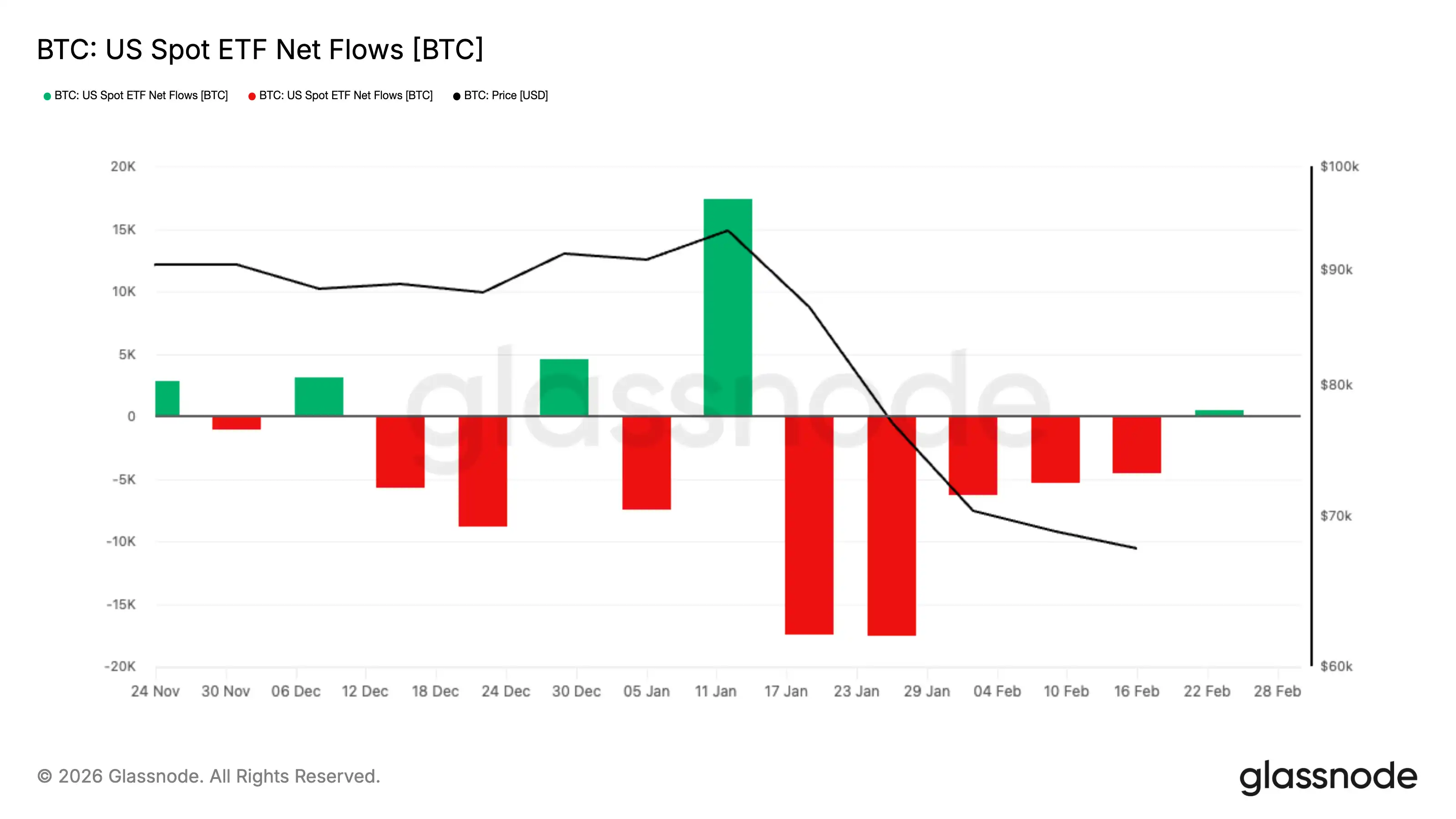
In the five consecutive weeks leading up to the end of February, investors withdrew approximately $3.8 billion from U.S.-listed spot Bitcoin ETFs, marking the longest streak of weekly net outflows since early 2025. Bitcoin mostly hovered around $60,000 during this period, with recent trading prices around $68,000 as the market attempts to regain balance.

The scale of this outflow is staggering, but the timing is even more critical. The outflow period coincided with tariff policy uncertainty seeping into interest rates, stocks, and commodities, making the entire macro environment jittery again.

However, since February 20th, the flow of funds has at least temporarily shifted.

Between February 20th and 27th, U.S.-listed spot Bitcoin ETFs recorded approximately $875.5 million in net inflows, with strong share creation on multiple consecutive days. This is not enough to erase the losses of the past five weeks, but it complicates the narrative.

What initially seemed like a one-way de-risking cycle may be turning into a reset—institutional demand is cautiously re-emerging amid ongoing macro uncertainty.

What Have ETFs Actually Done to the Bitcoin Market?

Spot ETFs operate through a share creation and redemption mechanism. When demand for ETF shares rises, authorized participants create new shares by injecting assets into the fund. When demand wanes and shares are redeemed, the mechanism contracts. This process connects the buying and selling activity in the stock market with Bitcoin exposure behind the scenes, which is why ETF flows serve as a daily scorecard for Bitcoin.

The SEC approved rules allowing certain crypto ETP shares to be created and redeemed in-kind, meaning authorized participants can exchange the underlying asset for shares directly without routing everything through cash. The SEC's focus was on efficiency and cost reduction.

But even if daily execution remains primarily cash-based, the core logic remains unchanged: ETF flows are one of the cleanest bridges between institutions and the Bitcoin market.

A simple framework to understand:

On net inflow days, the ETF expands, shares are created, and exposure grows. The market feels the presence of a buyer that doesn’t require a new catalyst every day.

On net outflow days, the ETF contracts, shares are redeemed, and exposure shrinks. The market loses that default buyer and must also absorb additional selling pressure.

How Are Five Consecutive Weeks Different from a Single Week of Large Outflows?

The cumulative withdrawal of approximately $3.8 billion over five weeks marks a record duration for weekly net outflows in the recent cycle. Such a prolonged streak of weekly net outflows has not been seen since early 2025. The macro backdrop adds extra weight to this.
Trade policy is once again impacting crypto markets. Tariff uncertainty creates a headline-driven environment where sudden repricing in one asset quickly spills over into others.

In such conditions, portfolios are managed more conservatively. When volatility rises, fund managers quickly cut positions that can be cut easily, forming a negative feedback loop that further depresses prices and exacerbates outflows. They often revisit the assets they cut later, but this does little to calm the outflows.

Whether one admits it or not, Bitcoin falls into the "quick to cut" bucket, and ETF flows are one of the first places this decision becomes visible.

Another comparison looming over this period is gold. Gold has gained safe-haven demand due to tariff uncertainty, with recent dollar weakness and geopolitical risks only amplifying this demand.

But this doesn’t mean Bitcoin has failed in this cycle. The market is clearly categorizing assets by behavior, and Bitcoin is trading more like risk exposure than a safe haven.

When ETF Buying Stops, Who Replaces It?

To understand this, set aside grand narratives and ask one simple question:

When Bitcoin drops 3% in a day, who becomes the buyer that doesn’t need convincing?

In 2024, ETFs gave the market a clear answer. Net inflows were the default demand. They didn’t need leverage, memes, or perfect sentiment—just a committee decision and broker execution.

But when this channel narrows, two specific things happen.

First, declines feel lonelier.

Without consistent ETF net inflows, price discovery relies more on active spot buyers and liquidity providers who require higher compensation to take the other side. This is why pullbacks feel sharper and rebounds feel more hesitant, even if the news doesn’t seem dramatic.

Second, net outflows can bring real market force.

Redemptions are not just a reflection of market sentiment; they are a mechanical contraction of institutional positions. Depending on the product structure and how participants hedge, redemptions can translate into actual Bitcoin sales, hedge adjustments, or basis trade unwinding.

The external result is the same: less support, more supply, weaker bounces.

We can attribute Bitcoin’s poor performance to an overall cooling of U.S. institutional participation and say that ETF net outflows and lighter overall positioning in regulated venues exacerbated this. You may disagree with the tone of this characterization, but it aligns with what the ETF data shows.

This shatters a misconception: ETFs are Bitcoin’s floor. A floor requires a consistently buying buyer. A buyer that steps away for five consecutive weeks was always a conditional buyer.

What to Watch?

To fully grasp the implications, watch four signals and understand what each means.

Watch the weekly net flow data. A single week turning positive is a pulse; two or three consecutive weeks indicate the channel reopening. If weekly data turns consistently positive, it means institutional money pipelines are reopening. If it slips back into sustained negative territory, rebounds may feel like climbing without a handrail, as the cleanest institutional money pipeline is still contracting.

Watch Bitcoin’s performance on macro-negative days. In tariff-driven markets, stocks swing with headlines, rates repricing, and volatility spikes. At such times, Bitcoin either holds up like a scarce asset or trades like risk beta.

Watch if the price can rise without ETF net inflows. If Bitcoin starts climbing while ETF flows are flat or negative, it means another type of buyer has taken the baton. Sometimes it’s derivative position resetting; other times, it’s crypto-native spot demand returning. Either way, that’s the moment it no longer relies solely on ETFs.

Watch the pattern of outflows. A slow drip is different from a sudden gush. A slow drip is position trimming; a sudden gush usually signals forced selling or rapid de-risking.

None of this predicts price, but it tells you whether the market’s biggest demand engine is running, idling, or reversing.

What’s Next?

The answer is no longer as one-directional as it was a week ago.

Five consecutive weeks and $3.8 billion in net outflows marked a clear contraction in institutional positioning. But the data since February 20th introduces a new variable: approximately $875.5 million in net inflows in just over a week.

This doesn’t negate the prior de-risking, but it does suggest the institutional money pipeline isn’t broken—it may have just undergone a stress test.

There are three realistic paths now.

The first is confirmation. If net inflows persist for multiple weeks and begin to stack steadily, these five weeks of outflows will look more like a position reset than a structural exit. In this scenario, ETFs resume functioning as a stable allocation channel, Bitcoin performs better under macro pressure, and recent volatility is reclassified as a shakeout rather than a demand collapse.

The second is fragility. A brief inflow rebound followed by a return to net outflows means last week’s share creation was tactical, not strategic—fast money reacting to price levels, not long-term capital rebuilding positions. If this happens, rebounds may continue to feel heavy, especially in a macro environment where fund managers are tariff-sensitive and quick to cut risk.

The third is stability without acceleration. Flows flatten near zero, extremes on both ends fade, Bitcoin trades in a compressed range, and positions quietly rebuild. This sideways repair may be less dramatic but is often more constructive, as it removes forced flows from the equation and returns price discovery to normal.

The key shift is this: the market is no longer facing one-directional, sustained ETF outflows. It is now testing whether the institutional demand engine is restarting.

The $3.8 billion outflow is eye-catching. But the more important question today is: has the marginal buyer returned, and are these buyers early allocators rebuilding positions, or just traders standing in front of what they perceive as a floor?

ETF flows don’t predict price. But they will continue to show whether Bitcoin’s cleanest institutional buying is expanding, idling, or sliding toward reversal again. And when macro uncertainty makes markets jittery once more, this pipeline matters most.


Perguntas relacionadas

QWhat was the recent trend in Bitcoin ETF flows before the reversal mentioned in the article?

ABitcoin ETFs experienced a five-week streak of net outflows totaling approximately $3.8 billion, marking the longest weekly net outflow period since early 2025.

QWhat key event or change occurred starting February 20th regarding Bitcoin ETF flows?

AStarting February 20th, U.S.-listed spot Bitcoin ETFs recorded net inflows of about $875.5 million over several days, indicating a potential reversal in the previous outflow trend.

QHow do ETF flows mechanically impact the Bitcoin market according to the article?

AETF flows create or redeem shares based on demand. Net inflows expand ETF size, creating shares and adding buying pressure, while net outflows shrink it, redeeming shares and increasing selling pressure.

QWhat are the three possible paths outlined for Bitcoin ETF flows going forward?

AThe three paths are: 1) Confirmation - sustained net inflows indicating stable institutional demand; 2) Fragility - inflows prove temporary with renewed outflows; 3) Stabilization without acceleration - flows flatten near zero, allowing quiet rebuilding.

QWhat does the article suggest Bitcoin ETF flows reveal about institutional demand during macroeconomic uncertainty?

AETF flows act as the cleanest pipeline for institutional demand, showing whether institutional buying is expanding, idling, or reversing, especially crucial during periods of macroeconomic uncertainty like tariff policy shifts.

Leituras Relacionadas

Hong Kong Airdrops Stablecoins, US Defines Boundaries: The Institutionalization Phase of Stablecoins

Stablecoin regulation is entering a new institutionalized phase, as evidenced by recent developments in Hong Kong and the United States. Hong Kong is set to issue its first stablecoin issuer licenses by March, marking the start of a licensed era. Lawmaker Johnny Ng has proposed distributing stablecoin-based consumption vouchers to citizens to encourage adoption among local SMEs—a strategy reminiscent of the e-voucher campaigns that boosted digital payment uptake. Hong Kong’s regulatory framework requires licensed issuers to hold full reserve backing, independent custody, and face-value redemption, effectively treating stablecoin operators as quasi-financial institutions. Meanwhile, the U.S. is clarifying the regulatory status of payment stablecoins. Following a key meeting between banking and crypto industry representatives, the SEC is revising Rule 15c3-1 to include payment stablecoins under broker-dealer capital rules, applying a 2% capital deduction. Eligible stablecoins must be dollar-denominated, fully reserved, audited monthly, and redeemable. This move formally integrates payment stablecoins into the U.S. financial regulatory system. Together, these developments signal that stablecoins are transitioning from market experiments to regulated financial instruments—no longer just crypto products but recognized gateways into the global monetary system.

marsbitHá 1h

Hong Kong Airdrops Stablecoins, US Defines Boundaries: The Institutionalization Phase of Stablecoins

marsbitHá 1h

Trading

Spot
Futuros

Artigos em Destaque

O que é BITCOIN

Compreender o HarryPotterObamaSonic10Inu (ERC-20) e a Sua Posição no Espaço Cripto Nos últimos anos, o mercado de criptomoedas assistiu a um aumento na popularidade das moedas meme, cativando não apenas os traders, mas também aqueles que procuram envolvimento comunitário e valor de entretenimento. Entre estes tokens únicos está o HarryPotterObamaSonic10Inu (ERC-20), um projeto intrigante que mistura referências culturais no tecido das criptomoedas. Este artigo explora os principais aspetos do HarryPotterObamaSonic10Inu, examinando os seus mecanismos, a sua ética orientada pela comunidade e o seu envolvimento com o vasto panorama cripto. O que é o HarryPotterObamaSonic10Inu (ERC-20)? Como o nome sugere, o HarryPotterObamaSonic10Inu é uma moeda meme construída na blockchain Ethereum, classificada sob o padrão ERC-20. Ao contrário das criptomoedas tradicionais, que podem enfatizar a utilidade prática ou o potencial de investimento, este token prospera no valor de entretenimento e na força da sua comunidade. O projeto visa promover um ambiente onde utilizadores envolvidos possam reunir-se, partilhar ideias e participar em atividades inspiradas por diversos fenómenos culturais. Uma característica notável do HarryPotterObamaSonic10Inu é a zero taxa sobre transações. Este elemento atraente visa encorajar a negociação e o envolvimento da comunidade, isento de encargos adicionais que podem desencorajar os traders de pequena escala. A oferta total da moeda está fixada em mil milhões de tokens, uma cifra que marca a sua intenção de manter uma circulação substancial dentro da comunidade. Criador do HarryPotterObamaSonic10Inu (ERC-20) As origens do HarryPotterObamaSonic10Inu estão um pouco envoltas em mistério; os detalhes sobre o criador permanecem desconhecidos. O desenvolvimento deste token carece de uma equipa identificável ou de um plano explícito, o que não é raro no setor das moedas meme. Em vez disso, o projeto surgiu de forma orgânica, com o seu progresso a depender fortemente do entusiasmo e da participação da sua comunidade. Investidores do HarryPotterObamaSonic10Inu (ERC-20) No que diz respeito a investimentos externos e apoios, o HarryPotterObamaSonic10Inu também permanece ambíguo. O token não lista quaisquer fundações de investimento conhecidas ou apoio organizacional significativo. Em vez disso, o “sangue vital” do projeto é a sua comunidade de base, que informa o seu crescimento e sustentabilidade através da ação coletiva e do envolvimento no espaço cripto. Como Funciona o HarryPotterObamaSonic10Inu (ERC-20)? Como uma moeda meme, o HarryPotterObamaSonic10Inu opera principalmente fora dos quadros tradicionais que muitas vezes governam o valor dos ativos. Existem vários aspetos distintivos que definem como o projeto funciona: Transações Sem Taxas: Sem taxas sobre transações, os utilizadores podem comprar e vender o token livremente, sem a preocupação de custos ocultos. Envolvimento da Comunidade: O projeto prospera na interação da comunidade, aproveitando plataformas de redes sociais para criar entusiasmo e facilitar a participação. Discussões, partilha de conteúdo e envolvimento são elementos cruciais que ajudam a expandir o seu alcance e a fomentar a lealdade entre os apoiantes. Sem Utilidade Prática: Deve ser notado que o HarryPotterObamaSonic10Inu não oferece utilidade concreta dentro do ecossistema financeiro. Em vez disso, é classificado como um token principalmente para entretenimento e atividades comunitárias. Referência Cultural: O token incorpora de forma inteligente elementos da cultura popular para atrair interesse, conectando-se tanto com entusiastas de memes como com seguidores de criptomoedas. HarryPotterObamaSonic10Inu exemplifica como as moedas meme operam de forma diferente de projetos de criptomoedas mais tradicionais, entrando no mercado como construções sociais inovadoras em vez de ativos utilitários. Linha do Tempo do HarryPotterObamaSonic10Inu (ERC-20) A história do HarryPotterObamaSonic10Inu é marcada por vários marcos notáveis: Criação: O token surgiu de um meme viral, capturando a imaginação de muitos entusiastas de criptomoedas. Datas específicas de criação não estão disponíveis, sublinhando a sua ascensão orgânica. Listagem em Exchanges: O HarryPotterObamaSonic10Inu conseguiu entrar em várias exchanges, permitindo um acesso e negociação mais fáceis pela comunidade. Iniciativas de Envolvimento da Comunidade: Atividades contínuas direcionadas a melhorar a interação comunitária, incluindo concursos, campanhas em redes sociais e geração de conteúdo por fãs e defensores. Planos de Expansão Futura: O roteiro do projeto inclui o lançamento de uma coleção de NFTs, mercadorias e um site de eCommerce relacionado aos seus temas culturais, envolvendo ainda mais a comunidade e tentando adicionar mais dimensões ao seu ecossistema. Pontos-Chave sobre o HarryPotterObamaSonic10Inu (ERC-20) Natureza Orientada pela Comunidade: O projeto prioriza a contribuição coletiva e a criatividade, assegurando que o envolvimento dos utilizadores está na vanguarda do seu desenvolvimento. Classificação como Moeda Meme: Representa o epítome da criptomoeda baseada em entretenimento, destacando-se dos veículos de investimento tradicionais. Sem Afiliação Direta com o Bitcoin: Apesar da semelhança no nome do ticker, o HarryPotterObamaSonic10Inu é distinto e não tem qualquer relação com o Bitcoin ou outras criptomoedas estabelecidas. Foco na Colaboração: O HarryPotterObamaSonic10Inu é projetado para criar um espaço de colaboração e partilha de histórias entre os seus detentores, proporcionando uma via para a criatividade e o fortalecimento da comunidade. Perspectivas Futuras: A ambição de expandir além da sua premissa inicial para NFTs e mercadorias delineia um caminho para o projeto potencialmente entrar em avenidas mais mainstream dentro da cultura digital. À medida que as moedas meme continuam a capturar a imaginação da comunidade cripto, HarryPotterObamaSonic10Inu (ERC-20) destaca-se devido aos seus laços culturais e abordagem centrada na comunidade. Embora possa não se encaixar no molde típico de um token orientado para utilidade, a sua essência reside na alegria e camaradagem fomentadas entre os seus apoiantes, destacando a natureza em evolução das criptomoedas em uma era cada vez mais digital. À medida que o projeto continua a desenvolver-se, será importante observar como as dinâmicas comunitárias influenciam a sua trajetória no panorama em constante mudança da tecnologia blockchain.

517 Visualizações TotaisPublicado em {updateTime}Atualizado em 2024.12.03

O que é BITCOIN

Como comprar BTC

Bem-vindo à HTX.com!Tornámos a compra de Bitcoin (BTC) simples e conveniente.Segue o nosso guia passo a passo para iniciar a tua jornada no mundo das criptos.Passo 1: cria a tua conta HTXUtiliza o teu e-mail ou número de telefone para te inscreveres numa conta gratuita na HTX.Desfruta de um processo de inscrição sem complicações e desbloqueia todas as funcionalidades.Obter a minha contaPasso 2: vai para Comprar Cripto e escolhe o teu método de pagamentoCartão de crédito/débito: usa o teu visa ou mastercard para comprar Bitcoin (BTC) instantaneamente.Saldo: usa os fundos da tua conta HTX para transacionar sem problemas.Terceiros: adicionamos métodos de pagamento populares, como Google Pay e Apple Pay, para aumentar a conveniência.P2P: transaciona diretamente com outros utilizadores na HTX.Mercado de balcão (OTC): oferecemos serviços personalizados e taxas de câmbio competitivas para os traders.Passo 3: armazena teu Bitcoin (BTC)Depois de comprar o teu Bitcoin (BTC), armazena-o na tua conta HTX.Alternativamente, podes enviá-lo para outro lugar através de transferência blockchain ou usá-lo para transacionar outras criptomoedas.Passo 4: transaciona Bitcoin (BTC)Transaciona facilmente Bitcoin (BTC) no mercado à vista da HTX.Acede simplesmente à tua conta, seleciona o teu par de trading, executa as tuas transações e monitoriza em tempo real.Oferecemos uma experiência de fácil utilização tanto para principiantes como para traders experientes.

3.1k Visualizações TotaisPublicado em {updateTime}Atualizado em 2025.03.21

Como comprar BTC

O que é $BITCOIN

OURO DIGITAL ($BITCOIN): Uma Análise Abrangente Introdução ao OURO DIGITAL ($BITCOIN) OURO DIGITAL ($BITCOIN) é um projeto baseado em blockchain que opera na rede Solana, com o objetivo de combinar as características dos metais preciosos tradicionais com a inovação das tecnologias descentralizadas. Embora partilhe um nome com o Bitcoin, frequentemente referido como “ouro digital” devido à sua percepção como uma reserva de valor, o OURO DIGITAL é um token separado projetado para criar um ecossistema único dentro da paisagem Web3. O seu objetivo é posicionar-se como um ativo digital alternativo viável, embora os detalhes sobre as suas aplicações e funcionalidades ainda estejam em desenvolvimento. O que é o OURO DIGITAL ($BITCOIN)? OURO DIGITAL ($BITCOIN) é um token de criptomoeda explicitamente projetado para uso na blockchain Solana. Em contraste com o Bitcoin, que fornece um papel amplamente reconhecido como armazenamento de valor, este token parece focar em aplicações e características mais amplas. Aspectos notáveis incluem: Infraestrutura Blockchain: O token é construído na blockchain Solana, conhecida pela sua capacidade de lidar com transações de alta velocidade e baixo custo. Dinâmicas de Oferta: O OURO DIGITAL tem um fornecimento máximo limitado a 100 quatrilhões de tokens (100P $BITCOIN), embora os detalhes sobre o seu fornecimento circulante ainda não tenham sido divulgados. Utilidade: Embora as funcionalidades precisas não estejam explicitamente delineadas, existem indicações de que o token poderia ser utilizado para várias aplicações, potencialmente envolvendo aplicações descentralizadas (dApps) ou estratégias de tokenização de ativos. Quem é o Criador do OURO DIGITAL ($BITCOIN)? Neste momento, a identidade dos criadores e da equipa de desenvolvimento por trás do OURO DIGITAL ($BITCOIN) permanece desconhecida. Esta situação é típica entre muitos projetos inovadores no espaço da blockchain, particularmente aqueles alinhados com finanças descentralizadas e fenómenos de moedas meme. Embora tal anonimato possa fomentar uma cultura orientada pela comunidade, intensifica as preocupações sobre governança e responsabilidade. Quem são os Investidores do OURO DIGITAL ($BITCOIN)? As informações disponíveis indicam que o OURO DIGITAL ($BITCOIN) não tem apoiantes institucionais conhecidos ou investimentos proeminentes de capital de risco. O projeto parece operar num modelo peer-to-peer focado no apoio e adoção da comunidade, em vez de rotas de financiamento tradicionais. A sua atividade e liquidez estão principalmente situadas em exchanges descentralizadas (DEXs), como a PumpSwap, em vez de plataformas de negociação centralizadas estabelecidas, destacando ainda mais a sua abordagem de base. Como Funciona o OURO DIGITAL ($BITCOIN) A mecânica operacional do OURO DIGITAL ($BITCOIN) pode ser elaborada com base no seu design de blockchain e nas características da rede: Mecanismo de Consenso: Ao aproveitar o exclusivo proof-of-history (PoH) da Solana combinado com um modelo de proof-of-stake (PoS), o projeto assegura uma validação eficiente das transações, contribuindo para o alto desempenho da rede. Tokenomics: Embora mecanismos deflacionários específicos não tenham sido extensivamente detalhados, o vasto fornecimento máximo de tokens implica que pode atender a microtransações ou casos de uso de nicho que ainda estão por definir. Interoperabilidade: Existe o potencial para integração com o ecossistema mais amplo da Solana, incluindo várias plataformas de finanças descentralizadas (DeFi). No entanto, os detalhes sobre integrações específicas permanecem não especificados. Cronologia de Eventos Chave Aqui está uma cronologia que destaca marcos significativos relacionados ao OURO DIGITAL ($BITCOIN): 2023: O lançamento inicial do token ocorre na blockchain Solana, marcado pelo seu endereço de contrato. 2024: O OURO DIGITAL ganha visibilidade ao tornar-se disponível para negociação em exchanges descentralizadas como a PumpSwap, permitindo que os utilizadores o negociem contra SOL. 2025: O projeto testemunha atividade de negociação esporádica e potencial interesse em envolvimentos liderados pela comunidade, embora não tenham sido documentadas parcerias ou avanços técnicos notáveis até ao momento. Análise Crítica Forças Escalabilidade: A infraestrutura subjacente da Solana suporta altos volumes de transações, o que pode aumentar a utilidade do $BITCOIN em vários cenários de transação. Acessibilidade: O potencial preço de negociação baixo por token pode atrair investidores de retalho, facilitando uma participação mais ampla devido a oportunidades de propriedade fracionada. Riscos Falta de Transparência: A ausência de apoiantes, desenvolvedores ou um processo de auditoria publicamente conhecidos pode gerar ceticismo em relação à sustentabilidade e confiabilidade do projeto. Volatilidade do Mercado: A atividade de negociação depende fortemente do comportamento especulativo, o que pode resultar em volatilidade significativa dos preços e incerteza para os investidores. Conclusão O OURO DIGITAL ($BITCOIN) surge como um projeto intrigante, mas ambíguo, dentro do ecossistema em rápida evolução da Solana. Embora tente aproveitar a narrativa do “ouro digital”, a sua divergência do papel estabelecido do Bitcoin como reserva de valor sublinha a necessidade de uma diferenciação mais clara da sua utilidade pretendida e estrutura de governança. A aceitação e adoção futuras dependerão provavelmente da abordagem da atual opacidade e da definição mais explícita das suas estratégias operacionais e económicas. Nota: Este relatório abrange informações sintetizadas disponíveis até outubro de 2023, e desenvolvimentos podem ter ocorrido além do período de pesquisa.

92 Visualizações TotaisPublicado em {updateTime}Atualizado em 2025.05.13

O que é $BITCOIN

Discussões

Bem-vindo à Comunidade HTX. Aqui, pode manter-se informado sobre os mais recentes desenvolvimentos da plataforma e obter acesso a análises profissionais de mercado. As opiniões dos utilizadores sobre o preço de BTC (BTC) são apresentadas abaixo.

活动图片