Bitcoin pushes past $70K – Will weak on-chain activity push BTC down again?

ambcryptoPublicado a 2026-03-10Actualizado a 2026-03-10

Resumen

Bitcoin has surpassed $70,000 amid renewed market optimism, but underlying on-chain indicators suggest weakness. Adjusted on-chain volume has declined to historically low levels, signaling reduced usage. Daily active users and transaction fees have also dropped significantly, reflecting diminished network activity and weakening demand. Despite the price rally, liquidity clusters indicate stronger incentives for downward movement toward $66,000, compared to limited upside toward $72,000. Analysts suggest a significant surge in volatility may be needed to reignite momentum, potentially in Q2 2026. Short-term downside risk remains before a stronger trend can be confirmed.

Bitcoin [BTC] has shown signs of recovery over the past day as the market pushed past the $70,000 mark, with sentiment pointing to renewed capital flowing into the market once again.

However, on-chain activity does not align with the ongoing rebound and instead offers a different perspective on what is happening with the leading crypto asset.

On-chain signals point to weakness

Adjusted on-chain volume, which tracks the cumulative buying and selling activity of Bitcoin, suggests underlying weakness in the market.

At the time of writing, this volume has declined to one of the lowest levels in its history, indicating weak on-chain usage of Bitcoin.

A comparison between volume and price trends reveals a clear relationship. When volume rises or shows consistent usage with occasional spikes, Bitcoin’s price has historically moved upward in strong rallies.

The opposite tends to occur when volume declines. Yet Bitcoin has rallied into the $70,000 range even as volume continues to weaken.

Nonetheless, crypto on-chain analyst Joao Wedson believes the second quarter, beginning in April, could influence Bitcoin’s volume activity.

“A significant surge in volatility is needed to reignite the crypto fire. And I believe this will start to happen from the second quarter of 2026.”

On-chain usage declines

There has also been a drop in usage on the Bitcoin blockchain. At the time of writing, data from Artemis showed that daily active users fell to 375,700 over the past day.

This drop marks one of the lowest levels recorded this year. A continued decline below the 343,000-user threshold would place network activity at its lowest point since April 2024.

A similar pattern has appeared in transaction fees, which have dropped to roughly $127,000.

This trend is notable because declining users and falling fees confirm that the weakness reflected in volume remains present.

Lower network activity also implies reduced demand for Bitcoin from circulating supply in the market.

Liquidity clusters suggest downside risk remains

While on-chain activity provides useful insight into Bitcoin’s potential trajectory, it does not offer a complete picture.

Unlike Ethereum, which supports extensive decentralized finance activity, Bitcoin’s ecosystem operates differently. This makes it necessary to examine additional market indicators.

One of those indicators is volatility and liquidity positioning. For this reason, the liquidation heatmap was analyzed, as it highlights probable directional bias and areas of concentrated market volatility.

The heatmap suggests that the market has stronger liquidity incentives for Bitcoin to move lower than to move higher.

This observation is based on liquidity clusters, represented by shaded areas on the chart, which appear more concentrated below the current price.

On the downside, these clusters extend toward the $66,000 region.

On the upside, liquidity concentration appears weaker and only stretches faintly toward the $72,000 level.

This structure suggests that although current momentum could still push Bitcoin higher, the downward pull remains present. As a result, Bitcoin could still face another short-term decline before establishing a stronger trend.


Final Summary

  • Bitcoin rallies despite declining on-chain usage, fees, and volumes.
  • Liquidity clusters show the downside pull for Bitcoin still exists and remains on the bears’ radar.


Preguntas relacionadas

QWhat is the main contradiction highlighted in Bitcoin's current market behavior according to the article?

AThe main contradiction is that Bitcoin's price has rallied past $70,000 despite showing significant weakness in key on-chain metrics like volume, daily active users, and transaction fees.

QWhat does the 'adjusted on-chain volume' metric indicate about the current state of the Bitcoin market?

AThe adjusted on-chain volume, which tracks cumulative buying and selling activity, has declined to one of the lowest levels in its history, indicating weak underlying on-chain usage and market strength.

QAccording to the liquidation heatmap analysis, where is the stronger liquidity incentive for Bitcoin's price to move: up or down?

AThe liquidation heatmap analysis suggests the market has stronger liquidity incentives for Bitcoin to move lower, with liquidity clusters more heavily concentrated below the current price, extending toward the $66,000 region.

QWhat two specific on-chain metrics, besides volume, are cited as evidence of declining network activity and demand?

AThe two other metrics are daily active users, which fell to 375,700, and transaction fees, which dropped to roughly $127,000.

QWhen does on-chain analyst Joao Wedson believe a significant surge in volatility could reignite activity in the crypto market?

AJoao Wedson believes a significant surge in volatility needed to reignite the crypto market will start to happen from the second quarter of 2026.

Lecturas Relacionadas

Podcast Notes: Hyperliquid Has Become the Top Interest Point for Traditional Hedge Funds

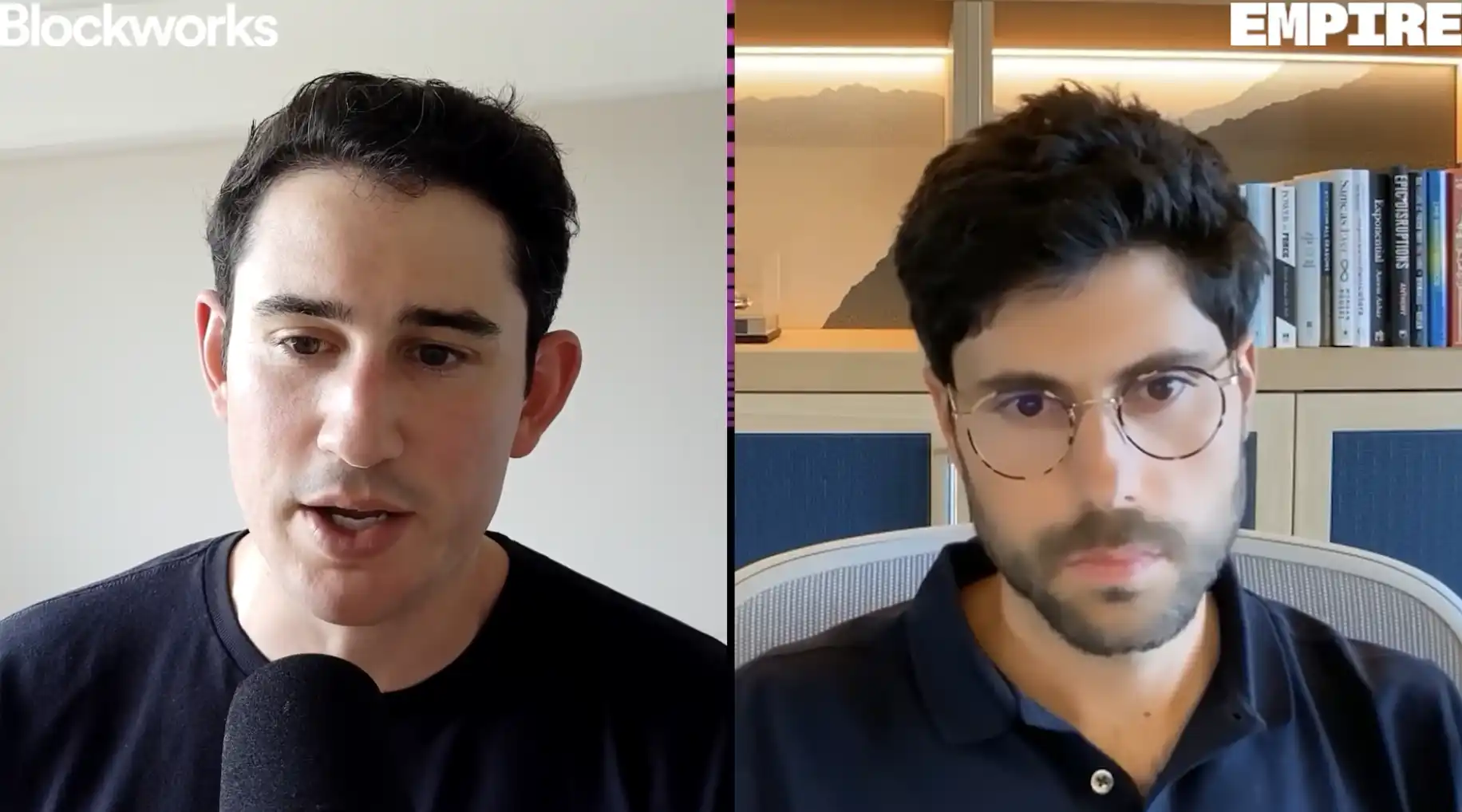
Empire Podcast hosts Jason Yanowitz and Santiago Santos discuss the surging institutional interest in Hyperliquid, a decentralized perpetual exchange, marking the highest level of engagement from traditional hedge fund managers since Paul Tudor Jones endorsed Bitcoin in 2020. The primary driver is the demand for weekend trading of commodities like oil, especially during geopolitical tensions such as the Iran conflict, as Hyperliquid provides the only active price discovery venue when traditional markets are closed. Trade XYZ, a front-end on Hyperliquid, has seen significant growth, with weekend oil price predictions having a median error of only 50 basis points. Santos predicts commodity trading volume on Hyperliquid will surpass Bitcoin within the year and that its market cap could rise from $25 billion to $100 billion. Other key points include Kraken raising $200 million at a reduced valuation of $13.3 billion, and the SEC clarifying that self-custodied DeFi frontends like MetaMask are not subject to broker-dealer rules, resolving a major regulatory uncertainty. The hosts also note the strong correlation between crypto and macro markets, with the S&P 500 posting one of its best 10-day rallies since 1950. They highlight MicroStrategy's continued Bitcoin acquisitions and the potential of real-world asset (RWA) tokenization as a key trend. The discussion concludes with skepticism towards many L2 projects, predicting a wave of protocols truly going to zero as capital concentrates in proven assets like Bitcoin and Hyperliquid.

marsbitHace 4 hora(s)

Podcast Notes: Hyperliquid Has Become the Top Interest Point for Traditional Hedge Funds

marsbitHace 4 hora(s)

a16z: The Next Frontier of AI, The Triple Flywheel of Robotics, Autonomous Science, and Brain-Computer Interfaces

a16z presents a comprehensive investment thesis for the next frontier of AI: Physical AI, centered on a synergistic flywheel of robotics, autonomous science, and novel human-computer interfaces (HCIs) like brain-computers. While the current AI paradigm scales on language and code, the most disruptive future capabilities will emerge from three adjacent fields leveraging five core technical primitives: 1) learned representations of physical dynamics (via models like VLA, WAM, and native embodied models), 2) embodied action architectures (e.g., dual-system designs, diffusion-based motion generation, and RL fine-tuning like RECAP), 3) simulation and synthetic data as scaling infrastructure, 4) expanded sensory channels (touch, neural signals, silent speech, olfaction), and 5) closed-loop agent systems for long-horizon tasks. These primitives converge to power three key domains: * **Robotics:** The literal embodiment of AI, requiring all primitives for real-world physical interaction and manipulation. * **Autonomous Science:** Self-driving labs that conduct hypothesis-experiment-analysis loops, generating structured, causally-grounded data to improve physical AI models. * **Novel HCIs:** Devices (AR glasses, EMG wearables, BCIs) that expand human-AI bandwidth and act as massive data-collection networks for real-world human experience. These domains form a mutually reinforcing flywheel: Robotics enable autonomous labs, which in turn generate valuable data for robotics and materials science. New interfaces provide rich human-physical interaction data to train better robots and scientists. Together, they represent a new scaling axis for AI, moving beyond the digital realm to interact with and learn from physical reality, promising significant emergent capabilities and value.

marsbitHace 4 hora(s)

a16z: The Next Frontier of AI, The Triple Flywheel of Robotics, Autonomous Science, and Brain-Computer Interfaces

marsbitHace 4 hora(s)

Trading

Spot
Futuros

Artículos destacados

Cómo comprar PUSH

¡Bienvenido a HTX.com! Hemos hecho que comprar Push Protocol (PUSH) sea simple y conveniente. Sigue nuestra guía paso a paso para iniciar tu viaje de criptos.Paso 1: crea tu cuenta HTXUtiliza tu correo electrónico o número de teléfono para registrarte y obtener una cuenta gratuita en HTX. Experimenta un proceso de registro sin complicaciones y desbloquea todas las funciones.Obtener mi cuentaPaso 2: ve a Comprar cripto y elige tu método de pagoTarjeta de crédito/débito: usa tu Visa o Mastercard para comprar Push Protocol (PUSH) al instante.Saldo: utiliza fondos del saldo de tu cuenta HTX para tradear sin problemas.Terceros: hemos agregado métodos de pago populares como Google Pay y Apple Pay para mejorar la comodidad.P2P: tradear directamente con otros usuarios en HTX.Over-the-Counter (OTC): ofrecemos servicios personalizados y tipos de cambio competitivos para los traders.Paso 3: guarda tu Push Protocol (PUSH)Después de comprar tu Push Protocol (PUSH), guárdalo en tu cuenta HTX. Alternativamente, puedes enviarlo a otro lugar mediante transferencia blockchain o utilizarlo para tradear otras criptomonedas.Paso 4: tradear Push Protocol (PUSH)Tradear fácilmente con Push Protocol (PUSH) en HTX's mercado spot. Simplemente accede a tu cuenta, selecciona tu par de trading, ejecuta tus trades y monitorea en tiempo real. Ofrecemos una experiencia fácil de usar tanto para principiantes como para traders experimentados.

190 Vistas totalesPublicado en 2024.12.13Actualizado en 2025.03.21

Cómo comprar PUSH

Discusiones

Bienvenido a la comunidad de HTX. Aquí puedes mantenerte informado sobre los últimos desarrollos de la plataforma y acceder a análisis profesionales del mercado. A continuación se presentan las opiniones de los usuarios sobre el precio de PUSH (PUSH).

活动图片