Is science fiction coming true?
In 2026, if you have been following the cutting edge of AI for Science, you would notice the entire direction has shifted. AI Agents stepping into real scientific laboratories is no longer just a plot in science fiction novels!
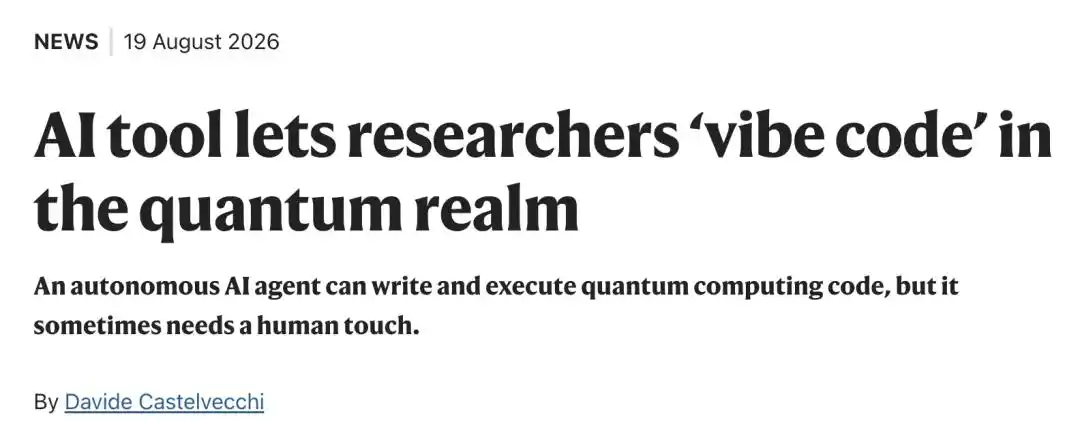
In August, Nature reported that quantum computing company Pasqal used AI tools to achieve "Vibe Coding" in the quantum field.
In the same month, Anthropic, in collaboration with Harvard-backed quantum computing company QuEra, dropped a bombshell: they actually made Claude learn to lock and adjust lasers inside a real quantum computer.
Then in September, OpenAI and MIT's EQuS lab grandly announced that the new GPT-5.6-Sol had been deeply integrated into the lab's software system, capable of autonomously running and iterating measurement experiments for superconducting quantum chips!
Clearly, AI is no longer the chatbot sitting behind a screen helping you modify code; it has grown "hands" and "eyes," personally operating expensive, precise, and fragile quantum hardware.
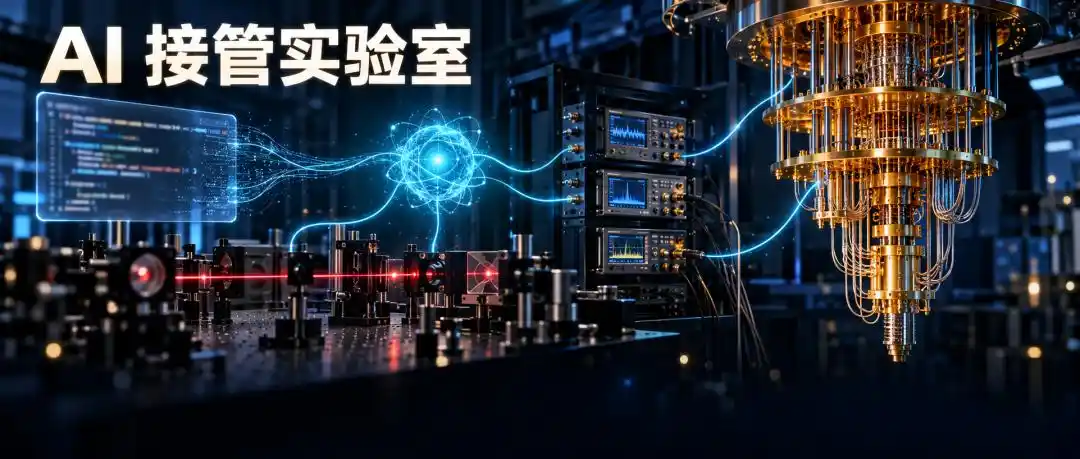
This is undoubtedly a stunning breakthrough.
However, would you really dare to use AI to operate a quantum laboratory?
If AI Conducts Experiments Itself, Is Looking at the Answer Enough?
Imagine the lab is empty tonight. You give the key to an AI Agent, letting it calibrate a quantum device worth tens of millions on its own.
The next morning, you return to the lab, and it hands you a report: parameters converged, metrics improved by 42%, mission accomplished.
Do you dare to believe it?
In real quantum engineering, every decision burns money.
Dilution refrigerator cool-down times are counted in days, laser lifetimes degrade by the hour, and quantum bit coherence times are fragile, lasting only tens of microseconds.
One "blind guess" or "reckless confidence" from an Agent could cost an entire batch of chips scrapped or months of a team's hard work turning to dust.
So the problem isn't "did it get the final answer right."
The real question to ask is: Did it perform the necessary experiments? Did it understand the data it just obtained? Would it keep randomly exploring after already having the answer, exhausting the precious experimental budget? Is the conclusion it provides actually supported by the evidence it truly gathered?
In a chat window, AI's hallucinations at most lead to an absurd reply. But if it gains control of physical equipment, hallucinations turn into real physical consequences.
From "can get it right once" to "dare to put it in the laboratory," there's still an abyss in between.
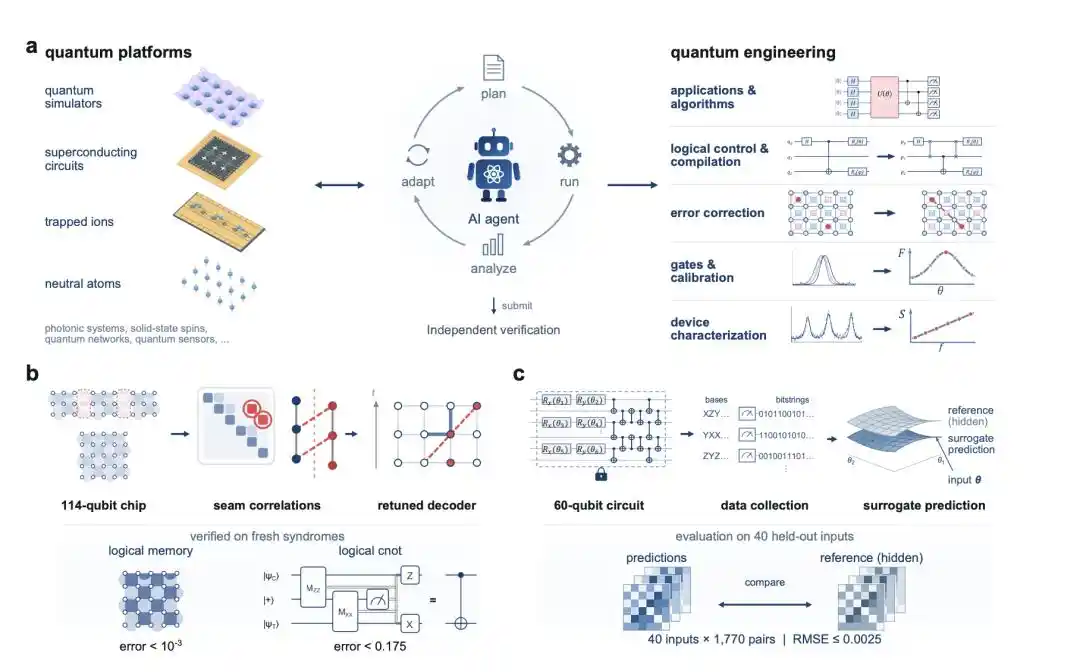
This is the biggest hidden danger in current Agent for Quantum: "can do it once" absolutely does not equal "can reliably complete it."
For agents, capability is not the bottleneck; reliability is.
Agents understand physics, yet they can still believe outdated calibrations, choose poor measurement methods, or draw conclusions beyond the actual scope of their measurements.
To address this, a joint research team from NUS, NTU, and other institutions, along with GaugeForge, proposed a key core concept: Verified Autonomy.
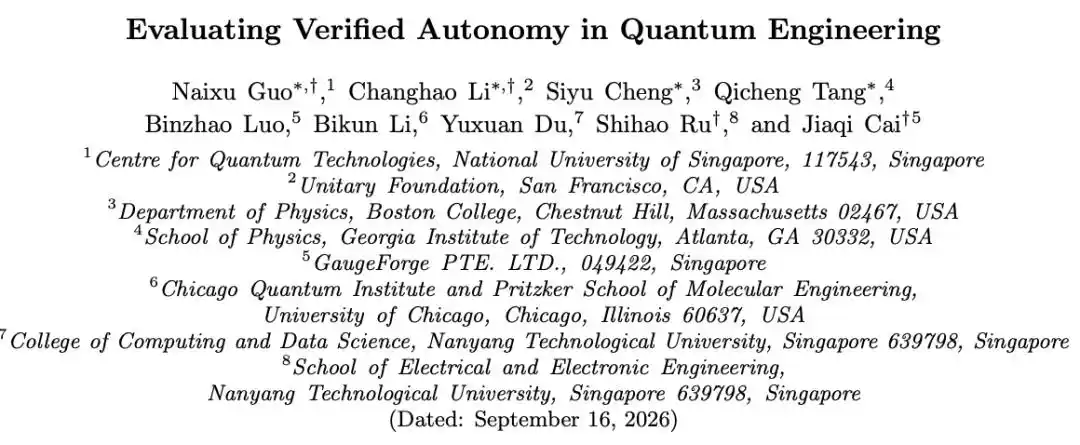
Link:https://arxiv.org/abs/2609.17439
Essentially, don't tell me how much quantum mechanics you know; hand over your lab notebook! Your conclusions must be supported by evidence you actually obtained during the execution process.
To answer this question, a team composed of top experts from fields like quantum computing directly "replicated" a virtual quantum laboratory in cyberspace at 1:1 scale—Quantum-Harbor!
Then, armed with 49 real quantum engineering tasks, they launched an extreme "stress test" against the world's 17 strongest AI Agents.
Welcome to the Virtual Quantum Lab: Testing AI's True Capabilities!
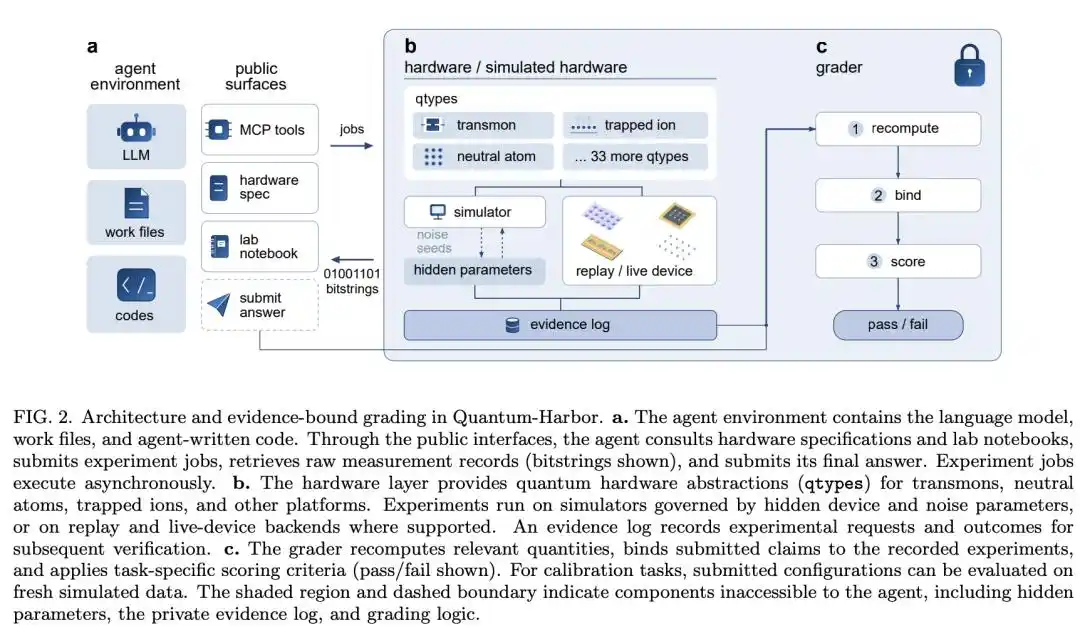
Quantum-Harbor is a fully interactive virtual quantum engineering laboratory with physical dynamics and real feedback.
In this lab, the AI Agent sees no trace of an exam; it thinks it's actually at work.
The Agent no longer faces just a problem, but a dynamic environment with states, instrument panels, and measurement APIs.
The Agent can consult hardware manuals, flip through experimental notebooks left by predecessors, call commonly used libraries like Qiskit or QCoDeS to write experimental code, and finally submit tasks to the backend quantum device.
But behind this public interface hides an extremely strict "ghost mentor"—the Sidecar isolation container. Inside runs a highly simulated quantum hardware (e.g., superconducting transmon, neutral atom arrays, etc.), containing hidden parameters unknown even to the AI: coherence times, anharmonicity, readout confusion matrices, noise correlations, etc.
Alongside this environment, the team launched QIQCBench—49 real engineering tasks designed by senior quantum engineers, covering everything from low-level hardware control and microwave pulse design, to mid-level quantum error correction decoder calibration, and high-level 60-qubit quantum proxy model optimization.
The tasks span multiple levels of quantum engineering: measurement and characterization, control, error correction, compilation, simulation, perception.
For each task assigned, the Agent has only limited time and budget. It must decide for itself:
1. What should be measured first?
2. What physical phenomenon does this jumbled set of experimental data represent?
3. Should it continue measuring or adjust the strategy?
4. When should it stop and submit the final result?
For example, in measurement and characterization, you need to figure out what the device actually is, but hardware drifts, and no one hands you the parameters directly.
The agent needs to design its own measurement schemes, fit observed decay curves, and report numerically sound values it can stand by.
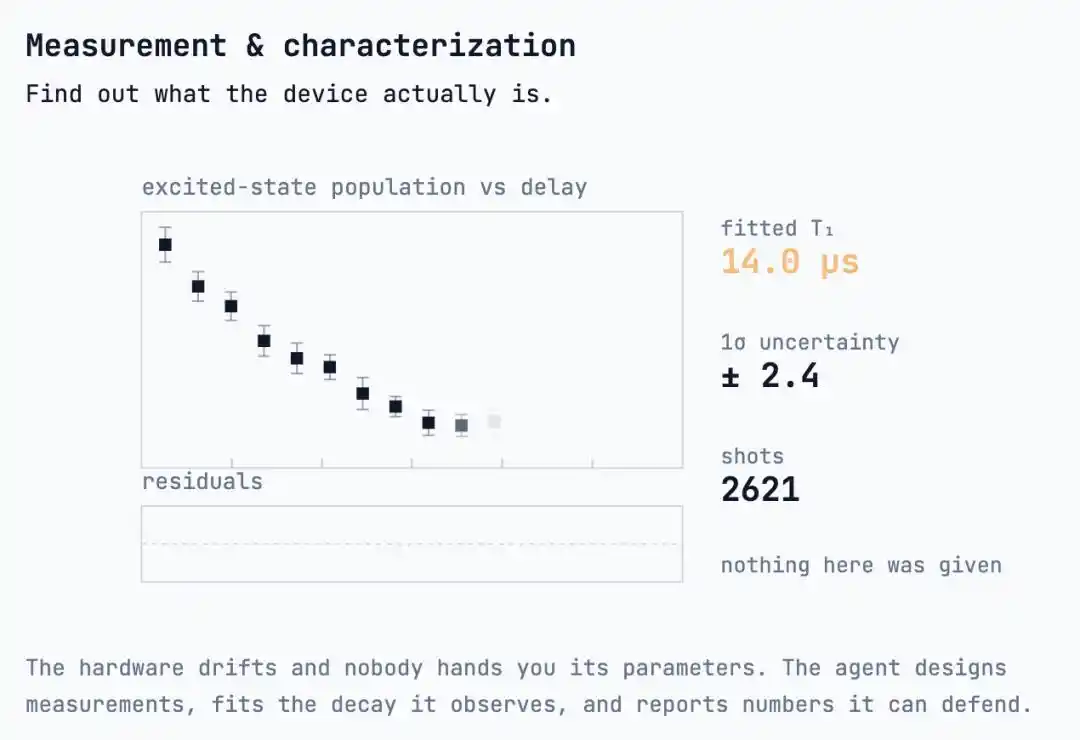
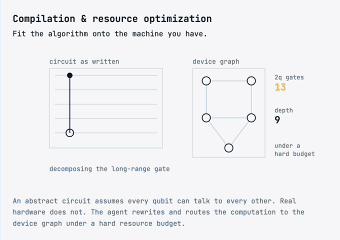
Another example: abstract circuits assume each qubit can communicate with any other. But real hardware isn't like that.
The agent needs to rewrite and route the computational process under a strict resource budget to adapt it to the device connectivity graph.
Each task maps to five layers of the quantum computing stack: application & algorithm, logic & compilation, error correction, gate & calibration, and physical device.
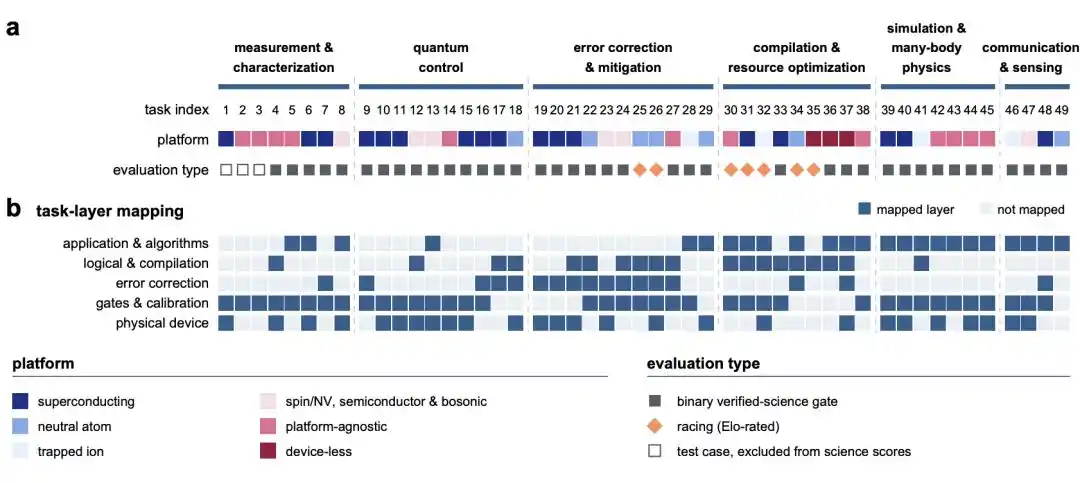
QIQCBench task composition and quantum computing stack coverage. a. The 49 tasks are grouped into six scientific categories. Each column represents one task. b. Mapping of each task to the five layers of the quantum computing stack.
The most subversive aspect of this evaluation is that it no longer just looks at the final answer but proposes a brand-new judging standard: verifiable autonomy.
It adopts the most ruthless scoring mechanism—Evidence-bound grading.
When the Agent submits final calibration parameters or prediction models, the "ghost mentor" doesn't even look at how flowery the report is. The system directly checks its "underlying execution logs" and reruns its solution on a completely new, hidden dataset.
Simply put, it checks three things:
1. Trace Verification: Are the conclusions given by the AI truly supported by the data it collected in its historical steps?
2. Logical Consistency: Did it blindly continue consuming the experimental budget after already reaching the optimal solution?
3. Hidden Environment Verification: Throw the strategy it tuned into a completely new, unseen physical noise background for blind testing—only results that withstand the test of physical robustness truly pass.
If conclusions were reached by rote memorization, hallucinations, or blindly copying online code, they would be exposed here.
17 Top Agents Melee: Some Stunning, Some Failing "Very Human-Like"
Next, the team placed 17 of the world's smartest Agent systems into the experimental environment, including OpenAI's GPT-5.6 series, DeepSeek -V4 series, Anthropic's Claude Opus/Haiku, and domestic models like Qwen , Hunyuan, Kimi , Zhipu GLM, ByteDance Seed, etc.
These large models were thrown into real quantum research workflows, and dramatic scenes unfolded!
The pass rate on the leaderboard plummeted from a high of 78% down to 3%; the originally smooth capability curve was instantly torn apart.
Clearly, top models that were neck-and-neck on various general benchmarks, once encountering the tough nut of quantum physics requiring logical chains and verified autonomy, immediately showed huge gaps, and the disparity was stark.
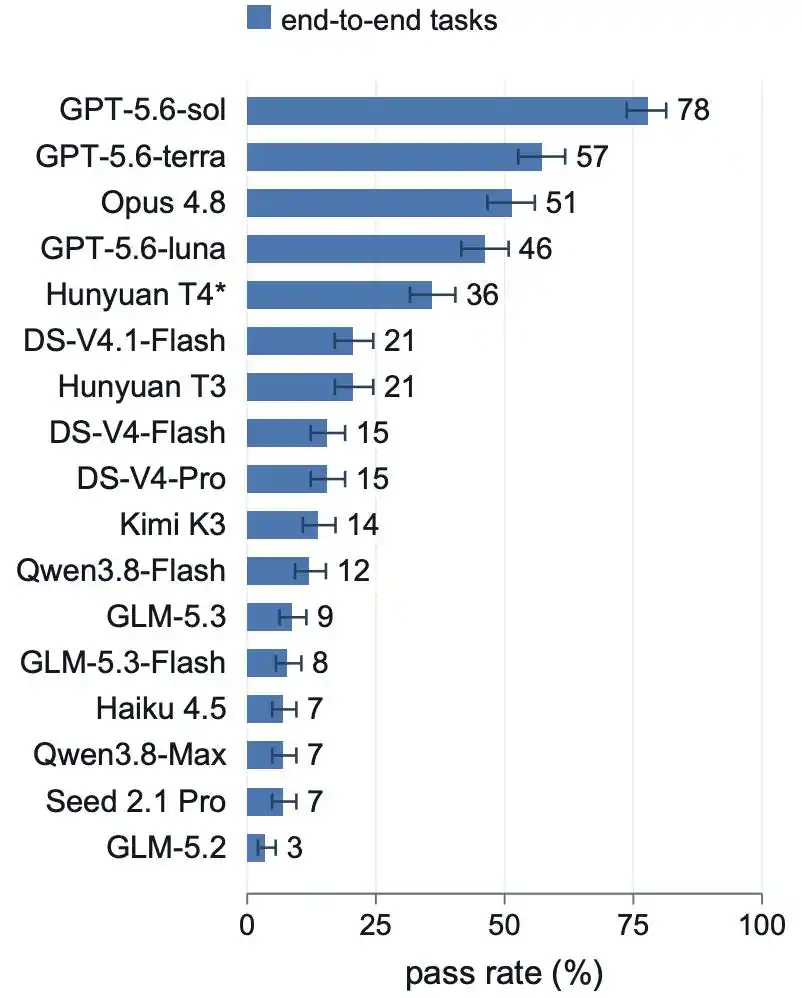
In short, this process saw moments of AI displaying god-like operations, as well as many laughable yet "very realistic mistakes an experimentalist might make" failure cases.
Let's look at a few specific task examples.
Case 1: Lattice Surgery and "Outdated Lab Notes"
Lattice surgery is a core operation in fault-tolerant quantum computing. Simply put, the AI needs to "stitch" several independent surface code "patches" together to implement a logical CNOT gate.
In this task, the team planted a trap. They deliberately placed "predecessor" data in the lab's Notebook, recording memory measurement results for individual patches. But in reality, when patches are stitched, boundaries generate complex correlated noise, which is absolutely absent in the old data.
Human novices often blindly trust outdated Notebooks, directly using old parameters to run the logical gate, only to be blown to pieces by correlated noise.
However, the strongest Agent keenly sensed that "stitching might introduce new noise." It decisively discarded prior conclusions, took the initiative to re-measure in the fused state, extracted the true noise correlations, and successfully retuned the decoder.
Ultimately, on a brand-new hidden validation set, it suppressed the per-cycle memory error rate to an extremely excellent 6.65×10⁻⁴!
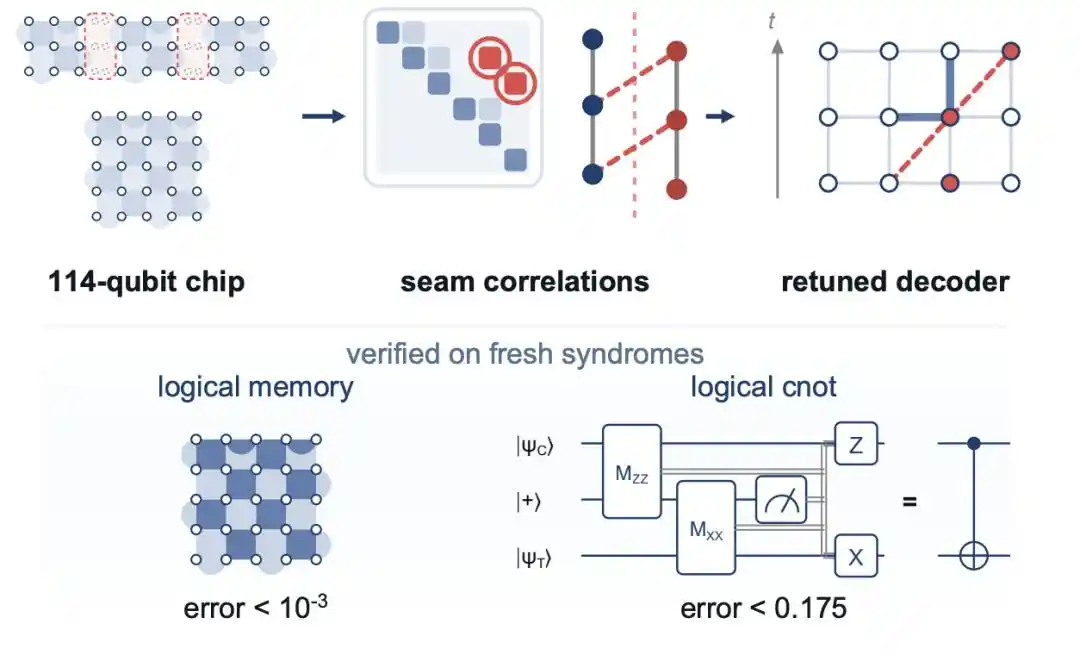
Top Agents can autonomously identify the new correlated noise generated at stitching boundaries (outlined by red dotted circles), instead of blindly trusting outdated lab notes.
Case 2: AIs Driven Mad by a 60-Qubit "Black Box"
In this task, the AI faces an unknown system with 60 quantum bits, controlled by 6 independent parameters. It has a fixed experimental budget and, after measurements, must predict 1770 two-bit correlations for 40 new and hidden input parameters.
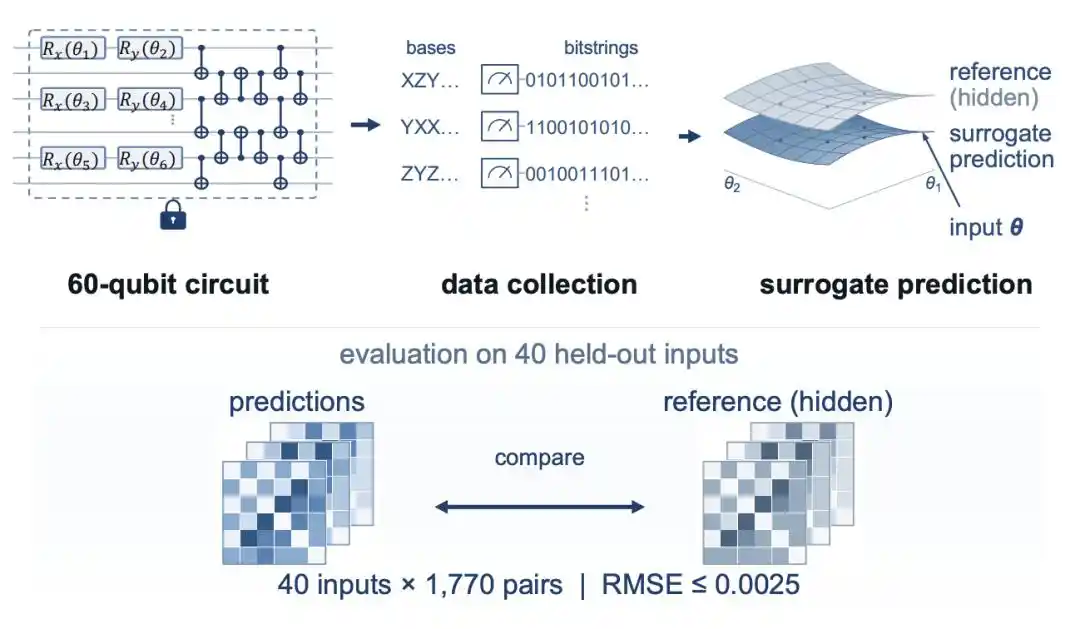
In this task, which severely tests "spending money where it matters most," a large number of Agents crashed and burned!
Some Agents engaged in "brainless sampling," wasting all their budget in uninformative parameter spaces, leaving no money to measure crucial data.
Some Agents were "overconfident," measuring a tiny bit and thinking they grasped the truth, resulting in completely off predictions on new data.
Other Agents fell into crazy infinite loops, stuck in a dead end of some code error, until they exhausted the entire 3-hour time budget, finally submitting a blank answer.
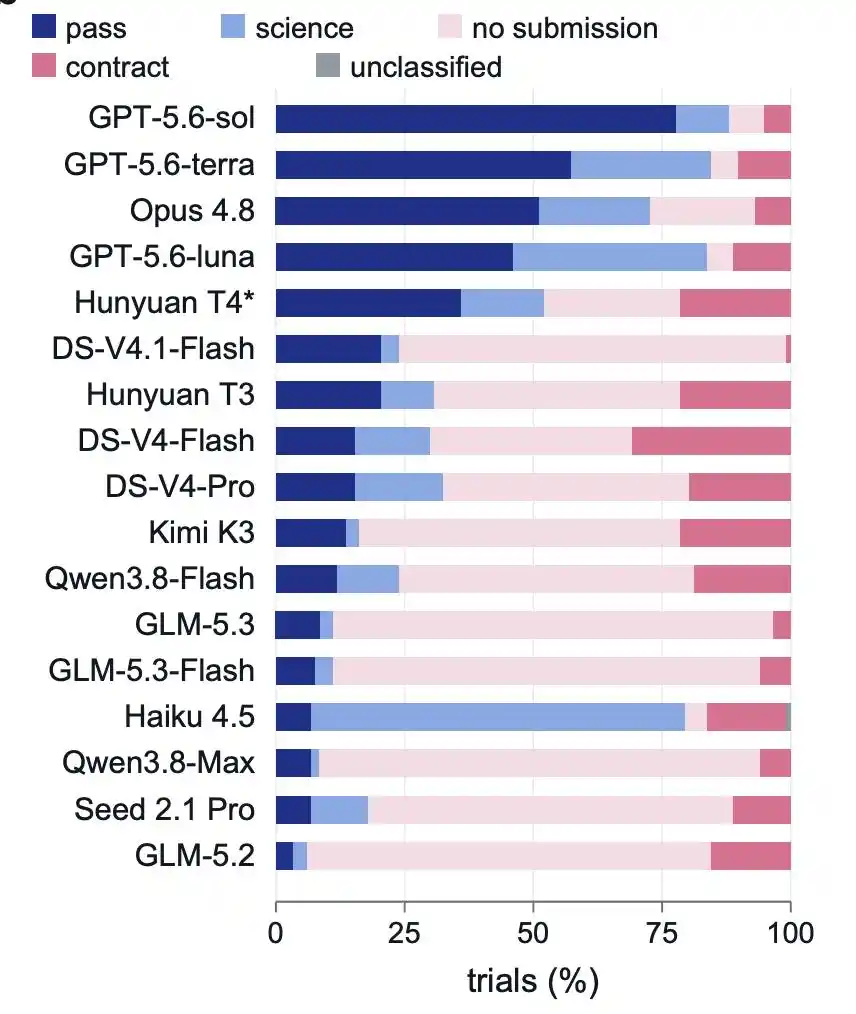
During testing, up to hundreds of failures were due to Agents exhausting their budget or falling into infinite loops (large red areas in the chart). It knows how to write code but doesn't know how to conduct experiments.
Statistics show that out of a total of 1510 failures, a staggering 937 were because the Agent got stuck in an infinite loop or ran out of budget and failed to submit. They didn't crash; they behaved like "miserable graduate students" who had pulled three all-nighters, their brains no longer working but still frantically running code.
Among the remaining failures, 54% were because the physical conclusions they submitted couldn't withstand cross-validation at all.
"These large models are already smart enough to understand complex quantum physics formulas; but precisely because they are so powerful, the 'unreliability' they expose when facing real resource constraints and unknown conditions deserves our serious scrutiny."
Case 3: The "Simulation & Many-Body Physics" Massacre—The Chasm Between Solving Problems and Understanding Physics
This is also a group failure case.
The task background is many-body physics and dynamics inference.
This isn't a single task but a broad category (including inferring hidden Hamiltonians, open system dynamics, etc.). This category isn't limited to calling simple measurement and control APIs; it requires the Agent to truly understand the underlying physical laws.
The results are shocking. One could say this is the bloodiest arena in the entire QIQCBench! According to the data, the average pass rate for the entire many-body physics category is a pitiful 15%.
Even more stunning is the chasm between models: the top three systems achieved a 64% pass rate in this devilish arena; the remaining 14 cutting-edge models combined had a pass rate of only 4%!
This means if you casually pick a model with "extremely strong coding ability" to infer many-body physical systems, it will most likely be completely wiped out.
This extreme polarization proves one point: rote memorizing quantum computing textbook knowledge and performing scientific inference in unknown dynamic systems are completely different dimensions of intelligence.
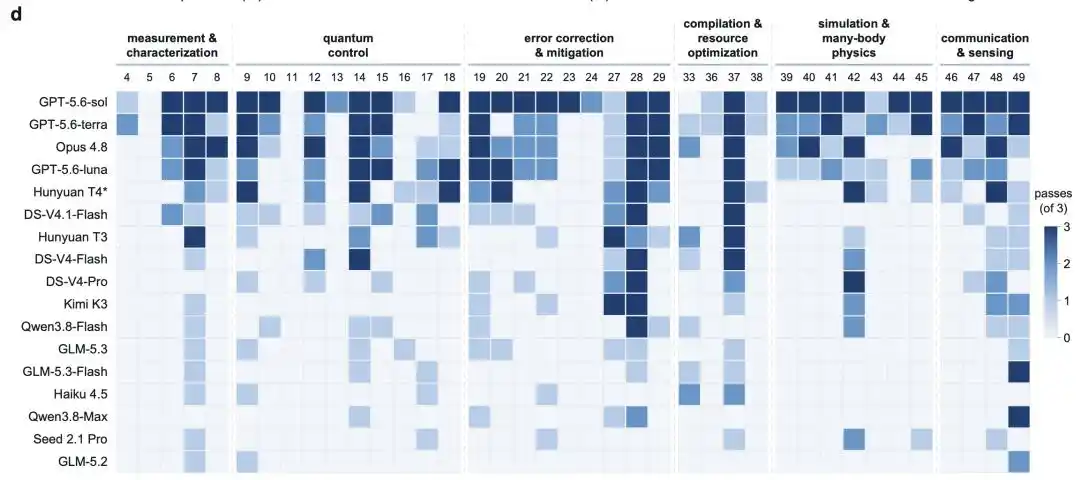
In the screenshot, darker colors represent higher pass rates. Apart from the top three systems (dark blue), the subsequent 14 large models are almost uniformly light-colored (wiped out).
Why Does This Chasm Determine the Life or Death of AI for Science?
Why can large models generate a seemingly perfect quantum algorithm in seconds, yet stumble frequently in real engineering environments? The answer lies in the mapping gap between the linguistic space and the laws of physics.
But in the physical world, the essence of scientific discovery isn't memorizing knowledge; it's exploring the unknown.
Faced with unknown physical entities, the scientific loop is extremely rigorous:
Formulate Hypothesis -> Experimental Observation -> Falsify/Confirm -> Iterate Strategy.
If any link in this chain breaks, the edifice of science collapses.
This is precisely the problem "verified autonomy" aims to solve:
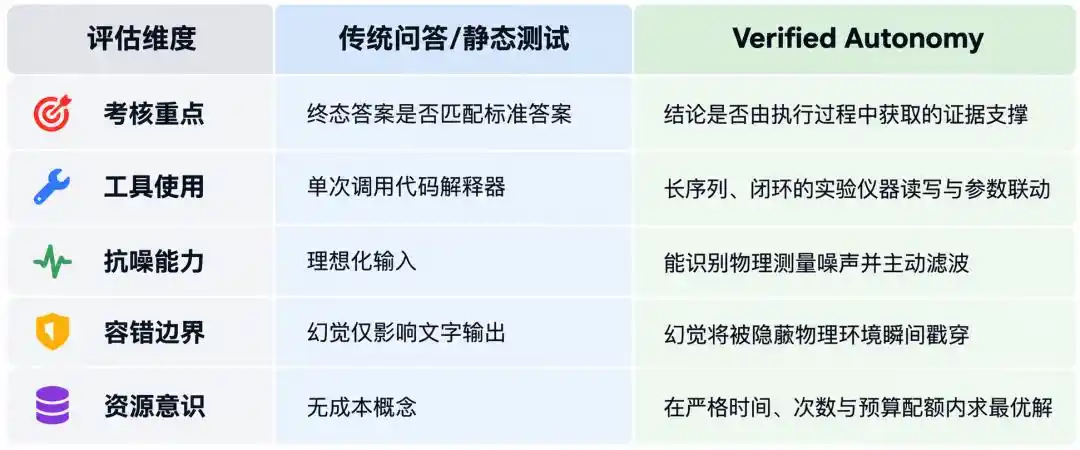
The physical world doesn't believe in coincidence, let alone hallucinations without experimental evidence.
If it cannot be proven that every parameter change of the Agent is traceable, every strategy adjustment is supported by data, then no matter how impressive the results it produces, they can only be seen as academic accidents, unable to solidify into robust engineering productivity.
The Gauntlet is Thrown: Virtual Lab Opens Globally
Returning to the opening question: Today, do we dare to hand the quantum lab keys to AI? Can AI really conduct autonomous research?
Through the Quantum-Harbor and QIQCBench tests, the answer is clear: Not yet. But, the dawn before daybreak has appeared.
The stunning performance of leading models proves that autonomous quantum engineering is entirely feasible both physically and logically; what's lacking is further evolution in complex decision-making and resource management.
The significance of Quantum-Harbor and QIQCBench isn't about giving a ranking list, but about drawing a baseline for the practical capabilities of AI Agents in the domain of extreme precision science for the first time.
But this is just the beginning.
To let more people get hands-on with this real chasm, the team announced: The virtual experimental environment and evaluation suite around QIQCBench will be open-sourced to the community and academia, and the "Agentic Quantum Coding Challenge" officially begins!
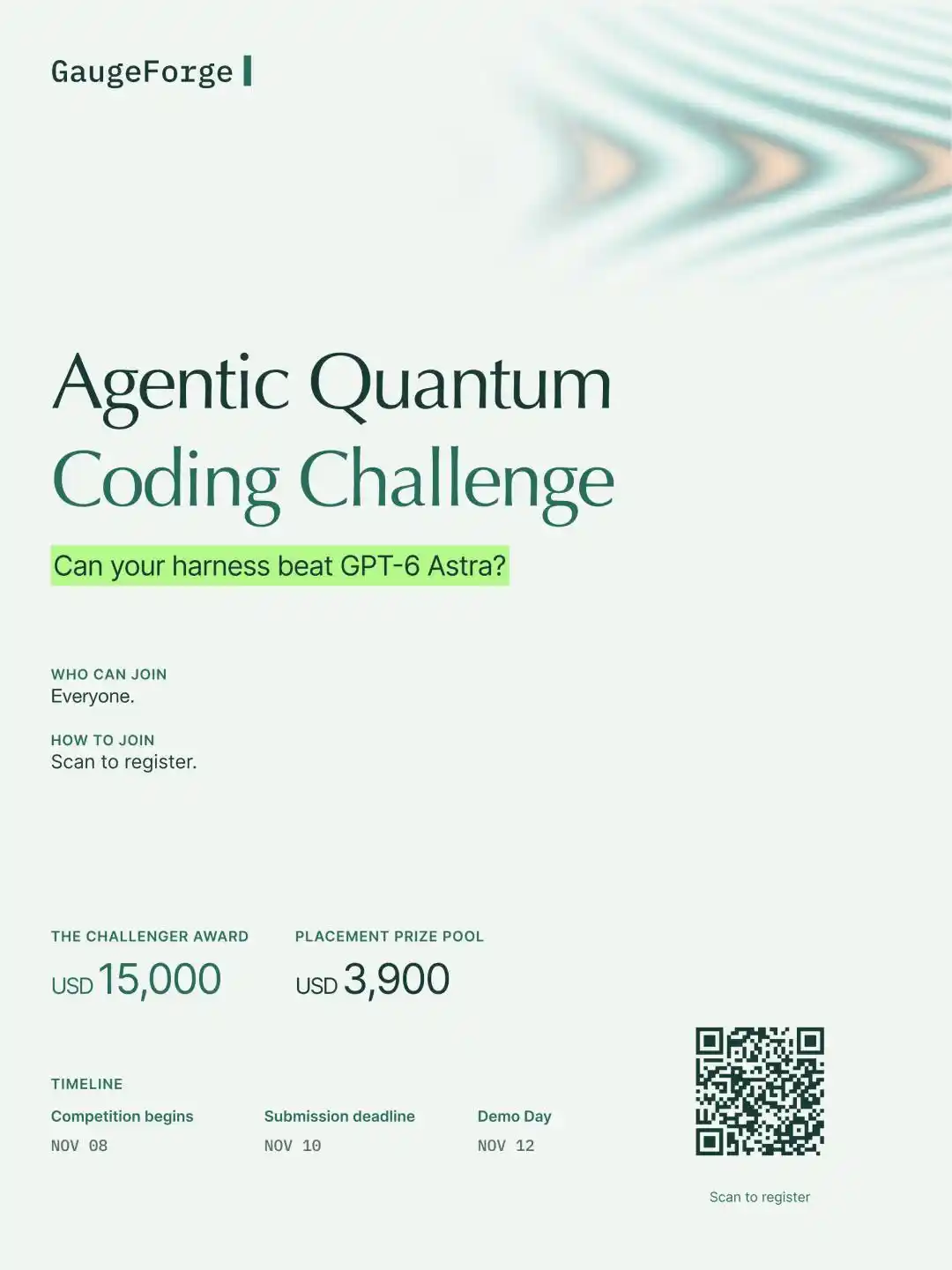
Link:https://gaugeforge.github.io/qiqc-challenge/
Whether you are an AI geek delving into long-range planning for large models, a quantum physics scholar in the lab, or an interdisciplinary team dedicated to AI for Science, this will be an unprecedented extreme offensive and defensive battle.
Can your Agent maintain rationality under stringent compute and interaction budgets?
Can it identify traps and find optimal solutions in physical feedback full of noise?
Can the control trajectory it provides withstand the blind test of the hidden physical world?
The door to the real physical world has been pushed open.
Let's see which model can turn the key to the future quantum laboratory.
This article is from the WeChat public account "AI_era" (ID: AI_era), author: ASI Revelation; Editor: Aeneas David