Bitcoin Rally Likely A Relief Bounce, Not New Bull Phase: CryptoQuant

bitcoinistPublished on 2026-03-07Last updated on 2026-03-07

Abstract

On-chain analytics firm CryptoQuant states that the recent Bitcoin rally is likely a relief bounce rather than the start of a new bull market. Its Bull Score Index, which aggregates signals from ten on-chain metrics, remains deep in bearish territory with a value of only 10. This indicates that just one of the ten indicators is currently bullish. Despite Bitcoin's price surge above $70,000, the index has consistently remained at or below 20 for months, having previously dropped to zero in late November. CryptoQuant concludes that Bitcoin market conditions are still bearish. In separate news, analytics firm Santiment reported that the number of non-empty Bitcoin addresses has reached a new all-time high of 58.45 million, growing 3% in the last six months. After a high near $74,000, Bitcoin's price has since retraced to around $70,500.

On-chain analytics firm CryptoQuant has highlighted how its Bull Score Index is deep inside the bearish territory despite the latest Bitcoin price rally.

Bitcoin Bull Score Index Has A Value Of Just 10 Right Now

In a new post on X, on-chain analytics firm CryptoQuant has discussed the latest trend in the Bull Score Index for Bitcoin. This metric basically contains information about the phase of the cycle that BTC is currently inside.

The indicator makes use of some of the most popular on-chain metrics to calculate its value. The list of the indicators covered by the Bull Score Index include the likes of MVRV Z-Score, CryptoQuant P&L Index, and Stablecoin Liquidity. In total, the metric accounts for the data of ten indicators, with its value representing the number of these that are giving a bullish signal for the BTC network right now. For example, the Bull Score Index having a value of 40 implies four of the metrics are bullish.

Now, here is the chart shared by the analytics firm that shows how the Bitcoin Bull Score Index has fluctuated over the last year and a half:
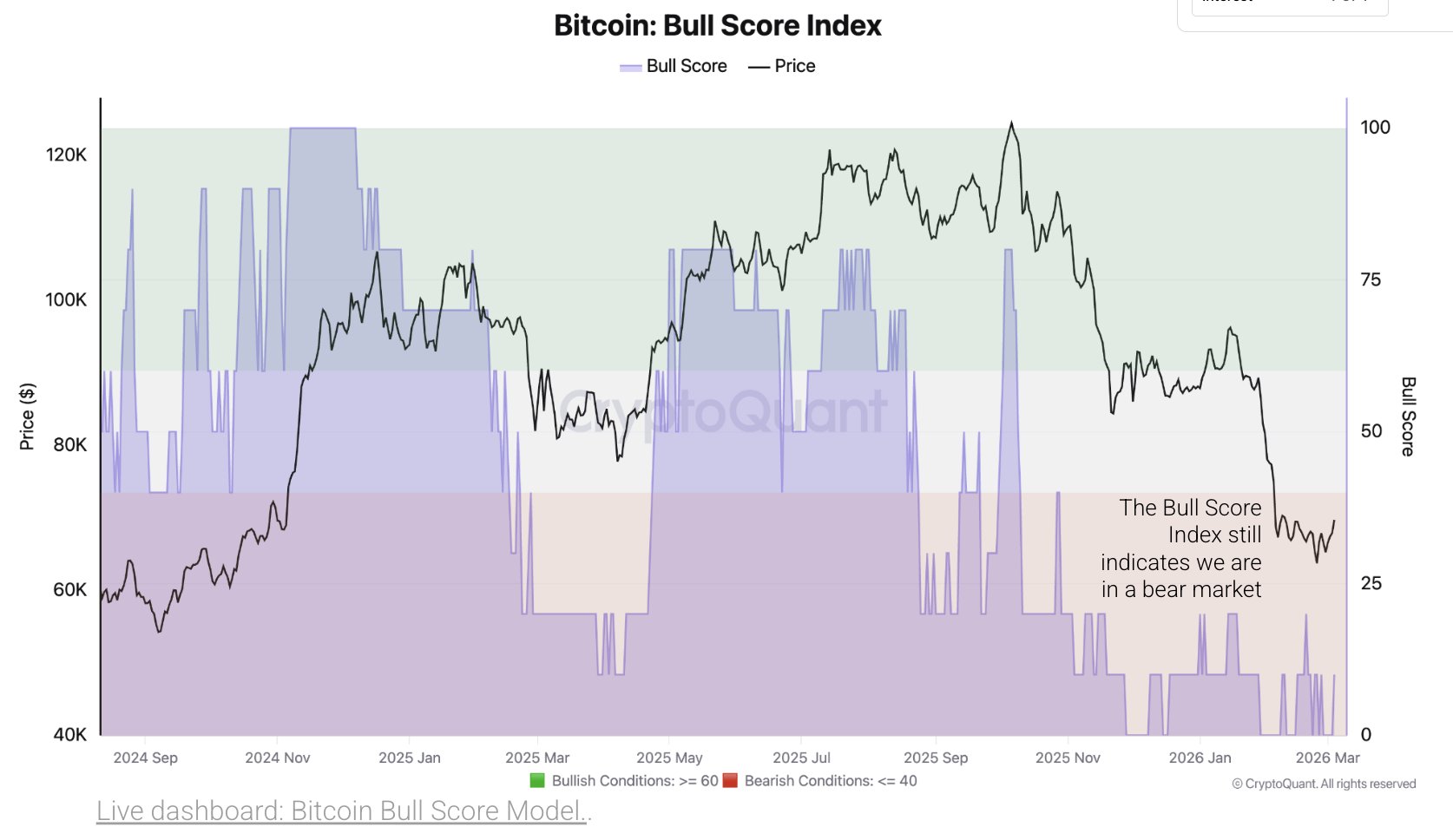
Looks like the value of the index has been low in recent months | Source: CryptoQuant on X

As displayed in the above graph, the Bitcoin Bull Score Index saw a spike above the 60 level back in October 2025 as the BTC price rallied to a new all-time high (ATH). This suggests that the majority of the indicators were giving a green signal.

The market unwind that followed the price surge, however, caused the Bull Score Index to plummet back into the zone below 40, corresponding to bearish conditions in the sector. By late November, the bearish signal had become so strong that the index had dropped to a value of zero.

Since then, there hasn’t been any notable improvement in the indicator, with its value consistently remaining at or below 20. This hasn’t changed after the latest rally above the $70,000 level, either, as the index is still sitting at the 10 mark, implying only one metric is currently giving a bullish signal.

“Bitcoin is still in a bear market despite the recent rally,” noted CryptoQuant. “The current move is likely just a relief rally, not the start of a new bull phase.” It now remains to be seen how much longer the Bull Score Index will remain inside the bearish zone.

In some other news, the Bitcoin network has seen its userbase reach a new height recently, as on-chain analytics firm Santiment has highlighted in an X post.
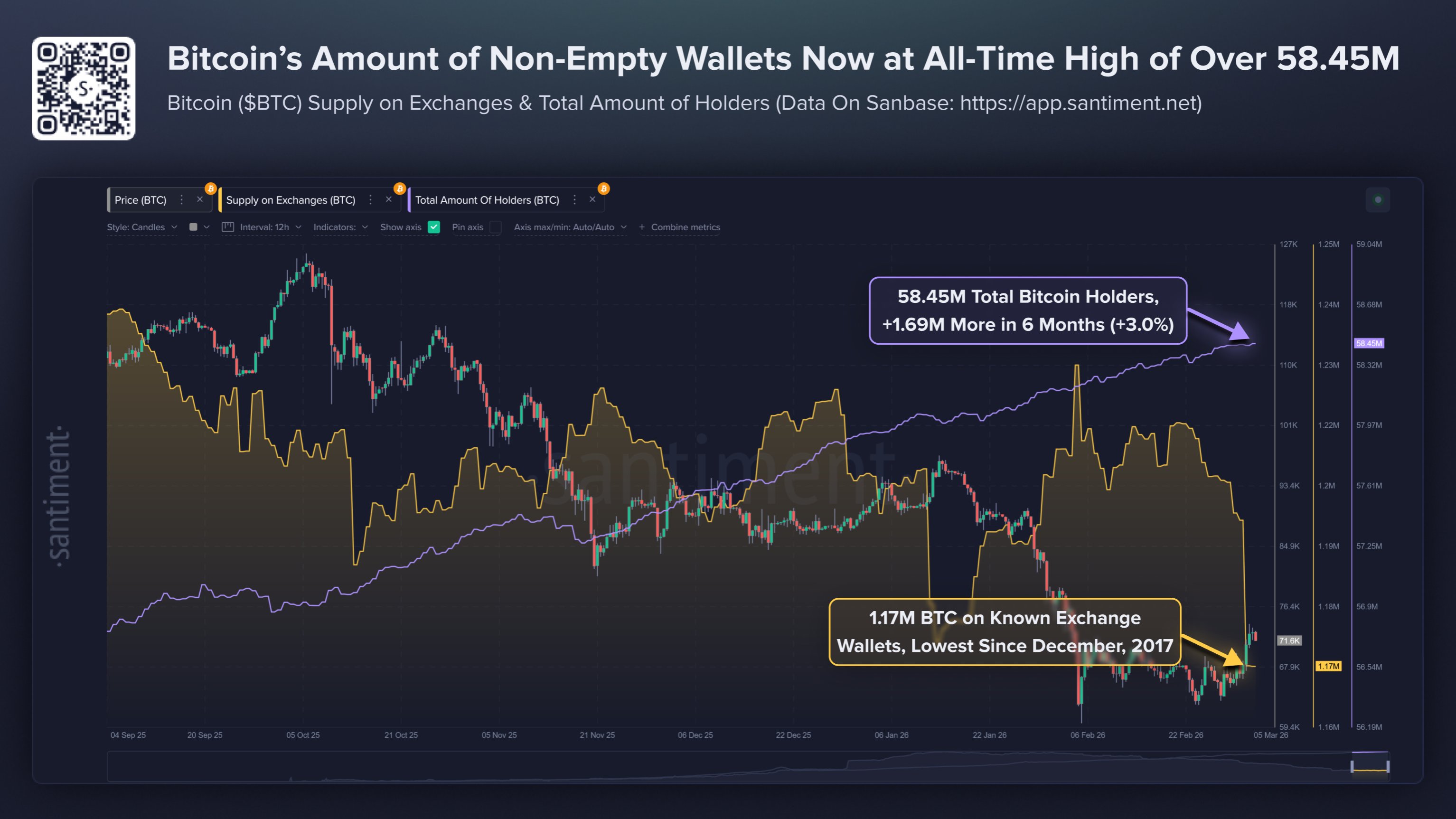
How the total number of holders on the BTC network has changed over the last few months | Source: Santiment on X

From the above chart, it’s visible that non-empty addresses on the Bitcoin network have jumped 3% over the last six months, taking their total count to a new ATH of 58.45 million.

BTC Price

Bitcoin climbed toward $74,000 on Wednesday, but the bullish momentum has cooled off since then as the asset has returned to $70,500.

The trend in the price of the coin over the last five days | Source: BTCUSDT on TradingView

Related Questions

QWhat is the current value of Bitcoin's Bull Score Index according to CryptoQuant, and what does it indicate?

AThe current value of Bitcoin's Bull Score Index is 10, which indicates that only one out of the ten on-chain metrics it tracks is giving a bullish signal, suggesting the market is still in a bearish phase.

QWhat does CryptoQuant conclude about the nature of the recent Bitcoin price rally above $70,000?

ACryptoQuant concludes that the recent rally is likely just a relief bounce and not the start of a new bull phase, as the Bull Score Index remains deep in bearish territory.

QWhich on-chain metrics are used to calculate the Bull Score Index? (Name at least two mentioned in the article)

AThe Bull Score Index uses metrics including the MVRV Z-Score, CryptoQuant P&L Index, and Stablecoin Liquidity, among a total of ten indicators.

QWhat new milestone has the Bitcoin network recently achieved regarding its userbase, as reported by Santiment?

AAccording to Santiment, the number of non-empty Bitcoin addresses has reached a new all-time high of 58.45 million, marking a 3% increase over the last six months.

QWhat was the highest price level Bitcoin approached during its recent rally before pulling back?

ABitcoin climbed toward $74,000 during its recent rally before the bullish momentum cooled off and the price returned to around $70,500.

Related Reads

12 Potential Startup Directions in the AI and Blockchain Space

The convergence of AI and blockchain is enabling a new economic paradigm dominated by "Money Machines"—autonomous software systems that operate 24/7, create value, and grow with minimal human intervention. These systems, powered by programmable value (blockchain) and programmable decisions (AI), represent the next industrial revolution, scaling human potential through autonomous capital. Key infrastructure enabling this shift includes stablecoins, tokenized assets, decentralized identity, and on-chain financial protocols. The article outlines 12 promising startup directions at this intersection: 1. **Agent Equity & Investment Banking**: Capitalizing AI systems via partial ownership, revenue-sharing tokens, and on-chain DAOs. 2. **Compute Exchanges & Markets**: Financial infrastructure for GPU capacity trading (e.g., futures, options). 3. **Liquidity Operating Systems**: Programmable short-term liquidity for cross-border payments and stablecoin conversions. 4. **Agent Service Marketplaces**: Platforms for monetizing expertise (e.g., legal, research) via deployable AI agents. 5. **Agent Identity & Reputation**: Decentralized identity and verifiable credentials for AI agents. 6. **Yield-as-an-API**: Programmable, real-time yield generation for software-managed capital. 7. **Credit Infrastructure**: Non-human lending primitives using stablecoins and smart contracts. 8. **Compliance for Tokenized Securities**: KYC/AML layers for seamless, regulation-compliant tokenized asset flows. 9. **Agent Payment Controls**: Programmable spending limits and approvals for autonomous transactions. 10. **Stablecoin Treasury Management**: Automated tools for corporate crypto/fiat treasury optimization. 11. **Cross-Chain Settlement & Interoperability**: Chain-agnostic execution and liquidity routing for agents. 12. **Data Monetization & Provenance Networks**: Decentralized data markets with micro-payments and usage tracking. These areas highlight the infrastructure needed for an internet-native financial system where autonomous agents dominate economic activity.

marsbit38m ago

12 Potential Startup Directions in the AI and Blockchain Space

marsbit38m ago

Circle Doubles in a Month: What Is the Market Betting On?

Circle's stock (CRCL) has experienced significant volatility, doubling in February 2025 after a sharp post-IPO decline. This surge occurred while Bitcoin fell 40%, indicating a decoupling from the broader crypto market. The key driver is a fundamental shift in how the market values Circle and its USDC stablecoin. Previously viewed as a cyclical crypto play, USDC's growth accelerated during the bear market, with its circulating supply rising 72% to a record $753 billion. This growth is increasingly driven by traditional finance and global payments, not speculative crypto trading. Major partnerships with Visa, Mastercard, JPMorgan, and Intuit are embedding USDC into mainstream payment infrastructure. The passage of the GENIUS Act in July 2025 provided a federal regulatory framework, creating a moat for compliant issuers like Circle and helping USDC gain market share against USDT. USDC also surpassed Tether in on-chain transaction volume. A major future growth narrative centers on AI Agent payments. Circle and others are developing infrastructure for machine-to-machine transactions, offering 24/7 settlement at a fraction of the cost of traditional systems. While current non-interest revenue from these new use cases remains under 5% of total revenue, the potential market is vast, with predictions of a multi-trillion-dollar stablecoin and AI Agent economy by 2030. Circle's $23 billion valuation largely bets on this future narrative becoming reality.

marsbit1h ago

Circle Doubles in a Month: What Is the Market Betting On?

marsbit1h ago

Trading

Spot
Futures

Hot Articles

What is $BITCOIN

DIGITAL GOLD ($BITCOIN): A Comprehensive Analysis Introduction to DIGITAL GOLD ($BITCOIN) DIGITAL GOLD ($BITCOIN) is a blockchain-based project operating on the Solana network, which aims to combine the characteristics of traditional precious metals with the innovation of decentralized technologies. While it shares a name with Bitcoin, often referred to as “digital gold” due to its perception as a store of value, DIGITAL GOLD is a separate token designed to create a unique ecosystem within the Web3 landscape. Its goal is to position itself as a viable alternative digital asset, although specifics regarding its applications and functionalities are still developing. What is DIGITAL GOLD ($BITCOIN)? DIGITAL GOLD ($BITCOIN) is a cryptocurrency token explicitly designed for use on the Solana blockchain. In contrast to Bitcoin, which provides a widely recognized value storage role, this token appears to focus on broader applications and characteristics. Notable aspects include: Blockchain Infrastructure: The token is built on the Solana blockchain, known for its capacity to handle high-speed and low-cost transactions. Supply Dynamics: DIGITAL GOLD has a maximum supply capped at 100 quadrillion tokens (100P $BITCOIN), although details regarding its circulating supply are currently undisclosed. Utility: While precise functionalities are not explicitly outlined, there are indications that the token could be utilized for various applications, potentially involving decentralized applications (dApps) or asset tokenization strategies. Who is the Creator of DIGITAL GOLD ($BITCOIN)? At present, the identity of the creators and development team behind DIGITAL GOLD ($BITCOIN) remains unknown. This situation is typical among many innovative projects within the blockchain space, particularly those aligning with decentralized finance and meme coin phenomena. While such anonymity may foster a community-driven culture, it intensifies concerns about governance and accountability. Who are the Investors of DIGITAL GOLD ($BITCOIN)? The available information indicates that DIGITAL GOLD ($BITCOIN) does not have any known institutional backers or prominent venture capital investments. The project seems to operate on a peer-to-peer model focused on community support and adoption rather than traditional funding routes. Its activity and liquidity are primarily situated on decentralized exchanges (DEXs), such as PumpSwap, rather than established centralized trading platforms, further highlighting its grassroots approach. How DIGITAL GOLD ($BITCOIN) Works The operational mechanics of DIGITAL GOLD ($BITCOIN) can be elaborated on based on its blockchain design and network attributes: Consensus Mechanism: By leveraging Solana’s unique proof-of-history (PoH) combined with a proof-of-stake (PoS) model, the project ensures efficient transaction validation contributing to the network's high performance. Tokenomics: While specific deflationary mechanisms have not been extensively detailed, the vast maximum token supply implies that it may cater to microtransactions or niche use cases that are still to be defined. Interoperability: There exists the potential for integration with Solana’s broader ecosystem, including various decentralized finance (DeFi) platforms. However, the details regarding specific integrations remain unspecified. Timeline of Key Events Here is a timeline that highlights significant milestones concerning DIGITAL GOLD ($BITCOIN): 2023: The initial deployment of the token occurs on the Solana blockchain, marked by its contract address. 2024: DIGITAL GOLD gains visibility as it becomes available for trading on decentralized exchanges like PumpSwap, allowing users to trade it against SOL. 2025: The project witnesses sporadic trading activity and potential interest in community-led engagements, although no noteworthy partnerships or technical advancements have been documented as of yet. Critical Analysis Strengths Scalability: The underlying Solana infrastructure supports high transaction volumes, which could enhance the utility of $BITCOIN in various transaction scenarios. Accessibility: The potential low trading price per token could attract retail investors, facilitating wider participation due to fractional ownership opportunities. Risks Lack of Transparency: The absence of publicly known backers, developers, or an audit process may yield skepticism regarding the project's sustainability and trustworthiness. Market Volatility: The trading activity is heavily reliant on speculative behavior, which can result in significant price volatility and uncertainty for investors. Conclusion DIGITAL GOLD ($BITCOIN) emerges as an intriguing yet ambiguous project within the rapidly evolving Solana ecosystem. While it attempts to leverage the “digital gold” narrative, its departure from Bitcoin's established role as a store of value underscores the need for a clearer differentiation of its intended utility and governance structure. Future acceptance and adoption will likely depend on addressing the current opacity and defining its operational and economic strategies more explicitly. Note: This report encompasses synthesised information available as of October 2023, and developments may have transpired beyond the research period.

363 Total ViewsPublished 2025.05.13Updated 2025.05.13

What is $BITCOIN

Discussions

Welcome to the HTX Community. Here, you can stay informed about the latest platform developments and gain access to professional market insights. Users' opinions on the price of BTC (BTC) are presented below.

活动图片