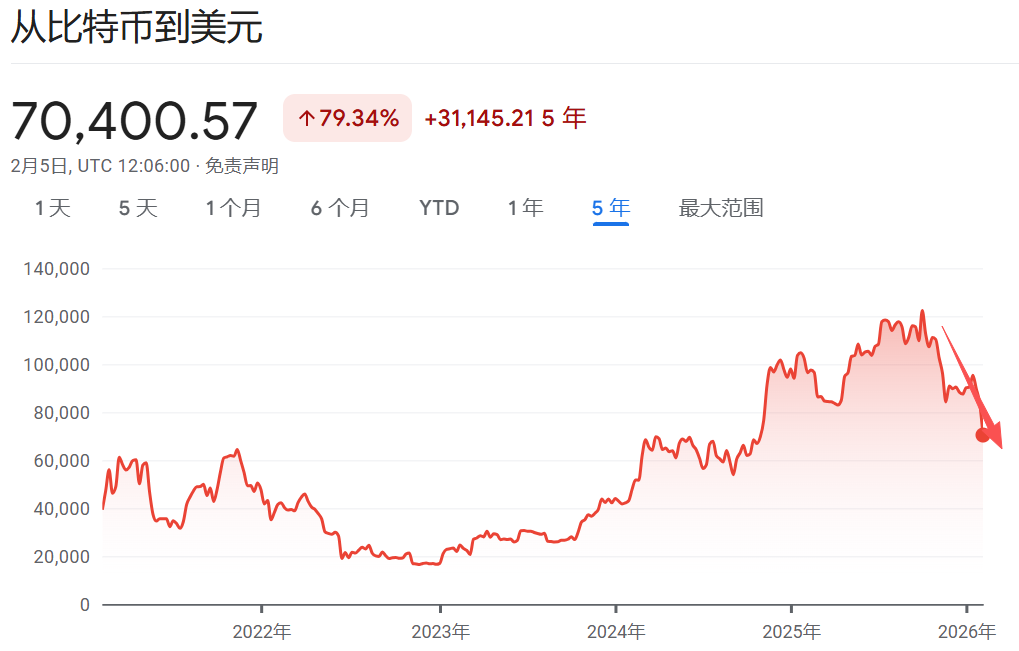
Bitcoin briefly fell below the key psychological level of $70,000 on Thursday, marking the first time the cryptocurrency has touched this level in 15 months, as a global sell-off in risk assets pushed the world's largest cryptocurrency into a new downward trend.
Shiliang Tang, Managing Partner of Monarq Asset Management, said, the market is currently experiencing a "crisis of confidence." Given that the current administration has promised to strengthen U.S. leadership in the digital asset space, $70,000 is seen as a crucial psychological barrier. Therefore, some market observers believe that with the breach of $70,000, it may trigger larger-scale selling in the short term.
In pre-market trading on Thursday, Bitcoin once fell to a low of $69,821. Since hitting its peak last October, Bitcoin has fallen by more than 44% and is currently hovering near its lowest level since Trump won the election in November 2024. Meanwhile, the total market capitalization has evaporated by $1.7 trillion since its peak last October, with over $460 billion lost in the past week alone.
According to Coinglass data, in the past 24 hours, the liquidation scale of long positions across various tokens reached $722 million. Wenny Cai, Chief Operating Officer of the trading platform SynFutures, pointed out that the liquidation scale is huge, market sentiment has shifted to risk aversion, and price movements are currently driven more by balance sheet mechanisms rather than narrative logic.
Bitcoin's role as a safe-haven asset under market pressure is increasingly being questioned. The token has fallen nearly 20% year-to-date, while global stock markets only began a synchronized sell-off on Wednesday, with the Nasdaq 100 Index falling more than 2%, and Asian and European stock markets continuing the decline on Thursday.
Key Psychological Level Breached, Is Bitcoin in a "Downward Spiral"?
The $70,000 price level holds critical political and psychological significance. This level was Bitcoin's trading price before the U.S. election, marking the starting point of the cryptocurrency rally triggered by Trump's election victory. As previously reported by Wall Street News, Citigroup analysts noted that cryptocurrency advocates are enthusiastic donors in the U.S. election, and the current administration has promised to strengthen U.S. leadership in the digital asset space and has established a Bitcoin strategic reserve.
According to CoinMetrics data, Bitcoin briefly fell to a low of $69,821 around 6:27 AM ET on Thursday before rebounding above $70,000. Some market observers believe that falling below $70,000 could trigger larger-scale selling.
Andrew Tu, Head of Business Development at cryptocurrency market maker Efficient Frontier, said that cryptocurrency market sentiment is currently in a state of extreme panic. "If Bitcoin cannot hold above $72,000, it is highly likely to fall to $68,000, and may even retreat to the lows seen after the initial rally in early 2024."
Maja Vujinovic, CEO of digital asset company FG Nexus, told CNBC: "The straight-line bull market that many people expected has not really materialized. Bitcoin is no longer trading based on hype; the story has lost some of its plot. It is now trading purely based on liquidity and capital flows."
Institutional Funds Continue to Flow Out, Warsh's Hawkish Signals Intensify Selling Pressure
Unlike the stock market, Bitcoin and other cryptocurrencies have been falling for months. The fund flows of U.S.-listed Bitcoin exchange-traded funds (ETFs) continue to fluctuate, indicating a significant reversal in institutional demand.
According to data compiled by Bloomberg, after recording a net inflow of approximately $562 million on Monday, over $800 million flowed out of such ETFs in the next two trading days. A CryptoQuant report on Wednesday pointed out that U.S. ETFs, which bought 46,000 Bitcoins during the same period last year, have turned into net sellers in 2026.
So far this week, the liquidation scale of cryptocurrency long and short positions has exceeded $2 billion. Analyst Wenny Cai said: "This does not mean the end of institutional participation, but it does mark the end of complacency."
Additionally, Trump's nomination of Warsh as the next Fed Chair on January 29 caused Bitcoin to fall 5.5% in a single day, and on January 31, it recorded its largest single-day drop since January 2018, falling 7.1%. Warsh is known for supporting higher real interest rates and reducing the balance sheet.