Bitcoin Following The 2022 Cycle? What To Expect If It Plays Out The Same Way

bitcoinistPublished on 2026-03-12Last updated on 2026-03-12

Abstract

The current Bitcoin market structure is showing similarities to the transition into the 2022 bear market, according to technical analysis. Following a cycle peak, Bitcoin has fallen below the 50-week Simple Moving Average (SMA), a key indicator that historically signals a shift from bullish momentum to a broader downtrend. After this breakdown, a brief consolidation and relief rally occurred, but it failed to reclaim the lost level, mirroring the pattern from the previous cycle. Additionally, the Relative Strength Index (RSI) has dropped below the 45 level, indicating weakening underlying market strength and echoing the momentum breakdown that preceded the prolonged 2022 decline. A descending trendline on the RSI has also capped multiple failed breakout attempts. If this pattern continues, Bitcoin could experience another significant downward leg before forming a definitive market bottom.

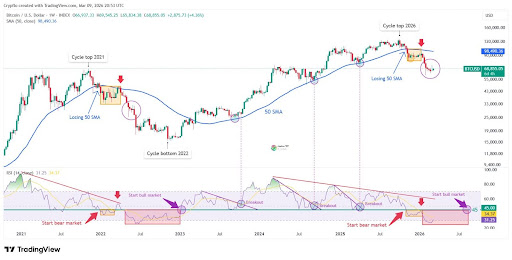
The current structure of Bitcoin may be unfolding in a way that closely resembles the transition that led into the 2022 bear market. A chart shared by an analyst on X highlights several technical signals that appeared during the 2021–2022 shift and are now emerging again in 2026. According to the comparison, the market could still face another downward phase before a definitive bottom forms.

Bitcoin Losing The 50-Week SMA Signals Structural Shift

During the previous cycle, Bitcoin peaked in 2021 before eventually falling below the 50-week simple moving average (SMA). That breakdown marked a turning point in the broader market structure. After losing the level, price entered a short consolidation phase where a relief rally briefly developed, but the recovery failed to reclaim the lost structure. The weakness ultimately extended into the prolonged decline that defined the 2022 bear market.

A similar sequence is now visible following the projected 2026 cycle top. According to @_cryptflow_ on X, Bitcoin recently moved beneath the 50-week SMA after peaking earlier in the cycle. This indicator has historically served as a major dividing line between sustained bullish momentum and broader downtrends, meaning its loss often signals a shift in the market’s underlying strength.
Source: X

The chart also outlines a comparable reaction after the breakdown. In both cycles, price stabilized temporarily after slipping below the moving average and attempted a recovery. However, those rebounds failed to reclaim the lost level, leaving the broader downward structure intact.

This stage is illustrated in the chart with a consolidation box forming after the break below the 50-week SMA. The zone represents a relief rally phase where the price attempts to recover but struggles to regain momentum. In the previous cycle, that temporary stabilization was followed by another significant decline, suggesting the current structure could still evolve in a similar direction.

Relative Strength Index (RSI) Signals Bear Market Shift

Beyond price structure, the chart also highlights the behavior of the RSI. During the previous market transition, the RSI dropping below the 45 level marked the beginning of a sustained bearish phase, separating bullish momentum from a period of prolonged weakness.

The same pattern is emerging again, with the chart showing RSI recently falling below the 45 level, echoing the momentum breakdown that preceded the extended 2022 decline. This shift suggests that underlying market strength may already be weakening as conditions move away from the bullish environment that characterized the earlier stage of the cycle.

The RSI chart also features a descending trendline that has repeatedly capped momentum since the cycle peak. Several breakout attempts occurred during the last bull phase, but each ultimately failed before momentum reversed. Similar failed breakout attempts are now visible in the current cycle.

If the broader structure continues to mirror the earlier template, the chart suggests Bitcoin could still experience another downward leg before a clear bottom forms. While cycles rarely repeat identically, the comparison highlights how similar momentum shifts and structural breaks have historically preceded deeper market corrections.

Bitcoin pushes above $70,000 | Source: BTCUSD on Tradingview.com

Related Questions

QAccording to the analyst's chart, what key moving average did Bitcoin break below in both the 2021-2022 cycle and the current 2026 cycle, signaling a structural shift?

AThe 50-week simple moving average (SMA).

QWhat does the article suggest typically happens after Bitcoin loses the 50-week SMA, based on the previous cycle?

AThe price enters a short consolidation phase with a relief rally that fails to reclaim the lost level, which is often followed by a prolonged decline.

QWhat level on the Relative Strength Index (RSI) is identified as a critical signal for the beginning of a sustained bearish phase?

AThe RSI dropping below the 45 level.

QWhat pattern on the RSI chart has repeatedly capped momentum since the cycle peak in both cycles?

AA descending trendline.

QIf the current cycle continues to mirror the 2021-2022 template, what does the analyst suggest could happen before a definitive bottom is formed?

ABitcoin could experience another downward leg or significant decline.

Related Reads

Buy BTC or MSTR? Analyzing the Capital Flywheel of MicroStrategy

MicroStrategy's mNAV (market cap to Bitcoin holdings ratio) has compressed to near parity, sparking debate about whether the premium will re-expand. The core argument centers on the company's ATM equity issuance strategy. Critics view it as shareholder dilution, while supporters see it as rational Bitcoin accumulation. However, both miss the deeper strategic shift: MicroStrategy is building a layered capital structure that operates differently across mNAV regimes. At ~1x mNAV (current phase), equity issuance is used to buy Bitcoin directly, justified by long-term undervaluation. In high mNAV regimes (3-4x+), equity becomes a tool to repay debt from preferred securities, not just acquire Bitcoin. The introduction of preferred stock attracts yield-seeking investors, creating a continuous funding source for Bitcoin purchases but also dividend obligations. The ATM acts as a proactive de-leveraging tool, building equity ahead of future payment needs. mNAV expansion may return not only from Bitcoin price appreciation but also from the market valuing MicroStrategy as a scalable Bitcoin capital markets platform. The company is evolving from a Bitcoin treasury into a financial engine with distinct investor segments: yield investors in preferred securities and growth investors in equity. This could form a self-reinforcing "capital flywheel": preferred demand funds Bitcoin buys, equity demand values platform growth, and Bitcoin appreciation strengthens the balance sheet. The discussion may shift from *if* mNAV premium returns to *how large* this financial platform can become.

marsbit45m ago

Buy BTC or MSTR? Analyzing the Capital Flywheel of MicroStrategy

marsbit45m ago

U.S. Crypto Regulatory 'Civil War' Ceasefire: A Turning Point in the Decade-Long Power Struggle Between SEC and CFTC

For over a decade, the U.S. cryptocurrency industry has operated under regulatory uncertainty, with two key questions unresolved: what exactly are crypto assets, and which agency should regulate them? The Securities and Exchange Commission (SEC) and the Commodity Futures Trading Commission (CFTC) have long held overlapping and conflicting claims over crypto oversight, creating a "regulatory fog" that hindered innovation and pushed businesses to more predictable jurisdictions. Recently, signs of change have emerged. The SEC introduced a new classification framework in November 2025, categorizing digital assets into four types—digital commodities, digital collectibles, digital tools, and tokenized securities—acknowledging that not all crypto assets are securities. More significantly, the SEC and CFTC signed a Memorandum of Understanding (MOU) to enhance coordination in areas like crypto regulation, investor protection, and federal policy. Although non-binding, the MOU signals a move toward resolving jurisdictional conflicts and creating an "adaptive regulatory framework" tailored to digital assets. This shift is partly a response to global competition, as other financial centers develop clearer crypto regulations. Additionally, the growing integration of crypto with traditional finance—through stablecoins and real-world asset tokenization—demands a more structured regulatory approach. If successful, these efforts may lead to a unified federal framework, ending long-standing ambiguities and positioning the U.S. to better compete in the evolving digital financial landscape.

marsbit58m ago

U.S. Crypto Regulatory 'Civil War' Ceasefire: A Turning Point in the Decade-Long Power Struggle Between SEC and CFTC

marsbit58m ago

Trading

Spot
Futures

Hot Articles

What is $BITCOIN

DIGITAL GOLD ($BITCOIN): A Comprehensive Analysis Introduction to DIGITAL GOLD ($BITCOIN) DIGITAL GOLD ($BITCOIN) is a blockchain-based project operating on the Solana network, which aims to combine the characteristics of traditional precious metals with the innovation of decentralized technologies. While it shares a name with Bitcoin, often referred to as “digital gold” due to its perception as a store of value, DIGITAL GOLD is a separate token designed to create a unique ecosystem within the Web3 landscape. Its goal is to position itself as a viable alternative digital asset, although specifics regarding its applications and functionalities are still developing. What is DIGITAL GOLD ($BITCOIN)? DIGITAL GOLD ($BITCOIN) is a cryptocurrency token explicitly designed for use on the Solana blockchain. In contrast to Bitcoin, which provides a widely recognized value storage role, this token appears to focus on broader applications and characteristics. Notable aspects include: Blockchain Infrastructure: The token is built on the Solana blockchain, known for its capacity to handle high-speed and low-cost transactions. Supply Dynamics: DIGITAL GOLD has a maximum supply capped at 100 quadrillion tokens (100P $BITCOIN), although details regarding its circulating supply are currently undisclosed. Utility: While precise functionalities are not explicitly outlined, there are indications that the token could be utilized for various applications, potentially involving decentralized applications (dApps) or asset tokenization strategies. Who is the Creator of DIGITAL GOLD ($BITCOIN)? At present, the identity of the creators and development team behind DIGITAL GOLD ($BITCOIN) remains unknown. This situation is typical among many innovative projects within the blockchain space, particularly those aligning with decentralized finance and meme coin phenomena. While such anonymity may foster a community-driven culture, it intensifies concerns about governance and accountability. Who are the Investors of DIGITAL GOLD ($BITCOIN)? The available information indicates that DIGITAL GOLD ($BITCOIN) does not have any known institutional backers or prominent venture capital investments. The project seems to operate on a peer-to-peer model focused on community support and adoption rather than traditional funding routes. Its activity and liquidity are primarily situated on decentralized exchanges (DEXs), such as PumpSwap, rather than established centralized trading platforms, further highlighting its grassroots approach. How DIGITAL GOLD ($BITCOIN) Works The operational mechanics of DIGITAL GOLD ($BITCOIN) can be elaborated on based on its blockchain design and network attributes: Consensus Mechanism: By leveraging Solana’s unique proof-of-history (PoH) combined with a proof-of-stake (PoS) model, the project ensures efficient transaction validation contributing to the network's high performance. Tokenomics: While specific deflationary mechanisms have not been extensively detailed, the vast maximum token supply implies that it may cater to microtransactions or niche use cases that are still to be defined. Interoperability: There exists the potential for integration with Solana’s broader ecosystem, including various decentralized finance (DeFi) platforms. However, the details regarding specific integrations remain unspecified. Timeline of Key Events Here is a timeline that highlights significant milestones concerning DIGITAL GOLD ($BITCOIN): 2023: The initial deployment of the token occurs on the Solana blockchain, marked by its contract address. 2024: DIGITAL GOLD gains visibility as it becomes available for trading on decentralized exchanges like PumpSwap, allowing users to trade it against SOL. 2025: The project witnesses sporadic trading activity and potential interest in community-led engagements, although no noteworthy partnerships or technical advancements have been documented as of yet. Critical Analysis Strengths Scalability: The underlying Solana infrastructure supports high transaction volumes, which could enhance the utility of $BITCOIN in various transaction scenarios. Accessibility: The potential low trading price per token could attract retail investors, facilitating wider participation due to fractional ownership opportunities. Risks Lack of Transparency: The absence of publicly known backers, developers, or an audit process may yield skepticism regarding the project's sustainability and trustworthiness. Market Volatility: The trading activity is heavily reliant on speculative behavior, which can result in significant price volatility and uncertainty for investors. Conclusion DIGITAL GOLD ($BITCOIN) emerges as an intriguing yet ambiguous project within the rapidly evolving Solana ecosystem. While it attempts to leverage the “digital gold” narrative, its departure from Bitcoin's established role as a store of value underscores the need for a clearer differentiation of its intended utility and governance structure. Future acceptance and adoption will likely depend on addressing the current opacity and defining its operational and economic strategies more explicitly. Note: This report encompasses synthesised information available as of October 2023, and developments may have transpired beyond the research period.

363 Total ViewsPublished 2025.05.13Updated 2025.05.13

What is $BITCOIN

Discussions

Welcome to the HTX Community. Here, you can stay informed about the latest platform developments and gain access to professional market insights. Users' opinions on the price of BTC (BTC) are presented below.

活动图片