Bitcoin Short-Term Holders Dump 48K BTC In Profit As Price Tests $75K

bitcoinistPublished on 2026-03-19Last updated on 2026-03-19

Abstract

Bitcoin is testing the key resistance level of $75,000 amid growing bullish momentum, but on-chain data reveals significant profit-taking by short-term holders (STHs). According to a CryptoQuant report, STHs sold over 48,000 BTC in profit in a single day as the asset approached this threshold, marking a yearly high in profit-realization activity. This behavior reflects continued caution among near-term investors, who are using price rallies as exit opportunities rather than holding for further gains. While demand is returning, persistent selling pressure at key resistance levels may slow upward momentum and delay a sustained breakout. The market remains in a balance between new buying interest and opportunistic profit-taking.

Bitcoin is attempting to push above the $75,000 level as market activity intensifies and bullish momentum begins to build. The recent price action suggests that buyers are testing a key resistance zone, with traders closely watching whether BTC can sustain a breakout and extend its recovery after weeks of volatility.

However, underlying data indicate that confidence among certain market participants remains fragile. According to a CryptoQuant report by analyst Darkfost, short-term holders (STHs) are still showing signs of caution despite the improving trend in Bitcoin’s price. Rather than fully committing to the rally, many of these investors continue to treat upward moves as opportunities to secure profits.

The report highlights that the current macro and liquidity environment is not particularly favorable for aggressive risk-taking, which is influencing behavior across the market. As a result, STHs are more inclined to realize gains quickly, contributing to intermittent selling pressure during periods of price strength.

This dynamic creates a mixed structure for Bitcoin. While demand is clearly returning and pushing prices toward higher levels, persistent profit-taking from short-term participants may act as a temporary ceiling, particularly around key resistance zones like $75K, where liquidity and sell-side pressure tend to concentrate.

Profit-Taking Pressure Builds as Bitcoin Tests $75K

According to CryptoQuant analyst Darkfost, recent on-chain data shows a clear resurgence in profit-taking activity among short-term holders as Bitcoin approaches key resistance levels. The report highlights that the amount of BTC in profit sent to exchanges has reached a yearly high, coinciding with Bitcoin’s attempt to break above the $75,000 level.
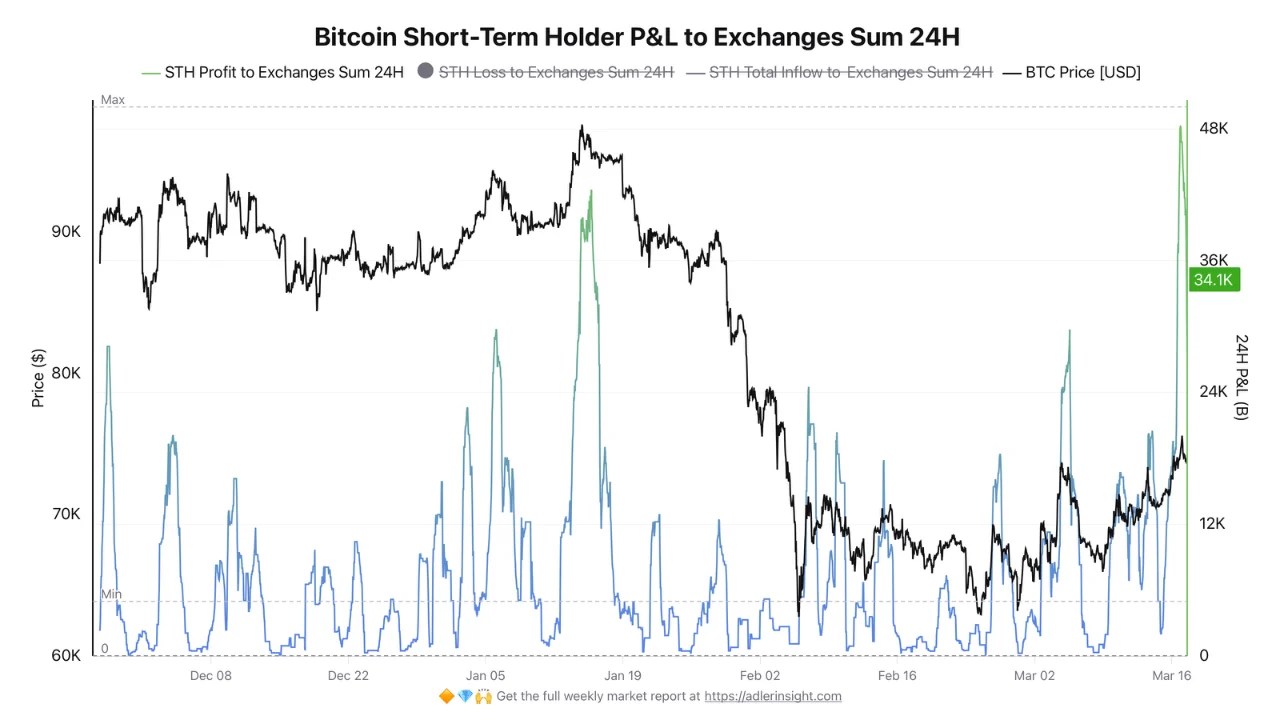
Bitcoin Short-Term Holder P&L to Exchange Sum 24H | Source: CryptoQuant

In a single day, more than 48,000 BTC in profit were transferred to exchanges by short-term holders, signaling a strong willingness among these participants to realize gains rather than hold through potential volatility. This behavior suggests that a significant portion of the market remains focused on short-term opportunities, even as broader conditions begin to improve.

Structurally, this trend reinforces the idea that each upward move is still being treated as an exit opportunity by short-term investors. Instead of supporting sustained upside, these participants are actively supplying liquidity into rallies, creating friction at key resistance zones.

This dynamic introduces a layer of complexity to Bitcoin’s current price action. While demand is clearly returning, persistent sell-side pressure from profit-taking can slow momentum and delay breakouts.

For now, the market appears to be balancing between renewed buying interest and opportunistic selling, with the behavior of short-term holders likely to play a critical role in determining whether Bitcoin can establish a sustained move above resistance.


Related Questions

QWhat is the key resistance level that Bitcoin is attempting to break above according to the article?

ABitcoin is attempting to break above the $75,000 level.

QAccording to the CryptoQuant report, how much BTC in profit did short-term holders send to exchanges in a single day?

AShort-term holders sent more than 48,000 BTC in profit to exchanges in a single day.

QWhat is the main reason short-term holders are selling their Bitcoin despite the price increase?

AShort-term holders are selling to realize gains and secure profits, treating upward price moves as exit opportunities due to an unfavorable macro and liquidity environment for aggressive risk-taking.

QWhat role do short-term holders play in creating resistance at key price levels like $75K?

AShort-term holders create selling pressure and act as a temporary ceiling by supplying liquidity into rallies and realizing gains at key resistance zones, which slows momentum and delays breakouts.

QWhat is the overall market dynamic described in the article regarding Bitcoin's price action?

AThe market is balancing between renewed buying interest and opportunistic selling from short-term holders, creating a mixed structure where demand is returning but persistent profit-taking is limiting upward momentum.

Related Reads

The Last Time I'll Talk About Backpack, and Also Discussing My Airdrop Farming Principles

The author outlines two primary approaches to airdrop farming (referred to as "撸毛"): a labor-intensive" method of mass participation in many projects, and their own "sniper" method. The sniper approach relies on a rigorous four-point checklist to filter projects and avoid "industrial garbage." The checklist evaluates: 1. **Team (People):** Founders must be intelligent, have strong execution skills, and be genuinely well-intentioned. This is assessed through their social media content and, if possible, personal interactions. 2. **Product (Product-Market Fit):** The product must have a clear market fit, be delivered competently, and the team must show a responsible attitude towards its quality, avoiding releases full of basic errors. 3. **Narrative (Story):** The project should operate in a promising, unproven narrative within Web3 that also aligns with major investment trends in Web2 (e.g., AI). 4. **Timing & Cost (Market Conditions):** Avoid participating when market sentiment is overly FOMO-driven and participation costs are high. If an opportunity causes hesitation, it's best to skip it, as overcrowded airdrops yield minimal or negative returns. Applying this framework, the author explains why they avoided heavily farming the Backpack exchange airdrop: * **Narrative:** They are skeptical of the "compliant CEX" narrative, questioning its unique selling point against giants like Binance and OKX. * **Product:** They criticize Backpack's frequent technical failures, rollbacks, and what they perceive as a lack of product development rigor, comparing it unfavorably to competitors like Hyperliquid. * **Timing & Cost:** The participation cost was high compared to zero-fee alternatives available at the time. The author concludes that Backpack lacks the technical and operational prowess of a serious exchange and views its token more as a "VC-backed meme coin" for secondary market speculation rather than a worthwhile airdrop target.

比推2h ago

The Last Time I'll Talk About Backpack, and Also Discussing My Airdrop Farming Principles

比推2h ago

Trading

Spot
Futures

Hot Articles

What is $BITCOIN

DIGITAL GOLD ($BITCOIN): A Comprehensive Analysis Introduction to DIGITAL GOLD ($BITCOIN) DIGITAL GOLD ($BITCOIN) is a blockchain-based project operating on the Solana network, which aims to combine the characteristics of traditional precious metals with the innovation of decentralized technologies. While it shares a name with Bitcoin, often referred to as “digital gold” due to its perception as a store of value, DIGITAL GOLD is a separate token designed to create a unique ecosystem within the Web3 landscape. Its goal is to position itself as a viable alternative digital asset, although specifics regarding its applications and functionalities are still developing. What is DIGITAL GOLD ($BITCOIN)? DIGITAL GOLD ($BITCOIN) is a cryptocurrency token explicitly designed for use on the Solana blockchain. In contrast to Bitcoin, which provides a widely recognized value storage role, this token appears to focus on broader applications and characteristics. Notable aspects include: Blockchain Infrastructure: The token is built on the Solana blockchain, known for its capacity to handle high-speed and low-cost transactions. Supply Dynamics: DIGITAL GOLD has a maximum supply capped at 100 quadrillion tokens (100P $BITCOIN), although details regarding its circulating supply are currently undisclosed. Utility: While precise functionalities are not explicitly outlined, there are indications that the token could be utilized for various applications, potentially involving decentralized applications (dApps) or asset tokenization strategies. Who is the Creator of DIGITAL GOLD ($BITCOIN)? At present, the identity of the creators and development team behind DIGITAL GOLD ($BITCOIN) remains unknown. This situation is typical among many innovative projects within the blockchain space, particularly those aligning with decentralized finance and meme coin phenomena. While such anonymity may foster a community-driven culture, it intensifies concerns about governance and accountability. Who are the Investors of DIGITAL GOLD ($BITCOIN)? The available information indicates that DIGITAL GOLD ($BITCOIN) does not have any known institutional backers or prominent venture capital investments. The project seems to operate on a peer-to-peer model focused on community support and adoption rather than traditional funding routes. Its activity and liquidity are primarily situated on decentralized exchanges (DEXs), such as PumpSwap, rather than established centralized trading platforms, further highlighting its grassroots approach. How DIGITAL GOLD ($BITCOIN) Works The operational mechanics of DIGITAL GOLD ($BITCOIN) can be elaborated on based on its blockchain design and network attributes: Consensus Mechanism: By leveraging Solana’s unique proof-of-history (PoH) combined with a proof-of-stake (PoS) model, the project ensures efficient transaction validation contributing to the network's high performance. Tokenomics: While specific deflationary mechanisms have not been extensively detailed, the vast maximum token supply implies that it may cater to microtransactions or niche use cases that are still to be defined. Interoperability: There exists the potential for integration with Solana’s broader ecosystem, including various decentralized finance (DeFi) platforms. However, the details regarding specific integrations remain unspecified. Timeline of Key Events Here is a timeline that highlights significant milestones concerning DIGITAL GOLD ($BITCOIN): 2023: The initial deployment of the token occurs on the Solana blockchain, marked by its contract address. 2024: DIGITAL GOLD gains visibility as it becomes available for trading on decentralized exchanges like PumpSwap, allowing users to trade it against SOL. 2025: The project witnesses sporadic trading activity and potential interest in community-led engagements, although no noteworthy partnerships or technical advancements have been documented as of yet. Critical Analysis Strengths Scalability: The underlying Solana infrastructure supports high transaction volumes, which could enhance the utility of $BITCOIN in various transaction scenarios. Accessibility: The potential low trading price per token could attract retail investors, facilitating wider participation due to fractional ownership opportunities. Risks Lack of Transparency: The absence of publicly known backers, developers, or an audit process may yield skepticism regarding the project's sustainability and trustworthiness. Market Volatility: The trading activity is heavily reliant on speculative behavior, which can result in significant price volatility and uncertainty for investors. Conclusion DIGITAL GOLD ($BITCOIN) emerges as an intriguing yet ambiguous project within the rapidly evolving Solana ecosystem. While it attempts to leverage the “digital gold” narrative, its departure from Bitcoin's established role as a store of value underscores the need for a clearer differentiation of its intended utility and governance structure. Future acceptance and adoption will likely depend on addressing the current opacity and defining its operational and economic strategies more explicitly. Note: This report encompasses synthesised information available as of October 2023, and developments may have transpired beyond the research period.

363 Total ViewsPublished 2025.05.13Updated 2025.05.13

What is $BITCOIN

Discussions

Welcome to the HTX Community. Here, you can stay informed about the latest platform developments and gain access to professional market insights. Users' opinions on the price of BTC (BTC) are presented below.

活动图片