Top five crypto winners (and losers) of 2022

CointelegraphPublished on 2022-12-27Last updated on 2022-12-27

Abstract

Bitcoin and Ethereum are not part of the surprising list of five best and worst-performing cryptocurrencies for 2022.

Cointelegraph looks back on the best and worst-performing cryptocurrencies of 2022 among the top 100 assets by market capitalization. We used the highest and the lowest year-to-date (YTD) returns through the close of Dec. 25, 2022.

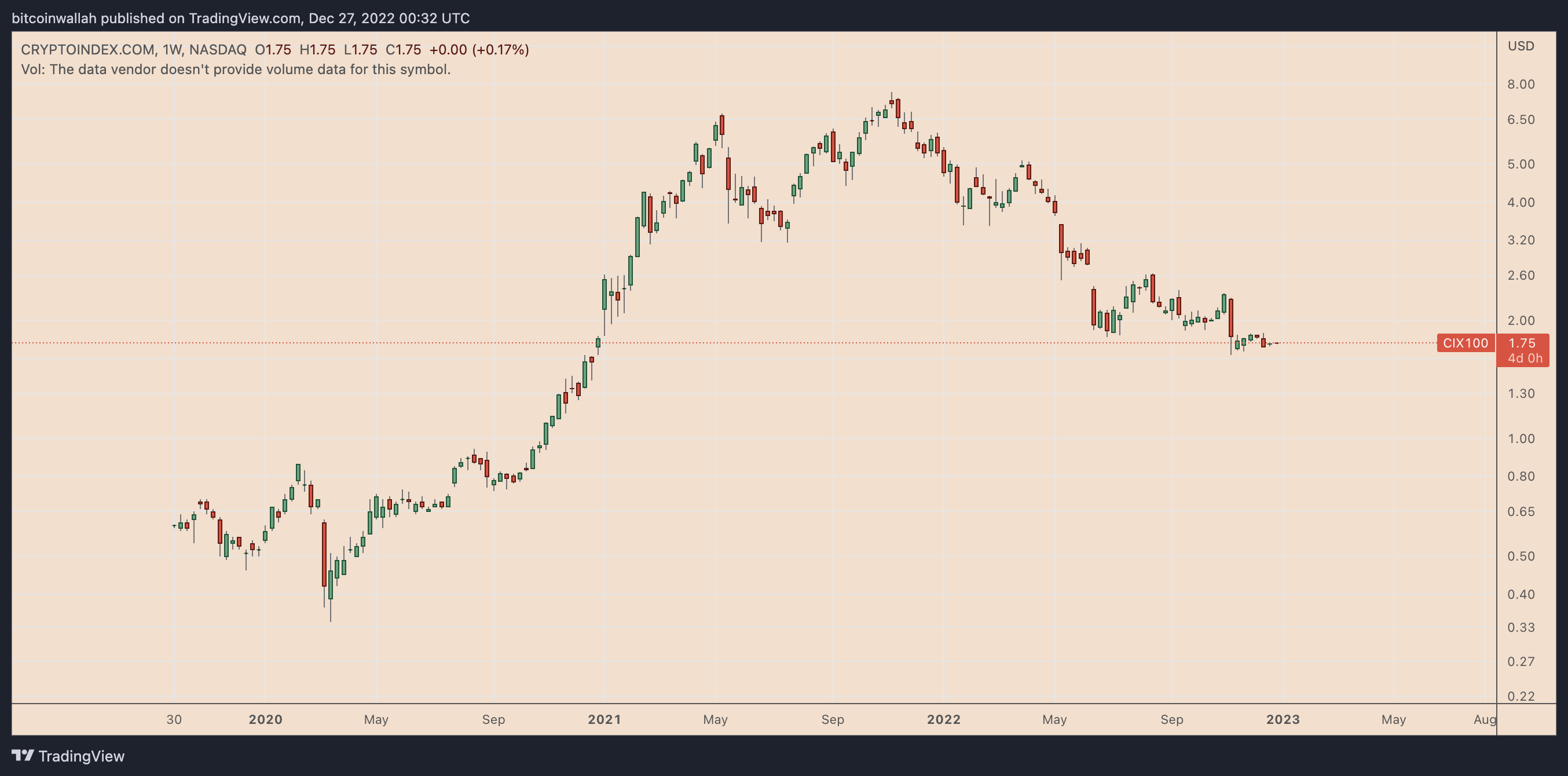
Overall, Cryptoindex.com 100 (CIX100), an index that tracks the 100 best-performing cryptocurrencies, fell nearly 68% YTD, suggesting most top coins underperformed in 2022.

CIX100 weekly price chart. Source: TradingView

Stablecoins are naturally omitted from the list below. Similarly, coins tracking the value of gold and similar mainstream assets have also been ignored.

Instead, the coins mentioned below include decentralized currencies, smart contract tokens, exchange tokens and others.

Top five crypto of 2022

1. GMX (GMX)

YTD return: 111%

Sector: Decentralized exchange

Market Cap: $379.4 million

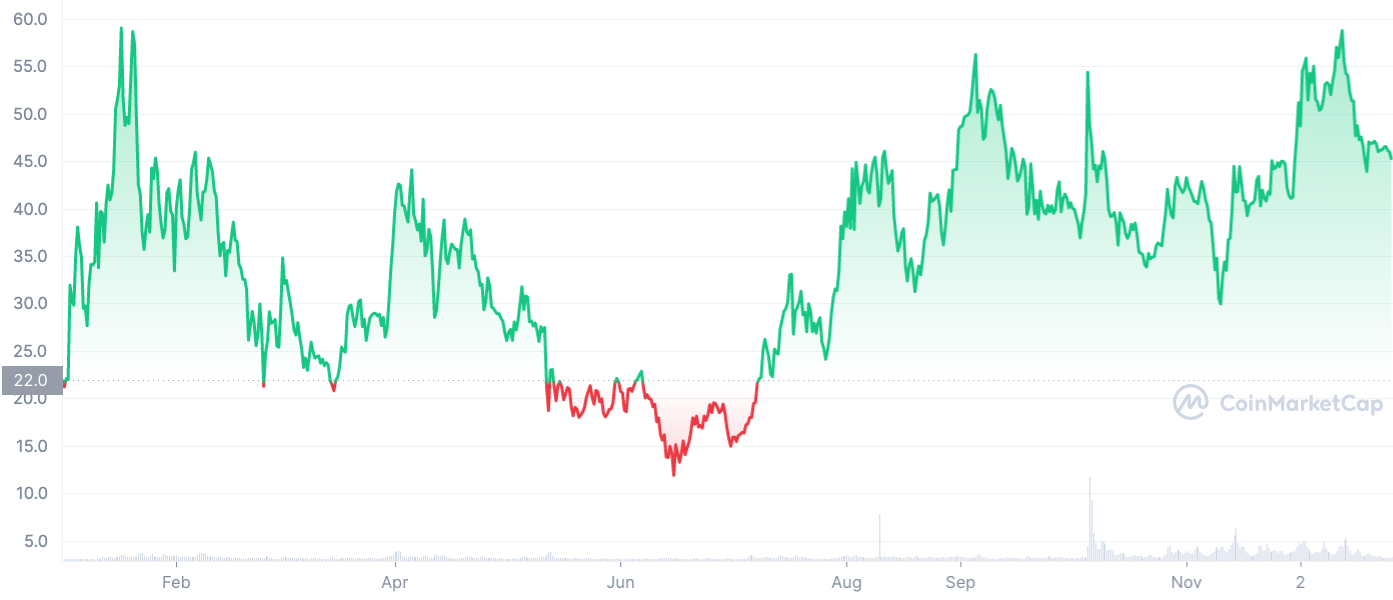
GMX acts as a utility and a governance token within the GMX decentralized exchange (DEX) ecosystem and is the best-performing digital asset among the top 100 coins (excluding stablecoins).

GMX’s price uptrend mostly picked its cues from the collapse of FTX, a centralized exchange, and its listing on popular trading platforms — including Binance and Huobi Global — across 2022. In addition, the token rallied impressively in late November after its platform briefly surpassed its top DEX rival, Uniwap, in daily trading fees.

GMX price performance YTD. Source: CoinMarketCap

2. Trust Wallet Token (TWT)

YTD return: 92%

Sector: Payment platform

Market Cap: $570 million

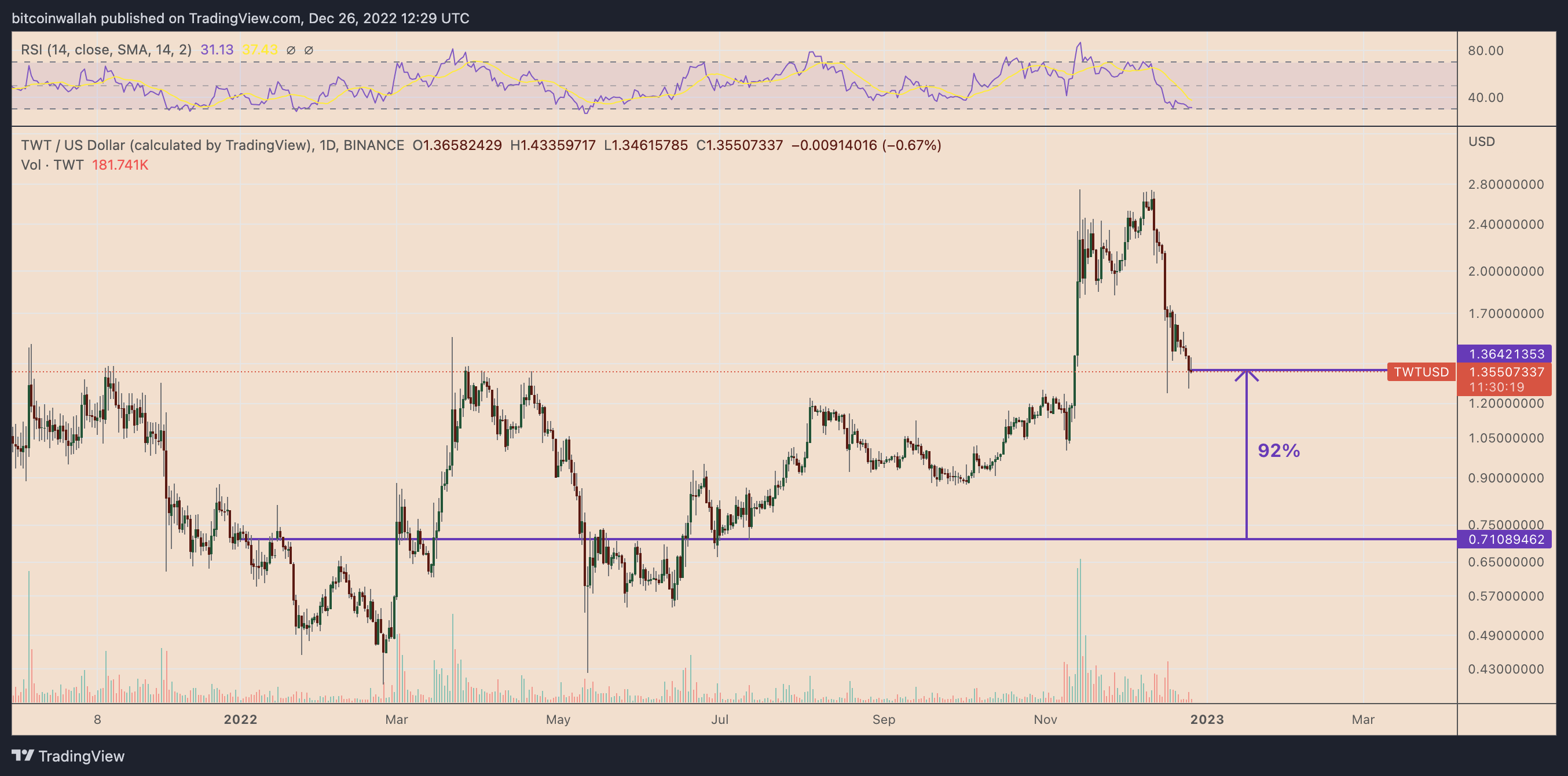
Trust Wallet Token (TWT) serves as a utility and a governance token within the Trust Wallet ecosystem. The token moved lower in tandem with the rest of the crypto market, mostly in 2022, but like GMX, its upside momentum increased amid the collapse of the FTX exchange in November.

TWT/USD daily price chart. Source: TradingView

As Cointelegraph reported, the FTX’s collapse boosted mistrust for centralized exchanges, which may have prompted investors to move their funds to self-custody wallets like Trust Wallet. The speculation could have played a major role in boosting TWT’s valuation.

3. Unus Sed Leo (LEO)

YTD return: -3.5%

Sector: Centralized exchange

Market Cap: $3.44 billion

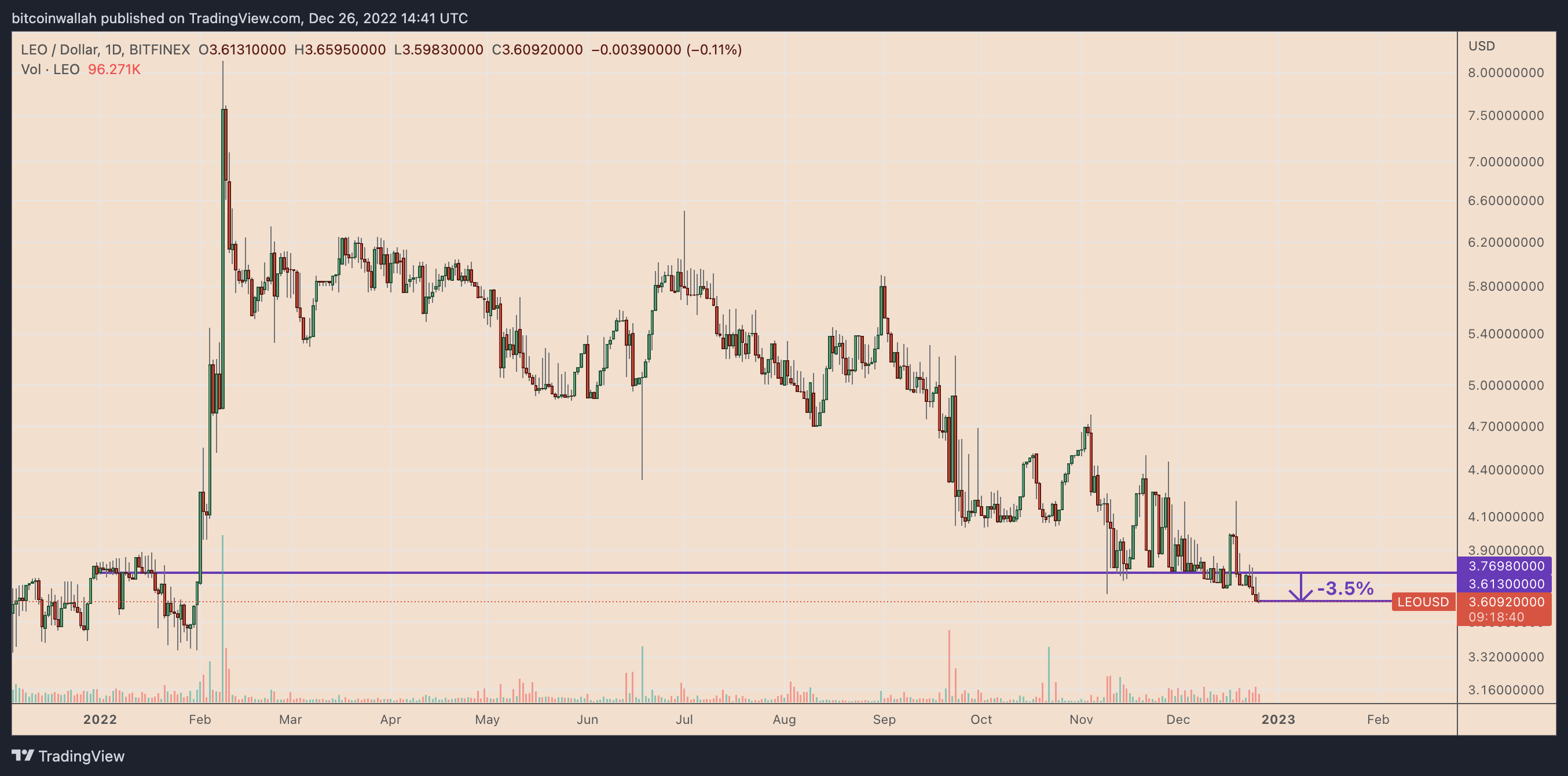
Unus Sed Leo (LEO) is native to the iFinex ecosystem. The token suffered losses in 2022, but at -3.5%, they were little compared to most top coins, including Bitcoin and Ether, which lost over 65% in the same period.

LEO/USD daily price chart. Source: TradingView

One of the reasons why LEO outperformed most top-ranking assets could be iFinex’s pledge. Notably, the firm declared at the time of LEO’s private sale in 2018 that it would employ 27% of its revenue to buy back the tokens until the entire supply of 985.24 million units was removed from circulation.

IFinex also said it would use the funds it lost during the August 2016 Bitfinex hack to purchase LEO tokens. That explains why LEO rallied by more than 100% at the start of the year, given the uptrend came after the United States Department of Justice recovered 94,000 BTC from Bitfinex hackers.

The rally took LEO’s price to a YTD high of $8.15 in February. However, the token has dropped 55% since, though still remaining one of the best performers in 2022.

4. OKB (OKB)

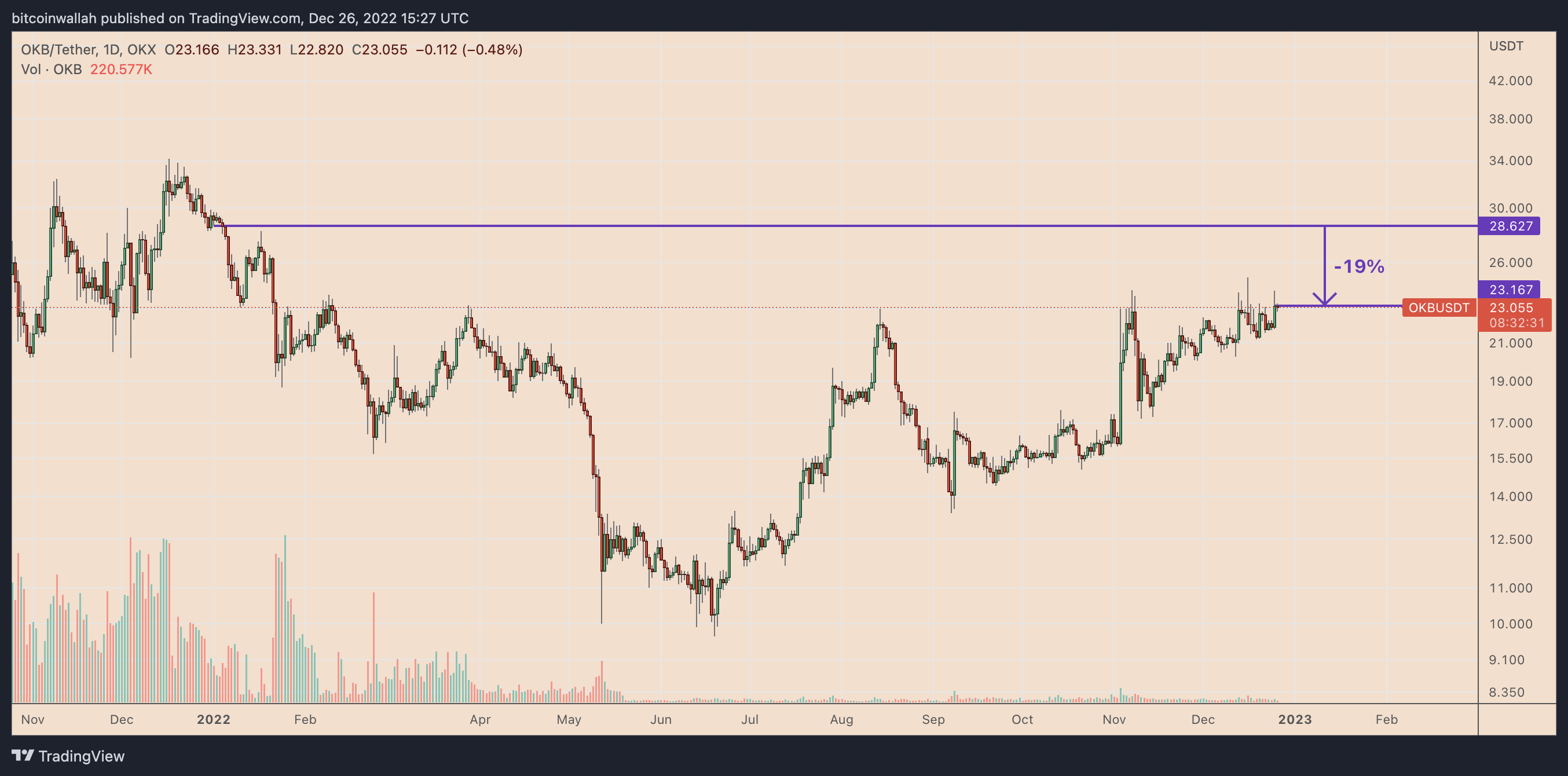
YTD return: -19%

Sector: Centralized exchange

Market Cap: $1.38 billion

OKB is the native token of the OKX exchange. It provides users discounts on trading fees, access to OKX's initial exchange offering (IEO) platform, and voting rights for tokens to be listed on the exchange.

OKB trended synchronously with the broader crypto market in 2022, including its 150% recovery after bottoming out at around $9.50 in June. The token’s bullish retracement occurred despite the absence of a major market-moving event, suggesting it had been mostly speculative.

OKB/USD daily price chart. Source: TradingView

Overall, OKB’s volatile recovery helped it limit its YTD losses compared to most top-ranking assets.

5. The Open Network (TON)

YTD return: -33.5%

Sector: Smart contracts

Market Cap: $3.52 billion

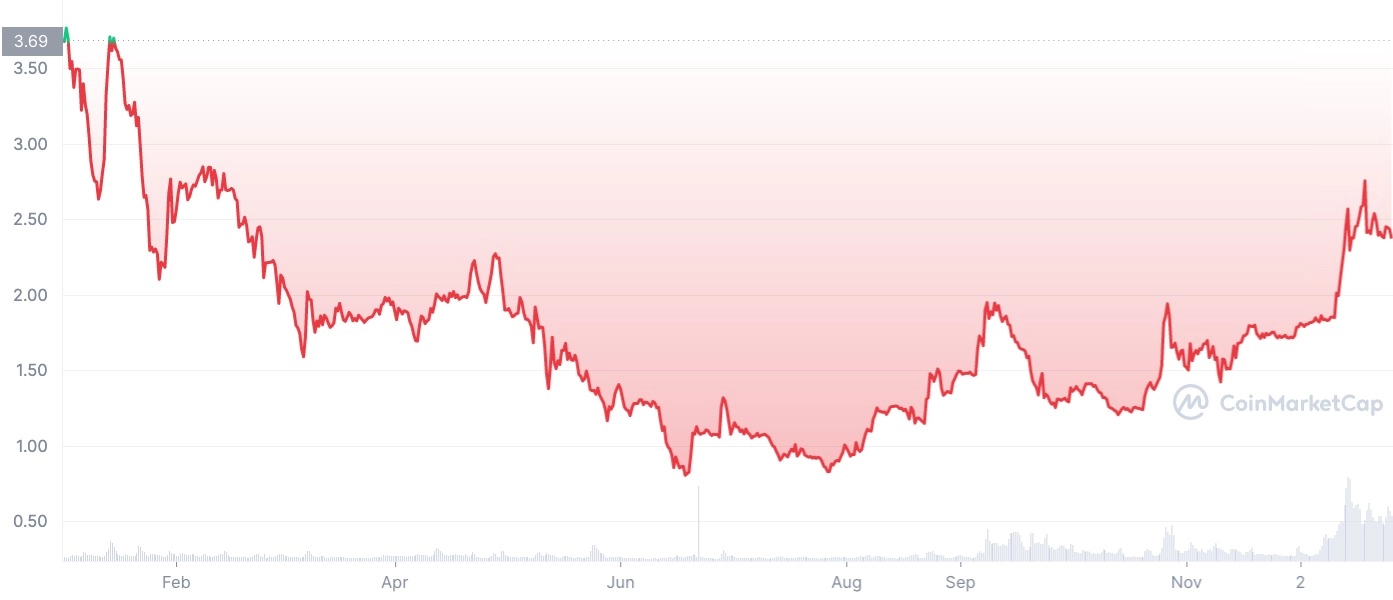
The Open Network is a layer-1 blockchain ecosystem developed by the Telegram founders Nikolai Durov and Pavel Durov. Its native token, TON, trended downward in line with other top crypto assets during most of 2022 but recovered impressively ahead of the year’s close.

TON/USD price performance YTD. Source: CoinMarketCap

TON’s recovery period coincided with back-to-back optimistic news. For instance, in October, Telegram announced that it would employ the Open Network to auction usernames. Similarly, the Open Network built a bot the next month that allows Telegrams users to trade cryptocurrencies in-app.

Nonetheless, TON failed to recoup all of its losses, still down 33.5% YTD at $2.36.

Worst five cryptos of 2022

1. Terra (LUNA)

YTD performance: -99.99%

Sector: Smart contracts

Market Cap: $604 million

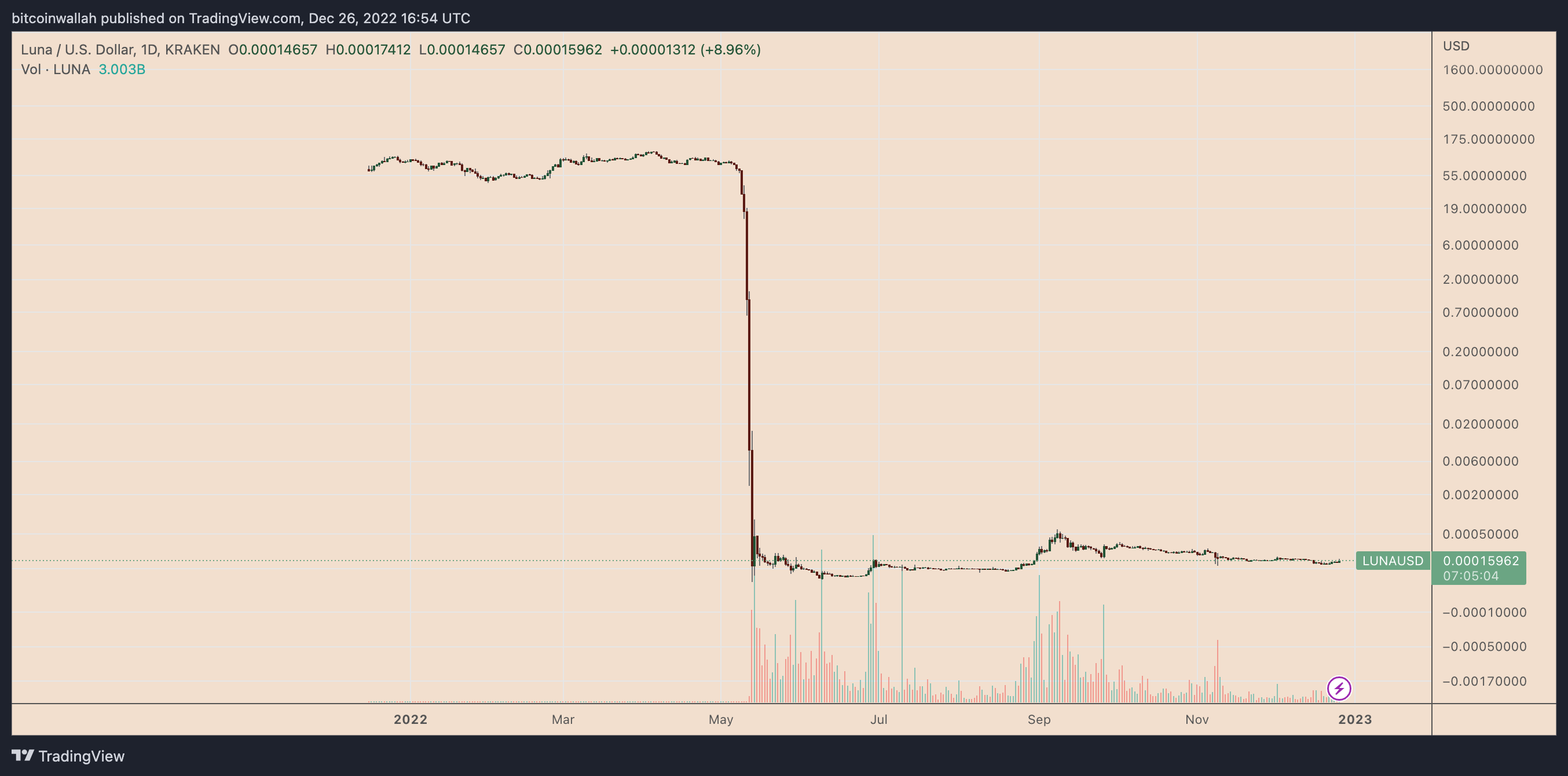
Terra became a debacle for the cryptocurrency sector after its market valuation crashed by 99.99% in May. The unraveling started with the implosion of Terra’s algorithmic stablecoin TerraUSD (UST), marking one of the biggest busts in the crypto industry’s history.

LUNA/USD daily price chart. Source: TradingView

Terra’s implosion prompted its founder Do Kwon to suggest a fork to revive the project. Eventually, Terra underwent a chain split, with the old chain existing as Terra Classic and the new chain as Terra 2.0.

Luna Classic (LUNC) jumped nearly 100% after its launch in late May 2022 while LUNA (LUNA2) dropped around 40% in the same period.

2. FTX Token (FTT)

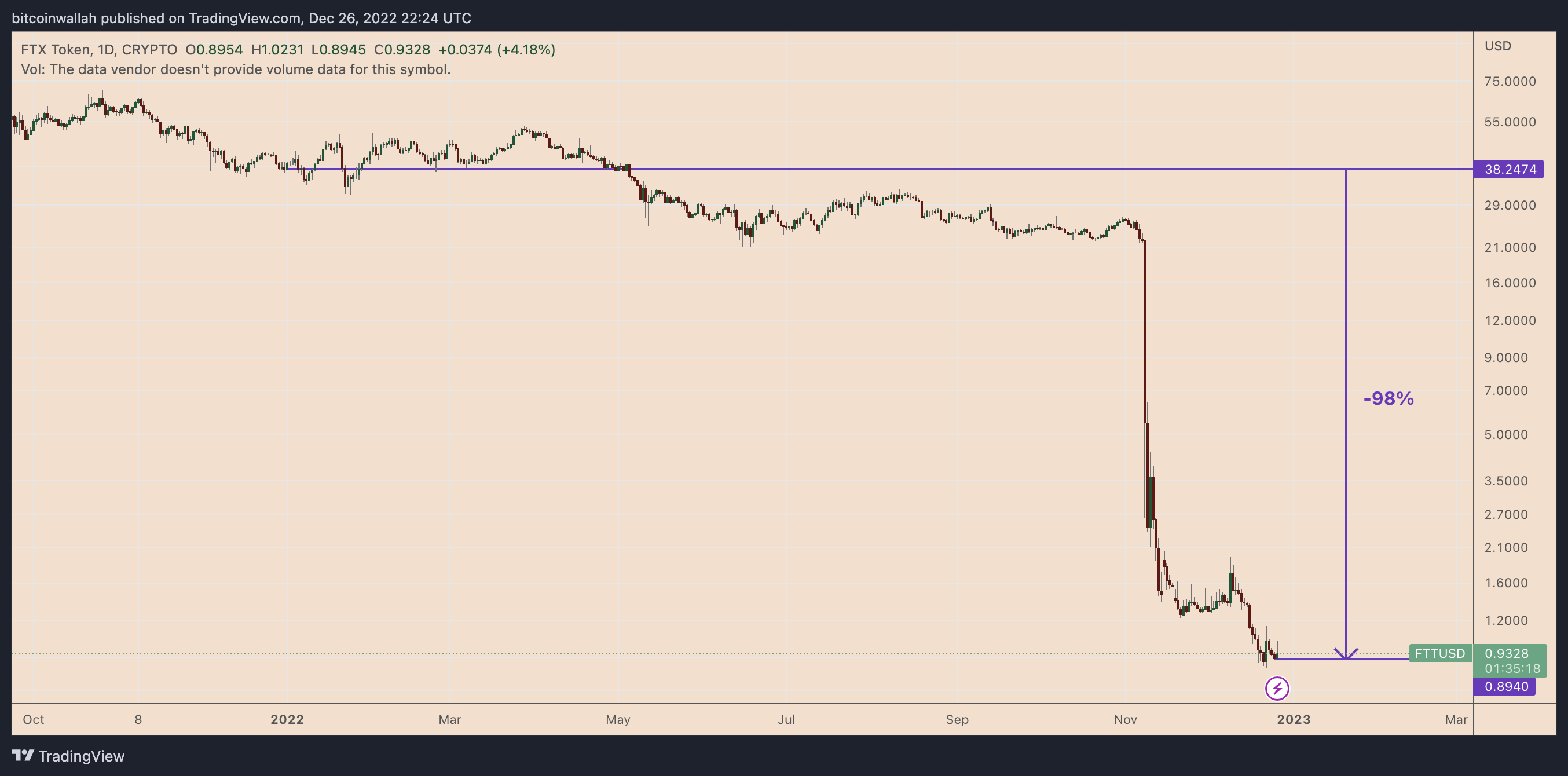
YTD performance: -98%

Sector: Centralized exchange

Market Cap: $307 million

FTX Token served as a native token to FTX, which collapsed after facing a liquidity crisis in November.

FTT/USD daily price chart. Source: TradingView

The token continues to trade across several exchanges but accompanies poor liquidity and volume. It is technically “dead” given the defunct status of FTX.

3. Solana (SOL)

YTD performance: -93.35%

Sector: Smart contracts

Market Cap: $4.11 billion

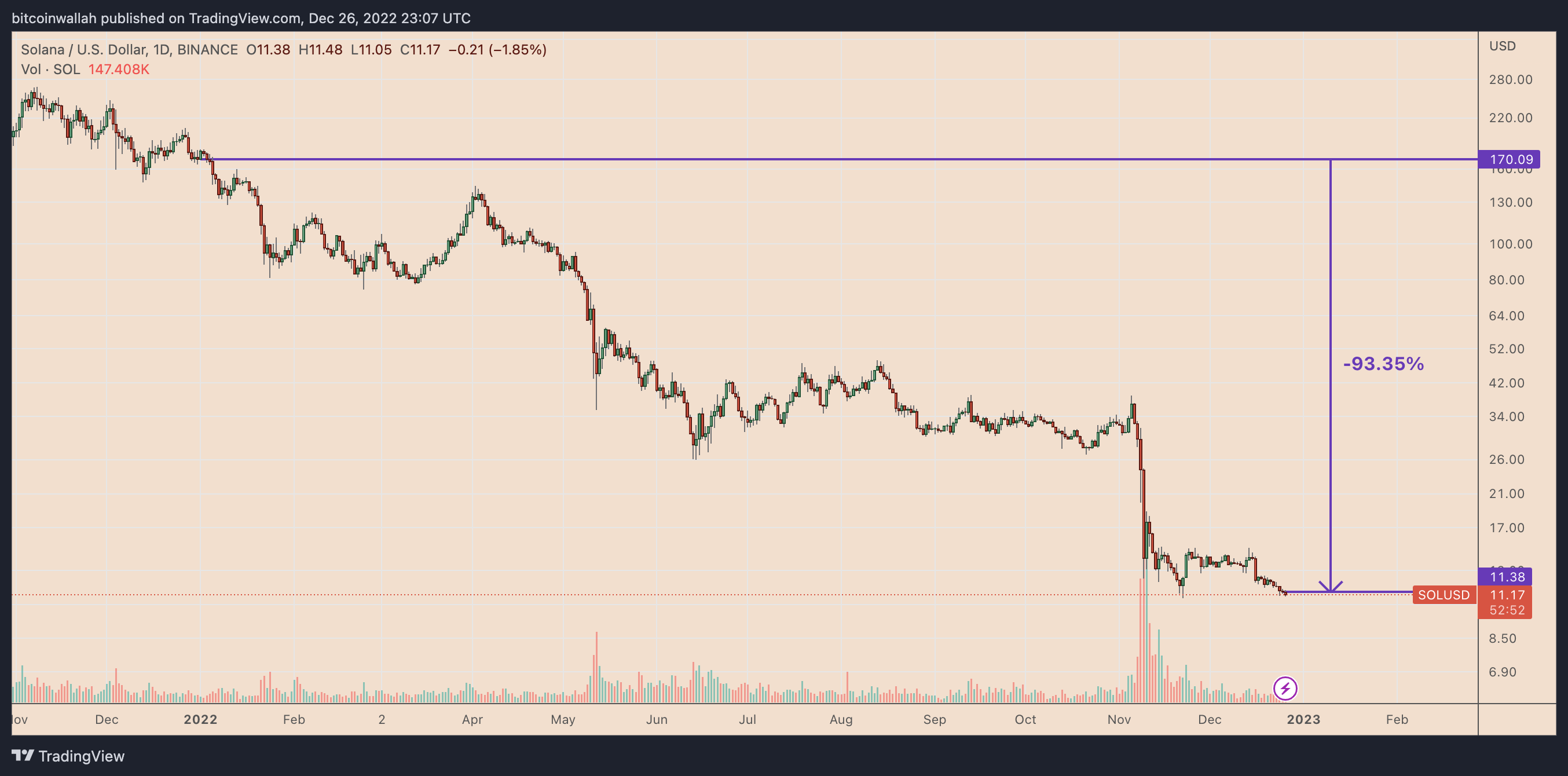
Solana, a layer-1 blockchain protocol, crashed 93.35% YTD due to a sequence of bad news all across 2022. That includes six network outages in the year, a $200 million hack on a Solana-based wallet and Solana’s association with FTX.

SOL/USD daily price chart. Source: TradingView

More bad coverage appeared in the form of accusations that Solana is not as decentralized as it claims to be, resulting in SOL being one of the worst-performers of 2022.

4. Axie Infinity (AXS)

YTD performance: -93%

Sector: Gaming/metaverse

Market Cap: $775 million

Axie Infinity Shard serves primarily as the governance token for Axie Infinity, a play-to-earn (P2E) gaming ecosystem. It also acts as a legal tender in the Axie Infinity marketplace, where in-game nonfungible tokens (NFT) can be purchased.

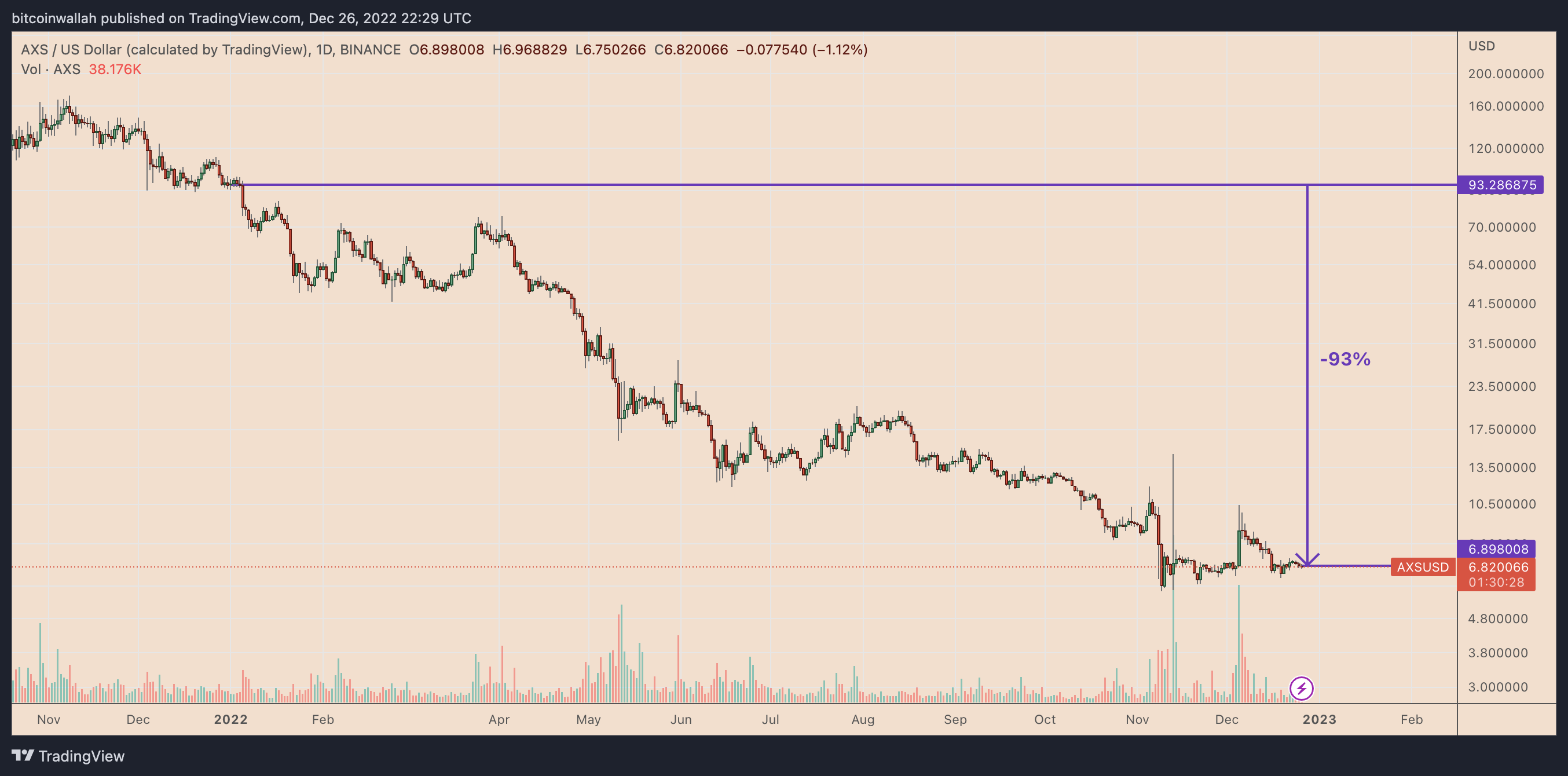
The AXS market has consistently trended lower in 2022 due to underwhelming players turnout (which lowers the demand for tokens), a $650 million hack concerning Axie Infinity’s blockchain Ronin in late March and fears surrounding the unlocking of 8% of supply in October.

AXS/USD daily price chart. Source: TradingView

AXS is down approximately 93% YTD, becoming one of the worst-performing assets in the current bear market.

5. The Sandbox (SAND)

YTD performance: -92.50%

Sector: Gaming/metaverse

Market Cap: $690 million

Like Axie Infinity, The Sandbox is a virtual platform where users can create, own and monetize their gaming skills using NFTs and The Sandbox, the platform’s utility token. But, despite initial success, the platform now has less than 500 unique users, according to data from DappRadar.

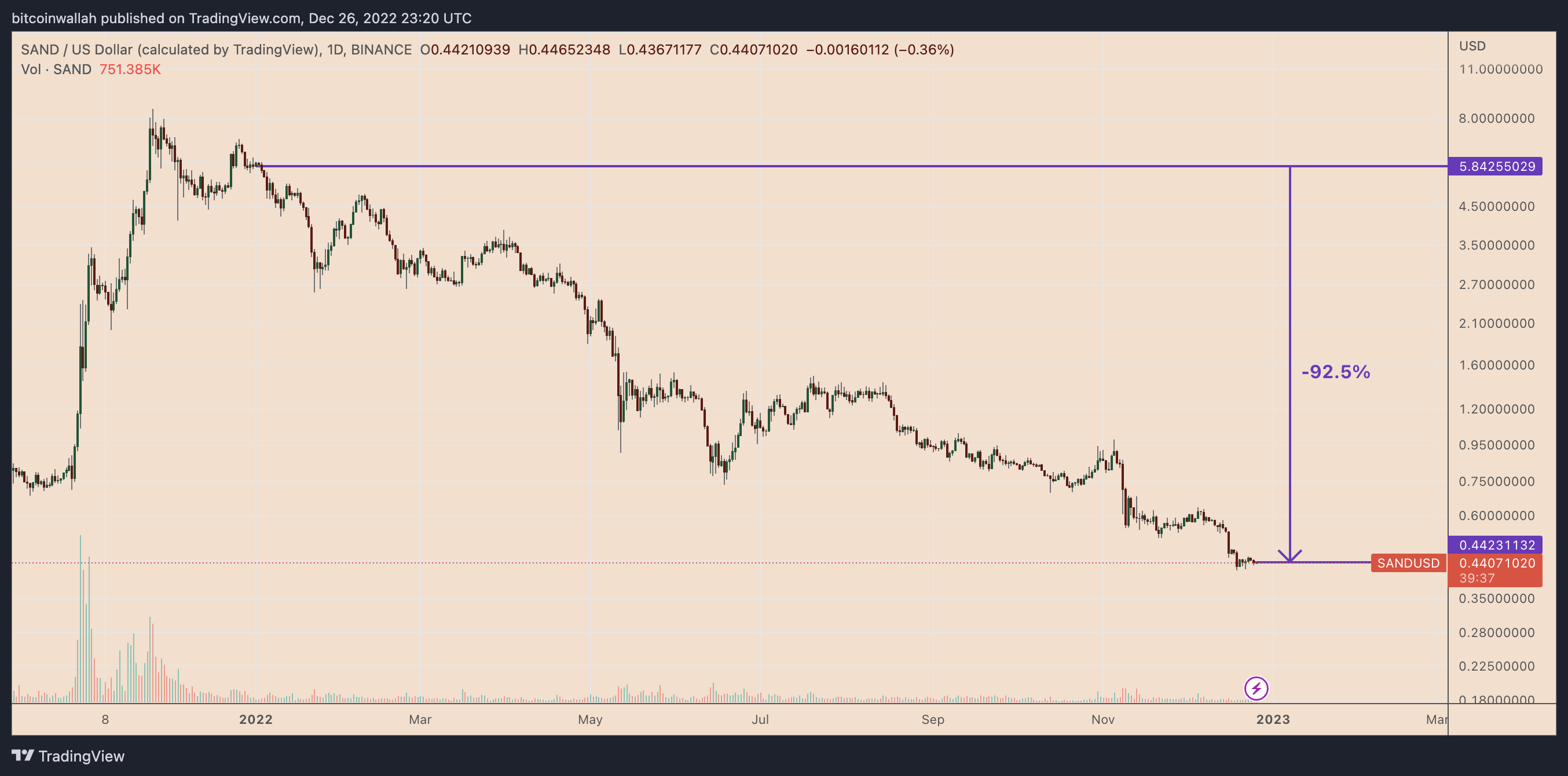
The lower turnout has affected SAND’s demand across spot exchanges, which, in turn, has pushed its price down 93.50% YTD, as shown below. Other factors behind the declining interest include a general lack of demand for riskier assets in a higher interest rate environment.

SAND/USD daily price chart. Source: TradingView

Other tokens that fell more than 90% YTD are Fantom, Avalanche, Algorand, Decentraland, BitTorrent (BTT) and others.


Related Reads

Breaking: OpenAI Undergoes Major Reorganization, President Brockman Assumes Command

OpenAI has announced a major internal reorganization just months before its anticipated IPO. The company is merging its three flagship product lines—ChatGPT, Codex, and the API platform—into a single, unified product organization. The most significant leadership change involves co-founder and President Greg Brockman moving from a background technical role to take full, permanent control over all product strategy. This follows the indefinite medical leave of AGI Deployment CEO Fidji Simo. Additionally, ChatGPT's longtime lead, Nick Turley, has been reassigned to enterprise products, with former Instagram executive Ashley Alexander taking over consumer offerings. The consolidation, internally framed as a strategic move towards an "Agentic Future," aims to break down internal silos and create a cohesive "Super App." This planned desktop application would integrate ChatGPT's conversational abilities, Codex's coding power, and a rumored internal web browser named "Atlas" to autonomously perform complex user tasks. The reorganization occurs amid significant internal and external pressures. OpenAI has recently seen a wave of high-profile departures, including Sora co-lead Bill Peebles and other senior technical leaders, leading to concerns about a thinning executive bench. Externally, rival Anthropic recently secured funding at a staggering $900 billion valuation, surpassing OpenAI's own. Google's upcoming I/O developer conference also poses a competitive threat. Analysts suggest the dramatic restructure is a pre-IPO move to present a clearer, more focused narrative to Wall Street—streamlining operations and demonstrating decisive leadership under Brockman to counter internal turbulence and intense market competition.

marsbit55m ago

Breaking: OpenAI Undergoes Major Reorganization, President Brockman Assumes Command

marsbit55m ago

Two Survival Structures of Market Makers and Arbitrageurs

Market makers and arbitrageurs represent two distinct survival structures in high-frequency trading. Market makers primarily use limit orders (makers) to profit from the bid-ask spread, enjoying high capital efficiency (nominally 100%) but bearing inventory risk. This "inventory risk" arises from passive, fragmented, and discontinuous order fills in the limit order book (LOB). This risk, while a potential cost, can also contribute to excess profit if managed within control boundaries, allowing for mean reversion. Market makers essentially sell "time" (uncertainty over execution timing) to the market for price control and low fees. In contrast, cross-exchange arbitrageurs typically use market orders (takers) to exploit price differences or funding rates, resulting in lower nominal capital efficiency (requiring capital on both exchanges) and higher transaction costs. Their risk exposure stems from asymmetries in exchange rules (e.g., minimum order sizes), execution latency, and infrastructure risks (e.g., ADL, oracle drift). These exposures are active, exogenous gaps that primarily erode profits rather than contribute to them. Arbitrageurs essentially sell "space" (capital sunk across venues) for localized, immediate certainty. Both strategies engage in a trade-off between execution friction and residual risk. Optimal systems allow for temporary, controlled risk exposure rather than enforcing zero exposure at all costs. Their evolution converges towards hybrid models: arbitrageurs may use maker orders to reduce costs, while market makers may use taker orders or hedges for risk management. Ultimately, both use different forms of risk exposure—market makers exposing inventory, arbitrageurs immobilizing capital—to extract marginal, hard-won certainty from the market.

链捕手55m ago

Two Survival Structures of Market Makers and Arbitrageurs

链捕手55m ago

Who Will Define the Rules of the AI Era? Anthropic Discusses the 2028 US-China AI Landscape

This article, based on Anthropic's analysis, outlines the intensifying systemic competition between the U.S./allies and China for AI leadership by 2028. It argues that access to advanced computing power ("compute") is the critical bottleneck, where the U.S. currently holds a significant advantage through chip export controls and allied innovation. However, China's AI labs remain competitive by exploiting policy loopholes—via chip smuggling, overseas data center access, and "model distillation" attacks to copy U.S. model capabilities—keeping them close to the frontier. The piece presents two contrasting scenarios for 2028. In the first, decisive U.S. action to tighten compute controls and curb distillation locks in a 12-24 month AI capability lead, cementing democratic influence over global AI norms, security, and economic infrastructure. In the second, policy inaction allows China to achieve near-parity through continued access to U.S. technology, enabling Beijing to promote its AI stack globally and integrate advanced AI into its military and governance systems, altering the strategic balance. Anthropic contends that maintaining a decisive U.S. lead is essential for shaping safe AI development and governance. The core recommendation is for U.S. policymakers to urgently close compute and model access loopholes while promoting global adoption of the U.S. AI technology stack to secure a lasting strategic advantage.

marsbit2h ago

Who Will Define the Rules of the AI Era? Anthropic Discusses the 2028 US-China AI Landscape

marsbit2h ago

Trading

Spot
Futures

Hot Articles

What is $BITCOIN

DIGITAL GOLD ($BITCOIN): A Comprehensive Analysis Introduction to DIGITAL GOLD ($BITCOIN) DIGITAL GOLD ($BITCOIN) is a blockchain-based project operating on the Solana network, which aims to combine the characteristics of traditional precious metals with the innovation of decentralized technologies. While it shares a name with Bitcoin, often referred to as “digital gold” due to its perception as a store of value, DIGITAL GOLD is a separate token designed to create a unique ecosystem within the Web3 landscape. Its goal is to position itself as a viable alternative digital asset, although specifics regarding its applications and functionalities are still developing. What is DIGITAL GOLD ($BITCOIN)? DIGITAL GOLD ($BITCOIN) is a cryptocurrency token explicitly designed for use on the Solana blockchain. In contrast to Bitcoin, which provides a widely recognized value storage role, this token appears to focus on broader applications and characteristics. Notable aspects include: Blockchain Infrastructure: The token is built on the Solana blockchain, known for its capacity to handle high-speed and low-cost transactions. Supply Dynamics: DIGITAL GOLD has a maximum supply capped at 100 quadrillion tokens (100P $BITCOIN), although details regarding its circulating supply are currently undisclosed. Utility: While precise functionalities are not explicitly outlined, there are indications that the token could be utilized for various applications, potentially involving decentralized applications (dApps) or asset tokenization strategies. Who is the Creator of DIGITAL GOLD ($BITCOIN)? At present, the identity of the creators and development team behind DIGITAL GOLD ($BITCOIN) remains unknown. This situation is typical among many innovative projects within the blockchain space, particularly those aligning with decentralized finance and meme coin phenomena. While such anonymity may foster a community-driven culture, it intensifies concerns about governance and accountability. Who are the Investors of DIGITAL GOLD ($BITCOIN)? The available information indicates that DIGITAL GOLD ($BITCOIN) does not have any known institutional backers or prominent venture capital investments. The project seems to operate on a peer-to-peer model focused on community support and adoption rather than traditional funding routes. Its activity and liquidity are primarily situated on decentralized exchanges (DEXs), such as PumpSwap, rather than established centralized trading platforms, further highlighting its grassroots approach. How DIGITAL GOLD ($BITCOIN) Works The operational mechanics of DIGITAL GOLD ($BITCOIN) can be elaborated on based on its blockchain design and network attributes: Consensus Mechanism: By leveraging Solana’s unique proof-of-history (PoH) combined with a proof-of-stake (PoS) model, the project ensures efficient transaction validation contributing to the network's high performance. Tokenomics: While specific deflationary mechanisms have not been extensively detailed, the vast maximum token supply implies that it may cater to microtransactions or niche use cases that are still to be defined. Interoperability: There exists the potential for integration with Solana’s broader ecosystem, including various decentralized finance (DeFi) platforms. However, the details regarding specific integrations remain unspecified. Timeline of Key Events Here is a timeline that highlights significant milestones concerning DIGITAL GOLD ($BITCOIN): 2023: The initial deployment of the token occurs on the Solana blockchain, marked by its contract address. 2024: DIGITAL GOLD gains visibility as it becomes available for trading on decentralized exchanges like PumpSwap, allowing users to trade it against SOL. 2025: The project witnesses sporadic trading activity and potential interest in community-led engagements, although no noteworthy partnerships or technical advancements have been documented as of yet. Critical Analysis Strengths Scalability: The underlying Solana infrastructure supports high transaction volumes, which could enhance the utility of $BITCOIN in various transaction scenarios. Accessibility: The potential low trading price per token could attract retail investors, facilitating wider participation due to fractional ownership opportunities. Risks Lack of Transparency: The absence of publicly known backers, developers, or an audit process may yield skepticism regarding the project's sustainability and trustworthiness. Market Volatility: The trading activity is heavily reliant on speculative behavior, which can result in significant price volatility and uncertainty for investors. Conclusion DIGITAL GOLD ($BITCOIN) emerges as an intriguing yet ambiguous project within the rapidly evolving Solana ecosystem. While it attempts to leverage the “digital gold” narrative, its departure from Bitcoin's established role as a store of value underscores the need for a clearer differentiation of its intended utility and governance structure. Future acceptance and adoption will likely depend on addressing the current opacity and defining its operational and economic strategies more explicitly. Note: This report encompasses synthesised information available as of October 2023, and developments may have transpired beyond the research period.

363 Total ViewsPublished 2025.05.13Updated 2025.05.13

What is $BITCOIN

Discussions

Welcome to the HTX Community. Here, you can stay informed about the latest platform developments and gain access to professional market insights. Users' opinions on the price of BTC (BTC) are presented below.

活动图片