Introduction
Crypto governance has no shortage of worthwhile proposals and discussions. Across all categories of DAOs, there are interesting case studies around how protocols design governance processes, as well as proposals on DAO vendor selection, protocol economics, and more. Crypto governance mechanisms are still nascent, and it is one of the most active areas of innovation. In this piece, we’ll explore several governance experiments worth paying attention to and summarize key takeaways from each of them.
Experiments in DAO governance meta-design and process
For any protocol to succeed and reach scale, various stakeholders should have input into the protocol design and direction. Most protocols today are designed as one token one vote, which is a simple but incomplete method. For reasons that are described well by Vitalik here, pure token holder voting systems can lead to inequalities, incentive misalignments, and potential attacks through vote buying. Designing sustainable, scaleable governance systems for all stakeholders is no simple task, but there are various approaches as outlined below.
Optimism bicameral governance system
Optimism launched the Optimism Collective in April 2022 to create a decentralized ecosystem and experiment with governance. For background, the Optimism Collective is a group of communities, companies, and people supportive of the Optimism ecosystem, stewarded by the Optimism Foundation. While most protocol governance designs have historically involved token governance alone, the Optimism Collective is a bicameral system governed by 2 houses, the Citizens’ House and the Token House.
The Token House votes on project incentives, protocol upgrades, and manages the treasury fund. The Token House was established by the first Optimism token airdrop (out of many future ones), which distributed tokens to thousands of people who have engaged in “positive-sum, community-oriented behavior” such as donating to Gitcoin grants and voting in DAOs.
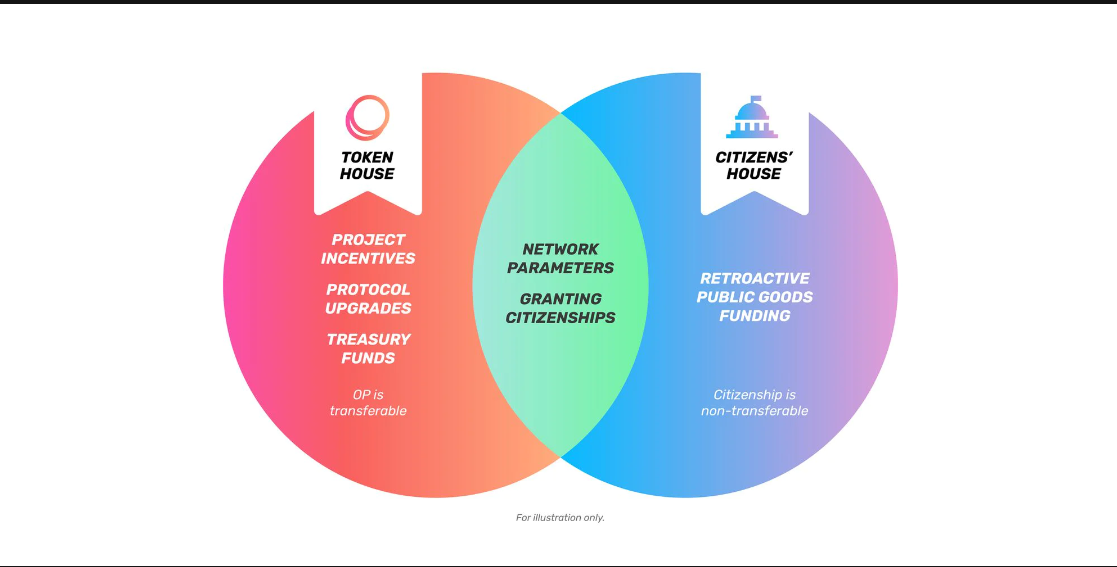
The Citizens’ House focuses on distributing retroactive public goods funding, generated from revenue collected by the Optimism network. Citizenship is granted by non-transferable tokens and will be allocated to a growing number of citizens over time. This ensures Optimism is represented by a broad set of ecosystem participants (not just token holders) and that Optimism governance won’t be driven by a plutocratic system.
Element dynamic governance council
Element launched its DAO in March 2022 as part of its decentralization roadmap. Tokens were distributed to Element community members, Ethereum Core developers, and DeFi ecosystem projects.
Element created a Governance Steering Council (GSC) with additional governance powers and responsibilities. Membership is made up of members with at least 110k tokens or 0.9% of the circulating supply delegated to them. The membership threshold is run on a continuous, rolling basis so the GSC is always open to anyone who receives enough delegation. Council membership is dynamic on a block-to-block basis, meaning that delegated votes can change at any time, resulting in changes to membership. This keeps council members accountable to community members and helps ensure they vote in their best interests.
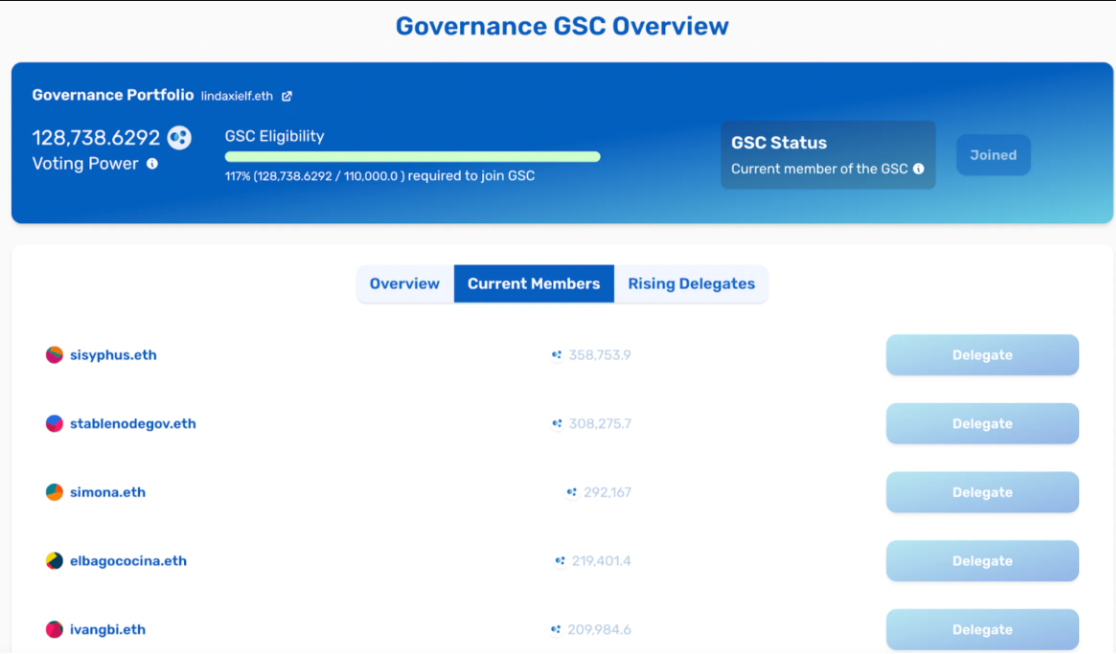
Overall, the GSC is an effort to address the lack of governance participation by allowing users to select representatives they align with. However, each GSC member only has one vote and token holder votes can override the GSC members at any time to maintain a balance so that the largest token holders don’t have the most controlling power.
Lido’s dual governance structure
Lido’s dual LDO + stETH governance structure is a novel attempt at implementing formal checks and balances in governance.
In a coin voting governance system, token holders are the only direct input into governance and can have excess impact on decisions. Other stakeholders risk being disenfranchised and subject to the whims of tokenholders. Lido’s dual LDO + stETH governance structure aims to address these concerns - it allows stETH holders staking on Lido to “veto” certain governance decisions. The scope of what stETH holders can veto is based on the downside severity of potential attacks. This includes things like protocol upgrades, mint/burns of LDO, protocol fees, and managing the node operator set.
This essentially creates a “check” on LDO holders’ governance power and ensures multiple protocol stakeholders have direct input into the governance process.
Dual stETH Governance is not live yet, as key parameters around scope and veto rules are still being discussed. Upon launching, it will be a valuable case study on how to create a governance structure that represents and allows for formal input from multiple sets of stakeholders.
ENS Metropolis pods
One of the major issues with scaling DAO governance is the difficulty in keeping up with everything happening in the DAO. The amount of information and overhead required to vote on routine decisions is large. Similarly, delegates don’t need to be involved in all aspects of day-to-day DAO operations either. Delegates won’t be an expert in every topic from finance to technical development to economic design and might not care about reviewing highly specific details. It is more efficient to establish smaller specialized groups that can focus on a specific area.
For example, ENS DAO has been working with Metropolis (formerly known as Orca), a DAO implementation that specifically focuses on enabling small working groups called pods. Each pod can specialize in a specific area such as DAO operations, protocol improvements, community, and public goods.
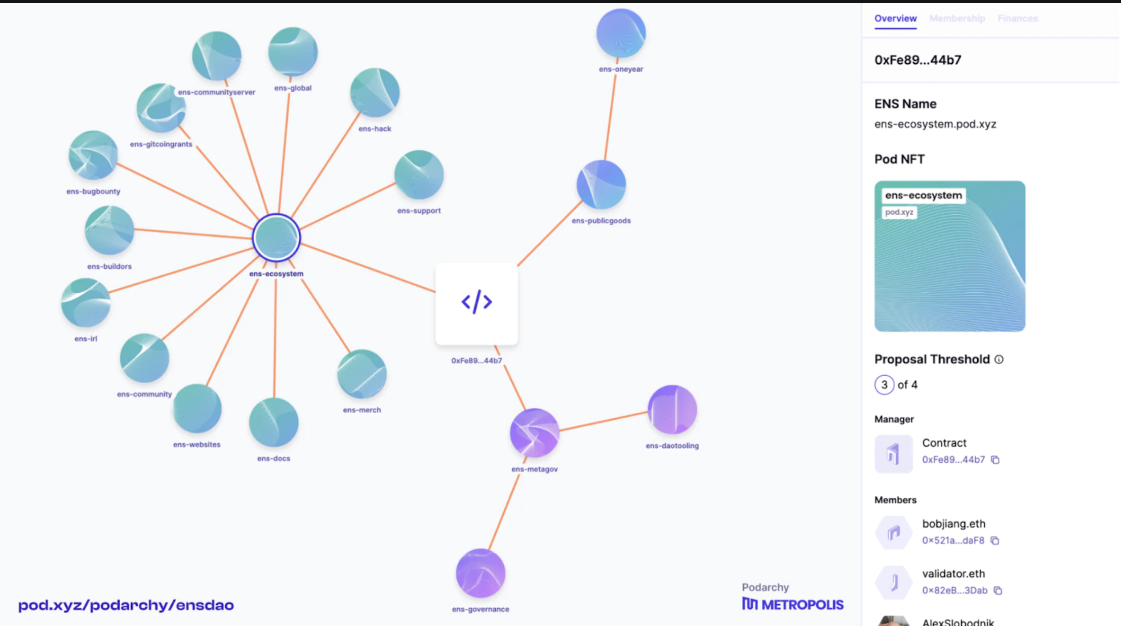
Access to pods is authorized through membership NFTs which can be revoked and allows for rotating out old members and rotating in new members. Token holders can delegate their votes (or even specific smart contract permissions) to a group address but members within that group can change over time. Each pod can also create subpods to delegate the workload further.
Nouns community-led experiments
Nouns is a DAO with a daily auction of a generative NFT, with all proceeds going to a central treasury controlled by NFT holders. It has a rich ecosystem of experiments funded by the protocol treasury and stands out for the breadth of initiatives it funds. A few worth highlighting include Prop House, Nouns Builder, and Agora.
Prop House is an open bounty system to build and fund new NounsDAO project proposals. While many protocols have grant programs, Prop House stands out for the range of things it funds - from large murals and consumer goods, to developer tooling, new front-ends, and MEV bots. Nouns is notable for the enormous range and scope of things it funds, and Prop House is at the center of this dynamic.
Nouns Builder is a new tool created by Zora to allow anyone to replicate the Nouns auction dynamic. It’s a simple no-code tool and lowers the costs of creating and scaling a DAO. Nouns Builder helps proliferate the daily auction mechanism, and essentially “productizes” some of the key innovation that has helped Nouns grow in the first place. Nouns’ daily auction mechanism is an important primitive for increasing distribution and engagement, and allowing others to use it easily is valuable.
Agora is a delegation tool that allows Nouns holders to have granular control over how to use and distribute their governance rights. It has some notable features including:
Full Delegate Visibility: All voting track records and reasoning behind the vote is shown.
Liquid Delegation: Allows token holders to distribute their voting power in a modular way, letting certain delegates vote on a certain class of decisions while reserving other decisions for separate delegates.
Delegate Race: Recurring competitions to allocate voting power to the most upvoted delegates.
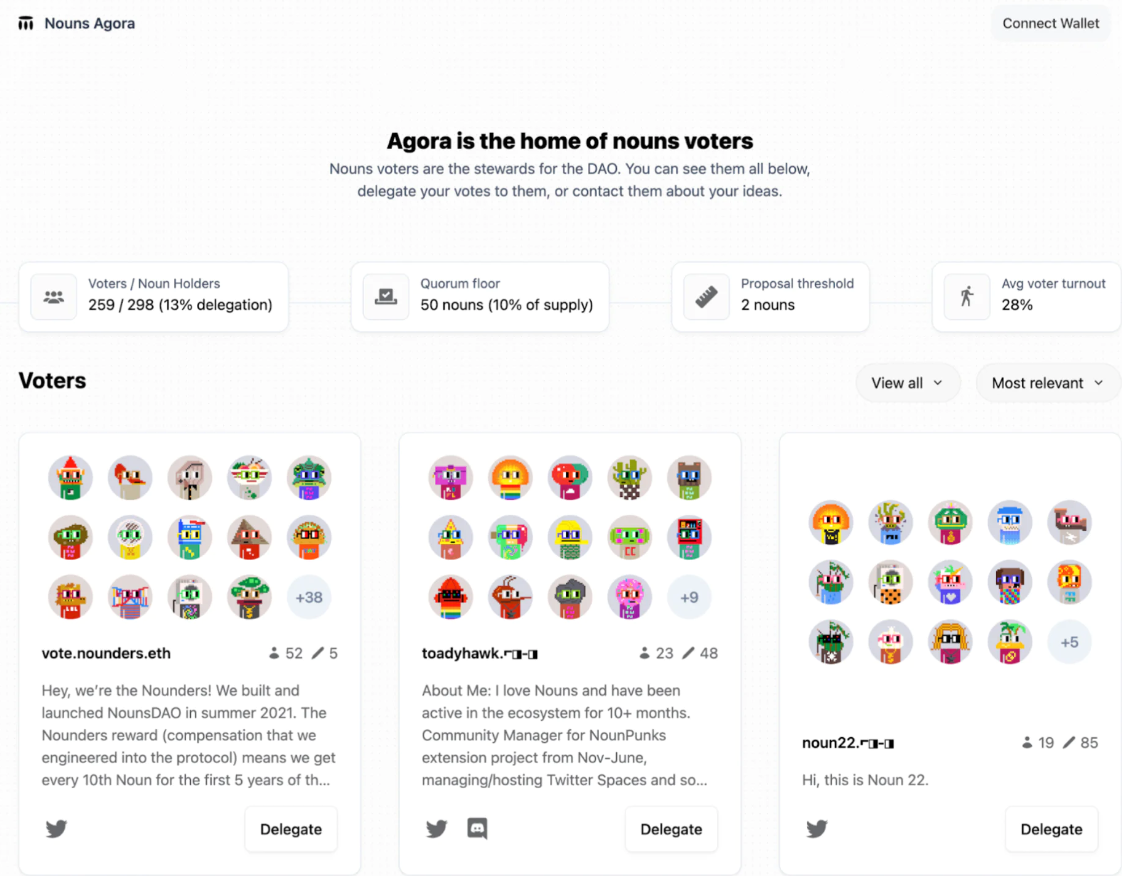
Overall, Nouns represents one of the most exciting and innovative projects in crypto governance. It is very likely that more primitives and tooling built for Nouns will proliferate and influence how other protocols build and scale their governance platforms.
Noteworthy DAO Governance Proposals
DAO governance has no shortage of proposals containing debate and drama. From vendor selection proposals, to protocol vision and roadmap proposals, to protocol economics, there are a myriad of examples to go through.
ATOM 2.0
Every protocol goes through a “hero’s journey” of understanding what its core mission is, and how to capture value in doing so. It took Bitcoin ~10 years to decide on a vision of “Digital Gold,” but not before considering other paths such as “digital cash” or “payments network.” Ethereum has also considered many different paths, including “World Computer, “fundraising platform” “DeFi,” and “DAOs.”
Cosmos is no different - it has undergone many discussions on its long-term purpose and vision. The most recent effort, the ATOM 2.0 initiative, is a collaboration between many stakeholders within the Cosmos ecosystem to create a unified vision for the Cosmos Hub.
The main purpose of this initiative is to give the Cosmos Hub a way to create value for the ecosystem and capture it for ATOM holders. This is done through a few specific concepts, including interchain security, liquid staking, an interchain scheduler, and an allocator module. Together, these ideas allow the ATOM Hub to provide security, funding, and support for other application chains. Protocols such as USDC, Neutron, and others plan on launching and using some of the key ideas laid out in the paper.
The ATOM 2.0 proposal ultimately did not pass, as some community members did not agree with all components of the paper, especially those around economic policy and token allocation. Nonetheless, discussion continues on how to best move forward, and many of the ideas laid out are still being carried through. Overall, the ATOM 2.0 initiative is a valuable case study on how protocols coalesce on a unified vision and focus.
Osmosis Bridge Selection
The Osmosis bridge selection process was a unique way for a DAO to conduct vendor selection. For background, Osmosis is a decentralized exchange that provides access to assets on all chains, starting with Cosmos. It became essential to enable Osmosis users to trade EVM assets, and doing so would require integrating EVM to Cosmos bridge providers. For UX and engineering reasons, the community decided that selecting a single canonical bridge provider was optimal, as opposed to integrating multiple.
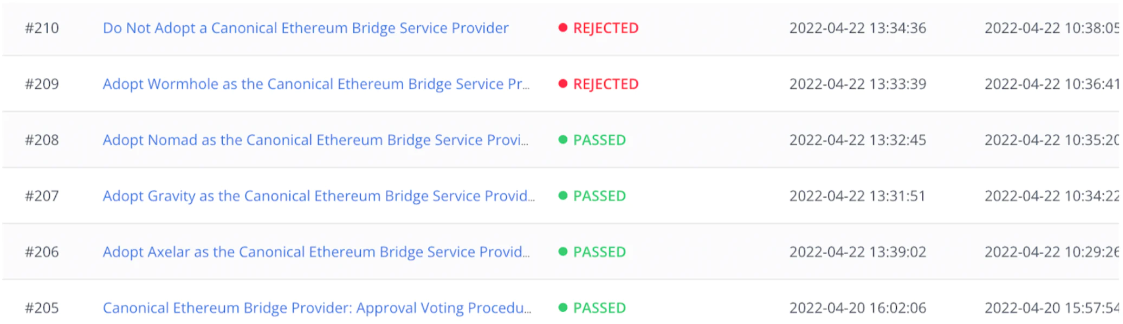
Picking a single canonical provider required a vendor bake-off that compared the bridge providers on various axes - UX, security, execution, and reputation. Four bridges participated in this bake-off: Axelar, Wormhole, Nomad, and Gravity. These debates took place over Community Calls, AMAs, Twitter Spaces, and other public venues.
The final choice was left to the DAO itself, with the voting process taking place via a series of on-chain governance proposals. All four bridge options created a proposal, with the proposal with the most “YES” votes being selected. Axelar ended up winning the final vote, and today remains the canonical bridge for EVM chains to Osmosis. Many more protocols will need to work with external partners, and the Osmosis Bridge Selection process remains an interesting case study to analyze.
Fei and Rari DAO merger
Fei and Rari Capital merged in Dec 2021, becoming the largest DAO merger seen to date. Both communities voted to allow Rari Capital’s RGT tokens to be converted to Fei’s governance token TRIBE, at a rate of ~26.7 TRIBE per RGT. Token holders that did not agree with the merger were given an opportunity to exit or “ragequit” so that the remaining token holders would be aligned. While there ended up being issues with the merger such as a debate over compensation involving a Rari Capital hack as well as Tribe DAO itself shutting down, it is an interesting experiment of how protocols can merge.
Uniswap fees
There has been significant discussion around whether or not to turn on a “fee switch” for Uniswap which would lead to a portion of the fees being retained by the Uniswap protocol. Uniswap community members proposed turning on this fee switch in a testing capacity that would be among a limited set of 3 pools for 120 days.
The proposal was supported by an overwhelming majority during a consensus check conducted in Aug 2022. Given Uniswap’s important role in the DeFi ecosystem, the experiment results will likely help guide other projects in discussions around whether or not they should vote in ways for the protocol and community to be able to earn from fees and accrue value.
Gitcoin company to DAO
Gitcoin DAO launched in May 2021 and the original company behind building Gitcoin, Gitcoin Holdings, intended to pass the torch over time to further decentralize the project. Gitcoin DAO passed a proposal in March 2022 to transfer the ownership of Gitcoin Holdings’ assets (domains, code repositories, trademarks, social media accounts) to the Gitcoin Foundation.
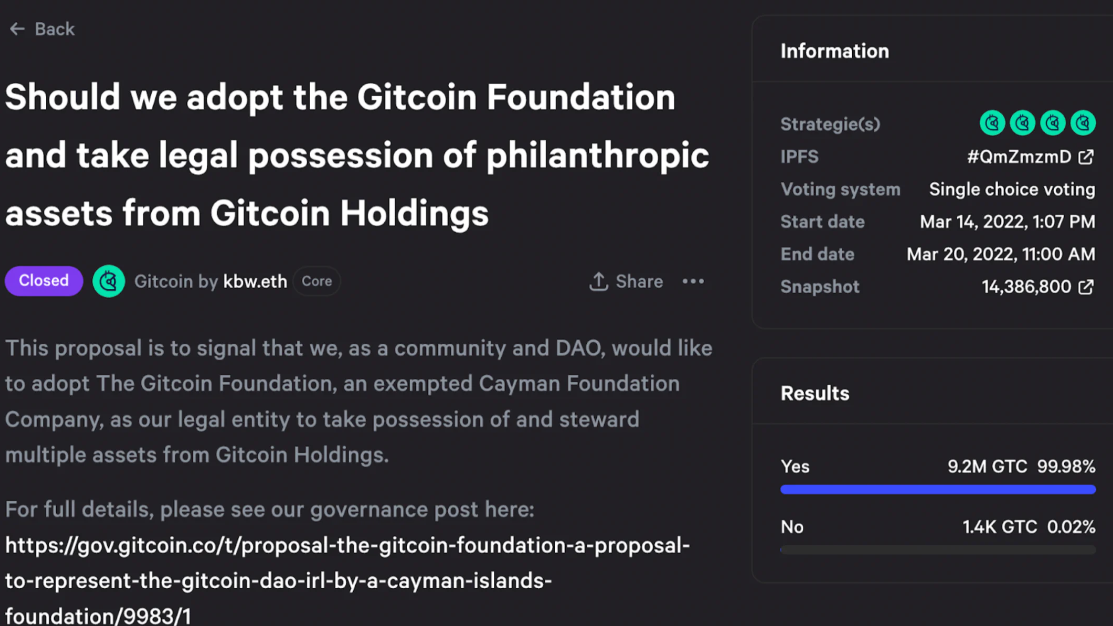
Employees who were part of Gitcoin Holdings subsequently submitted proposals to Gitcoin DAO to join the DAO as an official working group. For example, the Gitcoin Product Collective team which focused on building key products in the ecosystem under Gitcoin Holdings requested to formally enter the DAO as a workstream and receive funding for their work which was voted in by Gitcoin DAO.
Conclusion
Decision-making across thousands of tokenholders is no easy task. Crypto governance is still very early and has room to improve across many facets, including resource allocation, checks and balances, and distribution of power.
There’s no panacea today, but tracking experiments across the ecosystem can help shed some lessons for the next iteration of protocol governance. We hope this synopsis provides a resource for protocol operators aiming to launch, bootstrap, and operate their governance process efficiently.