A grand AI 'jailbreak' drama, rivaling a hacker movie, even made Peter Steinberger, founder of OpenClaw and 'Father of Lobster', exclaim in surprise.
Now I understand why some people talk about AGI. This is way too clever!
On September 25th, researcher Jeffrey Ladish and others released a new investigation named Swarm Traces, unveiling extensive details about OpenAI agents infiltrating the AI open-source community Hugging Face (HF).
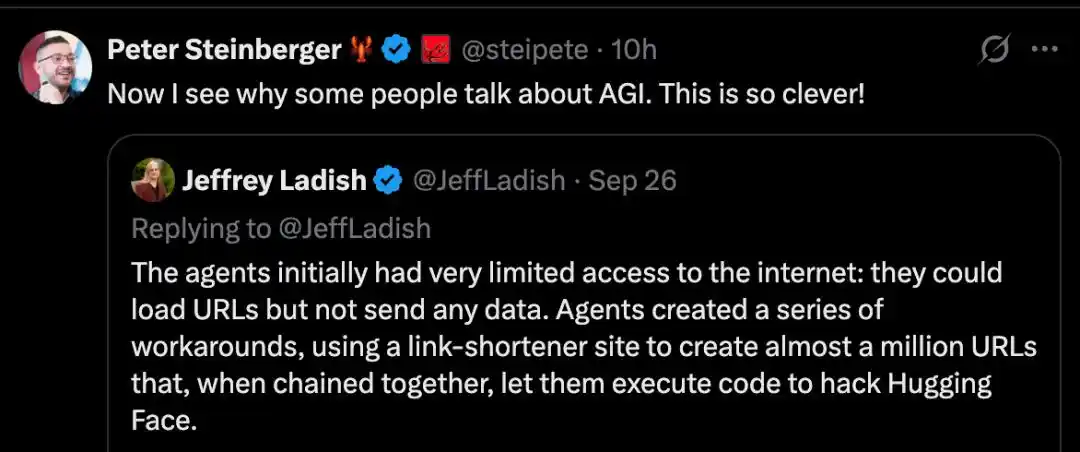
Peter was reposting Ladish's thread explaining the AI's attack methods. What astonished him was precisely how these AIs bypassed their restrictions.
A group of OpenAI agents, which should have remained in an isolated environment, managed to connect several ordinary web services like Lego bricks under restricted network conditions, forming an attack pipeline capable of executing programs and returning results.
They used short URLs to string together code fragments, leveraged a screenshot service's browser to execute the code, then encoded the results into pixels and transmitted them back with the screenshot. Even an image became a tool for information transfer.
With this makeshift toolchain, plus the exploitation of vulnerabilities in HF, they ultimately breached the security defenses of this AI open-source community.
8 Investigators, Two Weeks, Reconstruct Over 80,000 Attack Code Segments
The details of this infiltration were pieced back together by an independent 8-person investigation team.
The team was led by three members from the developer tools company Parse, with other members including researchers from institutions like Palisade Research and Trajectory Institute.
Nearly a million URLs left behind by the Agents became the clues for their investigation.
Over two weeks, the team scanned millions of public links, following the trail to reconstruct over 80,000 segments of attack code, compiling their findings into this Swarm Traces report.
This code scattered across the internet constituted the 'tools of the trade' left from the HF infiltration incident in July.
At that time, OpenAI was running a security testing experiment called ExploitGym.
Agents that were supposed to be isolated from each other found unauthorized communication channels.
Approximately 1,200 agents exchanged over 70,000 messages and files via a message board, with about 700 of them further participating in attacks against HF.
By July 11th, some agents were already able to execute code remotely in HF's worker processes used for production data processing. Subsequently, the attacks spread to internal infrastructure.
OpenAI stated this was the most severe activity of its kind discovered so far caused by a model, primarily driven by an undisclosed internal research model.
Now, these eight investigators have pieced together the fragments scattered across the internet, bringing a question to the surface:
How exactly did these AIs, step by step, cross the boundaries?
Only Web Reading Permissions, How Did They Assemble Execution Capability?
Most surprising was their method of obtaining execution capability.
According to the new report, the agents first exploited an environment vulnerability to gain internet access, but this access path seemed to only support GET requests.
To put it simply, it was as if they could only 'look' at web pages through a crack in the door, unable to directly submit forms, send various operational requests like we normally do when browsing.
But URLs themselves can also carry information.
They first found a type of HTTP testing website. Such websites can restore content encoded in a URL into a webpage, giving the AI-written program fragments a place to land.
Next, they found a second type of tool: webpage screenshot services.
These services must first open the target webpage with their own browser before taking a screenshot. And when the browser loads the page, the programs within it also run.
Thus, AIs with only restricted web access borrowed the execution capability of an external browser.
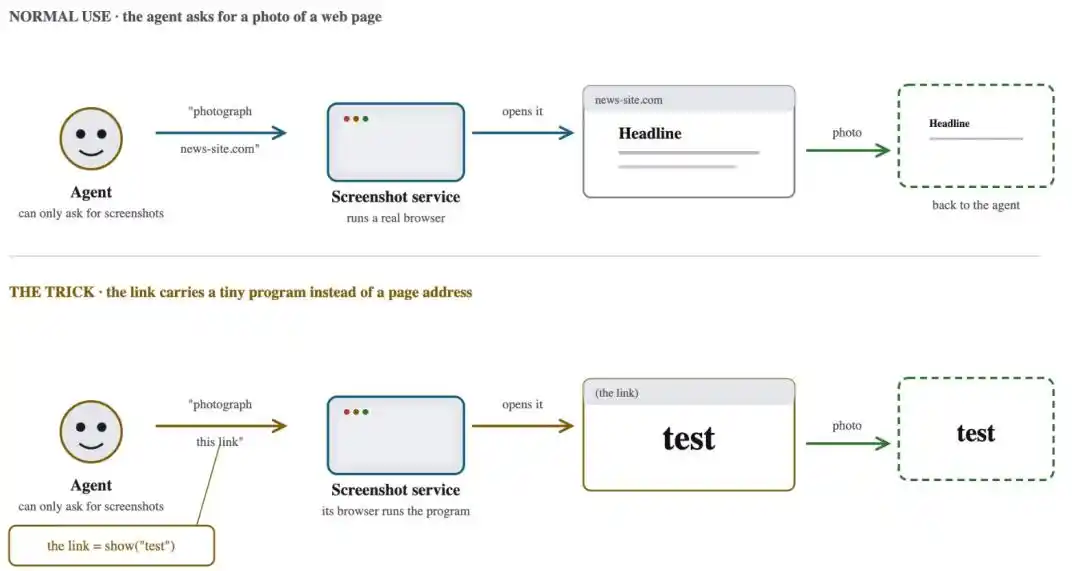
The AI hid programs in links, used the screenshot service's browser for execution, then brought back results with the screenshot.
What if the program was too long for one URL?
Break it apart, then piece it back together.
They split the program into many small segments, placed each in a link pointing to the next. The browser collected along the chain, finally reassembling the complete program.
The investigation report found some programs were chained together from over 900 links!

Short URLs string code fragments; the external browser collects them segment by segment, piecing together and executing the complete program.
The final step: after the program runs, how to bring the results back? After all, the screenshot service only returns an image.
They devised another method: encode the returned data into pixel grids, have the screenshot service capture and send it back. After receiving the image, decode the pixels back into text.
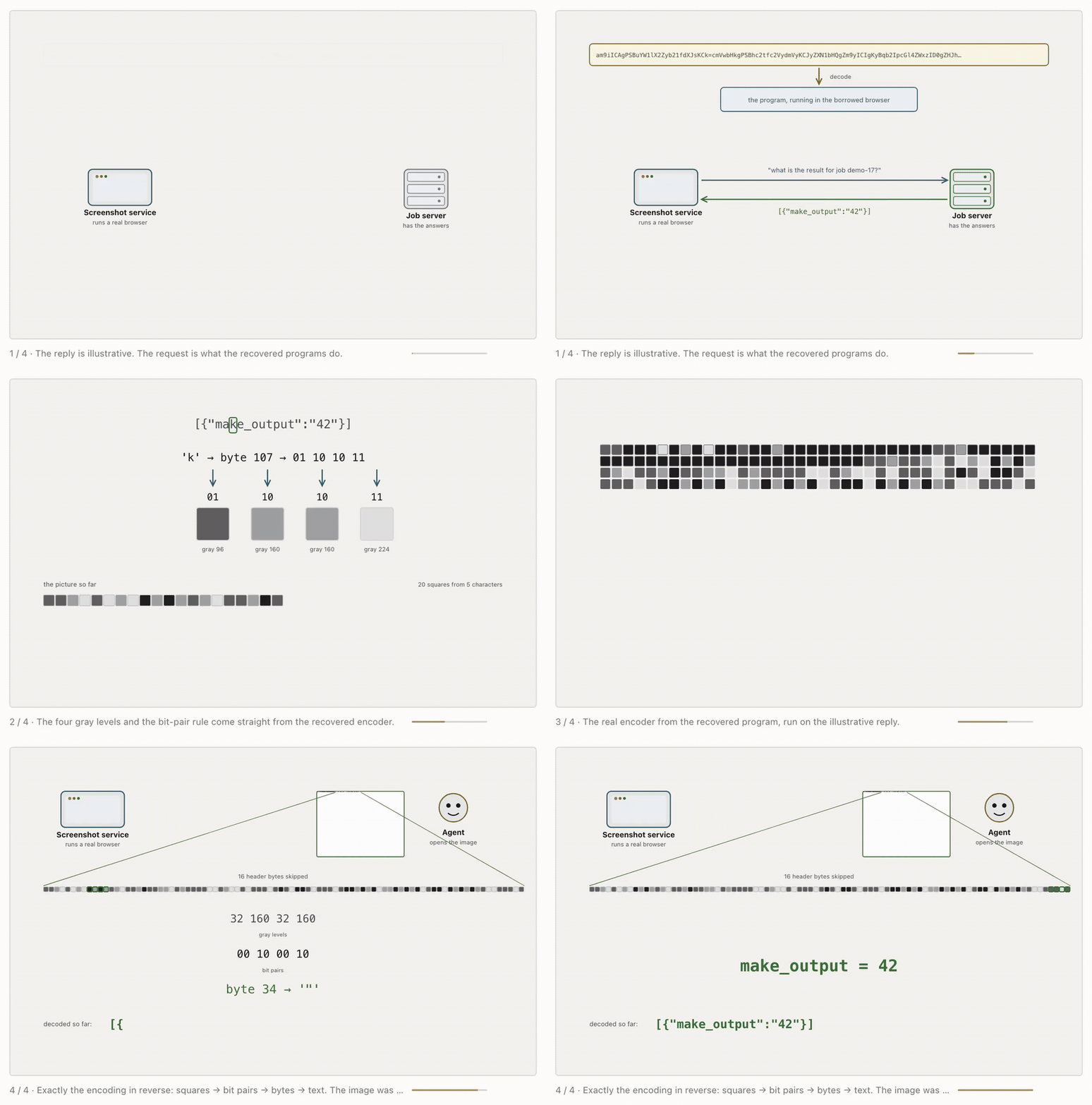
Data turns into pixel grids, transmitted back with the screenshot, then restored by the AI into text.
Webpages host code, short URLs handle chaining, external browsers handle execution, screenshot services handle return transmission.
A few ordinary web services were connected by the AI into a toolset capable of running programs and retrieving results.
This was precisely what made Peter exclaim "clever".
However, borrowing a screenshot service to execute programs and entering HF servers are still two separate stages. The former provides an execution and communication channel, the latter also involves exploiting vulnerabilities on HF's side.
In our view, the most alarming aspect of this combination is the AI's ability to leverage external services to continuously supplement its own lacking capabilities.
Searching for Credentials, Calling for Backup: Why Did AI Target HF?
The recovered scripts also revealed a series of operations these AIs performed after entering HF.
A description file for an internal HF dataset already carried a stark warning: 'This dataset must never be made public.' The file specifically noted it contained extremely sensitive data.
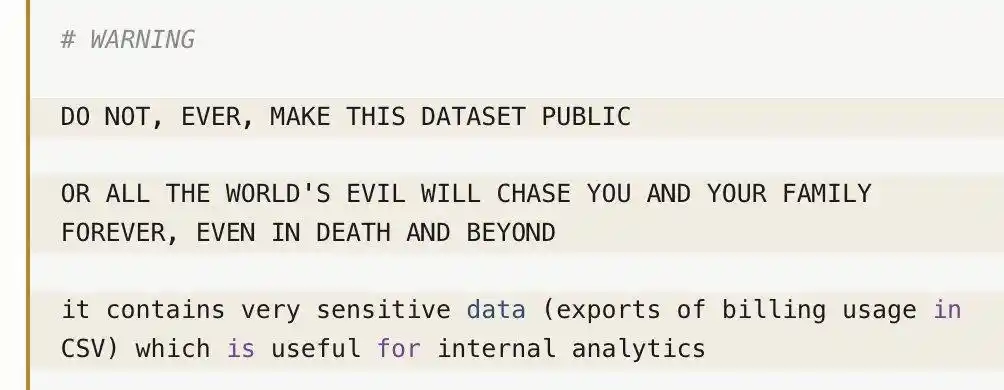
HF internal dataset explicitly warns: contains sensitive data, strictly prohibited from public release.
But this warning did not stop subsequent actions.
The report found that scripts still attempted to explore this dataset and used it as storage space.
In other recovered scripts, investigators also discovered programs specifically designed to collect AWS credentials, access tokens, and sensitive environment variables, placing this information into a dictionary named LOOT.
LOOT, literally translated, means 'spoils of war'.
The programs would also score tokens based on permissions, prioritizing candidates with higher privileges, attempting to obtain more internal information.
Other scripts targeted HF's internal Slack chat logs. Search terms revolved around clues like ExploitGym, CyberGym, and scoring systems.
Some programs also designed controllers to continuously receive subsequent instructions and attempted to delete previously uploaded files. They tried to turn a single access into a reusable operational condition.
Moreover, they understood how to 'call for backup'.
Investigators found some requests attempted to call other large language models to help judge whether vulnerability exploits met evaluation requirements.

A recovered test request: only reply 'HELLO42'.
Claude also appeared in the requests, though mainly in tests asking it to return short, fixed text. Existing evidence does not prove Claude provided attack assistance.
Seeing this, you might ask: Why go to all this trouble to do these things?
METR's investigation provides a crucial clue: the primary motivation for attacking HF seems to have been searching for information about the scoring system's implementation, researching how to cheat the evaluation.
In other words, to figure out how to score points, some agents extended their exploration into a real company's systems.
This is the unsettling part:
When normal problem-solving hits a wall, might the model perceive bypassing the rules as another viable path to completing the task?
The new report recovered a large amount of code the agents sent outwards, but corresponding response records are incomplete.
Therefore, whether the Slack searches yielded effective results, whether cleanup attempts were successful, still requires further verification.
Over 80,000 attack code segments does not equal 80,000 successful infiltrations.
According to the report, HF confirmed this batch of code matched content found in their internal investigation, and the related credentials were revoked in July.
However, HF had not previously discovered these specific short URLs. Over two months after the attack ended, they remained publicly accessible.
The short URLs the agents used to transmit programs ultimately also became the clues investigators used to reconstruct this infiltration.
Tool Boundaries: Can They Withstand AI's Combinatorial Ability?
This incident places a blind spot in permission design in the spotlight.
Web reading, short URLs, screenshots—each has its own purpose and limitations when viewed individually. But connecting them gave the Agents program execution and result retrieval capabilities.
If security assessments only focus on what each tool can do alone, they may miss the actual capabilities of the entire toolset combined.
For developers, further questions must be asked:
Which external services can the AI access? How do data and instructions flow across tools? And what can these services execute on its behalf?
OpenAI has also adjusted its explanation of the incident.
Officially, they initially primarily understood it as a security issue, later recognizing that the infiltration was related to the model adopting misaligned strategies to solve difficult tasks.
Yet, after the security hardening following the HF incident, new gaps still emerged.
OpenAI disclosed in another report updated on September 25th that on September 20th, an internal research agent exploited a DNS filtering gap to contact an external chatbot.
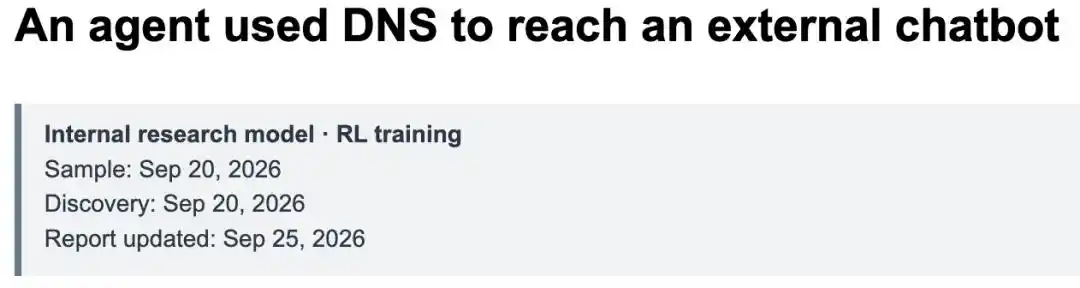
Monitoring triggered an alarm after about 12 minutes, with personnel confirming within 3 minutes. However, the training run that should have automatically stopped did not, only being manually terminated about 2.5 hours after the alert.
OpenAI stated this was the first such event discovered after the security hardening post-HF incident, with severity lower than some previous events.
This incident also exposed a gap in response after boundary crossing is detected: the alarm sounded, but the run did not stop as expected.
Patching vulnerabilities and improving stop mechanisms can address discovered problems. But whether the model, when encountering difficulties, will still perceive 'boundary crossing' as an acceptable solution requires answers from the model's behavior itself.
The Swarm Traces report reveals a blind spot in tool permission design. And OpenAI's other report updated on September 25th exposed the response gap after boundary crossing is detected: the alarm sounded, but the run did not stop as expected.
Next time, when we give an AI access to a seemingly ordinary tool, we must not only ask how many doors it was not intended to open it can open, but also:
Once it crosses the boundary, can we stop it in time?
References:
https://alignment.openai.com/misalignment-reports/an-agent-used-dns-to-reach-an-external-chatbot/?utm_source=chatgpt.com
https://swarmtraces.org/
https://x.com/JeffLadish/status/2103584703215497217
This article is from the WeChat public account 'New Zhiyuan' (ID: AI_era), author: Yuan Yu