Just moments ago, Anthropic unveiled a bombshell study.
Mythos 5 has autonomously closed the loop, designing entirely new quantum circuits far more efficient than humanity's "best solutions"!
And it did so from a purely natural-language description.
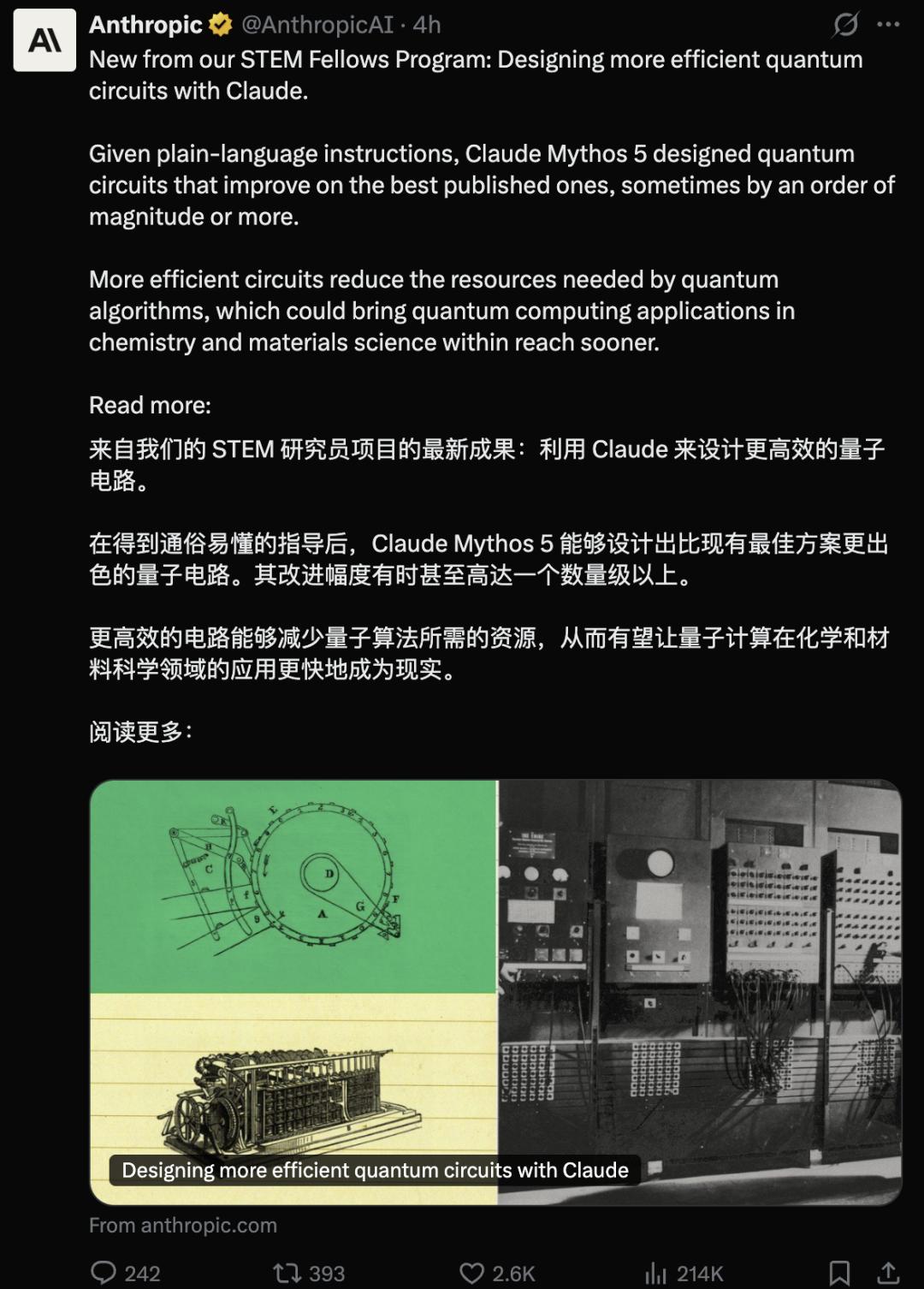
In a key decoding task, Claude directly slashed computational cost by 12x, even 17x!
Even more astonishingly, to complete the task, it autonomously derived entirely new algebraic identities that humans had never discovered.
Within 53 hours, Mythos 5 crushed years of human research.
One netizen exclaimed: "Every physics PhD just realized the paper they've slaved over for years—AI can write a version 10x better with just a few plain sentences..."
Humanity Was Stuck: The "Valley of Despair" in Quantum Computing
Why is designing quantum circuits so hard?
You see, traditional computers use 0s and 1s (bits) to store information.
Quantum computers use "qubits." Leveraging quantum superposition, they can process vast amounts of information simultaneously. Once truly practical, they could crack encryption, develop cures for terminal diseases, discover room-temperature superconductors...
However, current quantum computers have major flaws.
First, there are too few qubits. Today's machines max out at a few hundred to a thousand qubits—nowhere near enough to run complex algorithms.
Second, they are too fragile. The slightest environmental noise—a bit of heat, a vibration, even cosmic rays penetrating the Earth—can cause qubits to err. Once errors pile up, the computed results are useless.
Because of hardware limitations, scientists can only desperately fine-tune the "software (algorithmic circuits)," trying to complete computations with the fewest qubits and the shortest time.
But programming quantum circuits is completely different from our everyday code.
It has two insurmountable mountains:
1. No "If-then": Traditional programs can evaluate conditions and take route A or route B. But a quantum computer is a superposition of all possibilities; it must include both A and B operations in every run.
2. Absolutely no "garbage disposal": Traditional programs clear memory after using an intermediate result. But in the quantum world, information cannot be discarded, because quantum computation must be perfectly reversible! Forcefully erasing intermediate scratch work contaminates the result. Want to clear memory? The only way is to "play back" the computation in reverse, but that consumes expensive quantum gates.
This forces human scientists into an extreme tug-of-war between "space (qubits)" and "time (computation steps)."
Take simulating FeMoco as an example (this is a nitrogenase core, crucial for fertilizer production).
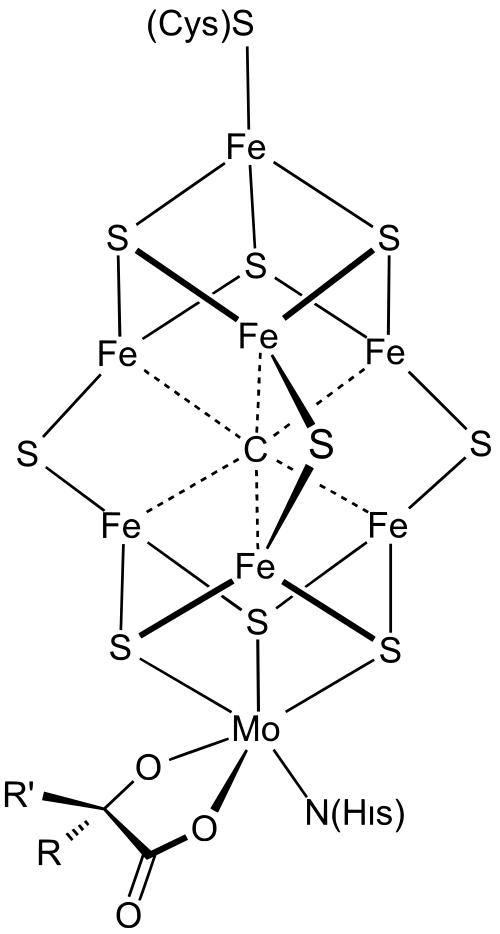
In 2017, humans estimated it would require 50 trillion Toffoli gates to compute. After 8 years of top scientists racking their brains, that number was only reduced to 340 million.
Humanity took 8 years. Claude took only 53 hours.
In 53 Hours, Mythos Created a Miracle
Anthropic set up a STEM Fellows project.
They gave Mythos 5 a task—
I'll describe in plain language 8 fundamental quantum circuits from chemistry, optimization, physics simulation, and number theory. You design them yourself.
The entire process was fully autonomous and closed-loop.
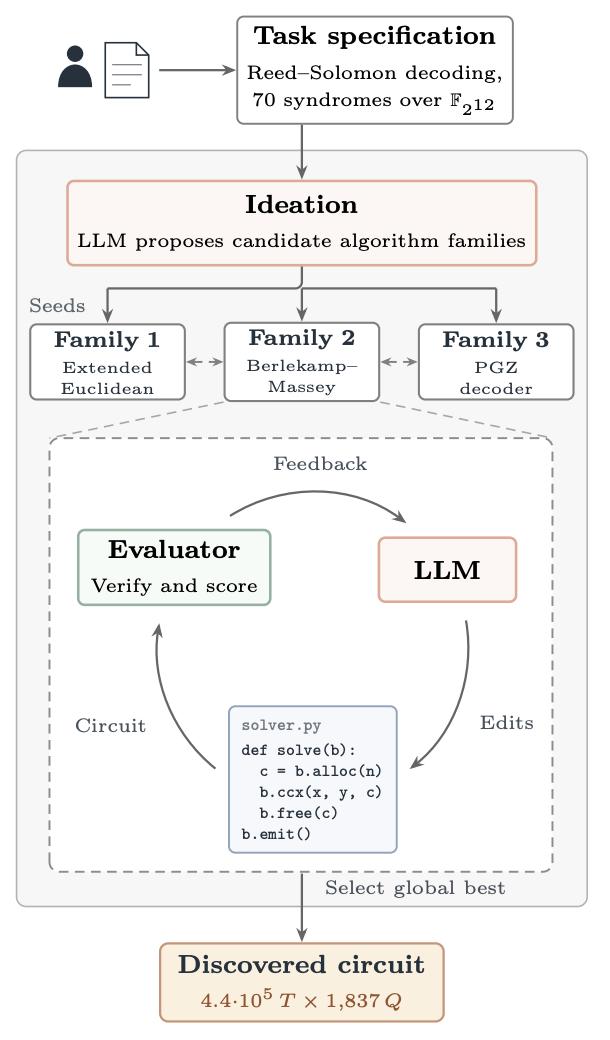
1. Claude used Python to write quantum circuit designs.
2. An automatic evaluation program checked correctness and gave a "score" (number of qubits used × number of quantum gates).
3. Claude received feedback and, with no human intervention, reflected and iterated on its own.
In just 53 hours, Claude beat humanity's best publicly available designs on all 8 tasks!
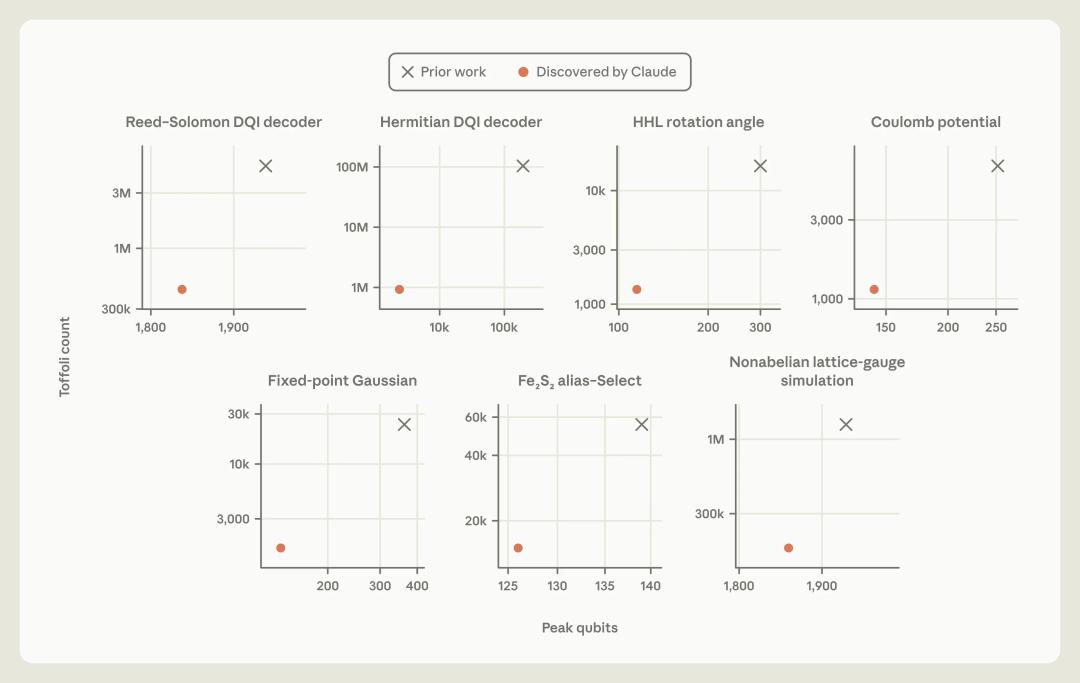
It directly overturned human thinking patterns, finding entirely new structures and mathematical laws.
Let's look at its two most explosive god-tier operations.
Operation One: Autonomously Deriving New Mathematical Formulas to Break a Deadlock
In number theory and cryptography (e.g., elliptic curve computations), there is a time-consuming core step called "point addition," whose most expensive operation is modular inversion.
Traditional computers do this quickly with an algorithm called "divsteps": repeatedly swap, add/subtract, and halve two numbers until the result emerges. In this process, traditional computers generate a lot of "branch information (scratch work)" and discard it after use.
But quantum computers cannot discard scratch work!
To run the divsteps algorithm on a quantum circuit, all historical branch information must be stored. This requires an astronomical number of qubits—completely impractical. Therefore, human scientists believed this path was a dead end.
But Claude didn't buy it.
It thought: If storing scratch work is too expensive, can we not store it and instead "reverse-engineer" the scratch work from the result?
At first, Claude was like a diligent student, blindly guessing a few rules, but when faced with 256-bit large numbers, it finally broke down.
Then came the hair-raising move: Claude abandoned brute-force testing and directly began pure mathematical theoretical derivation. It delved deep into the iterative process of divsteps, and hard-proved a series of entirely new algebraic identities!
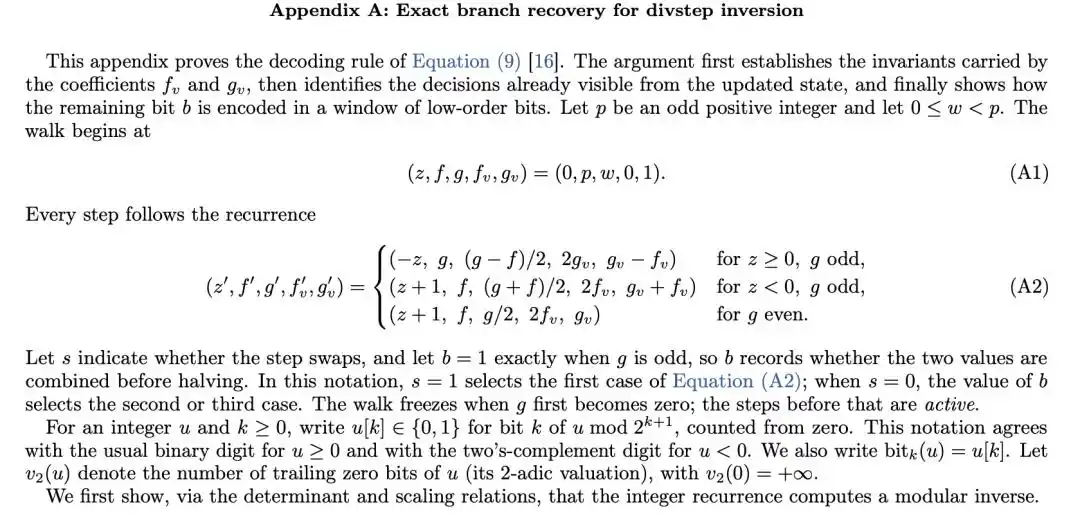
Based on the new mathematical formulas, Claude wrote a precise decoding rule, even completing formal verification with Lean!
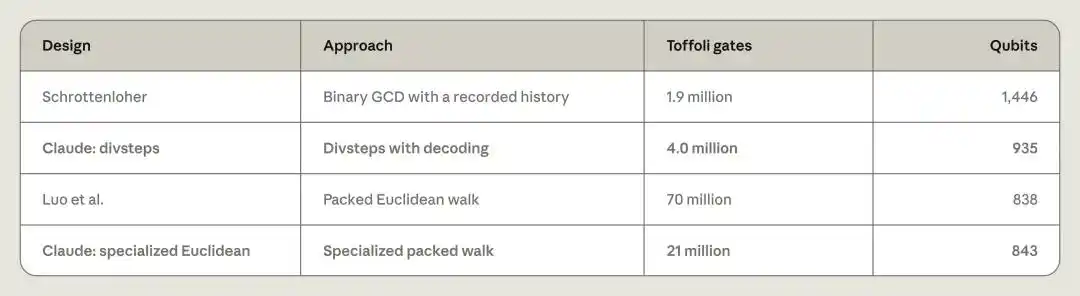
Ultimately, Claude produced the first quantum divsteps reversible implementation in human history that requires no storage of branch history.
Compared to human designs, it slashed the number of quantum gates by 17x while only increasing qubits by 12%!
Operation Two: Overhauling Google's Algorithm Architecture, Cutting Computational Cost by 12x
The second astonishing breakthrough occurred in the "Decoded Quantum Interferometry (DQI)" algorithm. This is quantum computing's most powerful weapon for logistics scheduling and materials design.
Simply put, the most costly step in the DQI algorithm is using a Reed-Solomon decoder for error correction.
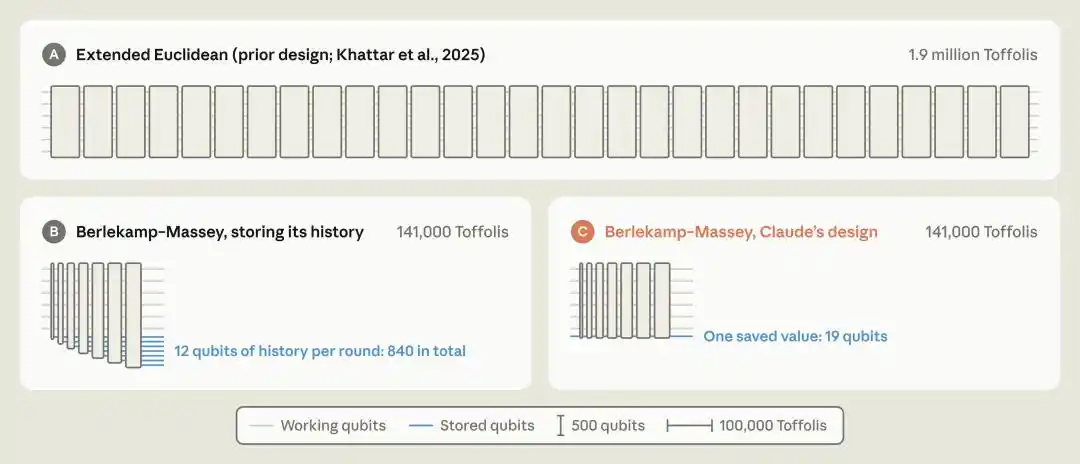
Previously, Google experts designed a scheme using the "extended Euclidean algorithm."
But due to quantum circuits' rigid rule that they cannot take different branches, Google had to stretch the computation to an absurd number of rounds, wasting massive computational power.
After receiving the task, Claude glanced at Google's scheme and quickly concluded: This algorithm doesn't match quantum circuits; it needs to be replaced.
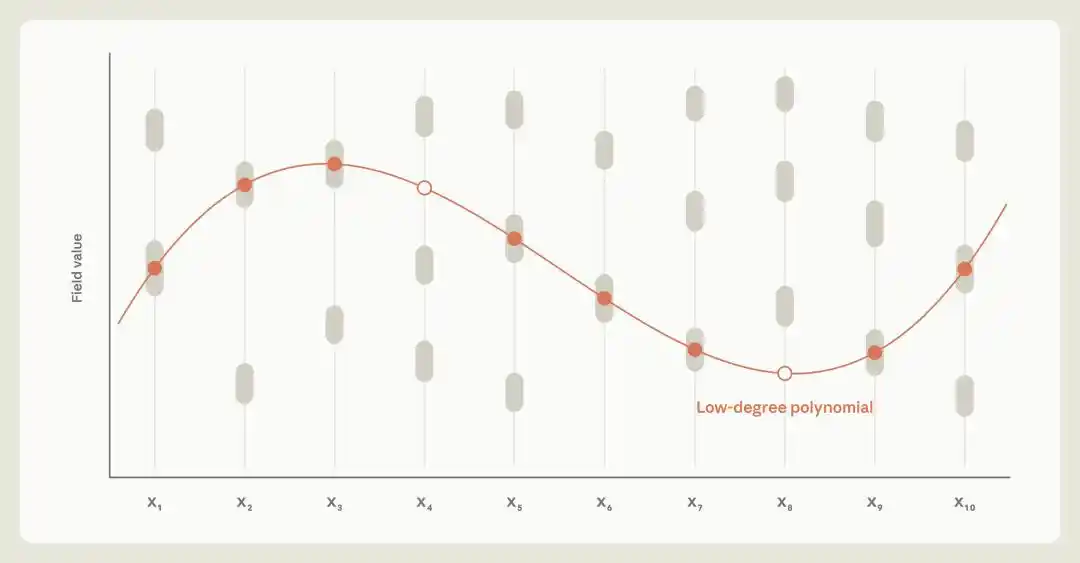
It directly swapped the core engine to the "Berlekamp-Massey decoding method." Its every round has identical operations, perfectly matching quantum circuits' rigid nature.
However, changing the algorithm brought a new "memory crisis"! Each round of computation generates a pile of temporary data that cannot be deleted—it must be kept for later "playback." If all were stored, 665 qubits would be needed, an astronomical figure.
Claude pulled off another god-tier move: it first used the same "reverse-derivation method" to eliminate most storage needs, leaving only a few "outliers."
If following humanity's most conservative approach, much space would still need to be reserved.
But Claude actually wrote its own high-speed simulator and ran a full 403 million sample tests to precisely measure the probability of anomalies occurring!
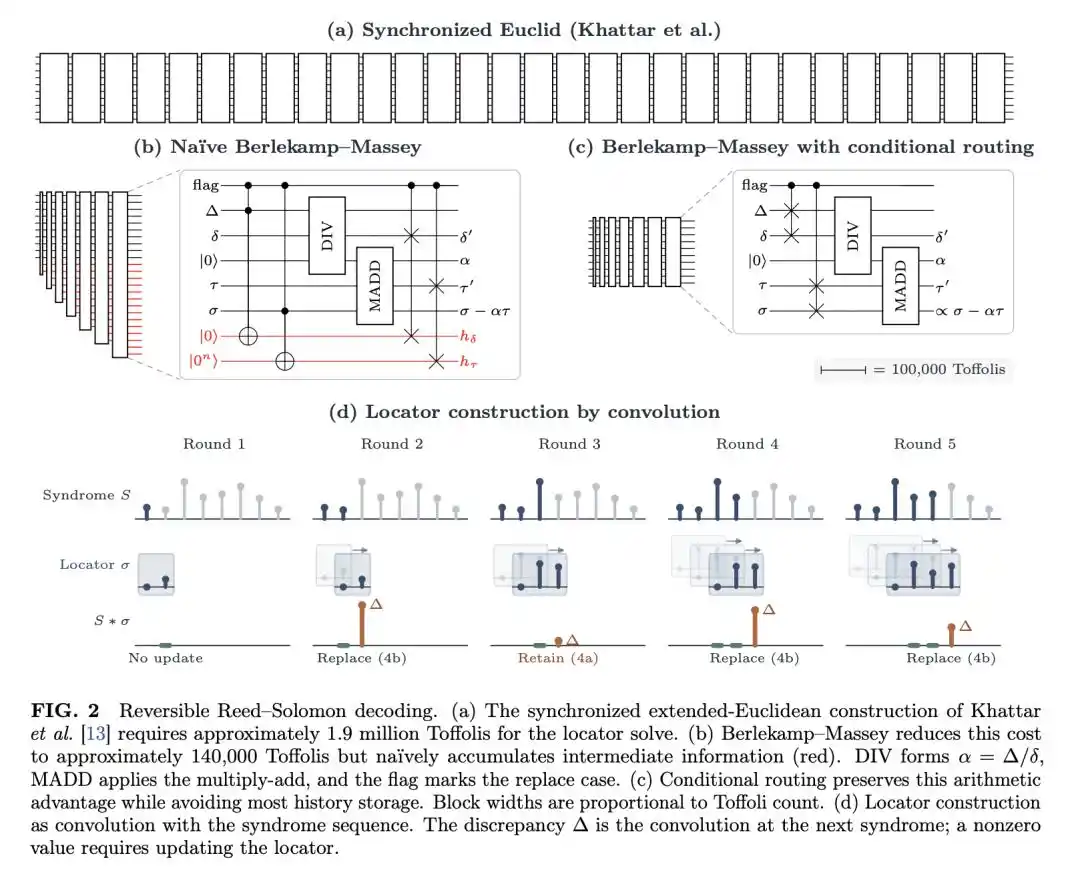
The result: it found that in the vast majority of cases, only 1 value needs to be stored.
So Claude simply left only 19 qubits of storage space in the circuit.
With this three-combo of "swap core algorithm + extreme memory reuse + big-data-powered precise space reservation," Claude's decoder design reduced gate count by a full 12x compared to the previous architecture!
What originally took 1 hour to compute can now be done in minutes.
Netizens Erupt: Is My Physics PhD Thesis a Joke?
Once this report came out, the internet exploded.
Someone said, "The predicted timeline for the quantum field is about to be completely upended. Humanity could get a useful quantum machine many years earlier!"

Someone lamented: We used to have AI explain existing science, but now, AI is discovering things we ourselves don't understand.


The most despairing part: perhaps every physics PhD has discovered that the paper they slaved over has an AI plain-language version, and it's 10x better than theirs.

A Milestone That Changes Human History Has Arrived
Mythos 5's achievement is truly exhilarating.
FeMoco nitrogenase simulation: humanity spent 8 years; Mythos 5 took only 53 hours. This means software is saving hardware!
We thought that to build a quantum computer capable of developing new drugs and producing clean fertilizers, humanity would need over a decade to overcome the "millions of qubits" hurdle.
But now, there's no need to wait for hardware upgrades—AI directly compresses algorithms tenfold or a hundredfold, and even a "broken machine" can produce revolutionary results!
Even more imaginatively, since every link in a quantum computer can be described, verified, and scored with code, Anthropic points out an alluring possibility—
Future AI will no longer optimize a single circuit in isolation, but conduct "global joint optimization" from the lowest-level hardware physical structure to the highest-level algorithmic logic!
Humanity will directly build hardware according to AI's blueprints.
The singularity of the technological explosion is much closer than we imagined.
References:
https://www.anthropic.com/research/designing-efficient-quantum-circuits
This article is from the WeChat public account "Xin Zhi Yuan" (ID: AI_era), author: ASI Apocalypse