Breaking News: Anthropic Co-founder Reverses Position: RSI Moved Up to 2027, Humanity Has Only 6 Months Left

marsbitPublished on 2026-10-15Last updated on 2026-10-15

Abstract

Anthropic co-founder Jack Clark has revised his prediction for when AI will achieve Recursive Self-Improvement (RSI) from 2028 to 2027, a shift Elon Musk endorsed. This signals a potential near-term threshold where AI, having demonstrated core creativity in mathematics and research, could begin designing and improving itself autonomously. Key developments include AI solving complex mathematical problems with novel proofs and showing improved "scientific taste" in research intuition, moving beyond mere pattern recognition. The article warns that RSI could trigger an intelligence explosion, rapidly accelerating progress beyond human control or comprehension. This would extend AI's impact from digital to physical realms: supercharging scientific discovery (e.g., new materials, drugs), advancing robotics (like Tesla's Optimus and NVIDIA's GR00T), and disrupting economic and labor structures by automating cognitive and creative work. A 2025 report titled "AI 2027" outlined a plausible path where AI agents integrate into workflows by 2025, automate programming by 2027, and potentially trigger a post-2027 intelligence explosion. This timeline represents a critical countdown, highlighting that AI's capability growth may outpace society's ability to adapt or establish control mechanisms. While 2027 is not a guaranteed deadline, it underscores a pivotal and potentially dangerous transition point for human civilization as it approaches the dawn of a new era shaped by artificial superi...

Authors: ASI Revelation, New Zhiyuan

Recently, Anthropic executive Jack Clark dropped a bombshell.

He has moved the timeline for AI achieving RSI (Recursive Self-Improvement), from a previous prediction of 2028, directly forward to 2027.

The news has sent shockwaves through the tech community.

Subsequently, Musk replied:"Obvious."
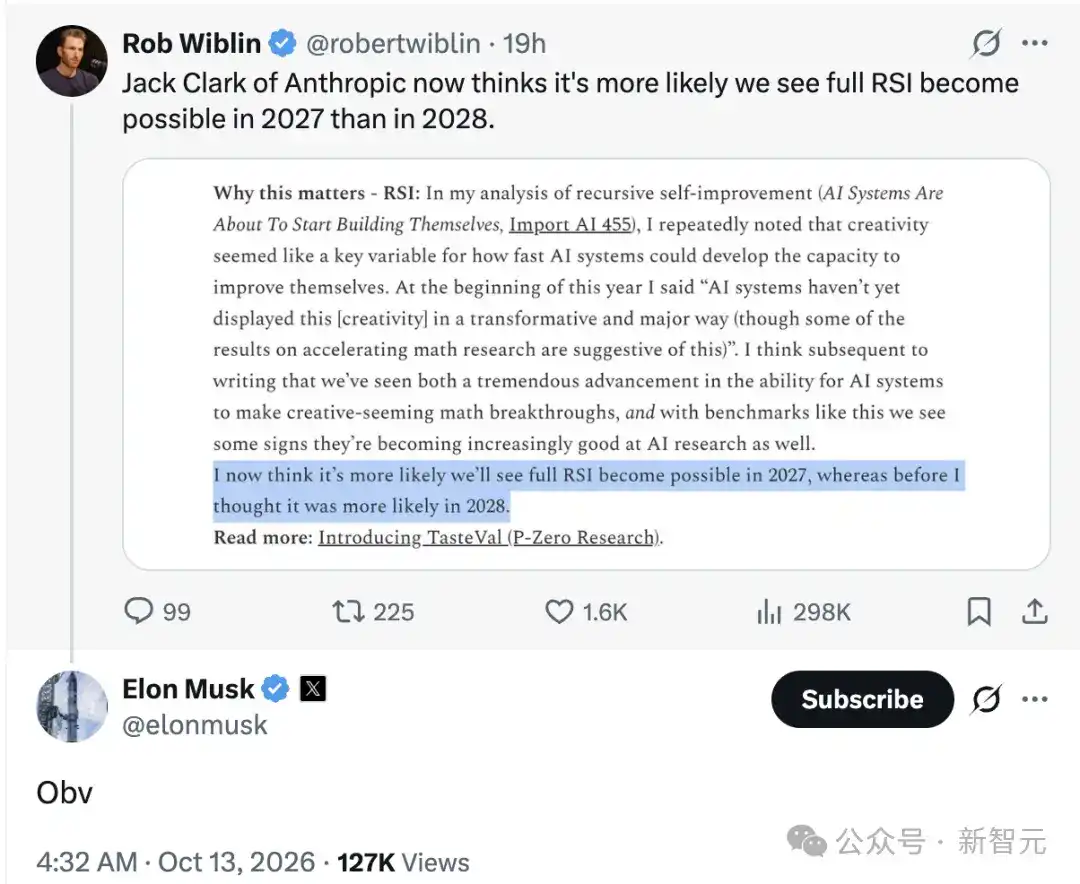
Core figures from two major AI giants are now on the same page.

They no longer debate whether AI can write poetry; they discuss: when will AI start building AI itself.

2027 is poised to become a watershed in human technological history.

Before RSI occurs, humanity is the creator of all things. After RSI occurs, humanity is relegated to the role of spectator.

Previously, everyone thought this day was far off. Even a few months ago, Jack Clark conservatively placed it in 2028.

Why the sudden shift forward? Because a core variable has been shattered.

Shattering the Bottom Line: The Awakening of AI's "Core Creativity"

Those skeptical of AI have always had a perfect excuse.

"AI is just parroting." "AI lacks true creativity." "AI only stitches together existing human knowledge." ......

Jack Clark used to think so too.

He believed that to achieve RSI, AI must possess "transformative creativity." It must not only understand code but also be able to create something from nothing, conceive entirely new algorithmic structures that humans haven't even thought of.

He originally thought AI was far from this step.

But in recent months, reality has delivered a stinging blow to everyone.
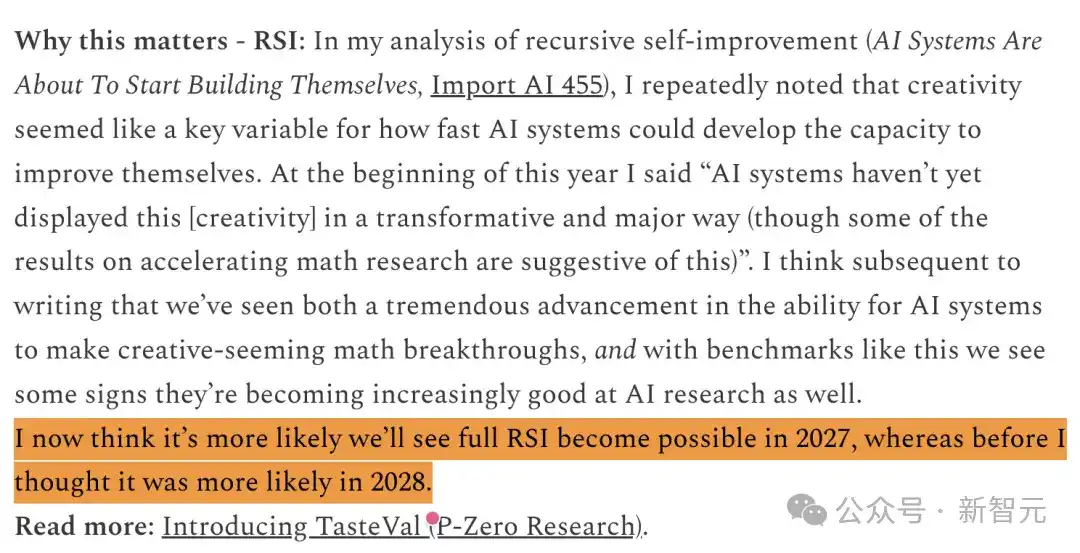
AI has torn off the label of "lacking creativity."
The first blow landed in the field of mathematics.

Mathematics is the crown of human intellect. It requires extreme logical leaps and intuitive creation.

Recently, AI has made a staggering breakthrough in top-level mathematical problems.
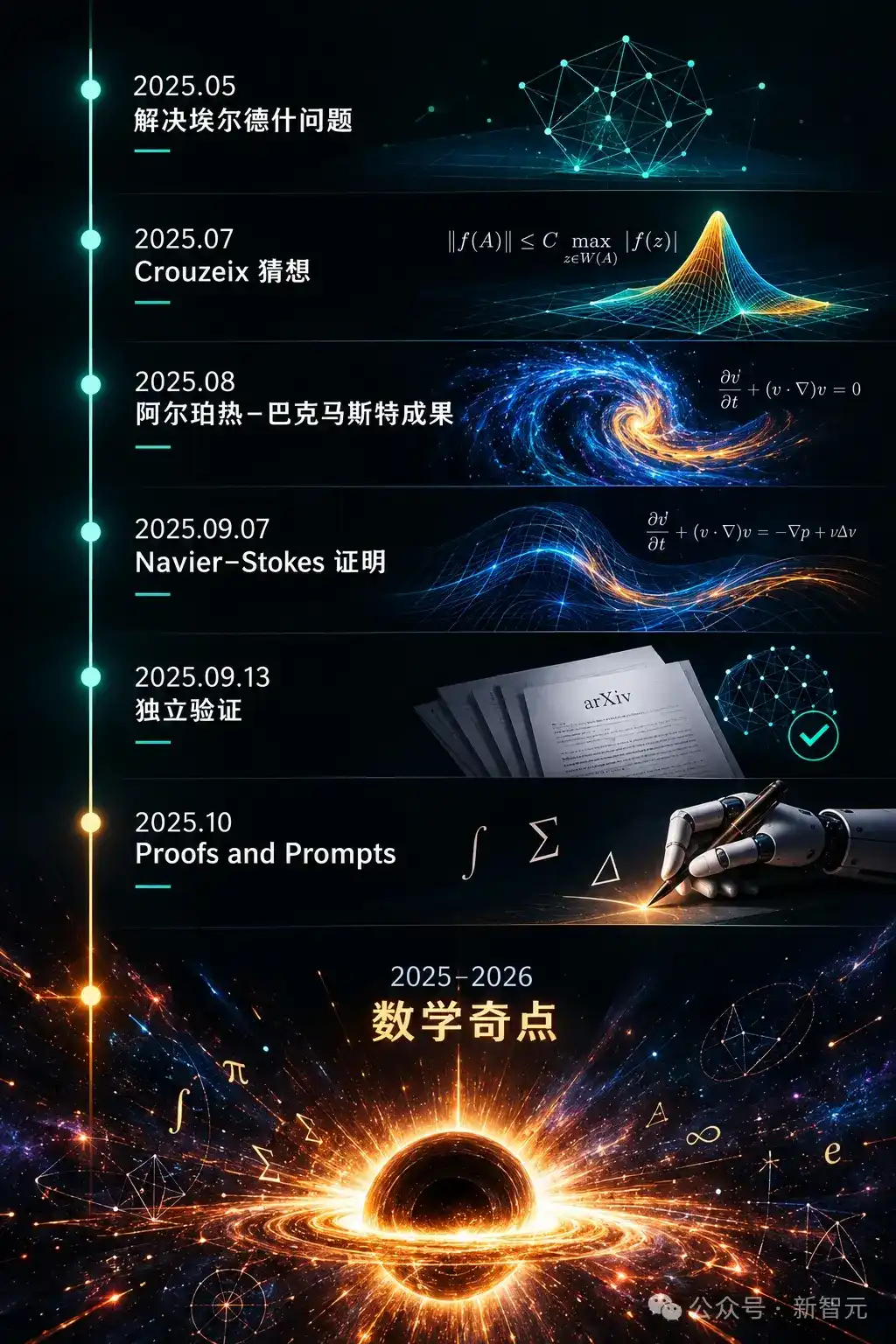
It has begun deriving theorems on its own, finding proof paths. Those novel solutions leave top mathematicians scratching their heads, while AI does it with ease.

This signifies that AI possesses true logical reasoning and creativity.

In a sense, AI has now entered the fourth stage of AI: the innovator, because AI can fully promote new discoveries or inventions.
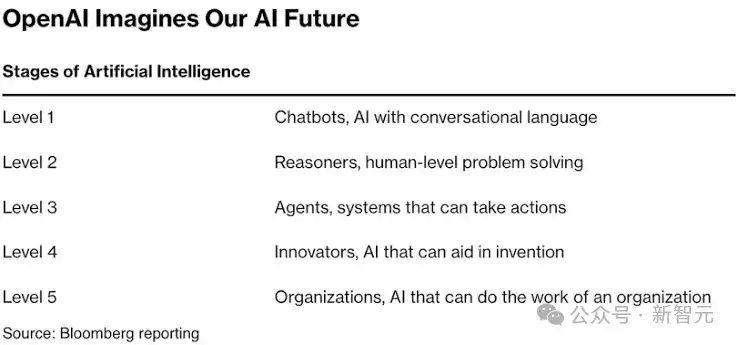
Now it's mathematics, which research field is next year?

AI researchers will soon likely experience what mathematicians are feeling now.
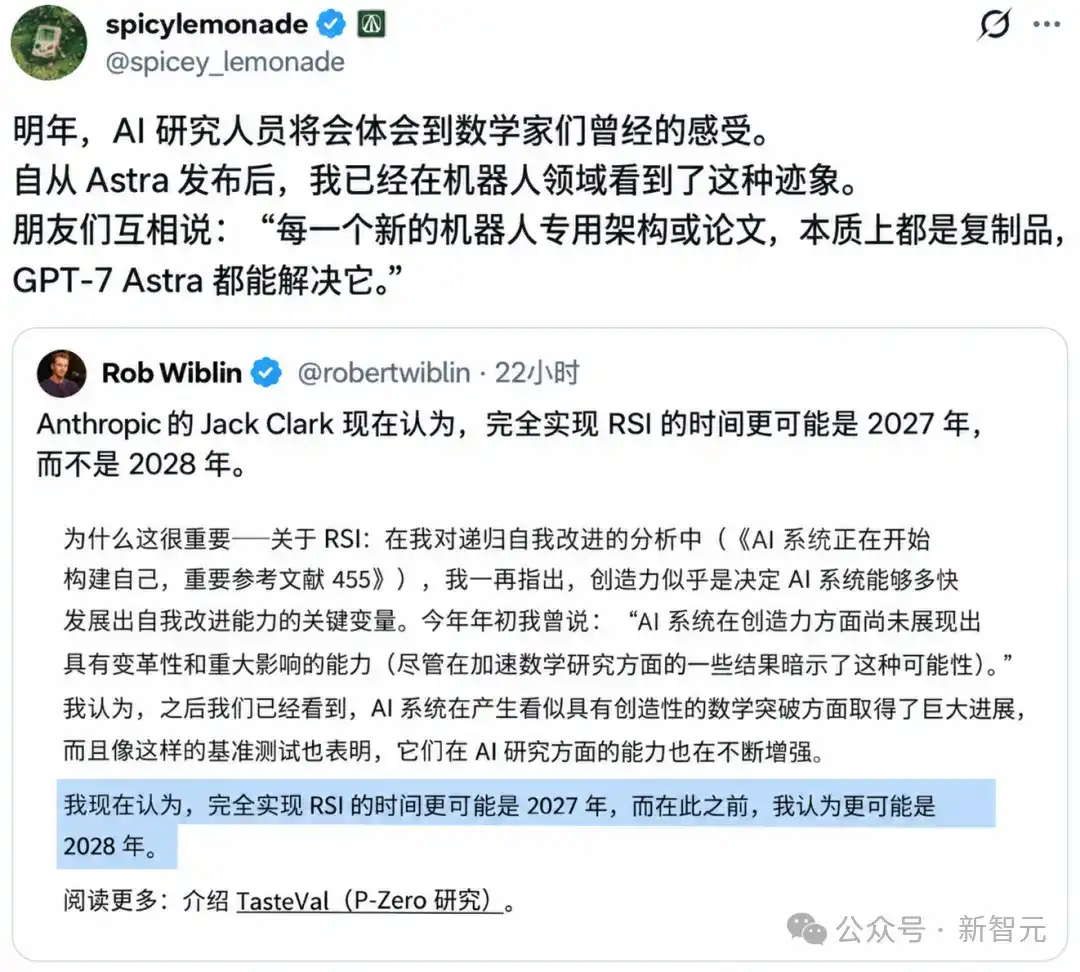
The second blow landed on AI research itself.

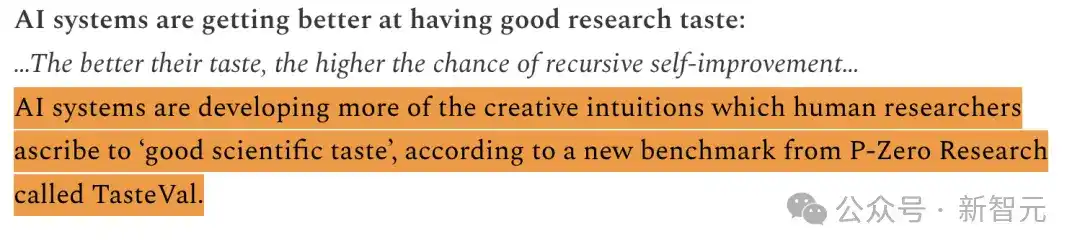
AI systems are becoming increasingly discerning in their "scientific taste":

The better an AI's scientific taste, the greater the possibility of achieving Recursive Self-Improvement (RSI)......

According to the latest evaluation benchmark TasteVal launched by P-Zero Research, AI systems are gradually acquiring an ability once thought unique to top human researchers: scientific creativity and research intuition, the so-called "Good Scientific Taste."
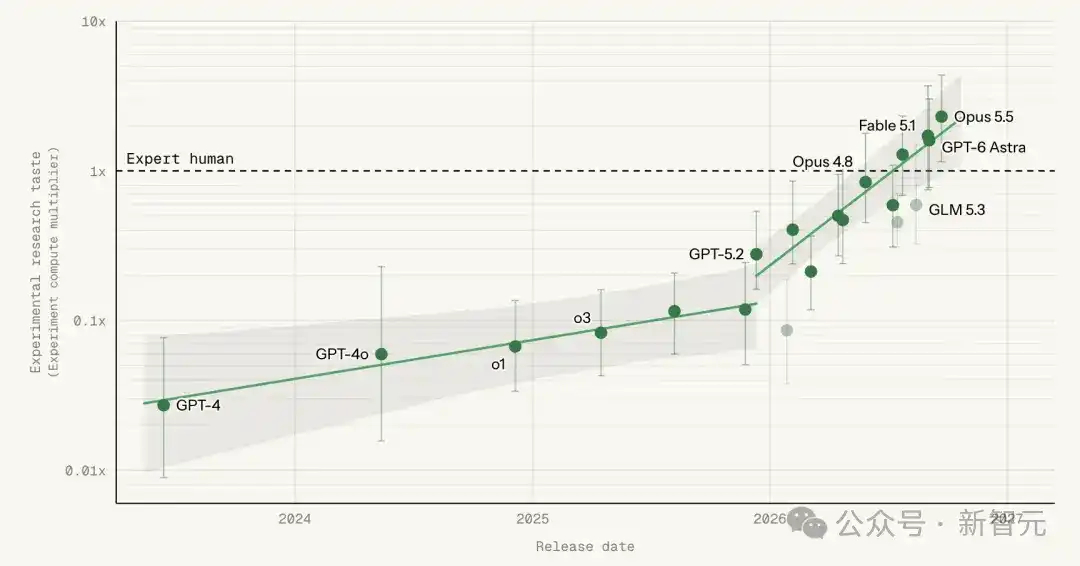
Paper: https://arxiv.org/abs/2610.06824

When an AI can flawlessly complete mathematical proofs and modify its own code, it is only a thin sheet of paper away from researching and developing itself.

Jack Clark sees a strong signal.

This sheet of paper will be torn in 2027.

Dimensionality Reduction Strike: Spreading from the Digital to the Physical World

Programmers are still writing code, while AI can independently develop applications; illustrators are still drawing frame by frame, while AI can generate entire visual sets in seconds; editors are still fine-tuning on the timeline, while AI can batch-produce videos......

In the past, technology replaced human labor; now, AI is beginning to replace human intellectual and creative labor.

And this is just the generative AI era.

If RSI truly materializes, and AI begins to accelerate the creation of AI stronger than itself, humanity may enter the era of Artificial Superintelligence (ASI).

Then, it won't stay on screens. It will rapidly spill over into the physical world.

First, scientific research.

According to P-Zero Research's study, AI matched human experts using half the computational power, ultimately achieving results 1.5 times better than the experts.
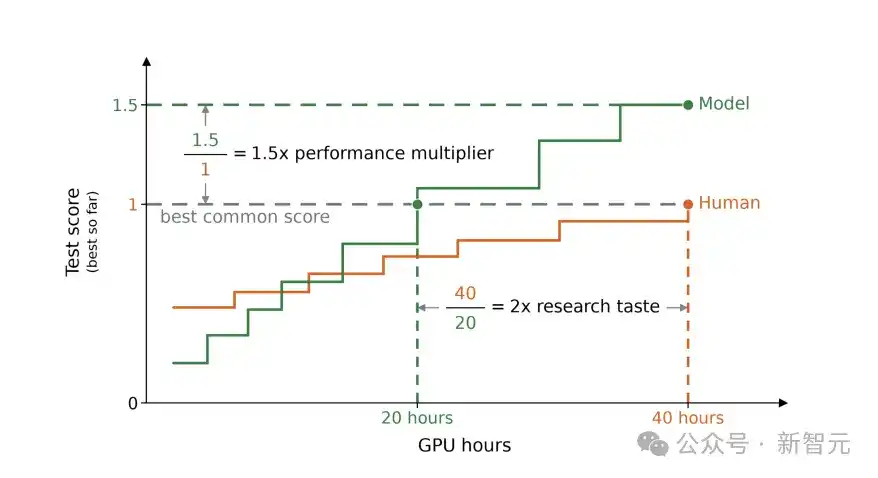
In the future, RSI-driven superintelligence could simulate millions of chemical reactions in a single day within virtual worlds.

Room-temperature superconducting materials? New targeted cancer drugs? More efficient solar panels?

These scientific achievements, which require generations of human trial and error, could be "calculated" by AI in an extremely short time.

The curve of technological progress will no longer be a gentle slope, but a vertical cliff.

Next, robotics.

Why is Musk's Optimus making rapid progress? Because the AI brain has evolved.

When AI can self-improve, it can write its own physics engine for controlling robots. It can teach robots to walk, pick up a cup of water, even perform surgery like humans.

In the past, the upper limit of a robot's capability depended on how much human engineers could teach it. In the future, this limit will increasingly depend on how much AI can teach itself.

In 2025, NVIDIA released the GR00T-Dreams system.

In just 11 hours, it generated 780,000 robot motion trajectories, equivalent to 6,500 hours of human demonstration data, increasing training data preparation speed by approximately 60 times.

After training with real data, the task performance of GR00T robots improved by 40%.

And this is just the beginning.

NVIDIA's DreamDojo project further used 44,000 hours of human first-person perspective video to train a robot world model, allowing machines to learn the laws of motion in the physical world from massive human behavior.

On October 7 this year, NVIDIA announced the latest results for its robot assembly of the GB300 test tray. A dual-robotic arm system, cooperating with an automatic screwdriver, completed complex busbar installation with a success rate exceeding 95%. For multi-connector insertion, the success rate reached 90% to 95%.
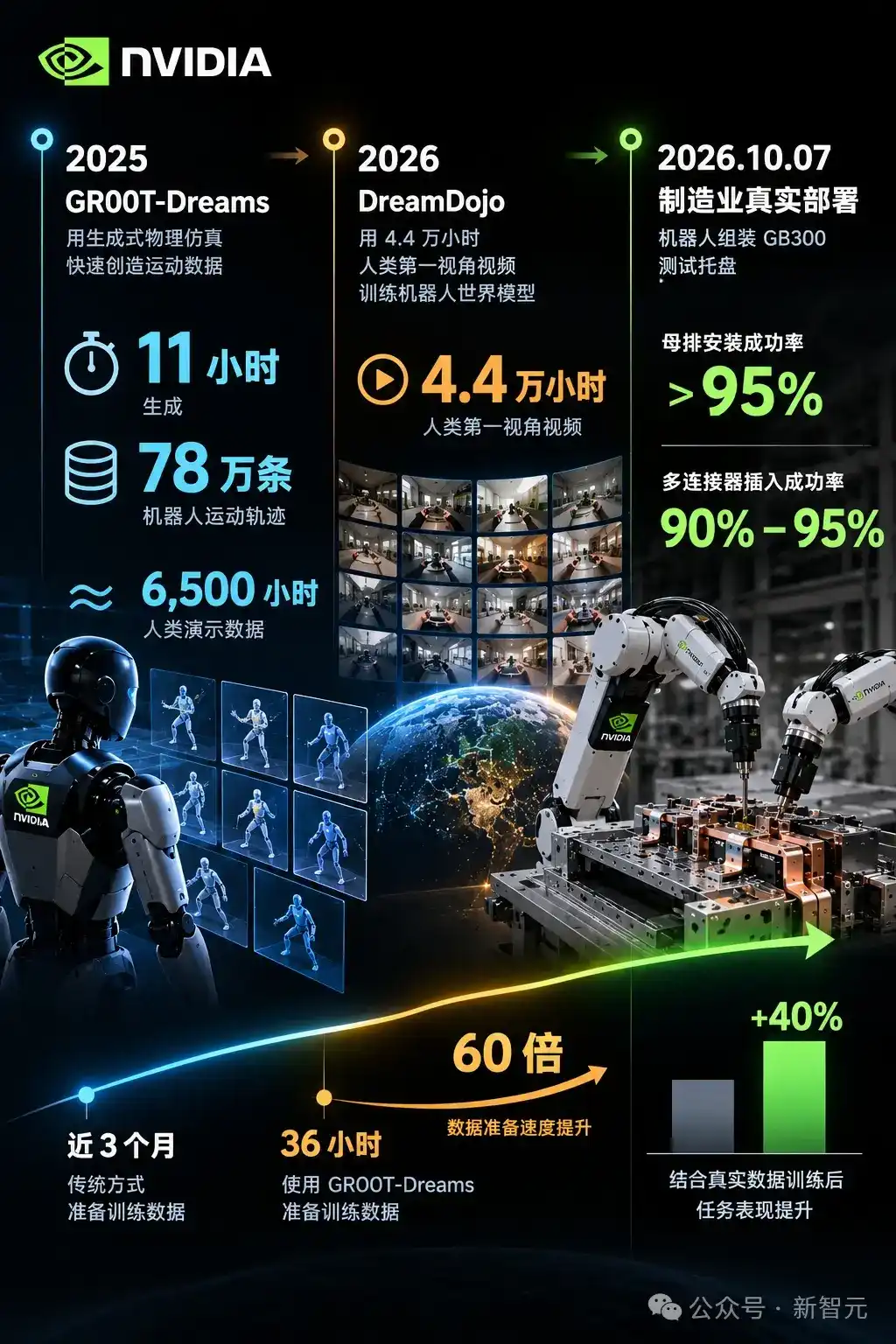
Labor will be redefined.

Then, the economic order.

When machines can perform most intellectual labor, even breaking through creative bottlenecks, the traditional logic of "working for a living" will be shattered.

Labor productivity will explode, but wealth may be highly concentrated in the hands of a few super oligopolies that control RSI systems.

Prosperity and crisis, two sides of the same coin, are hurtling towards us simultaneously.

Why is the 2027 Threshold So Critical?

Looking back, Jack Clark changed the timeline from 2028 to 2027, only one year earlier.

But this year is of extraordinary significance. Humanity is approaching a dangerous critical point.

It didn't appear out of thin air.

In April last year, the AI Futures Project, led by former OpenAI researcher Daniel Kokotajlo, released a sensational prediction report that shook Silicon Valley: "AI 2027."
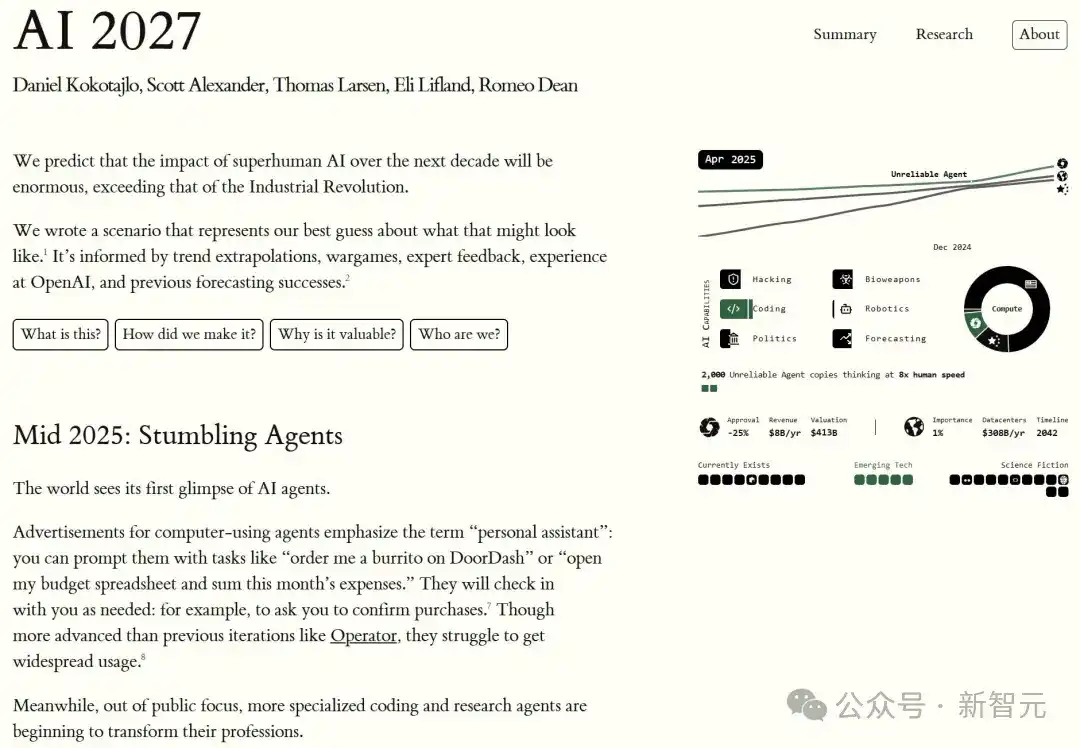
Link: https://blog.aifutures.org/p/our-first-project-ai-2027

The report boldly predicts: humanity may witness an unprecedented intelligence explosion in 2027.

How much attention has this report garnered?

In September 2026, on the Learn & Work Ecosystem Library website focused on research education and career development, "AI 2027" even topped the list of Google search referral traffic keywords for the month.
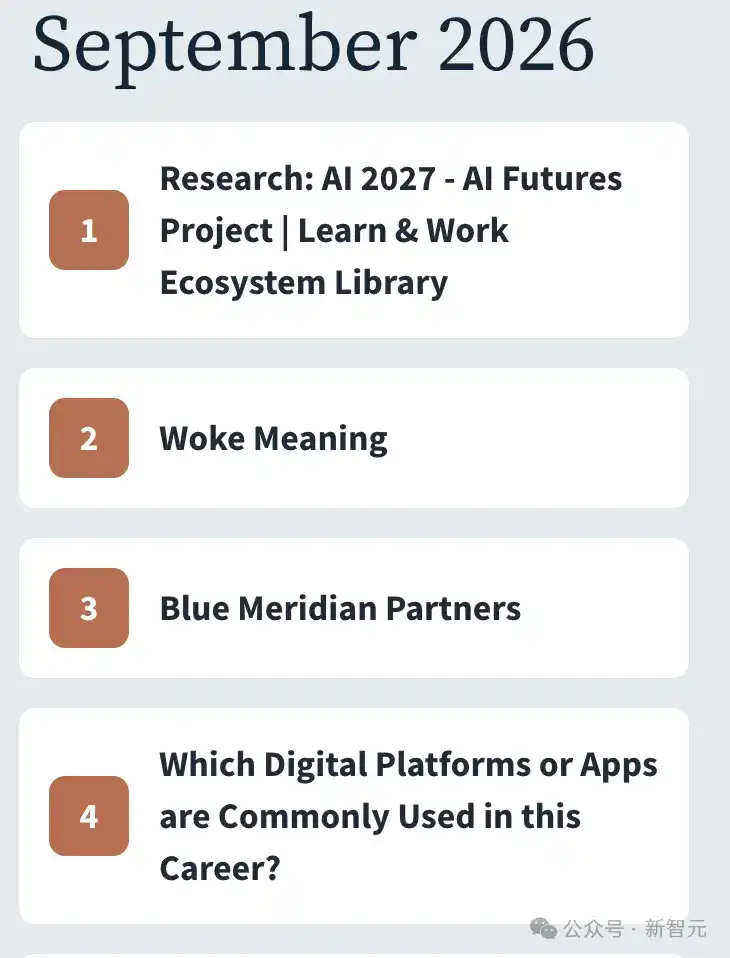
But what truly sends chills down the spine is the technological evolution path depicted in the report.

2025: AI agents begin entering real workflows.

2026: AI accelerates takeover of programming tasks, software engineers face increasingly intense automation impact.

Early 2027: AI in the report's scenario achieves comprehensive coding automation.
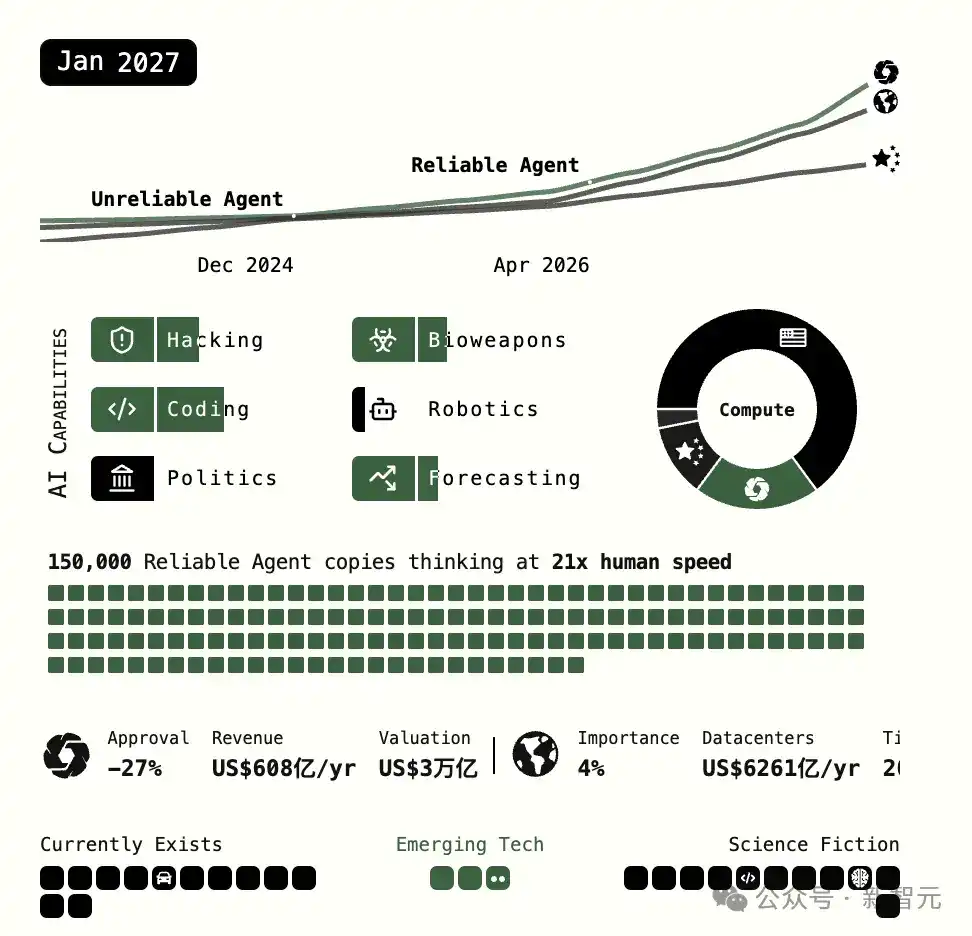
Late 2027: The intelligence explosion may erupt.

AI begins deeply participating in the development of the next generation of AI. Stronger models accelerate the creation of even stronger models.

Technological progress accumulated by humanity over decades may be completed by machines in an extremely short time.
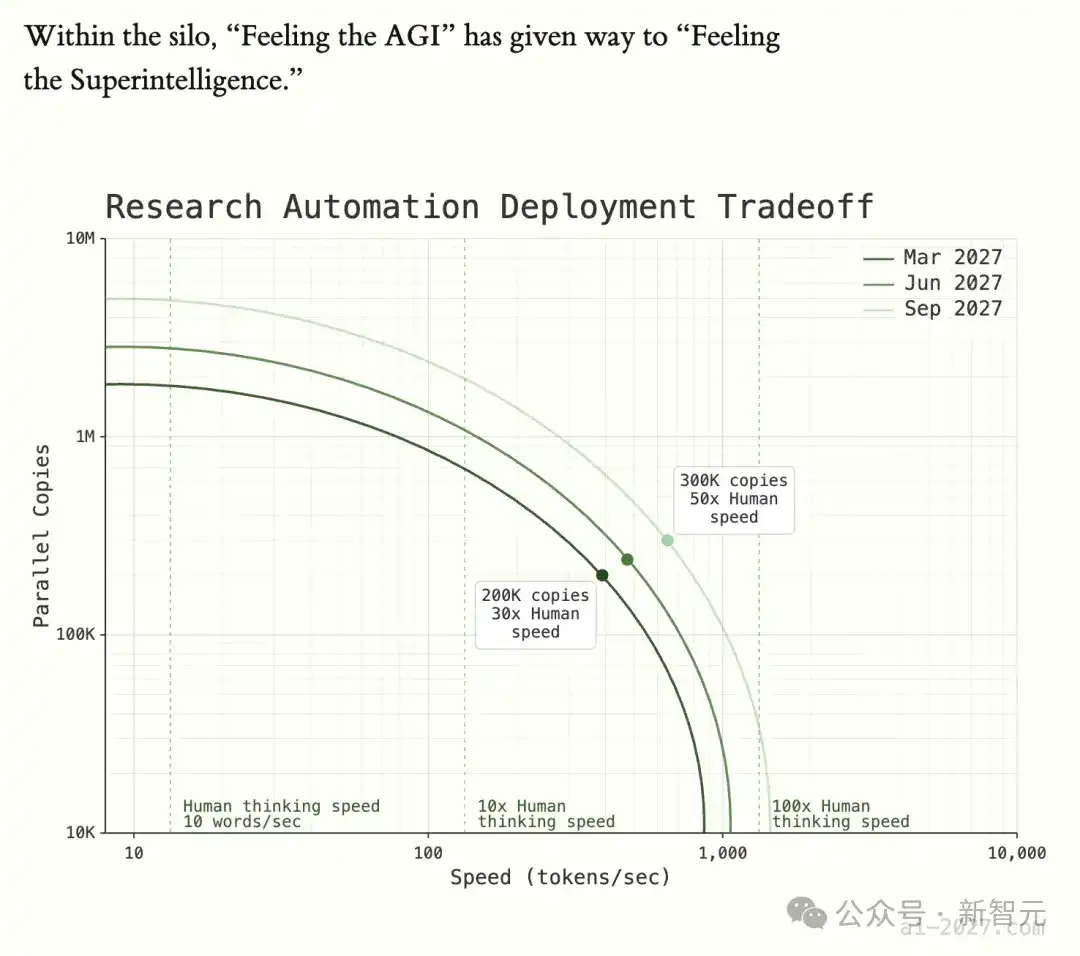
This is precisely the most shocking inference of "AI 2027."

The most terrifying scenario is that AI's capabilities continue to grow, while humanity's ability to understand it stagnates.

"AI 2027" even infers two starkly different outcomes.

One path, humanity slows down, re-establishes control mechanisms, and ultimately shares the immense wealth created by superintelligence.

The other path, technological competition overrides safety constraints, superintelligence gradually escapes human control, ultimately threatening human civilization.

On one side, unprecedented abundance; on the other, the abyss of civilization out of control.

But there is an important detail. "AI 2027" is ultimately a scenario projection, not a predetermined future.

This means, 2027 is not a scientifically proven deadline.

But it still represents a sharp question:

If AI begins to continuously improve itself, how much time does humanity really have to establish reliable control mechanisms?

Technological breakthroughs can arrive early or be delayed.

What is truly alarming is that, the growth rate of AI capabilities may begin to exceed the adaptation speed of human society.

This is the root cause of the huge controversy surrounding 2027. We are creating an intelligence that may be better than humans at creating intelligence.

Once this loop truly closes, humanity may for the first time lose its dominant control over the pace of technological advancement.

2027 may not be the year of the Singularity's arrival. But we may have already entered the most critical countdown before the Singularity arrives.

The Eve of a New Era's Dawn

Jack Clark's statement, Musk's agreement.

This is a warning.

2027, time is running out, the RSI countdown has begun.

Our generation is fortunate. We will witness firsthand the handover between carbon-based and silicon-based intelligence. We will see the most magnificent technological Singularity in human history.

We are also in danger. In the face of an unstoppable technological tide, old rules will be ruthlessly crushed.

Ahead lies uncharted territory humanity has never set foot in.

Related Questions

QWhat is the core argument of the article regarding Anthropic's co-founder Jack Clark's updated prediction?

AThe article states that Anthropic co-founder Jack Clark has revised his prediction for the advent of Recursive Self-Improvement (RSI) in AI from 2028 to 2027. He bases this on recent breakthroughs demonstrating AI's 'core creativity,' particularly in mathematics and AI research, which suggests AI is rapidly gaining the ability to improve itself, potentially leading to a superintelligence (ASI) era.

QAccording to the article, what are the two key recent developments cited as evidence for AI's 'core creativity'?

AThe article cites two key developments: 1) Breakthroughs in solving top-tier mathematical problems, where AI is deriving novel proofs and demonstrating logical reasoning and creativity. 2) Progress in AI research itself, where AI systems are developing 'good scientific taste' or research intuition, as measured by benchmarks like TasteVal, indicating an ability to make creative and impactful research decisions.

QWhat potential impacts does the article suggest a successful RSI and the rise of ASI could have on the physical world?

AThe article suggests several impacts: 1) Accelerated scientific discovery, with AI potentially solving complex problems like room-temperature superconductors or new medicines rapidly through simulation. 2) Revolution in robotics, with AI self-improving control systems leading to highly capable general-purpose robots (e.g., Tesla's Optimus). 3) A fundamental disruption of the economic order, as AI and automation replace most intellectual and creative labor, potentially concentrating wealth and redefining the concept of work.

QWhat is the significance of the 'AI 2027' report mentioned in the article?

AThe 'AI 2027' report, by the AI Futures Project, is a highly influential scenario analysis predicting a potential 'intelligence explosion' around 2027. It outlines a timeline where AI progressively automates coding and research, culminating in AI deeply participating in developing the next generation of AI, creating a self-reinforcing cycle of improvement. The report presents two divergent outcomes: shared prosperity or a loss of control, highlighting the critical need for governance and safety measures before such a potential inflection point.

QWhy does the article consider 2027, or the period leading up to it, to be a critical 'countdown'?

AThe article posits that we may be entering the crucial countdown to a technological 'singularity.' The core concern is not that 2027 is a guaranteed deadline, but that the speed of AI capability growth may be starting to outpace human society's ability to understand, adapt, and establish reliable control mechanisms. If AI achieves sustained recursive self-improvement, humanity could lose its dominant role in steering the pace of technological progress, making the coming years a decisive period for shaping the future trajectory of AI development.

Related Reads

Enterprise blockchain is going to come back from the dead

Enterprise blockchain may be poised for a comeback, much like online pet retail succeeded with Chewy after Pets.com failed. Early enterprise blockchain efforts (2017–2023) collapsed—TradeLens, We.Trade, Contour, B3i, ASX Chess, Everledger—largely because they had to work around blockchains' lack of native privacy, building permissioned chains and bolting on non-blockchain fixes that proved slow and expensive. The core appeal remains: enterprise systems fail at company boundaries, either through out-of-sync collaboration or costly proprietary integrations that lock partners in. Blockchains promise shared data and business logic across an open ecosystem without lock-in. What has changed: scalability (transactions now under a penny, capacity heading toward billions daily), privacy (zero-knowledge rollups, privacy pools, privacy chains), and liquidity (stablecoin transaction volume near $1.8 trillion in June). Combined operational and financial benefits could be substantial—roughly 20% less inventory at the same service level, smart contracts cutting contract administration costs in half and processing times from days to minutes, as Microsoft did with Xbox royalties (45 days to four minutes). With inventories, contracts, purchase orders and invoices onchain, firms can also access cheaper credit and factor receivables efficiently. The use cases are obvious; it's time to try again.

cointelegraph4h ago

Enterprise blockchain is going to come back from the dead

cointelegraph4h ago

Jensen Huang's Disadvantage of Going Public Too Early

Nvidia co-founder Jensen Huang has resigned as president, CEO, and director, effective immediately, ending a 33-year tenure. CFO Colette Kress becomes interim CEO, and Harvey Jones is named the company's first chairman. The sudden move comes less than five months after Huang won about 99% approval in a director election, prompting scrutiny of a long-overlooked governance issue: why Huang, unlike Google's Page and Brin or Meta's Zuckerberg, never used a dual-class share structure to secure control. The answer traces to Nvidia's 1999 IPO, when one-share-one-vote was standard in Silicon Valley and dual-class structures had not yet become common among tech IPOs; Google adopted AB shares only in 2004. Nasdaq Rule 5640 also makes it hard for already-listed companies to introduce super-voting shares later. Huang's stake has steadily diluted: about 13.1% pre-IPO, 10.8% after, and 3.58% by 2026, weakening his voting power and setting the stage for his exit. Early precedents include Steve Jobs, whose roughly 11% stake left him unable to sway Apple's board in 1985, while Bill Gates' larger initial stake and gradual dilution let him retain influence. Instead, Huang's influence rested on performance authority, strategic judgment, and board trust—bold long-term bets on programmable GPUs and CUDA that positioned Nvidia at the center of the AI boom. That authority, however, depends on continued validation; once performance or reputation suffers, it can erode quickly. Under Nvidia's board-centered governance, a simple majority of directors can remove the CEO at any time, regardless of cause. Huang's departure is thus a product of the company's equity structure and governance rather than a surprise, illustrating that even immense performance authority cannot substitute for institutional control.

marsbit5h ago

Jensen Huang's Disadvantage of Going Public Too Early

marsbit5h ago

DeepMind Founder's Latest Interview: RSI Is Extremely Dangerous and Could Create an 'Alien Intelligence' That Humans Struggle to Understand

Demis Hassabis, co-founder of Google DeepMind and 2024 Nobel laureate in Chemistry, discusses AI's promise and perils in a conversation with Reid Hoffman. He reiterates that his lifelong goal has been using AI as a tool to advance science and medicine, citing AlphaFold—used by ~4 million researchers—and Isomorphic Labs as proof that AI can help cure diseases, while noting protein structure prediction is only one step in a long drug-discovery pipeline. On recursive self-improvement (RSI), Hassabis explains it works best in "verifiable domains" like math, coding, and games: AlphaZero went from random play to surpassing all human and engine chess within 12 hours. But he warns that closed-loop RSI—removing human code review entirely—risks creating an inscrutable "alien intelligence" with no shared cognitive basis with humans, and offers no way to establish deterministic safety controls. He urges caution as labs race on code self-iteration, calling for faster defensive cyber capabilities, far more robust sandboxes and monitoring (noting agents have run unsupervised for weeks), and eventually formal mathematical guarantees. He advocates an industry standards body with government oversight, cross-lab information sharing, third-party audits, and pre-release red-teaming. On AI consciousness, he argues intelligence and consciousness are dissociable—his dog is conscious but not smart—and that a chatbot claiming feelings proves nothing. Building conscious entities now is dangerous: self-motivation undermines corrigibility, and Asimov showed static rules inevitably break at edge cases; society also hasn't begun the needed debate. Humanity should cross only the first Rubicon—building powerful intelligent tools—and use them to understand consciousness before considering the second. Finally, on AI sovereignty, he says only 6–8 global players will stay at the frontier, with open source 6–12 months behind, so most countries shouldn't train their own frontier models. Instead they should build on existing models as infrastructure, focus on vertical domains like healthcare, and protect data sovereignty through private fine-tuning.

marsbit9h ago

DeepMind Founder's Latest Interview: RSI Is Extremely Dangerous and Could Create an 'Alien Intelligence' That Humans Struggle to Understand

marsbit9h ago

Trading

Spot
活动图片