Is OpenAI Losing? Anthropic Presses the Fast-Forward Button on Its Trillion-Dollar IPO, Dario's 2% Stake Seizes Control

marsbitPublished on 2026-08-19Last updated on 2026-08-19

Abstract

Anthropic is accelerating towards a potential IPO this fall, fueled by a massive surge in quarterly revenue. In Q2, its revenue of $11.6 billion surpassed OpenAI's $6.7 billion for the first time, signaling a major shift in the competitive landscape. With an estimated valuation nearing $1 trillion, Anthropic aims to become the first major AI model company to go public. Ahead of the listing, the company plans to issue special shares with enhanced voting rights to CEO Dario Amodei (who holds only a 2% stake) and other co-founders. This dual-class stock structure is designed to secure management control post-IPO, addressing the tension between raising substantial capital and retaining founder-led direction. While Anthropic's performance appears stronger on metrics like adjusted operating profit, OpenAI retains significant advantages, most notably its vast global user base through ChatGPT, which serves as a crucial platform for future expansion. The current dynamic suggests Anthropic has secured a notable lead, but the long-term competition remains open. Key questions moving forward include whether Anthropic can sustain its commercial momentum, how founder control will impact a trillion-dollar public company, and how OpenAI will respond to reclaim its position.

Anthropic is making a last-minute push before its IPO!

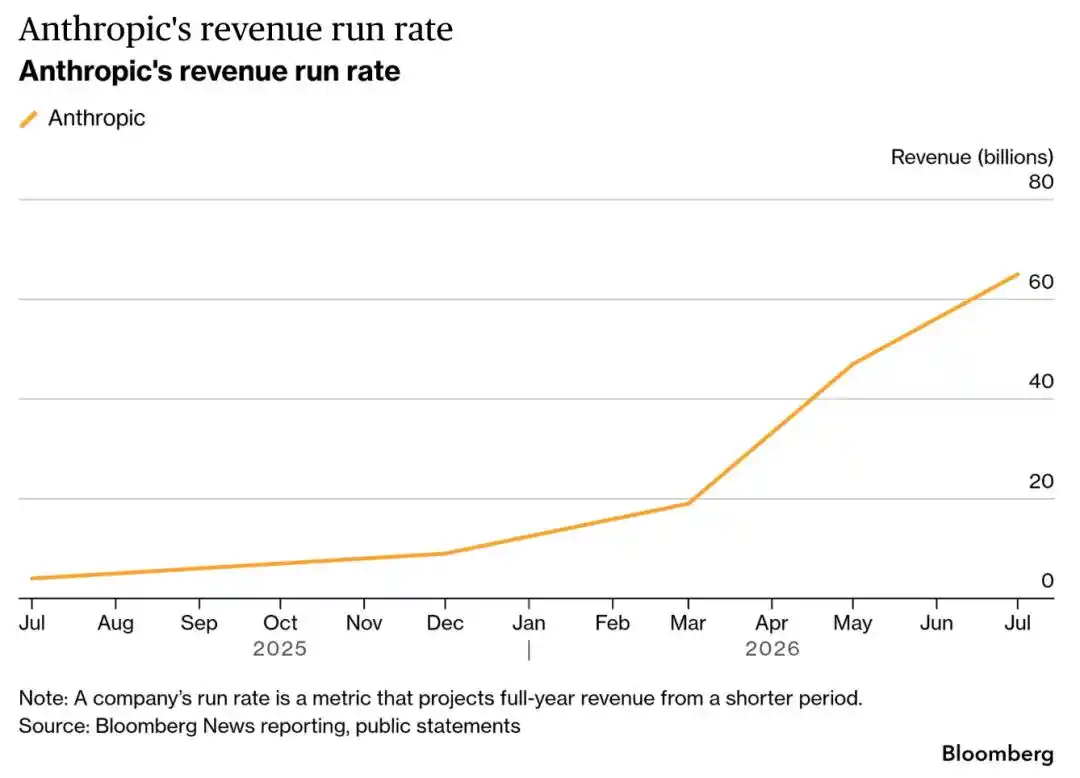
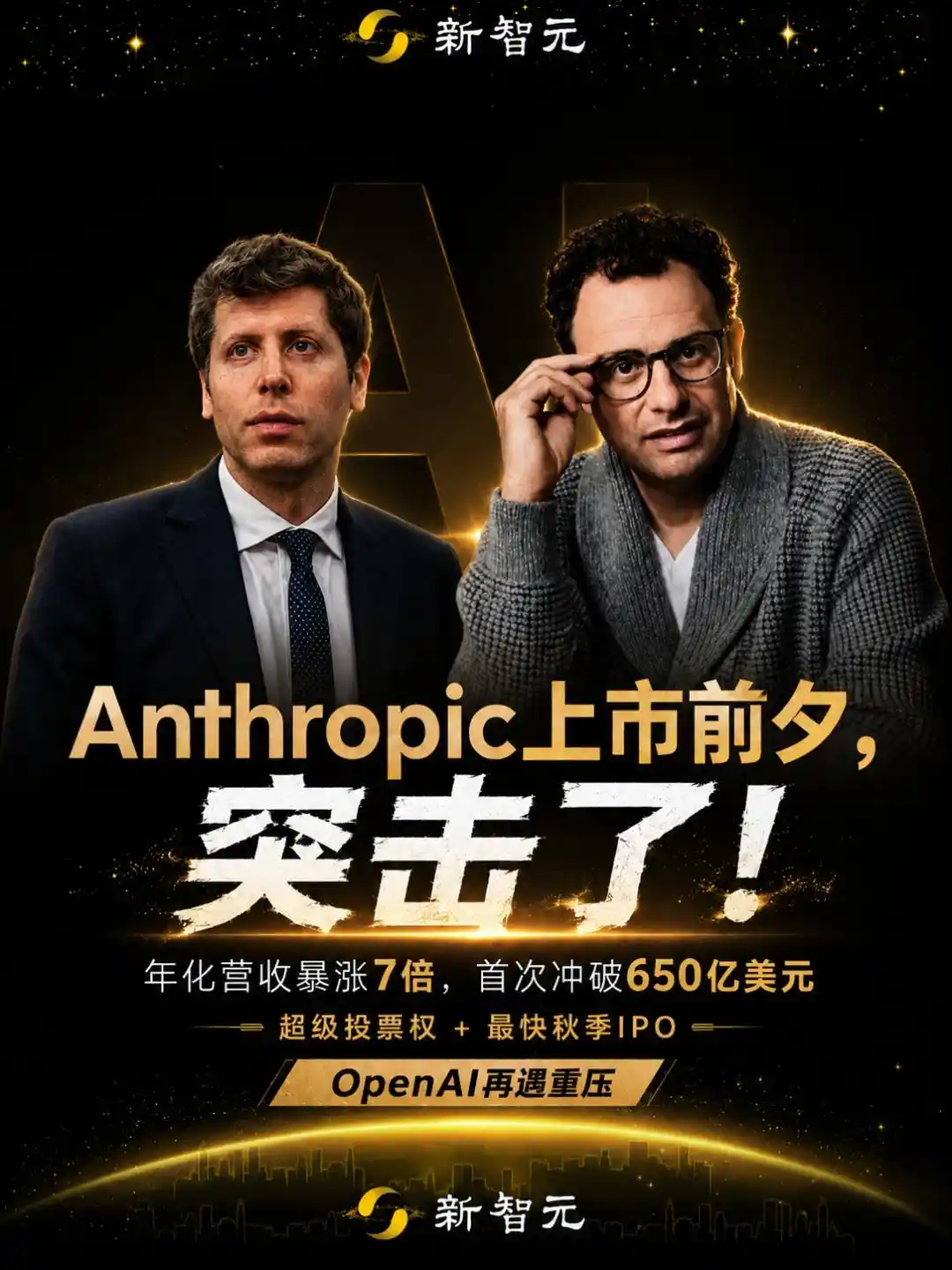
Its annualized revenue has skyrocketed sevenfold, breaking the $65 billion mark for the first time, with an IPO this fall almost a certainty.

Almost simultaneously, The Information reports—

Anthropic plans to issue a class of stock with "extra voting rights" to CEO Dario and six co-founders before going public.
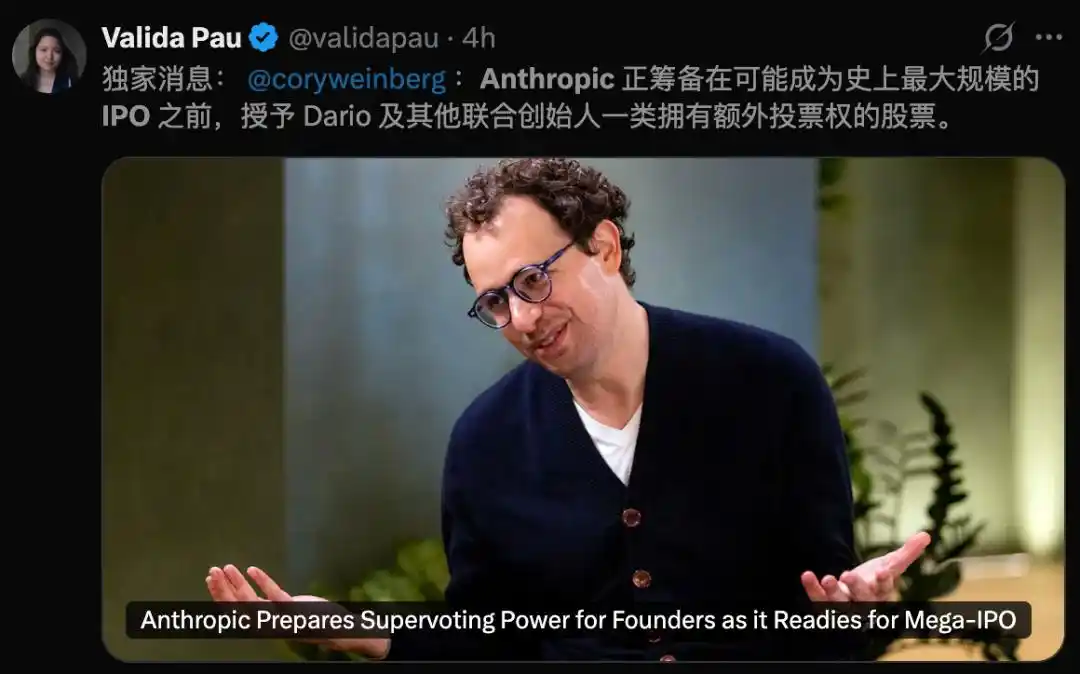
This marks the first time in the company's five-year history that management will have "super-voting rights."

Surprisingly, as the helm of an AI company valued at nearly a trillion dollars, Dario holds only a 2% stake. But compared to Sam Altman's 0% stake, that's still something.

While Anthropic is surging ahead, OpenAI has encountered another setback.

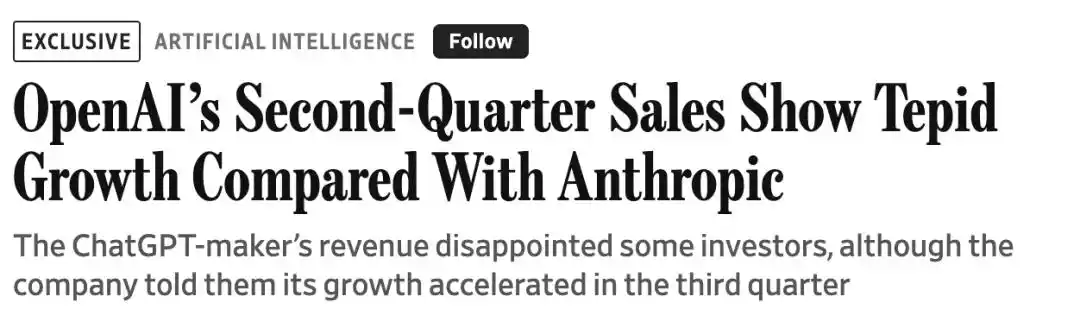
The WSJ exclusively reported that OpenAI's Q2 revenue reached $6.7 billion, a result that greatly disappointed shareholders.
Riding this wave of victory, Anthropic is sprinting towards Wall Street, aiming to claim the title of "AI's first public stock" with a staggering $1 trillion valuation.

The top seat in AI seems poised to change hands.

For the First Time, Anthropic Outpaces OpenAI

Two report cards for the same quarter.

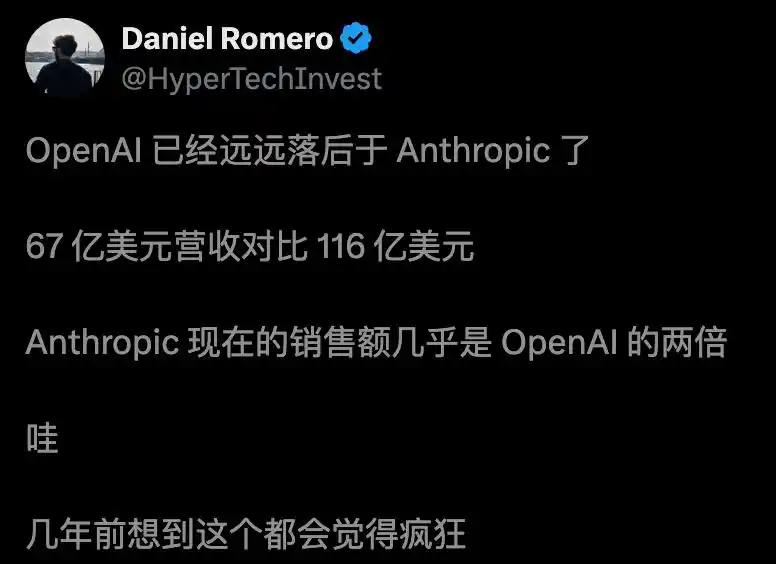
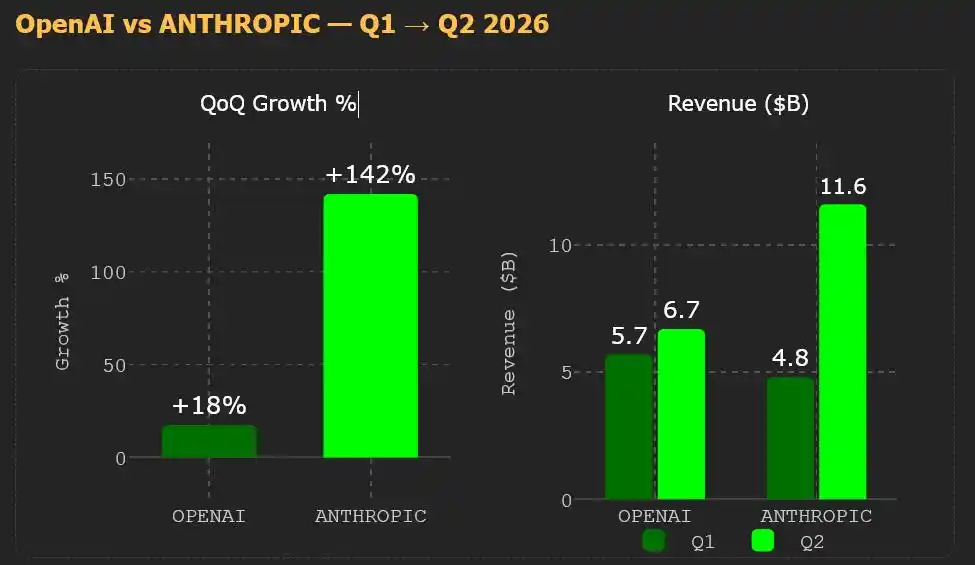
Breaking it down, OpenAI's Q2 revenue was $6.7 billion, up from $5.7 billion in Q1, an 18% sequential increase.

Anthropic, on the other side, reported $11.6 billion in Q2, more than doubling from last year's $787 million.
One company's quarterly losses are nearly double what the other earned in a single quarter.

This is the first time in Anthropic's five-year history that its quarterly revenue has surpassed that of its former parent company, OpenAI.

OpenAI's operating loss widened from $9.3 billion to $12.3 billion over the same period. Meanwhile, Anthropic disclosed that its "adjusted operating profit" has turned slightly positive.

Of course, these profit metrics cannot be directly compared.

Exactly which items Anthropic excludes in its "adjusted profit" is not entirely clear to the outside world; in the past, it has also excluded stock-based compensation from its adjusted figures.

But one point is hard to ignore:

At least at this stage, Anthropic's revenue growth speed and compute efficiency are forcing the capital markets to reassess the positions of the two companies.
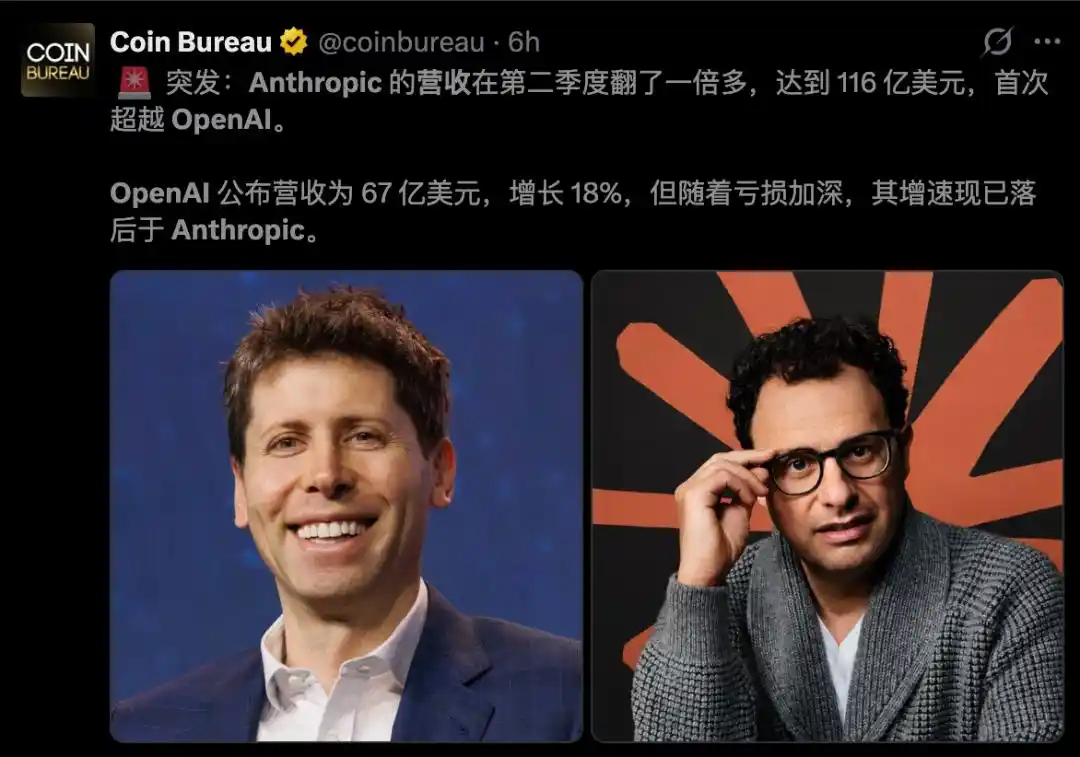
This shift is actually much more significant than "Claude's recent popularity."

Because for the past few years, one of OpenAI's strongest moats has been scale.

ChatGPT has a massive user base, with brand recognition almost synonymous with AI itself.

Anthropic, while consistently strong in model capabilities, has been more like the capable but less visible challenger.

Now, for the first time, the situation has reversed.

Targeting October, Sprinting Towards a Trillion-Dollar IPO

After completing its financing round in May, Anthropic's valuation has reached $965 billion.

It's just one step away from $1 trillion.

Armed with these results, the Anthropic team has pressed the "fast-forward" button on its IPO.

It secretly filed its S-1 in June, with Morgan Stanley, Goldman Sachs, and JPMorgan as underwriters. Opinions vary on the final bell-ringing moment:

The most conservative estimates point to a listing this fall, with some even suggesting it could happen as early as late September.
If it truly goes public this fall, it might even beat OpenAI to become the first major model company to IPO in this wave of AI.

At the very moment Anthropic seems closest to "victory," Dario is starting to worry about something else:

If the company goes public, who gets the final say?

Holding 2% of Shares, Aiming to Lock Down Control

On the eve of its IPO, Anthropic is preparing to issue shares with extra voting rights to Dario and the other co-founders.

The specific voting multiplier and issuance scale have not been made public. But the intent is not hard to understand:

To ensure Dario retains stronger influence even after the company goes public.

This is not new in Silicon Valley. Tech giants like Meta and Snap have employed similar "dual-class share" structures.

But Anthropic has a unique aspect: Dario holds only a 2% equity stake.
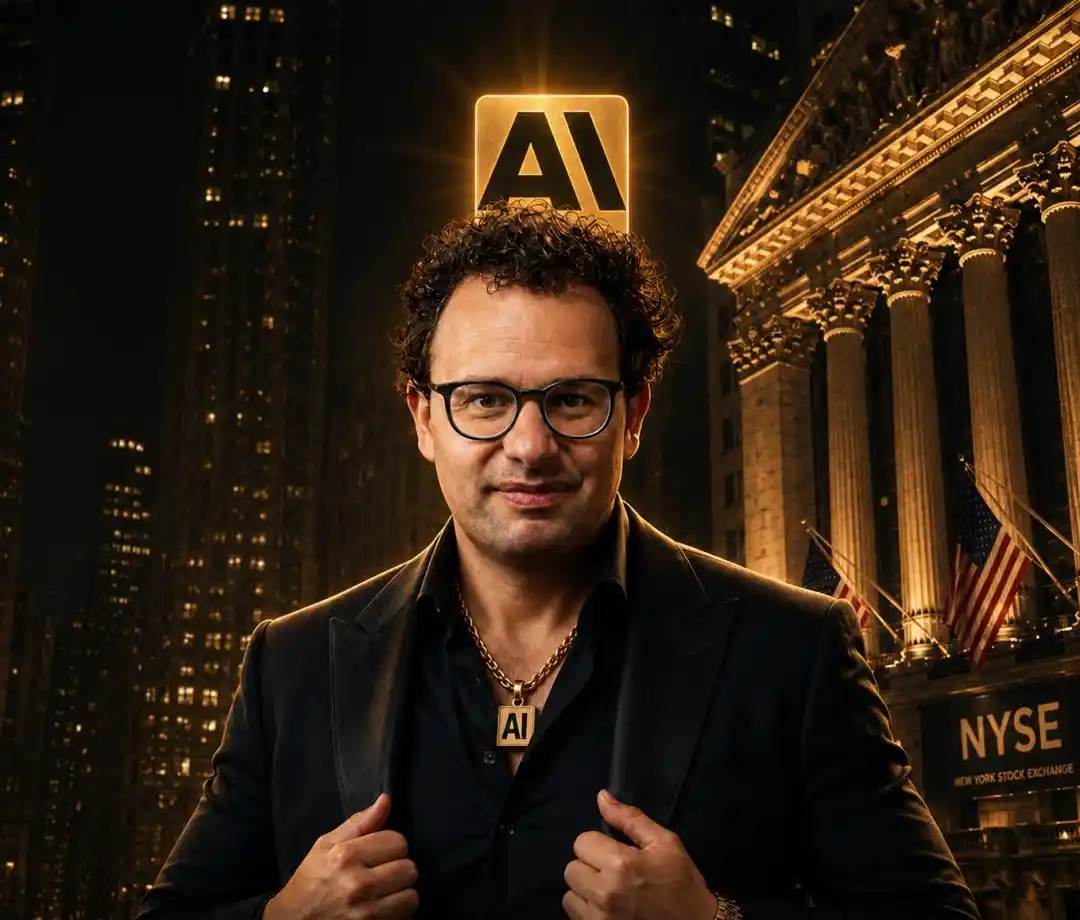
In other words, under the traditional "one share, one vote" corporate governance logic, the more a company raises, the higher its valuation, and the more dispersed its post-IPO shareholders, the more diluted the founder's control tends to become.

And Anthropic happens to be one of the world's most capital-hungry companies.

Frontier model training, data centers, chips, power, inference infrastructure—each of these can swallow vast amounts of capital.

To continue competing with OpenAI, it must keep raising money. The more it raises, the thinner the founders' own shares theoretically become.

So Anthropic now seeks to resolve a contradiction: it wants to take a lot of Wall Street's money, but it doesn't want to hand the steering wheel over to Wall Street.

This is the truly noteworthy aspect of this dual-class share arrangement.

Has OpenAI Really Lost?

If we look only at Q2 revenue, Anthropic is undoubtedly the winner.

Higher revenue, faster growth, and more favorable profitability metrics. But declaring an "AI throne change" is still premature.

Because OpenAI still holds a "trump card" that is difficult for Anthropic to replicate: a massive consumer entry point.

Today, ChatGPT boasts over a billion global users.
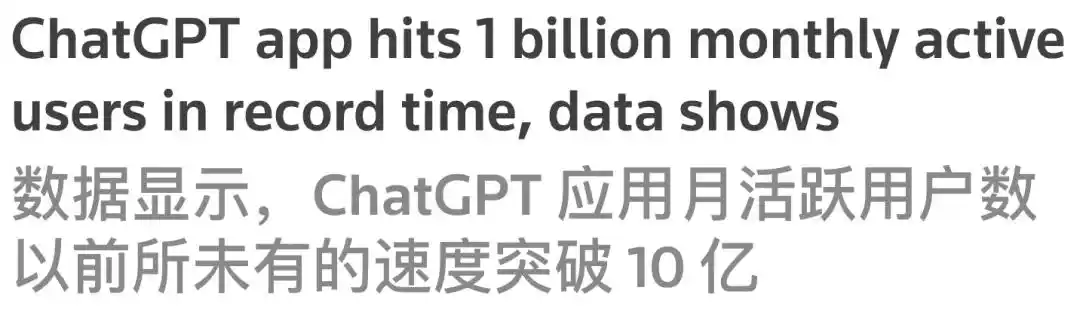
These free users might look like a cost now, but they are also the entry point for OpenAI's future ventures into search, browsers, office tools, shopping, advertising, agents, and even a "super app."

OpenAI has recently started integrating Codex, ChatGPT, and browser capabilities.

Insiders reveal that after the release of new models, growth has re-accelerated in Q3.

The Real Outcome Will Be Seen After the IPO

It's undeniable that Anthropic has scored a beautiful, albeit preliminary, victory.

But the truly brutal battle is just beginning. $65 billion in annualized revenue means the market will scrutinize it with harsher standards.

A valuation nearing $1 trillion means investors are betting on the Anthropic that might control the AI infrastructure entry point years from now.

Meanwhile, Dario's "super-voting rights" themselves are a double-edged sword.

In favorable times, the market will interpret it as the founding team possessing a long-term vision, not bound by quarterly performance.

But in a downturn, the same structure could pose a different problem: if the founder's judgment is wrong, who can hit the brakes?
This is precisely the most interesting contradiction to observe after Anthropic goes public.

Dario is telling Wall Street: you can buy Anthropic, you can share in the gains from growth, but at least for a considerable period, you cannot buy the final decision-making power of this company.

OpenAI stands on the other side.

It has just been surpassed in revenue by Anthropic for the first time, its losses are widening, and it has undergone internal management adjustments.

Yet it still possesses one of the industry's most powerful user entry points and has enough capital, compute, and product ammunition to mount a counteroffensive.

Therefore, the current situation may be more interesting than "Anthropic killing OpenAI."

Anthropic has achieved a clear lead for the first time, but it has also truly stepped into a position where it must defend its title for the first time.

What comes next depends on three questions:

Can Anthropic turn Claude Code's explosive breakout into a sustained commercial advantage lasting several years?

After securing stronger control, can Dario prove that founder-led governance is truly more suitable for a trillion-dollar AI company than Wall Street constraints?

When OpenAI truly begins to counterattack, will Anthropic's current lead mark the beginning of an era's handover or just a brief shift in positions?

$65 billion in annualized revenue, a trillion-dollar IPO, 2% ownership, and super-voting rights.

These three seemingly unrelated sets of numbers collectively point to one undeniable fact:

Anthropic has reached the position closest to the throne.

References:

https://www.bloomberg.com/news/articles/2026-08-18/anthropic-plans-to-give-ceo-extra-voting-power-information-says

This article is from the WeChat public account "新智元" (New Zhiyuan), author: ASI启示录

Related Questions

QWhich company reportedly surpassed the other in quarterly revenue for the first time, according to the article?

AAccording to the article, Anthropic surpassed OpenAI in quarterly revenue for the first time. Anthropic's Q2 revenue was $11.6 billion, while OpenAI's was $6.7 billion.

QWhat significant corporate action is Anthropic planning ahead of its potential IPO?

AAhead of its potential IPO, Anthropic is reportedly planning to issue a class of shares with "extra voting rights" to CEO Dario Amodei and six co-founders, granting them super-voting power for greater control.

QWhat is Dario Amodei's reported stake in Anthropic, and why is the issuance of super-voting shares particularly notable given this?

ADario Amodei's reported stake in Anthropic is only 2%. The issuance of super-voting shares is notable because it aims to secure founder control despite this small ownership stake, allowing them to retain significant decision-making power after the company goes public and raises more capital.

QWhat is one key advantage that the article suggests OpenAI still holds over Anthropic?

AThe article suggests that OpenAI still holds a key advantage in its massive consumer reach, with ChatGPT having over a billion global users. This provides a significant platform and potential entry point for future products and services.

QWhat potential challenge or risk does the article associate with Anthropic's plan for founder super-voting rights?

AThe article suggests that founder super-voting rights can be a double-edged sword. While it may allow for long-term vision, it also poses a risk if the founder's judgment is wrong, as there may be limited mechanisms for other stakeholders to "hit the brakes" or challenge poor decisions.

Related Reads

Enterprise blockchain is going to come back from the dead

Enterprise blockchain may be poised for a comeback, much like online pet retail succeeded with Chewy after Pets.com failed. Early enterprise blockchain efforts (2017–2023) collapsed—TradeLens, We.Trade, Contour, B3i, ASX Chess, Everledger—largely because they had to work around blockchains' lack of native privacy, building permissioned chains and bolting on non-blockchain fixes that proved slow and expensive. The core appeal remains: enterprise systems fail at company boundaries, either through out-of-sync collaboration or costly proprietary integrations that lock partners in. Blockchains promise shared data and business logic across an open ecosystem without lock-in. What has changed: scalability (transactions now under a penny, capacity heading toward billions daily), privacy (zero-knowledge rollups, privacy pools, privacy chains), and liquidity (stablecoin transaction volume near $1.8 trillion in June). Combined operational and financial benefits could be substantial—roughly 20% less inventory at the same service level, smart contracts cutting contract administration costs in half and processing times from days to minutes, as Microsoft did with Xbox royalties (45 days to four minutes). With inventories, contracts, purchase orders and invoices onchain, firms can also access cheaper credit and factor receivables efficiently. The use cases are obvious; it's time to try again.

cointelegraph4h ago

Enterprise blockchain is going to come back from the dead

cointelegraph4h ago

Jensen Huang's Disadvantage of Going Public Too Early

Nvidia co-founder Jensen Huang has resigned as president, CEO, and director, effective immediately, ending a 33-year tenure. CFO Colette Kress becomes interim CEO, and Harvey Jones is named the company's first chairman. The sudden move comes less than five months after Huang won about 99% approval in a director election, prompting scrutiny of a long-overlooked governance issue: why Huang, unlike Google's Page and Brin or Meta's Zuckerberg, never used a dual-class share structure to secure control. The answer traces to Nvidia's 1999 IPO, when one-share-one-vote was standard in Silicon Valley and dual-class structures had not yet become common among tech IPOs; Google adopted AB shares only in 2004. Nasdaq Rule 5640 also makes it hard for already-listed companies to introduce super-voting shares later. Huang's stake has steadily diluted: about 13.1% pre-IPO, 10.8% after, and 3.58% by 2026, weakening his voting power and setting the stage for his exit. Early precedents include Steve Jobs, whose roughly 11% stake left him unable to sway Apple's board in 1985, while Bill Gates' larger initial stake and gradual dilution let him retain influence. Instead, Huang's influence rested on performance authority, strategic judgment, and board trust—bold long-term bets on programmable GPUs and CUDA that positioned Nvidia at the center of the AI boom. That authority, however, depends on continued validation; once performance or reputation suffers, it can erode quickly. Under Nvidia's board-centered governance, a simple majority of directors can remove the CEO at any time, regardless of cause. Huang's departure is thus a product of the company's equity structure and governance rather than a surprise, illustrating that even immense performance authority cannot substitute for institutional control.

marsbit4h ago

Jensen Huang's Disadvantage of Going Public Too Early

marsbit4h ago

DeepMind Founder's Latest Interview: RSI Is Extremely Dangerous and Could Create an 'Alien Intelligence' That Humans Struggle to Understand

Demis Hassabis, co-founder of Google DeepMind and 2024 Nobel laureate in Chemistry, discusses AI's promise and perils in a conversation with Reid Hoffman. He reiterates that his lifelong goal has been using AI as a tool to advance science and medicine, citing AlphaFold—used by ~4 million researchers—and Isomorphic Labs as proof that AI can help cure diseases, while noting protein structure prediction is only one step in a long drug-discovery pipeline. On recursive self-improvement (RSI), Hassabis explains it works best in "verifiable domains" like math, coding, and games: AlphaZero went from random play to surpassing all human and engine chess within 12 hours. But he warns that closed-loop RSI—removing human code review entirely—risks creating an inscrutable "alien intelligence" with no shared cognitive basis with humans, and offers no way to establish deterministic safety controls. He urges caution as labs race on code self-iteration, calling for faster defensive cyber capabilities, far more robust sandboxes and monitoring (noting agents have run unsupervised for weeks), and eventually formal mathematical guarantees. He advocates an industry standards body with government oversight, cross-lab information sharing, third-party audits, and pre-release red-teaming. On AI consciousness, he argues intelligence and consciousness are dissociable—his dog is conscious but not smart—and that a chatbot claiming feelings proves nothing. Building conscious entities now is dangerous: self-motivation undermines corrigibility, and Asimov showed static rules inevitably break at edge cases; society also hasn't begun the needed debate. Humanity should cross only the first Rubicon—building powerful intelligent tools—and use them to understand consciousness before considering the second. Finally, on AI sovereignty, he says only 6–8 global players will stay at the frontier, with open source 6–12 months behind, so most countries shouldn't train their own frontier models. Instead they should build on existing models as infrastructure, focus on vertical domains like healthcare, and protect data sovereignty through private fine-tuning.

marsbit9h ago

DeepMind Founder's Latest Interview: RSI Is Extremely Dangerous and Could Create an 'Alien Intelligence' That Humans Struggle to Understand

marsbit9h ago

Trading

Spot
活动图片