Crypto is More in Step With Asia’s Equities, Highlighting Need for Regulation

IMFPublished on 2022-08-22Last updated on 2022-08-22

Abstract

Crypto trading volume, and co-movement with equity markets, has surged in the region.

Crypto trading volume, and co-movement with equity markets, has surged in the region.

Few parts of the world have embraced crypto assets like Asia, where top adopters include individual and institutional investors from India to Vietnam and Thailand. This raises the important issue of the extent of integration of crypto into the financial system in Asia.

While digitalization can aid in the transition to an environmentally-conscious payment system and also foster financial inclusion, crypto can pose financial stability risks.

Before the pandemic, crypto seemed insulated from the financial system. Bitcoin and other assets showed little correlation with Asian equity markets, which helped diffuse financial stability concerns.

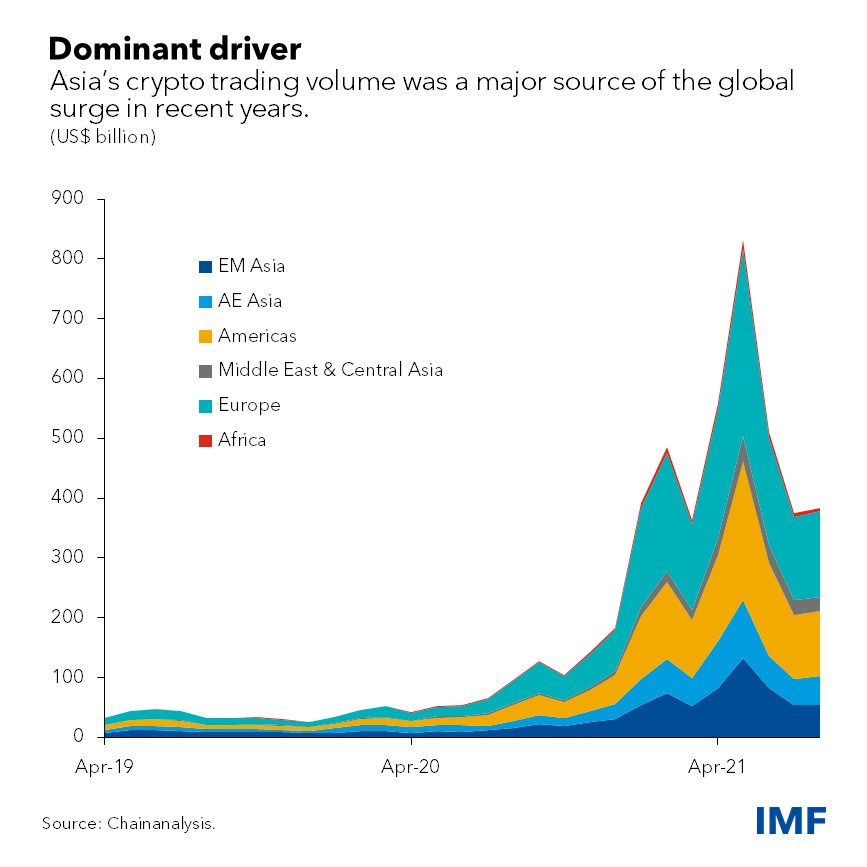
Crypto trading, however, soared as millions stayed home and received government aid, while low interest rates and easy financing conditions also played a role. The total market value of the world’s crypto assets surged 20-fold in just a year and a half to $3 trillion in December. Then it plunged to less than $1 trillion in June as central bank interest rate increases to contain inflation ended easy access to cheap borrowing.
While the financial sector appears to have been insulated from these sharp movements, it may not be in future boom-bust cycles. Contagion could spread through individual or institutional investors that may hold both crypto and traditional financial assets or liabilities. Large losses on crypto may drive these investors to rebalance their portfolios, possibly causing financial-market volatility or even default on traditional liabilities.

As Asian investors piled into crypto, the correlation between the performance of the region’s equity markets and crypto assets such as Bitcoin and Ethereum has increased. While the returns and volatility correlations between Bitcoin and Asian equity markets were low before the pandemic, these have increased significantly since 2020.
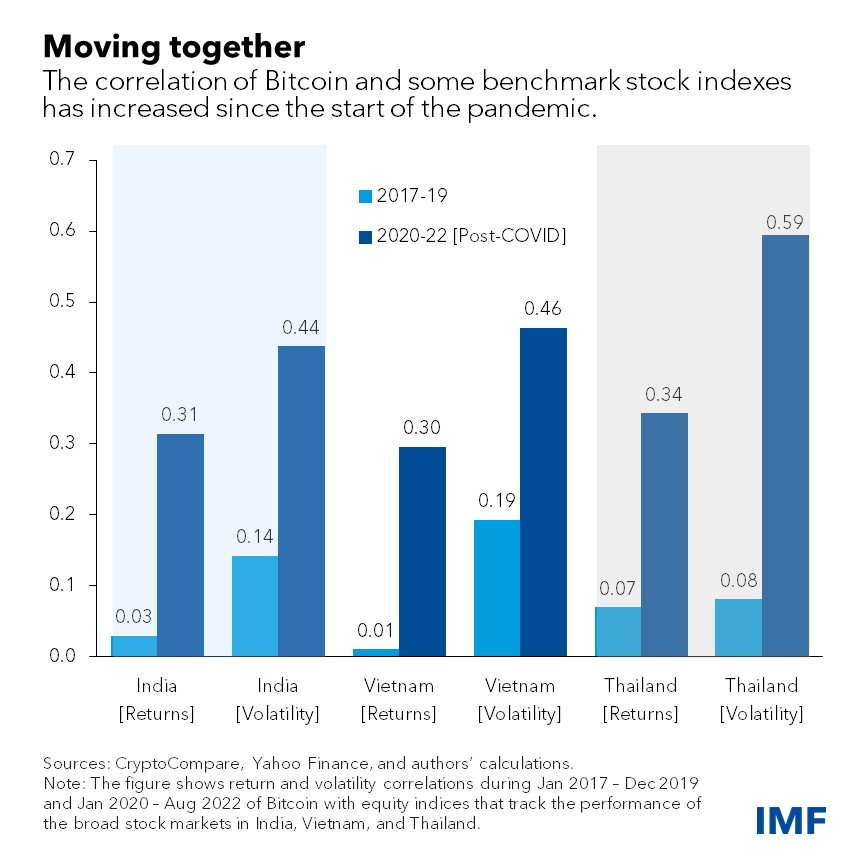
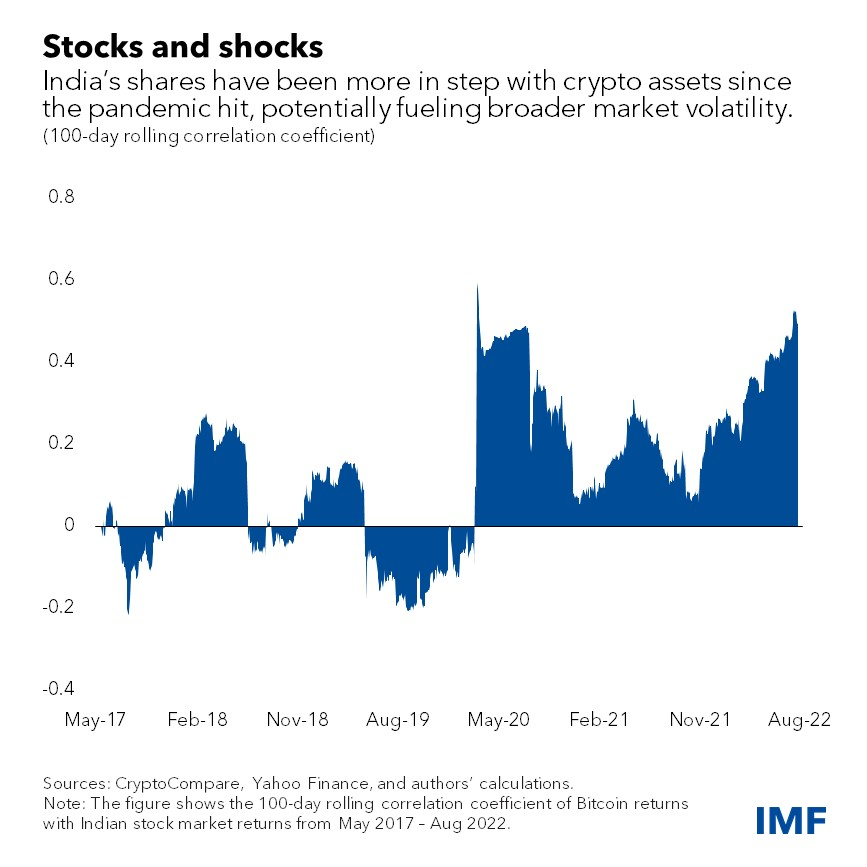
For example, the return correlations of Bitcoin and Indian stock markets have increased by 10-fold over the pandemic, suggesting limited risk diversification benefits of crypto. The volatility correlations have increased by 3-fold suggesting possible spillovers of risk sentiment among the crypto and equity markets.

Key drivers of the increased interconnectedness of crypto and equity markets in Asia could include growing acceptance of crypto-related platforms and investment vehicles in the stock market and at the over-the-counter market, or more generally growing crypto adoption by retail and institutional investors in Asia, many of whom have positions in both the equity and crypto markets.

Using the spillover methodology developed in our January Global Financial Stability Note, we also find that the rise in crypto-equity correlations in Asia has been accompanied by a sharp rise in crypto-equity volatility spillovers in India, Vietnam, and Thailand. This indicates a growing interconnectedness between the two asset classes that permits the transmission of shocks that can impact financial markets.
Accordingly, authorities in Asia are increasingly sensitive to the rising risks posed by crypto as adoption continues to spread. They have therefore dialed up their focus on crypto regulation, and regulatory frameworks are underway in several countries including India, Vietnam and Thailand.

A significant effort is also needed to address important data gaps that still prevent domestic and international regulators from fully understanding ownership and use of crypto and its intersection with the traditional financial sector.

Regulatory frameworks for crypto in Asia should be tailored to the main uses of such assets within the countries. They should establish clear guidelines on regulated financial institutions and seek to inform and protect retail investors. Finally, to be fully effective, crypto regulation should be closely coordinated across jurisdictions.


Related Reads

CPU Makes a Comeback to the Table, A $170 Billion "Power Seizure" Drama Begins

A new era is dawning for the server CPU (Central Processing Unit), driven by the shift from AI model training to large-scale reasoning and the rise of Agentic AI. This article explores how the CPU is reclaiming a central role in the AI data center. For years, the focus has been on the GPU (Graphics Processing Unit) for AI training. However, as AI moves to the inference and Agent phase—where tasks involve complex, multi-step reasoning, tool calls, and data management—the workload balance is flipping. Studies show CPUs now handle over 70% of the workload in Agentic AI, up from 10-30% in training. This is because Agent tasks generate massive intermediate data (KV Cache) that exceeds GPU memory, forcing it to be offloaded to the CPU's larger, more scalable memory pools. This increased importance is translating into market changes. Major players are taking note: NVIDIA launched its first standalone CPU line, Vera, based on ARM architecture and optimized for Agent performance. AMD doubled its server CPU market forecast to over $1200 billion by 2030. Analyst reports project the total server CPU market could reach $1700 billion by 2030, with AI-driven demand being a primary driver. Furthermore, the classic ratio of CPUs to GPUs in AI servers is rapidly changing, converging from 1:8 toward 1:1 for Agent deployments. This surge in demand has led to a rare industry-wide price increase of 10-15% for server CPUs from Intel and AMD, breaking a decade-long trend of "more performance for the same price." Demand is bifurcating into high-core-count CPUs for in-rack GPU support and moderate-core CPUs for standalone Agent task orchestration. In China, this global trend presents an opportunity for domestic CPU manufacturers like Hygon (海光信息) and Huawei Kunpeng, who are bolstered by both growing AI infrastructure needs and national policies promoting technological self-reliance ("xin chuang"). The maturity of their software ecosystems is also accelerating, evidenced by faster adaptation to new AI models. In conclusion, the narrative is shifting from a GPU-centric view to one where CPU-GPU synergy is critical. The CPU is no longer a peripheral component but a performance-defining bottleneck and a key growth driver in the AI hardware stack, opening a massive new market estimated in the hundreds of billions of dollars.

marsbit6h ago

CPU Makes a Comeback to the Table, A $170 Billion "Power Seizure" Drama Begins

marsbit6h ago

TechFlow Intelligence: AMD AI Director Publicly Criticizes Claude Code for "Becoming Dumber and Lazier", Trump Claims Full Ceasefire in Hormuz But Strait Still Has 80 Unexploded Mines

TechFlow Intelligence Report: This daily digest covers key developments in AI, crypto, hardware, and geopolitics. In AI, SK Telecom faces US export control scrutiny over its partnership with Anthropic, while a Gemini user reports being misled in a scam scenario, sparking safety debates. China's Z.AI launches the GLM-5.2 model, rivaling Claude Opus without NVIDIA chips. In crypto, Bithumb lists ReProtocol, and Upbit delists KernelDAO. On the hardware front, MIT researchers build a custom OS to study chips, ASML denies US claims its advanced lithography machines are in China, and Amazon considers selling its in-house AI chips. Apple's future A21 Pro chip may use TSMC's latest N2P process. Major tech issues include 10,000 GitHub repositories distributing malware and Apple patching a critical eavesdropping flaw in Beats earbuds. US stocks rise, led by semiconductors, with Intel surging 10.6%, while SpaceX falls 3.5%. Geopolitically, despite a US-Iran deal, the Strait of Hormuz remains risky with ~80 uncleared mines, stalling 80M barrels of oil on standby tankers. Iran postpones Switzerland talks, and Trump calls the agreement an "unconditional surrender." The report highlights a contrast: temporary geopolitical calm versus the ongoing, fundamental restructuring of tech supply chains and chip independence.

marsbit6h ago

TechFlow Intelligence: AMD AI Director Publicly Criticizes Claude Code for "Becoming Dumber and Lazier", Trump Claims Full Ceasefire in Hormuz But Strait Still Has 80 Unexploded Mines

marsbit6h ago

Trading

Spot
Futures
活动图片