Bitcoin Bounces to $67K, but Hidden Risks Remain

AmbcryptoPublished on 2026-03-02Last updated on 2026-03-04

Abstract

Bitcoin reclaims $67,000 amid geopolitical shock — Relief rally or looming bull trap?

Bitcoin pushed back above $67,000 even as geopolitical tensions between the United States and Iran rattled global markets and pressured risk assets.

The rebound has surprised traders who expected a deeper drawdown under heightened macro uncertainty.

The asset dropped to as low as $60,030 in the early hours of the 28th of February after tensions escalated and fear spread across financial markets.

Yet, instead of extending its losses, Bitcoin [BTC] stabilized and advanced toward $68,000, recovering a significant portion of its decline within hours.

Such resilience appears counterintuitive. Historically, geopolitical escalations have triggered sustained risk-off reactions, often leading to prolonged weakness in speculative assets.

Bitcoin’s swift rebound therefore raises a critical question: does this strength reflect genuine accumulation, or is it a temporary rally within a broader corrective phase?

A familiar pattern from 2022?

Market analyst Benjamin Cowen has urged caution. According to his recent assessment, the current price structure resembles Bitcoin’s behavior during the 2022 Russia–Ukraine conflict.

In 2022, Bitcoin initially sold off as geopolitical tensions intensified. It then staged a sharp rebound that many interpreted as the start of a recovery.

However, that rebound formed a lower high before the market resumed its downtrend.

The subsequent decline proved severe. Bitcoin fell approximately 67%, sliding from around $48,189 to a cycle low near $15,476.
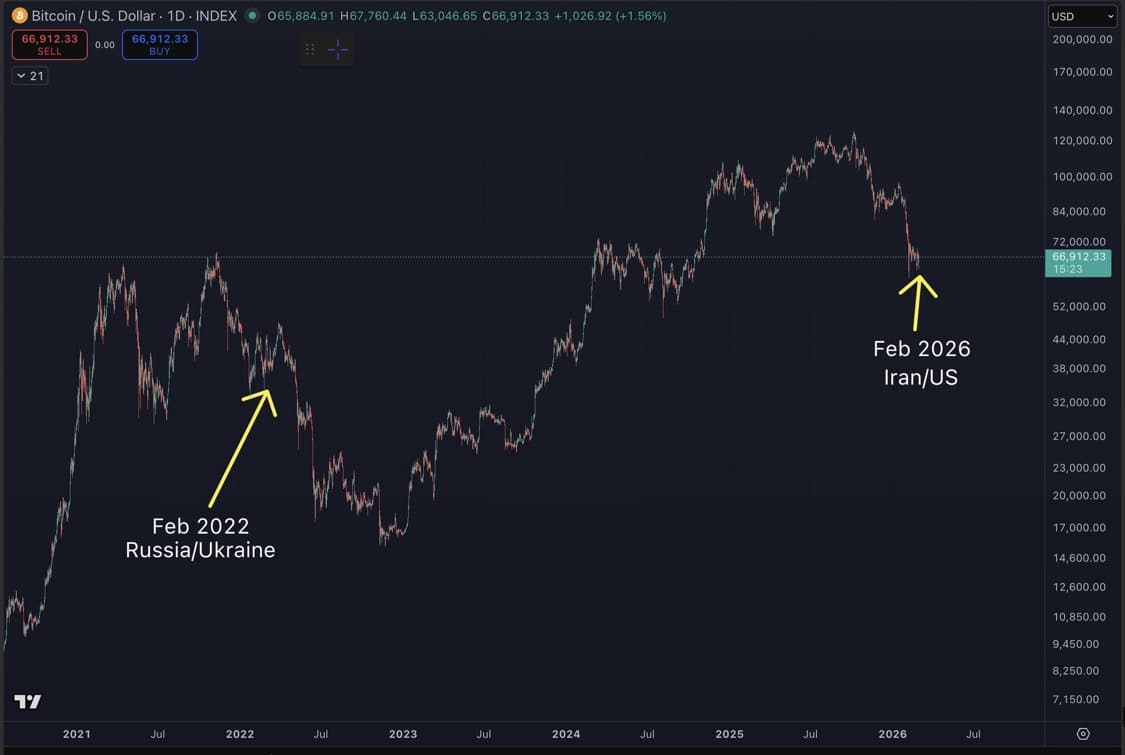
Cowen argues that the present setup may be tracing a similar fractal.

If the pattern holds, Bitcoin could experience a relief rally into the $70,000–$84,000 range before forming another lower high and extending its broader correction.

Cowen noted,

“Bear markets tend to take a while to play out.”

He added that even if March delivers upward momentum, the move may resemble the 2022 lower-high structure rather than confirm a sustained bull cycle.

Cowen has maintained a cautious long-term stance on Bitcoin for months, and this latest analysis reinforces his view that the market may not have completed its corrective phase.

Trading below realized price shifts the risk balance

Beyond technical structure, on-chain data adds another layer of concern.

At the time of analysis, Bitcoin traded below this adjusted realized price, estimated near $72,700. Historically, this level has acted as a structural support zone during expansion phases.

In both June and September 2023, price found stability around similar cost-basis levels before advancing.
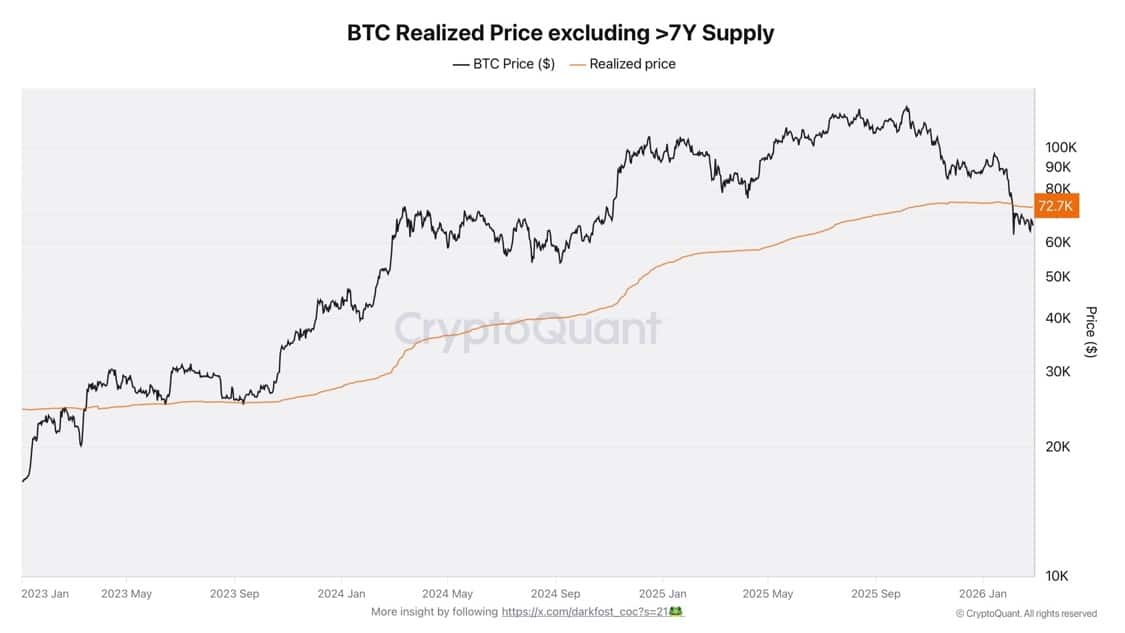
However, when Bitcoin last broke below this threshold in May 2022, the market endured sustained weakness until March 2023 before regaining stability.

Trading below the realized price often indicates that a large portion of active holders sit at an unrealized loss.

That condition can dampen demand, reduce conviction, and increase the likelihood of supply entering the market during rebounds.

If historical behavior repeats, Bitcoin could face an extended period of consolidation or gradual decline before establishing a durable recovery.

Liquidation clusters heighten volatility risk

Derivatives positioning further complicates the outlook. Liquidation data suggests the market holds significant leveraged exposure on both sides, increasing the probability of sharp, forced moves.

On the upside, $68,596 represents a high-interest zone where substantial 50x and 100x short positions are concentrated.

A decisive breakout above this level could trigger cascading short liquidations and amplify upward momentum.

On the downside, $65,656 carries similar leverage concentration among long positions. A breakdown below this level could force liquidations and accelerate selling pressure.
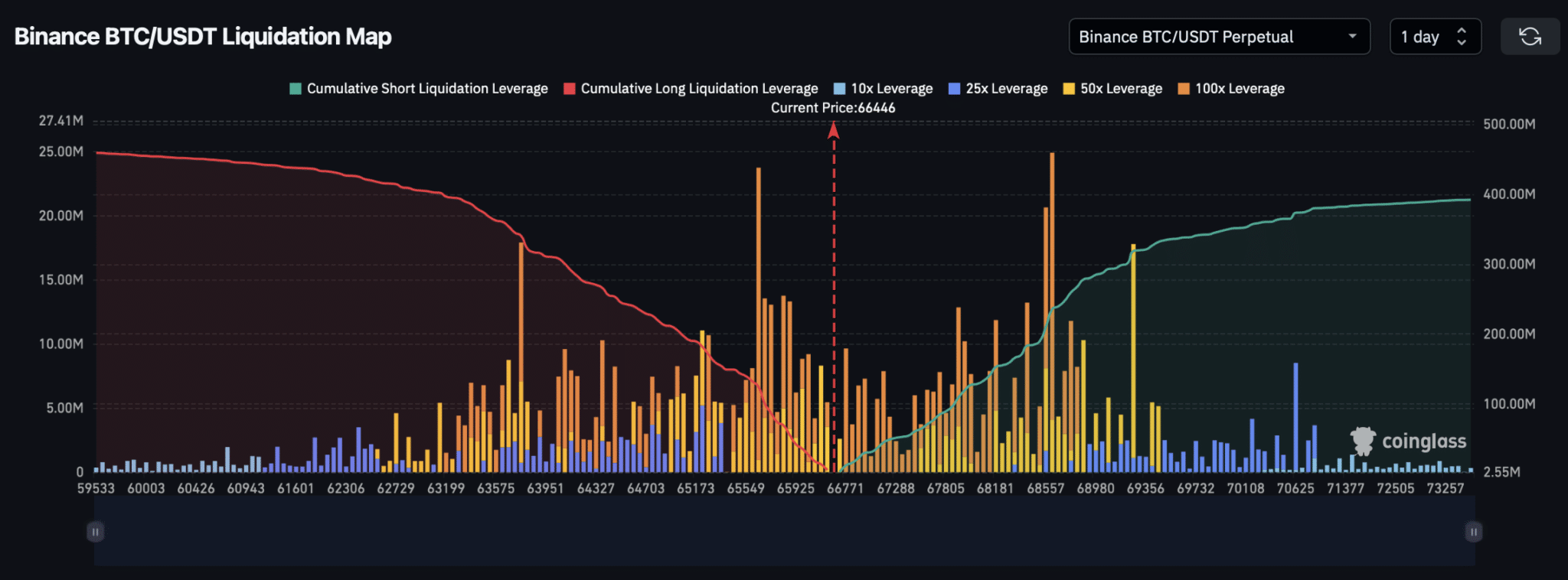
With leverage elevated and geopolitical risk unresolved, Bitcoin sits in a structurally sensitive position. A decisive move in either direction could trigger a volatility cascade.

For now, the rally above $67,000 reflects resilience.

Whether it marks genuine strength or a classic bull trap will likely depend on whether Bitcoin can reclaim its realized price and avoid forming another lower high in the weeks ahead.

Final Summary

  • Bitcoin’s recovery comes despite rising geopolitical tensions between the United States and Iran.
  • The asset now trades below its adjusted cost basis, a development that historically signals structural weakness.


Related Questions

QWhat was the key reason Bitcoin's rebound above $67,000 surprised traders?

AThe rebound surprised traders because it occurred despite heightened geopolitical tensions and macro uncertainty, which typically trigger sustained risk-off reactions and prolonged weakness in speculative assets.

QWhich historical event does market analyst Benjamin Cowen compare the current Bitcoin price structure to?

ABenjamin Cowen compares the current price structure to Bitcoin's behavior during the 2022 Russia-Ukraine conflict, where a sharp rebound formed a lower high before the market resumed a severe downtrend.

QWhat is the significance of Bitcoin trading below its 'realized price'?

ATrading below the realized price, estimated near $72,700, indicates that a large portion of active holders are at an unrealized loss. This can dampen demand, reduce conviction, and increase the likelihood of supply entering the market during rebounds, often signaling structural weakness.

QWhat are the key liquidation cluster levels mentioned that could trigger high volatility?

AOn the upside, $68,596 is a high-interest zone with concentrated short positions; a breakout could trigger cascading liquidations and amplify upward momentum. On the downside, $65,656 has concentrated long positions; a breakdown could force liquidations and accelerate selling pressure.

QAccording to the analyst, what two factors will determine if the current rally is genuine strength or a bull trap?

AThe rally will depend on whether Bitcoin can reclaim its realized price (around $72,700) and avoid forming another lower high in the weeks ahead.

Related Reads

Musk Casually Overturns the Rice Bowls of Crypto KOLs

Elon Musk's X platform has updated its paid partnership policy, causing significant disruption among crypto KOLs. The new rules mandate that all paid content must be clearly labeled with a "Paid Partnership" disclosure tag, replacing the previous "#ad" requirement. Additionally, reporting unlabeled paid promotions has been simplified to an anonymous form. Initially, the policy mistakenly included "cryptocurrency" in a list of prohibited promotion categories, but this was quickly corrected by X’s product lead, Nikita Bier, who clarified that the change was an error and not targeted at crypto or prediction markets. Despite this, the core policy changes still apply to crypto influencers. The new rules effectively end the era of "hidden advertisements" in crypto, where KOLs often promoted projects without disclosing paid arrangements. Many crypto projects and KOLs prefer undisclosed promotions to maintain an appearance of organic endorsement, as labeled ads may reduce credibility and trigger backlash from followers who might perceive them as scams. The anonymous reporting system has already led to penalties for several KOLs, including temporary bans and forced post removals. This has created uncertainty and fear within the community, as malicious or mistaken reports could easily target influencers. Some KOLs are protesting sarcastically by labeling all posts as "paid partnerships," while others consider migrating to crypto-friendly platforms like Binance Square, which may offer a more accommodating environment. However, given crypto’s niche size relative to the broader internet, X is unlikely to reverse its policy changes for this audience.

marsbit12m ago

Musk Casually Overturns the Rice Bowls of Crypto KOLs

marsbit12m ago

The Hottest Open Source Project in History, Almost Became a 'Trophy' in the Crypto World

OpenClaw has rapidly become one of the most popular and fastest-growing open-source projects in history, amassing over 250,000 stars on GitHub in just three months. Its creator, Peter Steinberger, has gained significant influence in the AI community but has also taken a strong stance against the crypto industry. Despite its success, OpenClaw has faced challenges, including a trademark dispute that led to a name change. During this process, crypto speculators quickly created and promoted fake tokens using the project’s name, leading to significant financial losses for some investors. Steinberger publicly denounced these activities, clarifying that OpenClaw would never issue a token and disavowing any association with cryptocurrency. The project also briefly listed Venice, a crypto-native AI project on Base chain, as a recommended model provider—a move that was quickly reversed to maintain neutrality and avoid perceived endorsements of crypto-related initiatives. Steinberger has repeatedly expressed frustration with crypto communities, citing harassment, malicious code submissions, and off-topic speculation as disruptive to genuine technical discussion. He has even considered abandoning the project due to these issues. Steinberger, who is financially independent, has advised young developers to avoid cryptocurrency, reflecting his broader criticism of the industry’s speculative culture. The conflict highlights the ongoing struggle between open-source innovation and crypto-driven commercialization.

marsbit12m ago

The Hottest Open Source Project in History, Almost Became a 'Trophy' in the Crypto World

marsbit12m ago

Musk Casually Overturns the Rice Bowls of Crypto KOLs

Elon Musk's X platform has updated its paid partnership policy, causing significant disruption among crypto KOLs. The new rules mandate that all paid promotional posts must use a "Paid Partnership" disclosure label, replacing the previous "#ad" requirement. Additionally, reporting unlabeled paid content has been simplified to an anonymous form. Initially, the policy mistakenly included "cryptocurrency" in a list of prohibited promotion categories, but this was quickly corrected by X's product lead, Nikita Bier, who clarified that the change aims to improve transparency and user trust, not target crypto or prediction markets. The new policy effectively ends the era of "hidden advertisements" common in crypto influencer marketing. Both projects and KOLs are concerned: projects fear that labeled promotions may reduce credibility, while KOLs risk reputational damage and fan backlash if their paid endorsements are visibly disclosed. The reporting mechanism allows anonymous user submissions, leading to fears of misuse. Several crypto KOLs have already been penalized, with accounts temporarily restricted or forced to delete non-compliant posts. As a result, some influencers are considering migrating to crypto-native platforms like Binance Square, which offer greater flexibility and alignment with crypto culture. However, X is unlikely to reverse its policy, as the crypto community represents a small fraction of its overall user base.

Odaily星球日报20m ago

Musk Casually Overturns the Rice Bowls of Crypto KOLs

Odaily星球日报20m ago

Trading

Spot
Futures

Hot Articles

What is $BITCOIN

DIGITAL GOLD ($BITCOIN): A Comprehensive Analysis Introduction to DIGITAL GOLD ($BITCOIN) DIGITAL GOLD ($BITCOIN) is a blockchain-based project operating on the Solana network, which aims to combine the characteristics of traditional precious metals with the innovation of decentralized technologies. While it shares a name with Bitcoin, often referred to as “digital gold” due to its perception as a store of value, DIGITAL GOLD is a separate token designed to create a unique ecosystem within the Web3 landscape. Its goal is to position itself as a viable alternative digital asset, although specifics regarding its applications and functionalities are still developing. What is DIGITAL GOLD ($BITCOIN)? DIGITAL GOLD ($BITCOIN) is a cryptocurrency token explicitly designed for use on the Solana blockchain. In contrast to Bitcoin, which provides a widely recognized value storage role, this token appears to focus on broader applications and characteristics. Notable aspects include: Blockchain Infrastructure: The token is built on the Solana blockchain, known for its capacity to handle high-speed and low-cost transactions. Supply Dynamics: DIGITAL GOLD has a maximum supply capped at 100 quadrillion tokens (100P $BITCOIN), although details regarding its circulating supply are currently undisclosed. Utility: While precise functionalities are not explicitly outlined, there are indications that the token could be utilized for various applications, potentially involving decentralized applications (dApps) or asset tokenization strategies. Who is the Creator of DIGITAL GOLD ($BITCOIN)? At present, the identity of the creators and development team behind DIGITAL GOLD ($BITCOIN) remains unknown. This situation is typical among many innovative projects within the blockchain space, particularly those aligning with decentralized finance and meme coin phenomena. While such anonymity may foster a community-driven culture, it intensifies concerns about governance and accountability. Who are the Investors of DIGITAL GOLD ($BITCOIN)? The available information indicates that DIGITAL GOLD ($BITCOIN) does not have any known institutional backers or prominent venture capital investments. The project seems to operate on a peer-to-peer model focused on community support and adoption rather than traditional funding routes. Its activity and liquidity are primarily situated on decentralized exchanges (DEXs), such as PumpSwap, rather than established centralized trading platforms, further highlighting its grassroots approach. How DIGITAL GOLD ($BITCOIN) Works The operational mechanics of DIGITAL GOLD ($BITCOIN) can be elaborated on based on its blockchain design and network attributes: Consensus Mechanism: By leveraging Solana’s unique proof-of-history (PoH) combined with a proof-of-stake (PoS) model, the project ensures efficient transaction validation contributing to the network's high performance. Tokenomics: While specific deflationary mechanisms have not been extensively detailed, the vast maximum token supply implies that it may cater to microtransactions or niche use cases that are still to be defined. Interoperability: There exists the potential for integration with Solana’s broader ecosystem, including various decentralized finance (DeFi) platforms. However, the details regarding specific integrations remain unspecified. Timeline of Key Events Here is a timeline that highlights significant milestones concerning DIGITAL GOLD ($BITCOIN): 2023: The initial deployment of the token occurs on the Solana blockchain, marked by its contract address. 2024: DIGITAL GOLD gains visibility as it becomes available for trading on decentralized exchanges like PumpSwap, allowing users to trade it against SOL. 2025: The project witnesses sporadic trading activity and potential interest in community-led engagements, although no noteworthy partnerships or technical advancements have been documented as of yet. Critical Analysis Strengths Scalability: The underlying Solana infrastructure supports high transaction volumes, which could enhance the utility of $BITCOIN in various transaction scenarios. Accessibility: The potential low trading price per token could attract retail investors, facilitating wider participation due to fractional ownership opportunities. Risks Lack of Transparency: The absence of publicly known backers, developers, or an audit process may yield skepticism regarding the project's sustainability and trustworthiness. Market Volatility: The trading activity is heavily reliant on speculative behavior, which can result in significant price volatility and uncertainty for investors. Conclusion DIGITAL GOLD ($BITCOIN) emerges as an intriguing yet ambiguous project within the rapidly evolving Solana ecosystem. While it attempts to leverage the “digital gold” narrative, its departure from Bitcoin's established role as a store of value underscores the need for a clearer differentiation of its intended utility and governance structure. Future acceptance and adoption will likely depend on addressing the current opacity and defining its operational and economic strategies more explicitly. Note: This report encompasses synthesised information available as of October 2023, and developments may have transpired beyond the research period.

363 Total ViewsPublished 2025.05.13Updated 2025.05.13

What is $BITCOIN

Discussions

Welcome to the HTX Community. Here, you can stay informed about the latest platform developments and gain access to professional market insights. Users' opinions on the price of BTC (BTC) are presented below.

活动图片