Dua Pendiri Blockchain Tua Tiongkok NEO Bertengkar, Transparansi Keuangan Jadi Penyebab Utama

marsbitPublished on 2026-01-01Last updated on 2026-01-01

Abstract

**Ringkasan: Konflik Pendiri NEO Terbuka, Transparansi Keuangan Jadi Isu Inti** Konflik antara dua pendiri NEO, Erik Zhang (Zhang Zhengwen) dan Da Hongfei, memanas di media sosial. Inti permasalahannya adalah kurangnya transparansi keuangan dalam yayasan NEO. Zhang, yang sebelumnya sempat hengkang, kembali pada September lalu dan langsung meminta laporan keuangan detail serta aliran dana yayasan, namun menghadapi kendala. Zhang menuduh yayasan di bawah kendali tunggal Da Hongfei beroperasi bagai "kotak hitam" dan menggunakan sumber daya NEO untuk mengembangkan proyek blockchain independen, EON. Ia juga menyebutkan bahwa ekosistem NEO sebelumnya hanya menciptakan "kemakmuran palsu" melalui hackathon tanpa pengguna yang nyata. Sebagai balasan, Da Hongfei menuduh Zhang justru mengendalikan sebagian besar aset inti NEO/GAS dan hak suara node konsensus, serta menunda pemindahan dana ke alamat multisig yayasan. Da berjanji akan merilis laporan keuangan untuk akhir tahun 2025 pada kuartal pertama 2026. Zhang secara sepihak mengumumkan bahwa mulai 1 Januari 2026, Da akan fokus pada pengembangan sidechain NeoX dan proyek SpoonOS, dan tidak lagi terlibat dalam urusan mainnet NEO.

Tidak disangka blockchain tua Tiongkok bisa mengalami hari seperti ini, yang lebih menyedihkan adalah, proyek AI top Tiongkok seperti Manus, Kimi, Minimax selama dua hari berturut-turut memiliki berita besar, baik diakuisisi puluhan miliar dolar AS maupun pendanaan ratusan juta, tetapi blockchain tua malah mulai bertengkar.

Saat ini, dua pendiri bersama blockchain NEO yang didirikan tahun 2014, Zhang Zhengwen (Erik Zhang) dan Da Hongfei, pada dasarnya telah benar-benar putus, dan masih saling menyindir di X. Berdasarkan pernyataan kedua belah pihak, serta informasi publik online, mencoba memahami apa yang sebenarnya terjadi antara dua pendiri blockchain tua ini.

Kotak Hitam Keuangan

Sebenarnya Zhang Zhengwen telah meninggalkan NEO beberapa tahun yang lalu, ini juga dikonfirmasi di twitternya sendiri, kemudian secara resmi kembali pada bulan September tahun ini. Pemicu pertengkaran ini terjadi pada bulan November, menurut pesan komunitas dan data publik, Zhang Zhengwen sebagai inti teknis mengalami hambatan ketika mencari laporan keuangan detail dan aliran dana yayasan Neo.
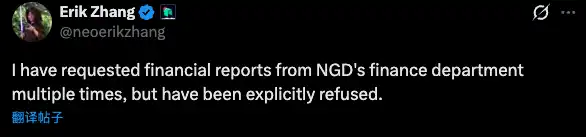
Kemudian Zhang Zhengwen menuduh yayasan Neo telah beroperasi tidak transparan dalam jangka panjang, kondisi aset seperti "kotak hitam". Dia menunjuk, Da Hongfei telah lama mengendalikan secara tunggal aset yayasan selain token NEO/GAS, dan kurangnya mekanisme pengungkapan yang lengkap dan dapat diaudit.

Dalam saling sindir kedua belah pihak hari ini, kami juga menemukan alasan Zhang Zhengwen meninggalkan sebelumnya, dia berkata Da Hongfei secara terpisah mencarinya, berkata bahwa efisiensi rendah jika dua orang bertanggung jawab atas NEO, jadi dia memilih untuk sementara keluar dari manajemen untuk "meningkatkan efisiensi". Namun, dia menemukan Da Hongfei menggunakan sumber daya NEO untuk mengembangkan proyek blockchain independen EON. Ini juga mendorongnya untuk kembali dan turut campur dalam tata kelola yayasan.

Dalam komunikasi komunitas bulan November, Zhang Zhengwen pernah menyatakan NEO sebelumnya mengandalkan hackathon untuk menciptakan "kemakmuran palsu", tidak ada pengguna nyata, banyak proyek hackathon menghilang setelah memenangkan hadiah.

Eskalasi Konflik

Pada bulan Desember, Zhang Zhengwen merilis pernyataan publik, menuntut Da Hongfei memenuhi kewajiban pengungkapan keuangan yang dijanjikan sejak 9 Desember. Yang lebih eksplosif adalah, Zhang Zhengwen secara sepihak mengumumkan, berdasarkan perjanjian telepon sebelumnya, mulai 1 Januari 2026, Da Hongfei tidak akan lagi berpartisipasi dalam urusan mainnet NEO, beralih fokus pada pengembangan dan operasi sidechain NeoX dan proyek baru SpoonOS.

Da Hongfei juga segera merespons, berkata bahwa Zhang Zhengwen sebenarnya mengendalikan sebagian besar dana di ekosistem NEO (termasuk aset inti token NEO dan GAS), dan mendominasi hak suara node konsensus, juga menuduh Zhang Zhengwen selama bertahun-tahun dengan berbagai alasan (seperti menunggu migrasi N3 selesai) menunda transfer dana ke alamat multisig yayasan (Multisig).

Da Hongfei berkomitmen akan merilis laporan keuangan akhir tahun 2025 pada kuartal pertama tahun 2026, dan akan berbagi data awal sebelumnya.


Related Questions

QApa yang menjadi penyebab utama perselisihan antara dua pendiri NEO, Erik Zhang dan Da Hongfei?

APenyebab utama perselisihan adalah ketidaktransparanan keuangan dalam yayasan NEO, di mana Erik Zhang menuduh Da Hongfei mengontrol aset yayasan secara tunggal tanpa mekanisme pengungkapan yang dapat diaudit.

QMengapa Erik Zhang sempat meninggalkan NEO sebelum kembali pada September tahun ini?

AErik Zhang meninggalkan NEO karena Da Hongfei mengatakan bahwa kepemimpinan bersama mereka tidak efisien, dan ia memilih keluar untuk 'meningkatkan efisiensi', tetapi kemudian mengetahui Da Hongfei menggunakan sumber daya NEO untuk mengembangkan proyek blockchain independen EON.

QApa yang dimaksud dengan 'kotak hitam' yang disebutkan Erik Zhang terkait keuangan NEO?

A'Kotak hitam' merujuk pada kondisi aset yayasan NEO yang tidak transparan, di mana aliran dana dan laporan keuangan detail sulit diakses atau diaudit oleh pihak lain.

QApa tanggapan Da Hongfei terhadap tuduhan Erik Zhang tentang kontrol keuangan?

ADa Hongfei membalas dengan menyatakan bahwa Erik Zhang justru mengontrol sebagian besar aset ekosistem NEO (termasuk token NEO dan GAS) dan hak suara node konsensus, serta menunda transfer dana ke alamat multisig yayasan.

QApa komitmen yang diumumkan Da Hongfei terkait laporan keuangan NEO?

ADa Hongfei berkomitmen untuk merilis laporan keuangan akhir tahun 2025 pada kuartal pertama 2026 dan akan berbagi data awal sebelumnya.

Related Reads

Fed's Internal Doves Flock to Hawkish Stance, Warsh's Debut "Between a Rock and a Hard Place"

U.S. Federal Reserve officials who previously advocated for rate cuts, including Governor Christopher Waller, have recently shifted their stance, with many now not ruling out the possibility of future rate hikes. This sets a challenging stage for new Fed Chair Kevin Warsh's first policy meeting. Appointed by President Trump based on his dovish views, Warsh now faces a committee where the debate has pivoted from "when to cut" to "whether to hike," driven by persistent inflation above 3%, a strong labor market, and supply-side pressures from AI infrastructure demands and geopolitical tensions. Key figures illustrate the shift. Governor Waller, once concerned about employment, now says data has pushed him toward considering rate increases. Even moderate voices like Governor Lisa Cook, while expecting inflation to ease, have indicated readiness to hike if it fails to do so. Long-time hawks such as regional Fed presidents Beth Hammack, Lorie Logan, and Neel Kashkari have grown more vocal, arguing that the real policy rate is effectively falling and that action may soon be needed. The upcoming Fed meeting is expected to keep rates steady but will likely remove the "easing bias" from its statement, signaling a neutral stance between cuts and hikes. The quarterly "dot plot" is anticipated to show most officials projecting no cuts this year, with some potentially indicating hikes. Chair Warsh, a critic of the Fed's reliance on forward guidance like the dot plot, must navigate communicating this pivot using tools he has questioned, all while steering policy in a direction counter to the preferences of the president who appointed him. The consensus suggests the Fed's next move could well be a rate increase.

marsbit34m ago

Fed's Internal Doves Flock to Hawkish Stance, Warsh's Debut "Between a Rock and a Hard Place"

marsbit34m ago

The Trillion-Yuan Market Cap 'Yi Zhong Tian': Who is the True Value King?

The article analyzes the three leading Chinese optical module companies, collectively nicknamed "Yi Zhong Tian": Xinyisheng, Zhongji Innolight, and TFC Optical Communication. It evaluates their "cost-performance" not by current stock price, but through three lenses: PEG ratio (growth vs. valuation), earnings quality, and premium/discount for certainty. Xinyisheng shows the most attractive PEG ratio and high profitability, but its valuation reflects discounts for risks like high customer concentration and reliance on overseas markets. Zhongji Innolight, the most expensive, commands a premium for its market leadership, dominant share in key products like 800G/1.6T modules, and higher earnings certainty, though it faces geopolitical risks. TFC Optical, as an upstream component supplier ("water seller"), has the highest gross margin and bets on the long-term CPO/NPO architecture trend, but trades at a high valuation with more stable, less explosive growth. The core argument is that while these companies dominate module assembly, the true profit pool and technological moat lie upstream in laser and switch chips, currently controlled by U.S. firms like Lumentum and Coherent. The long-term "cost-performance" for these Chinese leaders hinges on whether the domestic industry, exemplified by companies like Yuanjie Technology, can successfully move up the value chain into high-power laser chips. Otherwise, their high growth may remain confined to the lower-margin assembly segment.

marsbit44m ago

The Trillion-Yuan Market Cap 'Yi Zhong Tian': Who is the True Value King?

marsbit44m ago

Has the Crypto Market Bottomed? Here's What Institutions Think

The crypto market is in a period of significant debate, with leading institutions offering differing views on whether a bottom has been reached. Three prominent firms have published detailed analyses: * **Galaxy Digital** argues Bitcoin has **not yet bottomed**. Their analysis of 13 historical indicators across six dimensions (valuation, profit-taking, miner pressure, etc.) shows only four are fully met. They project a potential bottom range between $30k and $54k. * **NYDIG** states a bottom is **possible but not likely**. While metrics are close to historic bear market extremes, they note the absence of a classic panic-selling event. They also suggest increased institutional adoption may have structurally altered the market cycle, potentially leading to a shallower downturn. * **Standard Chartered Bank** asserts the **bottom has already occurred** at around $59k. They cite two key factors: potential US-Iran diplomatic progress and the anticipated SpaceX IPO, which they believe absorbed capital and caused ETF selling pressure that is now subsiding. They forecast a year-end price target of $100k. Despite the surface-level disagreement, the reports share critical common ground more valuable for long-term investors: 1. All three believe the market bottom will form **within this year**. 2. All agree the current price is **closer to the bottom than to previous highs**. 3. All maintain a **bullish long-term outlook** for Bitcoin and a new cycle. The core takeaway is that while the exact bottom price ($40k, $50k, or $60k) is debated, the consensus is that a bottom is imminent. For long-term holders, the primary focus should not be pinpointing the absolute low, but on the future potential for prices to reach $100k, $200k, or higher. The fundamental thesis for Bitcoin—sovereign debt accumulation, inflation, declining trust in centralized institutions, global digitization, and improved accessibility—remains intact and is arguably strengthening. The overall landscape is viewed as more favorable than in previous crypto winters.

marsbit54m ago

Has the Crypto Market Bottomed? Here's What Institutions Think

marsbit54m ago

The 'Chip' Challenge and Breakthroughs in China's Optical Industry Chain

China's Photonics Industry: Bottlenecks and Breakthroughs In the global AI race, computing chips dominate the narrative, but the underlying bottleneck increasingly defining the scale of AI clusters is light—or more specifically, optical connectivity. Optical modules, which translate electrical signals to light and vice versa, are crucial for connecting thousands of GPUs in AI data centers, preventing data congestion and ensuring efficient model training. High-speed modules (800G, 1.6T) are now standard, with performance hinging on advanced DSP (Digital Signal Processor) chips. This is where a critical dependency lies. Two US giants—Marvell and Broadcom—collectively dominate over 90% of the high-end DSP chip market. Chinese optical module leaders like Zhongji Innolight and Eoptolink rely on these chips to manufacture modules for overseas AI customers, primarily in North America. While this creates a supply chain vulnerability, complete decoupling is difficult. Marvell derives over half its revenue from Greater China, and the US firms depend on Chinese partners for chip packaging and optical components. The risk from laser chips (e.g., from Lumentum), another key component, is considered more manageable due to multiple global suppliers and faster progress in domestic alternatives from companies like YOFC and Accelink. To mitigate risks, China's industry is pursuing a multi-pronged strategy: diversifying supply chains and locking in long-term orders; fostering a domestic market ecosystem to adopt homegrown DSPs from firms like Huawei HiSilicon and CETC; accelerating R&D in high-speed DSPs and advanced packaging; and investing in next-gen technologies like silicon photonics and Co-Packaged Optics (CPO) to reduce reliance on discrete DSPs. The ultimate solution lies not in short-term博弈 but in persistent advancement of domestic high-end chip R&D and manufacturing. While challenges remain in performance, certification, and ecosystem building, China's vast domestic market and manufacturing base provide a crucial buffer, buying time for the industry to achieve greater technological independence.

marsbit1h ago

The 'Chip' Challenge and Breakthroughs in China's Optical Industry Chain

marsbit1h ago

Trading

Spot
Futures

Hot Articles

How to Buy CORE

Welcome to HTX.com! We've made purchasing CORE (CORE) simple and convenient. Follow our step-by-step guide to embark on your crypto journey.Step 1: Create Your HTX AccountUse your email or phone number to sign up for a free account on HTX. Experience a hassle-free registration journey and unlock all features.Get My AccountStep 2: Go to Buy Crypto and Choose Your Payment MethodCredit/Debit Card: Use your Visa or Mastercard to buy CORE (CORE) instantly.Balance: Use funds from your HTX account balance to trade seamlessly.Third Parties: We've added popular payment methods such as Google Pay and Apple Pay to enhance convenience.P2P: Trade directly with other users on HTX.Over-the-Counter (OTC): We offer tailor-made services and competitive exchange rates for traders.Step 3: Store Your CORE (CORE)After purchasing your CORE (CORE), store it in your HTX account. Alternatively, you can send it elsewhere via blockchain transfer or use it to trade other cryptocurrencies.Step 4: Trade CORE (CORE)Easily trade CORE (CORE) on HTX's spot market. Simply access your account, select your trading pair, execute your trades, and monitor in real-time. We offer a user-friendly experience for both beginners and seasoned traders.

5.5k Total ViewsPublished 2024.03.29Updated 2026.06.02

How to Buy CORE

Discussions

Welcome to the HTX Community. Here, you can stay informed about the latest platform developments and gain access to professional market insights. Users' opinions on the price of CORE (CORE) are presented below.

活动图片