Bitcoin Cierra el Cuarto Trimestre en Rojo, el Mercado Bajista Podría Extenderse 2-3 Meses

bitcoinistPublished on 2025-12-27Last updated on 2025-12-27

Abstract

Bitcoin cierra el cuarto trimestre de 2025 con una caída del 19,15%, reforzando las preocupaciones sobre la persistencia del mercado bajista. Desde su máximo de octubre en $126,200, la criptomoneda ha perdido un 30% de su valor. El analista GugaOnChain advierte que la presión a la baja podría extenderse hasta principios de 2026, respaldado por indicadores de capitulación: el SOPR está en 0,99 (ventas con pérdidas), el MVRV de corto plazo en 0,87 y el 35,66% del suministro de BTC está en pérdidas. El índice Fear & Greed marca 20, indicando "miedo extremo". Los flujos institucionales también muestran desconfianza, con salidas netas de ETFs en EE.UU. y un Coinbase Premium Gap negativo. Se anticipan correcciones adicionales en el primer trimestre de 2026 hasta que se estabilice la demanda. Al cierre, Bitcoin cotiza en $87,436.

Bitcoin está cerrando el cuarto trimestre de 2025 con debilidad, lo que refuerza las preocupaciones de que la fase de corrección del mercado está lejos de terminar. Después de alcanzar un máximo de alrededor de $126,200 a principios de octubre, la criptomoneda principal ha caído en una tendencia a la baja sostenida, perdiendo el 30% de su valor de mercado al cierre de esta edición.

Desde ese pico, Bitcoin ha luchado por recuperar de manera decisiva el nivel de $92,000, y los repetidos rechazos a precios más altos destacan una demanda menguante y una creciente cautela entre los inversores. Cabe destacar que el analista de criptomonedas GugaOnChain advierte que el cierre trimestral deficiente podría extender la presión a la baja hasta principios de 2026, ya que tanto los datos on-chain como los indicadores de sentimiento apuntan a una continuación de las condiciones bajistas.

Los Indicadores de Capitulación Señalan que el Estrés del Mercado Permanecerá en 2026

Según GugaOnChain en la publicación de QuickTake del viernes, el indicador de Rendimiento del Precio Trimestral de BTC (BTC: Quarterly Price Performance) reporta un rendimiento negativo del cuarto trimestre de -19.15%, lo que sirve como base de esta perspectiva bajista. Además, varios indicadores clave de capitulación también sugieren que el mercado no está preparado para ningún tipo de recuperación alcista.

Por ejemplo, el Ratio de Ganancias de Salidas Gastadas (Spent Output Profit Ratio - SOPR) se sitúa actualmente por debajo de 1 en 0.99, lo que indica que los inversores están vendiendo Bitcoin con pérdidas, una característica común de las fases de mercado bajista. De manera similar, el MVRV de Titulares a Corto Plazo (MVRV-STH) permanece por debajo de 1 en 0.87, señalando que los titulares a corto plazo están en una situación de pérdidas significativas y son más propensos a la capitulación en este momento.

Reforzando aún más esta narrativa, GugaOnChain señala el elevado porcentaje de la oferta de Bitcoin en pérdidas, que actualmente se sitúa en 35.66%, lo que empuja a más titulares de BTC a posiciones de pérdidas significativas, reduciendo así la confianza y aumentando el estrés del mercado. Además de estas métricas, el Índice de Miedo y Codicia (Fear & Greed Index) ha caído a la zona de "miedo extremo" en 20, lo que sugiere un pesimismo generalizado y aversión al riesgo entre los participantes.
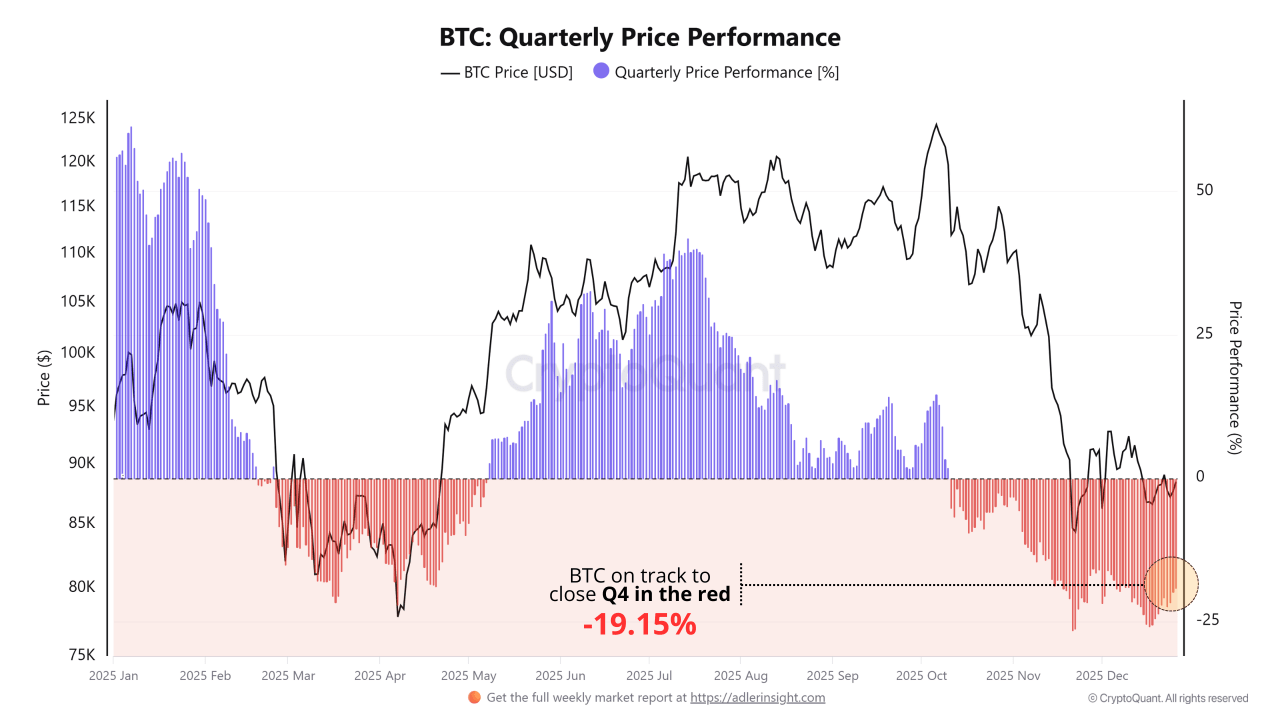
Fuente: CryptoQuant

Indicadores de Confirmación del Mercado Bajista

Más allá de las métricas de capitulación, GugaOnChain destaca indicadores de confirmación adicionales que sugieren que los riesgos a la baja seguirán siendo dominantes a corto plazo. Uno de estos indicadores, la Tasa de Crecimiento de la Capitalización de Mercado (Market Cap Growth Rate), medida por la brecha de la media móvil de 30 días frente a la de 365 días, es firmemente negativo en -11.65%, lo que apunta a una contracción del crecimiento del mercado en lugar de una expansión.

Los flujos institucionales también reflejan una confianza decreciente. Los ETF spot de Bitcoin en EE.UU. registraron salidas netas de $825.7 millones entre el 18 y el 24 de diciembre de 2025, lo que destaca el apetito institucional reducido mientras persisten las luchas de precios del Q4. Mientras tanto, la Brecha de Prima de Coinbase (Coinbase Premium Gap) se ha mantenido negativa en –66.11, lo que señala una demanda más débil de los inversores con sede en EE.UU. en comparación con los mercados extranjeros.

Al evaluar juntas estas varias métricas, GugaOnChain concluye que es probable que el mercado de criptomonedas permanezca en una fase bajista durante los próximos dos o tres meses. Por lo tanto, los inversores deberían anticipar más correcciones en el primer trimestre de 2026 hasta que las señales de capitulación disminuyan y la demanda se estabilice.

Al cierre de esta edición, Bitcoin cotiza a $87,436, lo que refleja una ligera pérdida del mercado del 0.42% en el último día.

BTC cotizando a $87,660 en el gráfico diario | Fuente: Gráfico BTCUSDT en Tradingview.com

Trending Cryptos

Related Questions

Q¿Cómo cerró Bitcoin el cuarto trimestre de 2025 según el artículo?

ABitcoin cerró el cuarto trimestre de 2025 con un rendimiento negativo del -19,15%, reforzando la preocupación de que la fase de corrección del mercado está lejos de terminar.

Q¿Qué indicador muestra que los inversores están vendiendo Bitcoin con pérdidas y cuál es su valor actual?

AEl Spent Output Profit Ratio (SOPR) es el indicador que muestra que los inversores están vendiendo Bitcoin con pérdidas, y actualmente se sitúa en 0,99 (por debajo de 1).

QSegún GugaOnChain, ¿cuánto tiempo podría persistir el mercado bajista en el criptomercado?

ASegún GugaOnChain, el criptomercado podría permanecer en una fase bajista durante los próximos dos o tres meses, extendiendo la presión a la baja hasta principios de 2026.

Q¿Qué reflejan los flujos institucionales de los ETF spot de Bitcoin en EE.UU. entre el 18 y el 24 de diciembre de 2025?

ALos ETF spot de Bitcoin en EE.UU. registraron salidas netas de 825,7 millones de dólares entre el 18 y el 24 de diciembre de 2025, lo que refleja una disminución del apetito institucional.

Q¿A qué precio cotizaba Bitcoin al cierre de la publicación y cuál fue su variación en el último día?

AAl cierre de la publicación, Bitcoin cotizaba a 87.436 dólares, reflejando una ligera pérdida del 0,42% en el último día.

Related Reads

Sevenfold Oversubscription, Can SK Hynix Save the Semiconductor Industry This Time?

SK Hynix's planned US ADR listing is drawing intense interest, with its offering reportedly oversubscribed by over seven times, potentially making it the largest foreign listing in US history. The fundraising of approximately $24.5 billion is intended for expanding its Korean production capacity, including advanced packaging and EUV equipment. This massive demand from long-term funds and prominent institutions like Baillie Gifford and Situational Awareness Partners (led by noted investor Leopold Aschenbrenner) presents a stark contrast to the recent downturn in the broader semiconductor sector. The sector has faced a significant correction, with SK Hynix's own stock falling nearly 30% from its June high. This sell-off was triggered by concerns that major tech giants might slow their AI infrastructure spending, following signals like Meta's reported plan to sell surplus computing capacity. The strong ADR appetite suggests long-term investors still believe in the AI investment cycle's fundamentals, viewing the recent decline more as a valuation reset than a demand collapse. Some market speculation even suggests the pre-IPO price drop could be strategic, setting the stage for a stronger post-listing performance. While SK Hynix's successful listing may act as a short-term positive catalyst for market sentiment, the article argues the true signal for a sustained semiconductor recovery will come from upcoming earnings reports of tech giants like Microsoft, Google, Meta, and Amazon. Their future capital expenditure plans will be crucial in determining whether the AI-driven growth cycle can continue.

Odaily星球日报12m ago

Sevenfold Oversubscription, Can SK Hynix Save the Semiconductor Industry This Time?

Odaily星球日报12m ago

Breaking News: Musk Delivers the Most Powerful Grok 4.5, Slashes Price of Top-tier Opus Intelligence Drastically

**Elon Musk Launches Grok 4.5: A Cost-Effective, High-Performance AI Rival** SpaceXAI, in collaboration with Cursor, has released Grok 4.5, its new flagship AI model designed specifically for coding and agentic tasks. Trained on tens of thousands of NVIDIA GB300 GPUs using massive, high-quality data filtered from trillions of Cursor developer interactions, the model emphasizes "per-token intelligence." In benchmark performance, Grok 4.5 is highly competitive. It scores 64.7% on SWE Bench Pro (surpassing GPT-5.5's 58.6% and Opus 4.7's 64.3%), 83.3% on Terminal Bench 2.1 (nearly matching GPT-5.5), and 62.0% on DeepSWE 1.0 (beating Opus 4.8). Overall, it ranks fourth in AAAI official tests and first in the Harvey legal agent benchmark. The model's key advantage is its combination of speed, efficiency, and low cost. It generates responses at 80 tokens per second and, crucially, uses far fewer tokens to complete tasks—4.2 times fewer than Opus 4.8 on SWE Bench Pro. It is priced at $2 per million input tokens and $6 per million output tokens, significantly undercutting competitors. Musk stated it is "roughly equivalent to Opus 4.7, but much faster." Early user tests show Grok 4.5 can generate functional code for applications like 3D solar system simulators and basic games from simple prompts, though some note it still lags behind top models in certain creative tasks. Musk has hinted at a major update next month, leveraging real-world engineering data from his companies, with an even larger 2-trillion parameter version reportedly in development. Grok 4.5 positions itself not as the absolute strongest model, but as a highly efficient and affordable alternative in the top tier.

marsbit17m ago

Breaking News: Musk Delivers the Most Powerful Grok 4.5, Slashes Price of Top-tier Opus Intelligence Drastically

marsbit17m ago

Today, The Hong Kong Exchange Was Once Again Overwhelmed

Hong Kong's stock exchange witnessed an exceptionally busy day on July 9, with a record seven companies conducting initial public offerings (IPOs) simultaneously. The list included major firms such as Luxshare Precision, which launched the largest Hong Kong IPO of the year, and other notable names like Tri-Ring Group and Qiyunshan Food. However, the market reception was sharply divided on the first trading day. While Qiyunshan Food's shares surged over 110%, several other newcomers, including Luxshare Precision, Dingtai High-Tech, and Rigol Technologies, opened below their issue prices, with some falling nearly 20%. This event highlights a broader, bustling IPO scene in Hong Kong for 2024, with 82 Chinese companies listing in the first half alone—more than double the figure from the same period last year. A significant portion of this activity comes from dual "A+H" listings, where mainland China-listed firms seek secondary listings in Hong Kong. These larger companies have accounted for nearly 60% of total fundraising. Despite the high volume, recent trends show a cooling market sentiment for many new listings. Several IPOs in early July, including that of Tongrentang Healthcare, debuted with significant losses, indicating increased investor caution and selectivity. The market narrative is shifting, with capital increasingly concentrating on high-growth sectors like artificial intelligence, robotics, and semiconductors, while traditional manufacturing and consumer goods face greater pressure and volatility. This divergence underscores a market where success is no longer guaranteed by merely listing, but depends heavily on a company's growth prospects and sector appeal.

marsbit21m ago

Today, The Hong Kong Exchange Was Once Again Overwhelmed

marsbit21m ago

Glassnode: Crypto Market Enters Later Stages of Bottoming Phase

Glassnode: Crypto Market Enters Later Stages of Bottom Formation Bitcoin has traded below the true market average and the short-term holder cost basis for five consecutive months, indicating a deep undervaluation. On-chain data reveals a significant shift in selling pressure, with long-term holders now accounting for 43% of all realized losses. Daily realized losses for this group recently peaked at $280 million, the highest level since December 2022. While this large-scale capitulation is a hallmark of bear market bottoms, a sustained decline in this metric is a prerequisite for a sustained recovery. Institutional demand remains weak. US spot Bitcoin ETFs continue to see monthly net outflows, although the pace has moderated from June's peak. Furthermore, average daily ETF trading volumes have contracted by approximately 80% from their October 2025 peak, reflecting subdued institutional participation. Derivatives markets present a mixed picture. Overall positioning has shifted to cautiously bullish, with the put/call ratio dropping to a yearly low. However, the options volatility skew remains elevated, signaling that traders are still paying a premium for downside protection. The spot price also trades below the gamma "max pain" level. In summary, multiple indicators suggest the market is in the later phases of a bottoming process, characterized by long-term holder capitulation and weak institutional inflows. However, key confirmation signals for a durable trend reversal—a sustained drop in long-term holder selling pressure, stabilization of ETF flows, and a price recovery above key cost bases—are still pending.

Foresight News47m ago

Glassnode: Crypto Market Enters Later Stages of Bottoming Phase

Foresight News47m ago

Trading

Spot

Hot Articles

What is $BITCOIN

DIGITAL GOLD ($BITCOIN): A Comprehensive Analysis Introduction to DIGITAL GOLD ($BITCOIN) DIGITAL GOLD ($BITCOIN) is a blockchain-based project operating on the Solana network, which aims to combine the characteristics of traditional precious metals with the innovation of decentralized technologies. While it shares a name with Bitcoin, often referred to as “digital gold” due to its perception as a store of value, DIGITAL GOLD is a separate token designed to create a unique ecosystem within the Web3 landscape. Its goal is to position itself as a viable alternative digital asset, although specifics regarding its applications and functionalities are still developing. What is DIGITAL GOLD ($BITCOIN)? DIGITAL GOLD ($BITCOIN) is a cryptocurrency token explicitly designed for use on the Solana blockchain. In contrast to Bitcoin, which provides a widely recognized value storage role, this token appears to focus on broader applications and characteristics. Notable aspects include: Blockchain Infrastructure: The token is built on the Solana blockchain, known for its capacity to handle high-speed and low-cost transactions. Supply Dynamics: DIGITAL GOLD has a maximum supply capped at 100 quadrillion tokens (100P $BITCOIN), although details regarding its circulating supply are currently undisclosed. Utility: While precise functionalities are not explicitly outlined, there are indications that the token could be utilized for various applications, potentially involving decentralized applications (dApps) or asset tokenization strategies. Who is the Creator of DIGITAL GOLD ($BITCOIN)? At present, the identity of the creators and development team behind DIGITAL GOLD ($BITCOIN) remains unknown. This situation is typical among many innovative projects within the blockchain space, particularly those aligning with decentralized finance and meme coin phenomena. While such anonymity may foster a community-driven culture, it intensifies concerns about governance and accountability. Who are the Investors of DIGITAL GOLD ($BITCOIN)? The available information indicates that DIGITAL GOLD ($BITCOIN) does not have any known institutional backers or prominent venture capital investments. The project seems to operate on a peer-to-peer model focused on community support and adoption rather than traditional funding routes. Its activity and liquidity are primarily situated on decentralized exchanges (DEXs), such as PumpSwap, rather than established centralized trading platforms, further highlighting its grassroots approach. How DIGITAL GOLD ($BITCOIN) Works The operational mechanics of DIGITAL GOLD ($BITCOIN) can be elaborated on based on its blockchain design and network attributes: Consensus Mechanism: By leveraging Solana’s unique proof-of-history (PoH) combined with a proof-of-stake (PoS) model, the project ensures efficient transaction validation contributing to the network's high performance. Tokenomics: While specific deflationary mechanisms have not been extensively detailed, the vast maximum token supply implies that it may cater to microtransactions or niche use cases that are still to be defined. Interoperability: There exists the potential for integration with Solana’s broader ecosystem, including various decentralized finance (DeFi) platforms. However, the details regarding specific integrations remain unspecified. Timeline of Key Events Here is a timeline that highlights significant milestones concerning DIGITAL GOLD ($BITCOIN): 2023: The initial deployment of the token occurs on the Solana blockchain, marked by its contract address. 2024: DIGITAL GOLD gains visibility as it becomes available for trading on decentralized exchanges like PumpSwap, allowing users to trade it against SOL. 2025: The project witnesses sporadic trading activity and potential interest in community-led engagements, although no noteworthy partnerships or technical advancements have been documented as of yet. Critical Analysis Strengths Scalability: The underlying Solana infrastructure supports high transaction volumes, which could enhance the utility of $BITCOIN in various transaction scenarios. Accessibility: The potential low trading price per token could attract retail investors, facilitating wider participation due to fractional ownership opportunities. Risks Lack of Transparency: The absence of publicly known backers, developers, or an audit process may yield skepticism regarding the project's sustainability and trustworthiness. Market Volatility: The trading activity is heavily reliant on speculative behavior, which can result in significant price volatility and uncertainty for investors. Conclusion DIGITAL GOLD ($BITCOIN) emerges as an intriguing yet ambiguous project within the rapidly evolving Solana ecosystem. While it attempts to leverage the “digital gold” narrative, its departure from Bitcoin's established role as a store of value underscores the need for a clearer differentiation of its intended utility and governance structure. Future acceptance and adoption will likely depend on addressing the current opacity and defining its operational and economic strategies more explicitly. Note: This report encompasses synthesised information available as of October 2023, and developments may have transpired beyond the research period.

683 Total ViewsPublished 2025.05.13Updated 2025.05.13

What is $BITCOIN

Discussions

Welcome to the HTX Community. Here, you can stay informed about the latest platform developments and gain access to professional market insights. Users' opinions on the price of BTC (BTC) are presented below.

活动图片